





Nausea has been reported with AOD 9604, but the published human data does not show it rising with the dose. Whether the peptide itself is the cause is hard to separate from other factors: the quality and handling of the vial, how it was reconstituted, how it was injected, and how you were feeling that day. This article sets out what the trial data says, what to check on your side, and when a stomach upset needs a health professional rather than a tweak to your routine. Pure Peptide supplies research-grade peptides with third-party certificates of analysis, so the quality checks below are the ones we care about most.
TL;DR
- In the main safety review of AOD 9604, nausea appeared among the digestive events reported, but it showed no observable trend across dose groups compared with placebo.
- That review covers six placebo-controlled trials from 2001 to 2006, so it tells you about the trial products and doses, not about every vial sold today.
- Product quality, reconstitution and injection technique are the parts of the process you control, and they are where a clean routine helps most.
- Health Canada has warned that unauthorized injectable peptides can contain undeclared ingredients or contaminants, so check the label and the source before you inject.
- If you feel unwell after a dose, stop and speak to a doctor or pharmacist. Seek urgent care for signs of an allergic reaction.
Table of Contents
- What AOD 9604 is
- What the trials report about nausea
- Why you might feel sick after a dose
- A calm routine for when you feel nauseous
- What the regulatory picture means for your safety
- How to tell a product problem from a body problem
- Who should be especially careful
- Perspective
- Where to go from here
- FAQ
- Sources
What AOD 9604 is
AOD 9604 is a short peptide, a chain of 16 amino acids, that matches the tail end of human growth hormone (the Tyr-hGH 177-191 fragment). The 2013 safety review by Stier, Vos and Kenley describes it as a fragment developed to investigate fat-reducing effects. It is not growth hormone itself, and the research focus was on fat metabolism rather than muscle or recovery.
That matters for nausea because most of what we know comes from one body of work: a set of early clinical trials, mostly in overweight and obese adults, run by the developer. The same review summarizes six randomized, double-blind, placebo-controlled trials conducted between 2001 and 2006 with 893 adults. Anything you read about tolerability usually traces back to this set.
What the trials report about nausea
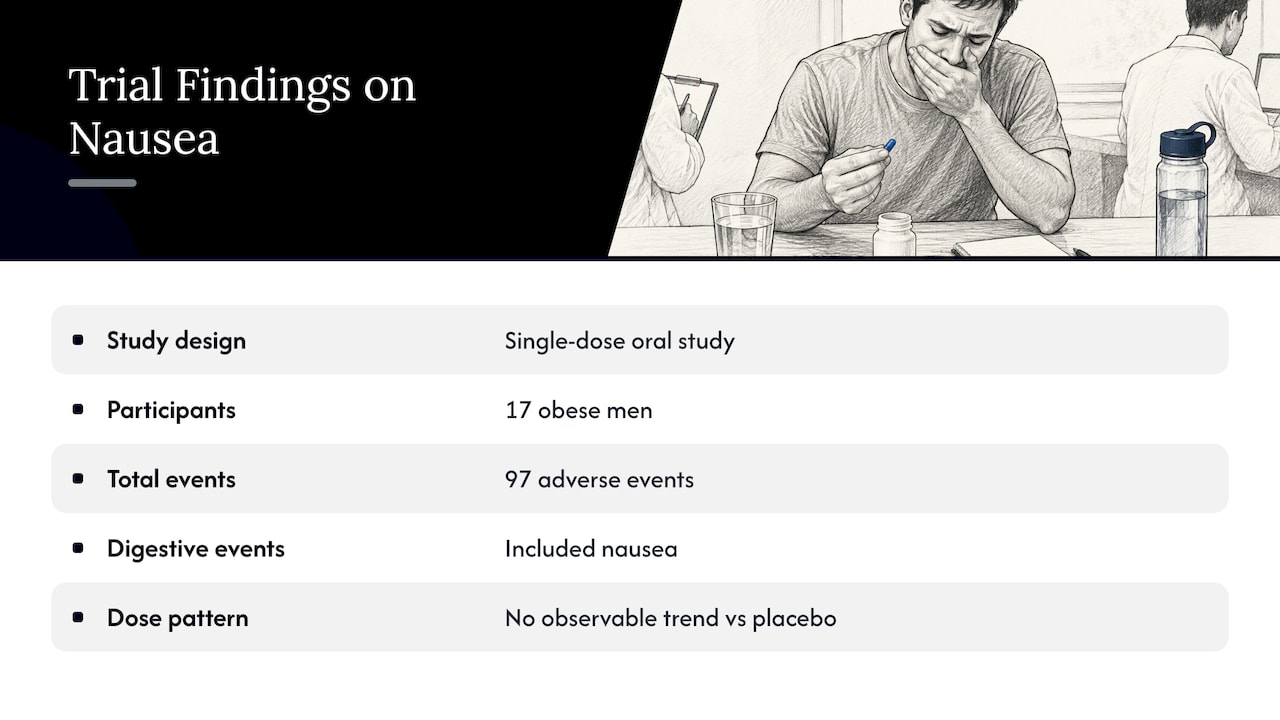
The most detailed look at nausea comes from a single-dose oral study called METAOD003. In that study, 17 obese men reported 97 adverse events in total. The digestive events included diarrhea, flatulence, increased appetite and nausea. In other words, nausea was on the list.
The same review adds the context that makes the list meaningful: nausea and the other events showed no observable trend between the AOD 9604 dose groups and placebo. If the peptide were a straightforward cause of nausea, you would expect more cases in higher-dose groups. The data did not show that pattern.
How to read that result
Three points help you interpret it.
- Small numbers. Seventeen participants in a single-dose study is a narrow window. It tells you what was recorded in that setting, not what every person will feel.
- Oral, single dose. The study looked at one oral dose. Most people who ask about nausea today are asking about repeated subcutaneous injections, which are a different situation.
- Placebo effects and background symptoms. Nausea is common in everyday life and in any trial. When placebo groups report it too, it is difficult to pin on the active ingredient.
A fair summary: nausea is a recorded event in the trial literature, it was not shown to scale with dose, and it is not a certain or expected reaction. If you do feel queasy, the useful question is what else changed, not simply whether the peptide is to blame.
Why you might feel sick after a dose
Without a clear dose-response signal, it makes sense to look at the parts of the routine you can check. Here are the common ones.
The vial: purity and contamination
A peptide is only as predictable as what is actually in the vial. Health Canada’s December 2025 advisory notes that unauthorized drugs may contain undeclared ingredients or contaminants and may not be safely manufactured or stored. A vial that is off-spec can produce symptoms that look like a side effect of the peptide.
This is why we publish third-party lab certificates of analysis with our products and why our formulations are made to exceed 99% purity through advanced purification methods. A certificate tied to the batch you hold gives you something concrete to compare against the label. Our contamination and COA checklist walks through how to read one, and it is worth doing before the first dose rather than after the first bad evening.
Reconstitution and storage
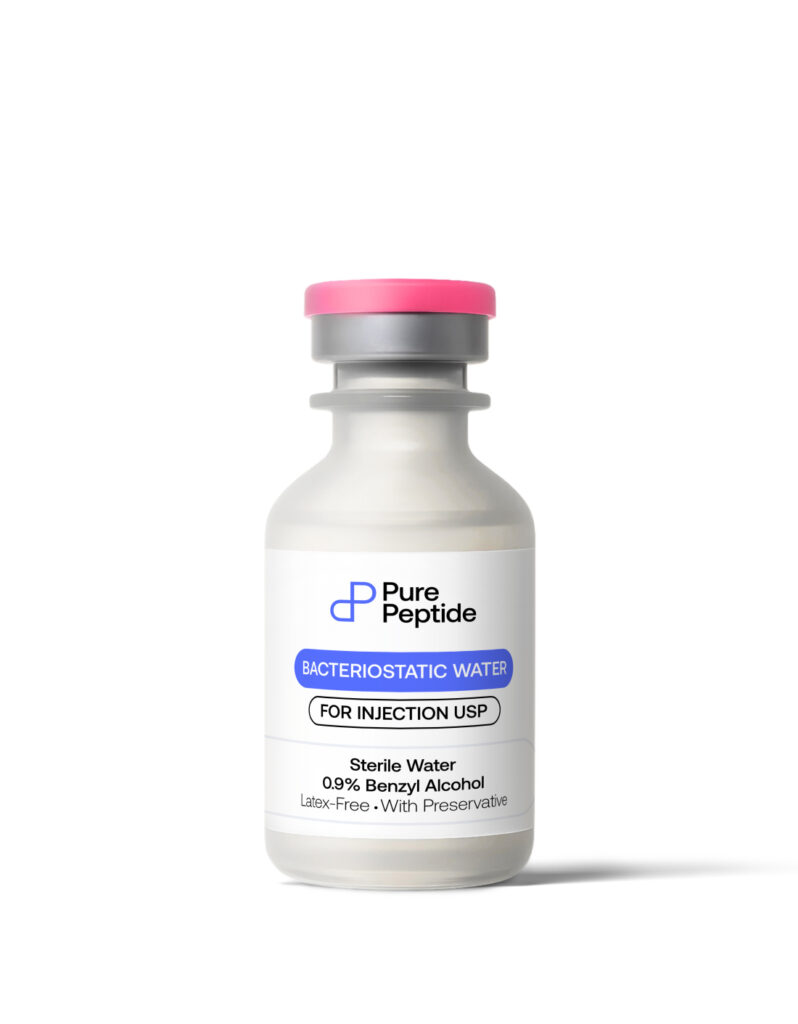
Lyophilized (freeze-dried) peptide has to be mixed with bacteriostatic water before use, then stored properly. Mistakes here include shaking the vial hard, using the wrong diluent, or keeping a mixed vial past its useful life. We stock the reconstitution ancillaries, including bacteriostatic water, syringes and alcohol pads, so the whole routine can come from one place with consistent quality. Our syringe guide for Canadian beginners covers measuring accurately, because a dosing error is a very practical reason to feel unwell.
Injection technique and site
Subcutaneous injections go into the fat layer under the skin, usually the abdomen or thigh. Rotating sites, clean skin and a steady, unhurried technique reduce local irritation. Our guide to injection sites and how to inject safely shows the options. Local redness or soreness is separate from nausea, but both are easy to confuse when you are not feeling well overall.
Timing, food and everything else
Taking a dose on an empty stomach, after a hard session, while dehydrated, or alongside a new supplement can all leave you queasy. If you started two things in the same week, you cannot tell which one is responsible. Changing one variable at a time is the only way to learn anything from your own experience.
A calm routine for when you feel nauseous
These steps are general safety steps for anyone using injectable products. They are not a diagnosis.
- Stop dosing for now. Do not inject again until you understand what happened.
- Write down the details. Note the date, time, how much you took, the batch or lot number and what you ate. This helps you and anyone who treats you.
- Check the vial and your prep. Look for cloudiness, particles or colour change in the solution, and confirm the diluent, storage and syringe measurements were correct.
- Compare the batch with its certificate. Make sure the lot on your vial matches the certificate of analysis you received.
- Speak to a health professional. Health Canada’s advisory recommends consulting a health professional if you have used these products and have health concerns. Your doctor or pharmacist is the right call, and they can check for interactions with any medication you take.
Red flags that need urgent care
The same advisory notes that injectable unauthorized drugs carry risks including infection and allergic reactions. Do not wait it out if you notice any of these after an injection:
- swelling of the lips, face or throat, or difficulty breathing
- hives or a rash that spreads quickly
- fever, chills or shaking
- vomiting that does not settle, or severe abdominal pain
- a hot, spreading, painful area around the injection site
Call 911 or go to the nearest emergency department for breathing trouble or swelling. For fever or chills after injecting, our guide on flushing after injection and the contamination page above explain why these symptoms deserve prompt attention.
What the regulatory picture means for your safety
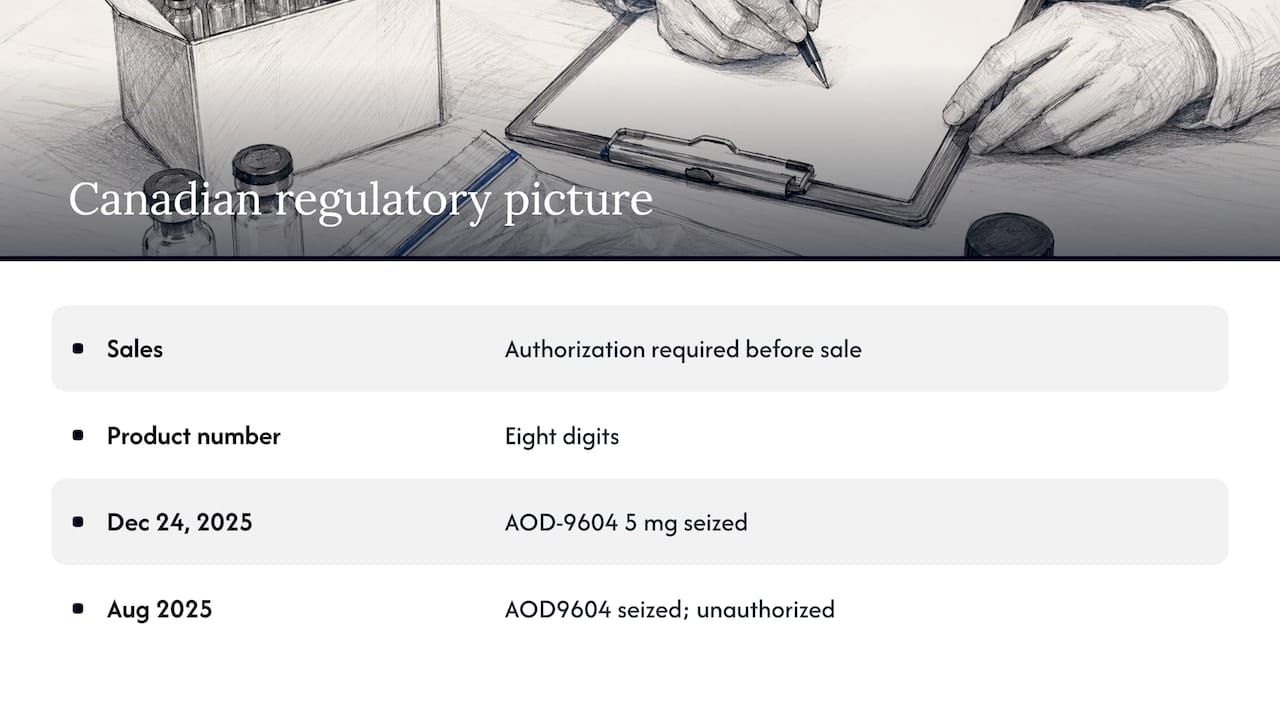
In Canada, drugs and natural health products must be authorized before they are sold, and an authorized product carries an eight-digit number. Health Canada’s advisory explains that you can check for a DIN, NPN or DIN-HM and look the number up in the Drug Product Database or the Licensed Natural Health Product Database.
AOD 9604 has appeared in recent enforcement notices. The December 24, 2025 advisory names AOD-9604 5 mg among unauthorized injectable peptide drugs seized from a fitness retailer and says the products were not assessed for safety, efficacy or quality. An earlier notice from August 2025, published in French, also lists AOD9604 among injectable peptides seized and says they had not been authorized.
The practical lesson for you is about verification and caution. Our page on peptide legality in Canada and the eight-digit DIN explains how that system works, and our general peptide safety guide covers what to know before you inject anything. If you want a third-party look at lab results for AOD-type products, an AODT peptide lab test review discusses how unauthorized injectable products and their risks show up in testing.
How to tell a product problem from a body problem
It helps to separate what points to the product from what points to you.
| Observation | More likely about the product or prep | More likely about you or timing |
|---|---|---|
| Cloudy or discoloured solution | Yes | No |
| Symptoms after several different vials from one source | Yes | Possibly |
| Nausea only when injecting fasted or after hard training | No | Yes |
| Fever, chills or spreading redness after injecting | Yes, treat as urgent | Possibly |
| Nausea started the same week as another new supplement | Possibly | Yes |
| Dose measured differently each time | Yes (measuring error) | Possibly |
This is a way to organize your thinking, not a diagnosis. When the pattern is unclear, a professional can look at the full picture, including your medications and health history.
Who should be especially careful
Nausea is a common symptom, so anyone with a health condition, who is pregnant or breastfeeding, or who takes prescription medicine should talk to a doctor or pharmacist before using any injectable peptide. The trial evidence above comes from adults in specific study settings, and it does not tell you how AOD 9604 behaves alongside your own medications. Athletes subject to testing should also read our page on peptides and drug testing, since purity and declared ingredients matter there.
Perspective
Most of the questions we hear about side effects come down to the same three things: what is in the vial, how it was prepared, and how it was used. We treat the first as our job. Every product we sell is backed by a third-party certificate of analysis, and our formulations are made to exceed 99% purity through advanced purification methods, because you should not have to wonder whether a symptom came from an impurity.
We also supply the ancillaries, bacteriostatic water, syringes and alcohol pads, so your preparation uses matching, clean supplies. That is a small thing, but a routine with fewer unknowns is easier to read when something feels off.
Our advice is simple. Read the certificate for your batch, measure carefully, change one thing at a time, and write things down. If you feel unwell, stop and talk to a health professional. A careful routine is the best way to get a clear answer about how your body responds.
Pure Peptide
Where to go from here
If your goal is fat loss, muscle or recovery, you can browse our range by goal. Each category is built around high-purity, certificate-backed products, with the reconstitution supplies alongside them. Start with the Pure Peptide catalogue, or read our guide to peptides for weight loss to compare options for your goal. For a wider overview of buying in Canada, see our Canadian peptide buying guide.
FAQ
Can AOD 9604 cause nausea?
Nausea is listed among the digestive events reported in the METAOD003 single-dose oral study, alongside diarrhea, flatulence and increased appetite. The same review found no observable trend across dose groups compared with placebo. That means nausea has been recorded, but it was not shown to increase with dose.
Should I keep using AOD 9604 if I feel sick after a dose?
Pause and work out what happened first. Note the dose, timing, food and batch, check your preparation, and speak to a doctor or pharmacist before the next injection. Seek urgent care for breathing trouble, facial swelling, hives, fever or chills.
Can peptides in general make you feel nauseous?
Any injectable can leave someone feeling unwell for reasons that include the product, the preparation, the injection and unrelated factors such as an empty stomach or another new supplement. A batch certificate of analysis, careful reconstitution and one change at a time make the cause easier to identify. A health professional can assess persistent symptoms.
How can I check whether a peptide product is authorized in Canada?
Look for an eight-digit DIN, NPN or DIN-HM on the label and search it in Health Canada’s Drug Product Database or Licensed Natural Health Product Database, as the December 2025 advisory recommends. Our page on the eight-digit DIN explains the process in more detail.
Who should I talk to about side effects?
Your family doctor or pharmacist is the right first contact for nausea or any other symptom after injecting, especially if you take other medicines. For severe symptoms, call 911 or go to an emergency department.
Sources
- Safety and Tolerability of the Hexadecapeptide AOD9604 in Humans (Stier, Vos and Kenley, 2013)
- Health Canada: Unauthorized health products sold online and seized at Rize Fitness (December 24, 2025)
- Health Canada: Saisie de médicaments à base de peptides injectables non homologués (August 1, 2025)