






There is no evidence-based BPC-157 dose for people. Clinical experts at Cleveland Clinic say there is no universal guidance on how much to take, how often or for how long, because human trials have not established safety or efficacy. The numbers you see in online dosing charts are borrowed from animal work, forum habit and guesswork. This guide shows what has actually been tested, how to read the units, and where Canadian rules stand, so you can judge any dose claim for yourself.
TL;DR
- No regulator or clinical trial has set a BPC-157 dose for humans. Animal studies used a huge range, from 6 µg/kg to 20 mg/kg.
- Human data is thin: a 2026 systematic review found only three human studies (30 people in total), all rated poor quality.
- Oral bioavailability in humans is unknown, and Health Canada notes that oral peptides can break down in digestion.
- In Canada, BPC-157 is not approved in any natural health product, and Health Canada warns about unauthorized injectable peptides.
- Talk to a licensed physician before using any peptide, and check anti-doping rules first if you compete.
Table of Contents
- Why every BPC-157 dosing chart is a guess
- What animal studies actually tested
- What human studies have tested
- Reading mcg, mg and syringe units without mistakes
- Oral versus injection: what we know about bioavailability
- Half-life, frequency and why “daily” is not a proven schedule
- Safety and legal status in Canada
- Where to see a professional
- Our perspective
- If you are sourcing research peptides
- FAQ
- Sources
Why every BPC-157 dosing chart is a guess
Search for this topic and you will find charts promising 200 mcg in week one, 1,200 mcg by week twelve, or a flat 250 to 500 mcg a day. They look authoritative. They are not.
A dose becomes a dose when a trial shows what amount, by what route, produces a measurable effect with acceptable risk. BPC-157 has not been through that process. The Compound Evidence Institute grades every human claim for BPC-157 as very low certainty because adequate human trials do not exist. It also points out that the lack of human pharmacokinetic data means doses used in unregulated practice cannot be meaningfully related to animal study doses.
So when a page gives you a number, ask three questions:
- Which study produced it, and in which species?
- By which route was it given (injection into the abdomen, into an injured site, into a vein, by mouth)?
- Was anyone measuring blood levels, or is it simply what people repeat?
Most dosing charts cannot answer the first question at all.
What animal studies actually tested
BPC-157 is a short chain of 15 amino acids studied mostly in rats and mice. A 2025 review in orthopaedic sports medicine notes that animal studies used doses from 6 µg/kg up to 20 mg/kg. That is a range of more than 3,000-fold.
To see why this matters, do the arithmetic for an 80 kg adult. This is a calculation only, not a suggestion:
| Animal dose | Straight scaling to 80 kg |
|---|---|
| 6 µg/kg | 480 µg (0.48 mg) |
| 20 mg/kg | 1,600 mg (1.6 g) |
Nobody can responsibly pick a point on that scale. Body-size scaling between species is not linear, absorption differs by route, and the animal studies were not designed to find a safe human amount. The Compound Evidence Institute adds that substantial, consistent animal data is not evidence that the same effects will occur in human physiology.
Researchers also stress that although the peptide was derived from a protein in human gastric juice, safety in humans cannot be assumed and definitive human trials are needed.
What human studies have tested
The human record is short enough to list in full.
- Knee pain injections and bladder injections. A 2025 narrative review describes small retrospective injection studies for knee pain and interstitial cystitis, and states that rigorous, large-scale trials are lacking.
- Intravenous safety pilot. In the same review, two healthy adults received infusions of up to 20 mg with no adverse events or clinically significant changes in vital signs or lab markers. Two people is a pilot, not a safety profile. The pharmacokinetic analysis showed BPC-157 levels returning to baseline within 24 hours.
- Oral tablet trial. A clinical trial registered in 2015 planned to give 42 healthy volunteers oral tablets at 0.25, 0.5, 1 and 2 µg/kg, but results were still pending as of 2019. For an 80 kg person, those per-kilogram figures work out to 20 to 160 µg, again arithmetic rather than advice.
Put together, a 2026 systematic review found only three human studies with 30 participants, all judged poor methodological quality with very low certainty of evidence. Its authors strongly recommend that BPC-157 not be used clinically outside regulated, ethically approved, high-quality trials.
Notice what is missing: a trial in which people took a defined daily amount for weeks and were measured for healing, pain or function against a placebo. Until that exists, “250 to 500 mcg for four to six weeks” is a convention, not a finding.
Reading mcg, mg and syringe units without mistakes
Most real-world harm from peptide use of any kind starts with a unit slip, so the maths deserves care.
- 1 mg = 1,000 mcg (µg). Mixing these up gives a 1,000-fold error.
- A standard insulin syringe is marked in units, where 100 units equal 1 mL. Units are a volume, not a weight.
- The weight in a unit depends entirely on how much liquid the powder was dissolved in.
Example of the concept: if a 10 mg vial is mixed with 2 mL of liquid, the concentration is 5 mg/mL, or 5,000 mcg/mL. One mL is 100 units, so each unit holds 50 mcg. Mix the same vial with 1 mL and each unit holds 100 mcg. The syringe reading is identical, the content is double.
This is why a chart that says “10 units” without stating the vial size and the volume of diluent is meaningless. It is also why anyone working with research peptides needs a clear label, a documented dilution and a second person checking the sums. For products meant for human use, that checking is the job of a pharmacist or prescriber, not a forum thread.
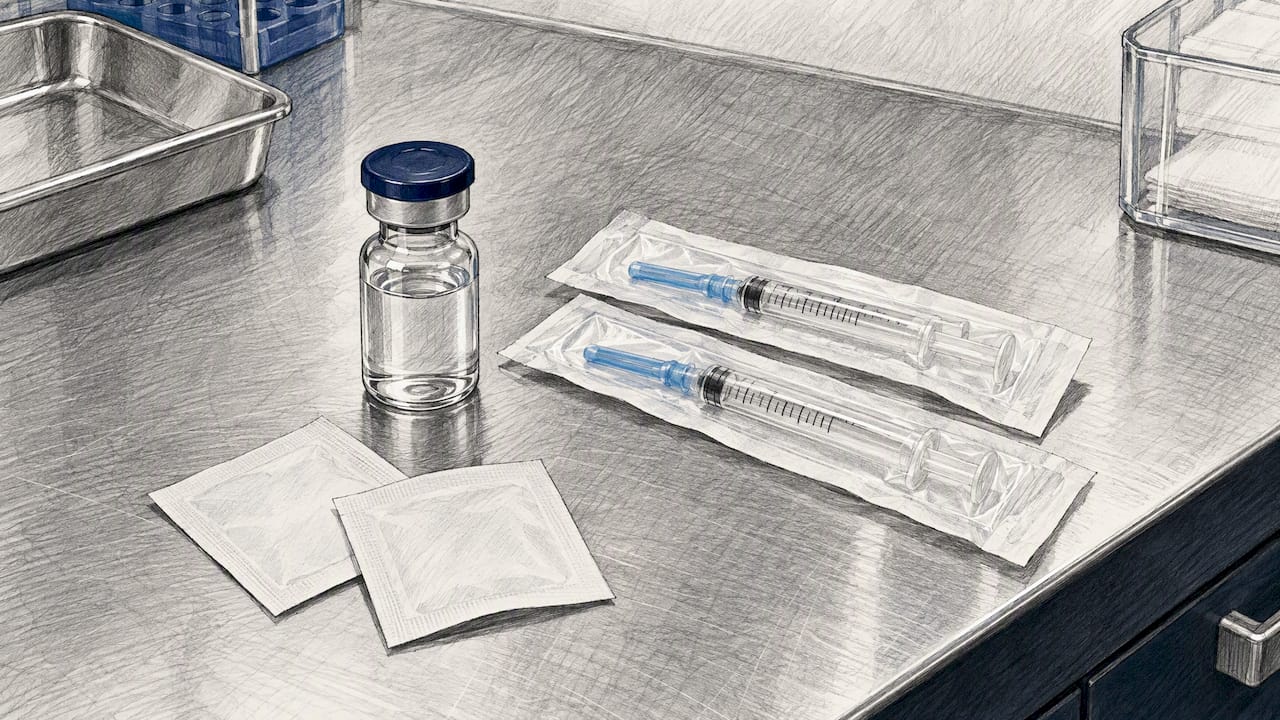
If you handle research-grade material, the supplies matter as much as the peptide. We stock reconstitution ancillaries such as bacteriostatic water, syringes and alcohol pads alongside our peptides; see the Pure Peptide catalogue for what is available.
Oral versus injection: what we know about bioavailability
Oral BPC-157 is popular because it avoids needles. The evidence for it is weaker than the marketing.
The Compound Evidence Institute states plainly that there is no human bioavailability data for BPC-157, so how much reaches the bloodstream from a capsule is unknown. Health Canada explains the general problem: oral peptides can break down during digestion before they can work, which is why many peptide drugs are injected.
There is a counter-argument. BPC-157 was first described in gastric juice, and animal work has focused on the gut, so a local effect in the digestive tract is plausible. A 2025 abstract in the American Journal of Gastroenterology discusses oral BPC-157 as an emerging adjunct and notes preclinical data of a liver-metabolized peptide with a half-life under 30 minutes and kidney clearance. A local gut effect, though, says nothing about whether an oral dose can reach a tendon or a knee.
Here is how the two routes compare on what is actually known:
| Question | Oral | Injected |
|---|---|---|
| Human absorption data | None | None for BPC-157 specifically |
| Human efficacy shown | No | No |
| Tested in humans | Tablet trial registered, results pending as of 2019 | Small knee, bladder and intravenous studies |
| Main practical risk | Breakdown in digestion, unknown dose reaching tissue | Contamination, dosing errors, injection-site problems |
Neither route has a proven dose. Anyone who says oral is “just as good” or injection is “ten times stronger” is asserting something no human study has measured.
Half-life, frequency and why “daily” is not a proven schedule
Many guides justify daily dosing by pointing to a short half-life. Preclinical work suggests a half-life of less than 30 minutes, and the 2025 intravenous pilot showed concentrations back at baseline within 24 hours. A short half-life explains why people debate splitting doses. It does not tell you how often a person needs a dose, because nobody has linked blood levels to a benefit in humans. We cover that topic in more detail in our BPC-157 half-life explainer.
The same applies to cycle length. Four to six weeks, eight weeks, twelve weeks: all are customs. The honest summary is that duration, frequency and total exposure are unknown, and long-term safety in people has not been studied.
Safety and legal status in Canada
This is the part dosing charts leave out.
Regulatory status. Health Canada told CBC that BPC-157 is not approved for use in any natural health product, oral or injectable, and that its safety, efficacy and quality have not been assessed. The same reporting describes a gap that allows compounding for topical or oral use as an NHP. Health Canada has separately issued a public warning that unauthorized injectable peptides bought online can seriously harm you. It notes that peptides are generally regulated as prescription drugs in Canada.
Product quality. Cleveland Clinic lists potential contamination or impurity and a lack of quality standards among the risks. Without a regulated manufacturing standard, the label on a vial is only as reliable as the maker. A third-party certificate of analysis for each batch is the minimum you should expect to see, and even it tests the vial, not its safety in a body.
Theoretical cancer concern. BPC-157 promotes blood vessel growth in animal models. Clinical experts say that could theoretically promote cancer growth, though more research is needed to confirm it. If you have a personal or family history of cancer, or a tumour under surveillance, that is a conversation for your oncologist or family doctor before anything else.
Sport. BPC-157 is listed under S0, non-approved substances, on the World Anti-Doping Agency list, prohibited at all times. If you compete in a tested sport, this alone can end a season.
For a broader, plain-language overview of what peptides can and cannot do, this guide to peptide benefits, uses and risks is a reasonable companion read.
Where to see a professional
Some situations should never be handled alone:
- A tendon or joint injury that is not improving. See a sports medicine physician or physiotherapist. Imaging and a proper diagnosis matter more than any peptide.
- Pregnancy, breastfeeding or trying to conceive. No safety data exists. Speak to your obstetrician or midwife.
- Current cancer, a past cancer or unexplained lumps. Raise it with your oncologist.
- Gut conditions such as Crohn’s or colitis. Talk to your gastroenterologist, as you may be tempted to self-treat.
- Existing medication. A pharmacist can check what the unknowns might mean for your list.
If a clinician does discuss peptides with you, any dosing decision should come from them, based on your health, not from a chart.
Our perspective
We sell research-grade peptides, and we think honesty about dosing is part of selling them responsibly. Our view is simple. Purity is something we can document, and our products carry third-party lab certificates of analysis with purity above 99%. Dose is something no one, including us, can responsibly prescribe through a web page, because the human evidence is not there.
That is why we do not publish a “recommended BPC-157 dose”. We would rather point you to the studies, explain the units, and tell you to speak to a licensed physician than give you a number that looks precise and is not. If you want to go deeper on how the compound is studied, our guides on BPC-157 and tendon healing research and on what BPC-157 is and how it is used set out the preclinical picture and its limits.
We also want you to buy with open eyes: research peptides are sold for research, the quality of any vial should be verifiable, and the legal rules in Canada are tight and changing.
— Pure Peptide
If you are sourcing research peptides
What we can offer is verifiable quality and the supplies to handle it correctly. Pure Peptide supplies high-purity research-grade peptides across weight loss, muscle growth, recovery, anti-aging and libido categories, plus blends and reconstitution ancillaries, each backed by third-party certificates of analysis. Browse the range on our home page, or read our recovery peptide guide first if you are still deciding what fits your goal.
FAQ
What is the standard BPC-157 dosage?
There is no standard dose. Cleveland Clinic experts say no universal guidance exists on amount, frequency or duration, and human trials have not established safety or efficacy. The figures in online charts come from animal studies and community habit, not from a human dose-finding trial.
How many mcg of BPC-157 have human studies used?
The only documented human exposures are small. Two healthy adults received intravenous infusions of up to 20 mg in a 2025 pilot, and a registered oral trial planned 0.25 to 2 µg/kg. A 2026 systematic review found just three human studies in total, all of poor quality, so none of these amounts is a recommended dose.
Does oral BPC-157 work?
Nobody knows. There is no human bioavailability data, and Health Canada notes that oral peptides can break down during digestion. Studies in people have not shown that oral BPC-157 is effective for any outcome.
Is BPC-157 legal in Canada?
Health Canada says BPC-157 is not approved for use in any natural health product, and its safety, efficacy and quality have not been assessed. Peptides are generally regulated as prescription drugs, and the agency warns against unauthorized injectable products bought online. Speak to a licensed physician or pharmacist about your situation.
Is BPC-157 allowed in competitive sport?
No. It is on the World Anti-Doping Agency Prohibited List under S0, non-approved substances, banned at all times. Check with your sport’s governing body if you are tested.
Sources
- What Is BPC-157 Peptide? (Cleveland Clinic)
- Emerging Use of BPC-157 in Orthopaedic Sports Medicine (PMC)
- Regeneration or Risk? A Narrative Review of BPC-157 (PMC)
- Human evidence for BPC-157 in orthopaedic and regenerative medicine (Poolton et al., 2026)
- Gastric pentadecapeptide BPC 157 review (Cell and Tissue Research, 2019)
- Human evidence for BPC-157 (Compound Evidence Institute)
- Peptides: Overview (Health Canada)
- Think twice before injecting peptides bought online (Health Canada)
- CBC Investigates: unauthorized peptide loophole and BPC-157
- Oral peptide BPC-157: an emerging adjunct (American Journal of Gastroenterology, 2025)
- BPC-157 Information (Sport Integrity Australia)