







Peptides such as BPC-157, TB-500 and GHK-Cu are widely discussed for fracture recovery, but the honest answer is that they are not proven to heal bone in people. Most of the support comes from cell and animal studies, a review of the orthopaedic literature found no human clinical evidence establishing BPC-157 for bone healing, and in Canada these products are not authorized for human use. This guide explains what has been studied, how to read the claims, and what actually helps a fracture heal.
TL;DR
- No peptide has been shown in human trials to speed up fracture healing. The evidence for BPC-157 and TB-500 is mostly preclinical (animal and lab work).
- Proven fracture care is alignment, stable fixation, good nutrition, not smoking and, for non-unions, bone graft. Teriparatide has the best human data among bone-active drugs, and it is a prescribed medicine.
- Health Canada has not authorized injectable peptides such as TB-500 and BPC-157 for human use, and warns that unauthorized products can be mislabelled or contaminated.
- If you have a fracture, your surgeon or doctor leads the plan. Peptides are a question to raise with them, not a replacement for care.
Table of Contents
- How a bone heals, and where peptides are supposed to fit
- Which peptides are discussed for bone, and what is the evidence?
- A fair way to read “peptides help bone healing”
- What actually supports fracture healing
- Peptides and the law in Canada
- Our perspective
- Where to learn more or shop research materials
- Questions to bring to your appointment
- FAQ
- Sources
How a bone heals, and where peptides are supposed to fit
A broken bone repairs itself in overlapping phases. First comes bleeding and inflammation around the break. Then a soft callus of cartilage forms, it is replaced by woven bone, and finally the bone is remodelled over months into its original shape. Each phase depends on blood supply, stable positioning and the right cell signals.
Peptides are short chains of amino acids that act as signals. That is why the idea is attractive: a signal that increases new blood vessel growth, calms inflammation or recruits repair cells could in theory speed up one of those phases. The key words are “in theory”. A signal that works in a petri dish or in a rat with a standardised injury does not automatically work in a person with a complex fracture, other illnesses and a cast.
Some fractures fail to heal at all. A non-union is a break that has stopped progressing toward healing. Established care for these cases includes correct fracture reduction and alignment, fixation, and autogenous bone graft, which remains the gold standard for augmenting healing. Any peptide has to be measured against that bar.
Which peptides are discussed for bone, and what is the evidence?
BPC-157
BPC-157 is a synthetic fragment of a protein found in gastric juice. It is the peptide most often named for injuries, and animal studies have reported effects on tendon, muscle and some bone models, usually linked to blood vessel growth and inflammation. Those are the claims you will see repeated on product pages and forums.
The human picture is thin. The orthopaedic review mentioned above found a knee-pain study and a safety trial with two participants, and nothing establishing the peptide for bone healing. For a fuller look at how we read this research, see our BPC-157 overview and our guide to BPC-157 and tendon healing.
TB-500 (thymosin beta-4 fragment)
People searching for TB-500 and bone healing usually want to know whether it works like BPC-157. The research is, if anything, thinner. Much of what exists concerns soft tissue. A 2026 rat study of Achilles tendon healing found that TB-500 was associated with better histopathological results and a greater maximum load to failure at four weeks, though the authors describe it as exploratory and needing further research. That is a tendon, in a rat. It says little about a fractured tibia in a person.
Some general-audience coverage notes that animal studies hint at a role for thymosin beta-4 in bone repair, but that human research is only beginning. That is a reason for curiosity, not for confidence. Our comparison pages, such as BPC-157 and TB-500 side by side, cover how the two are usually discussed together.
GHK-Cu, PTH-based peptides and others
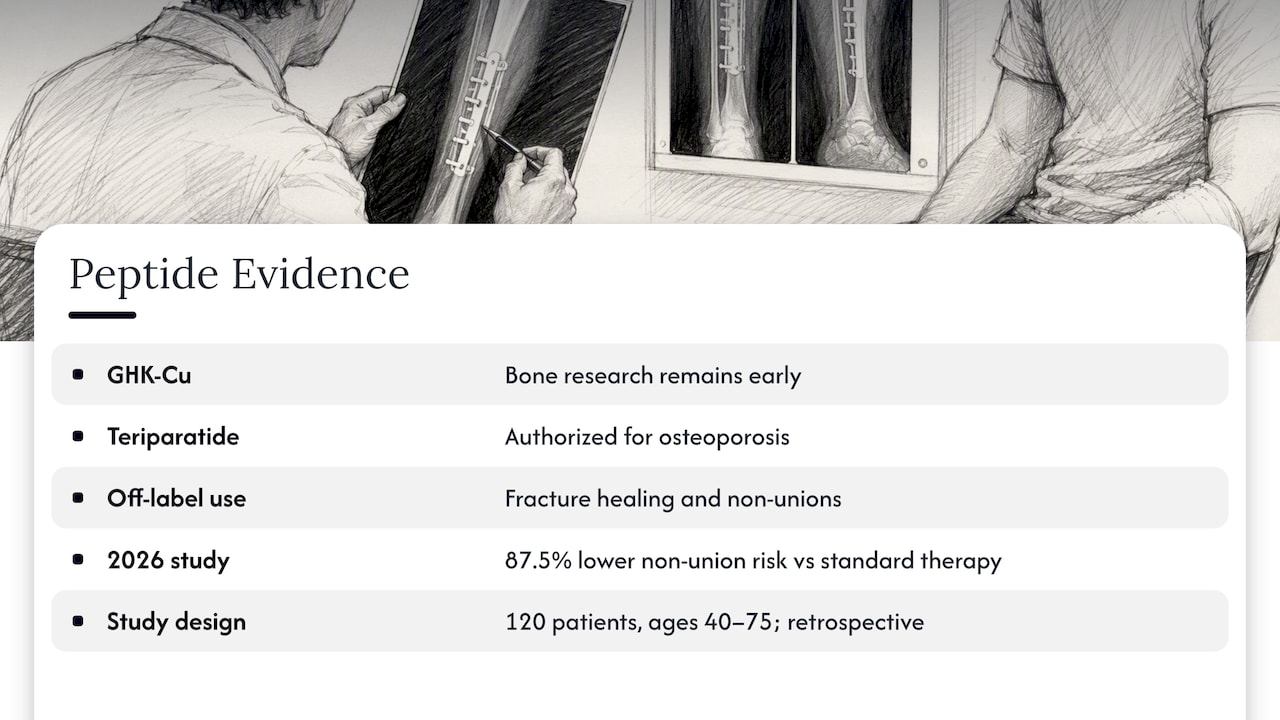
Copper peptide GHK-Cu is mostly studied for skin and wound repair, and any bone angle remains early. Our page on GHK-Cu sticks to that skin and ageing research.
Parathyroid hormone (PTH) fragments are a different category. Teriparatide is a PTH fragment and a regulated medicine. It is authorized for osteoporosis (in the United States it was licensed by the FDA in 2002), and doctors sometimes use it off-label to aid fracture healing or treat non-unions. Reviews note that well-designed randomized trials are still needed before it becomes a standard approach.
The newer data are encouraging but still not definitive. A 2026 retrospective study of 120 patients aged 40 to 75 found that adjuvant teriparatide reduced the risk of non-union by 87.5% in osteoporotic fractures compared with standard therapy. Retrospective means researchers looked back at records, so patients were not randomly assigned, and the result should be read with that in mind.
Other experimental peptides, including ones that target bone mineralization or the nerve-bone connection, are being investigated in animal models. Researchers describe them as promising, and none is an option for the average person with a broken wrist.
A fair way to read “peptides help bone healing”
| Level of evidence | What it can tell you | Where most bone-healing peptide claims sit |
|---|---|---|
| Cell studies | A mechanism is plausible | Many claims |
| Animal studies | Effect in a controlled injury | BPC-157, TB-500 |
| Small human safety studies | Basic tolerability | Very few |
| Randomized human trials | Whether it works for patients | Essentially absent for these peptides |
The review authors advise orthopaedic and sports medicine specialists to be cautious about the gap between social media marketing claims and the lack of human trial evidence. We agree, and we would rather you hear it from us than discover it after spending money.
What actually supports fracture healing
Before any supplement or peptide, the factors with real evidence matter more:
- Alignment and stable fixation. A cast, splint, plate or rod keeps the fragments where they need to be. Movement at the break is a leading cause of delayed healing.
- Bone graft for non-unions. Autogenous graft, often from the pelvis (iliac crest) or taken with a reamer-irrigator-aspirator technique, is the established gold standard because it supplies living bone-forming cells and helps blood vessels grow back in.
- Medication review. Some drugs and conditions, including osteoporosis, slow bone repair. This is where a physician may consider a bone-active drug such as teriparatide, which is a prescription decision.
- Everyday basics. Stopping smoking, adequate protein, calcium and vitamin D, and following weight-bearing instructions are the unglamorous parts of healing. Ask your care team what applies to you, since needs differ with age, diabetes and the type of fracture.
If your fracture is not progressing at the follow-up X-ray, ask your orthopaedic surgeon about delayed union or non-union and what options exist. That conversation will do more for you than any product.
Peptides and the law in Canada
This part matters before you buy anything. Health Canada has stated that the injectable peptide products it seized from a Calgary clinic, including TB-500 and BPC-157, have not been authorized, assessed for safety, efficacy or quality, and are illegal to sell in Canada. The agency also advises checking for an eight-digit Drug Identification Number (DIN), a Natural Product Number (NPN) or a Homeopathic Drug Number (DIN-HM) in its authorized databases.
It has further warned that products labelled “for research use only, not for human consumption” are not exempt from regulatory requirements just because of that wording. That is worth knowing if you see this label anywhere, including on our own site: research-grade materials are intended for laboratory research, not as a treatment for a fracture.
Risks Health Canada lists
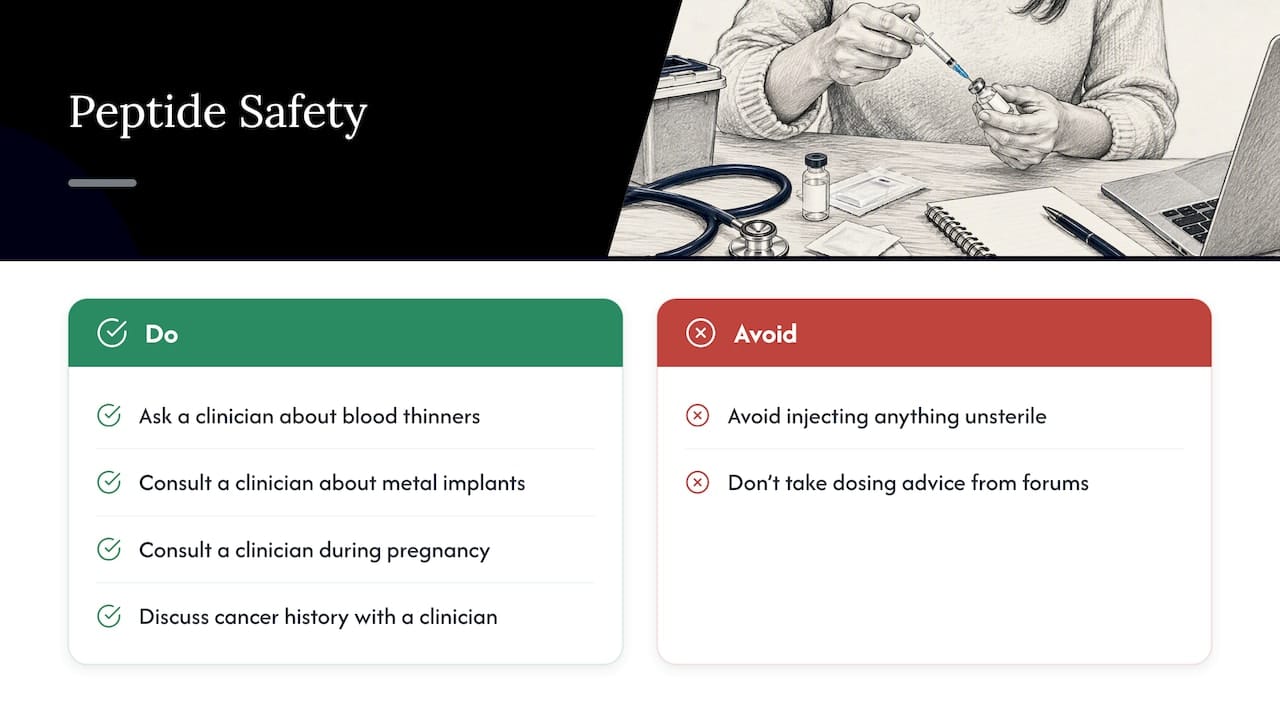
The department’s guidance names infections, allergic reactions, medication interactions, contaminants or unknown ingredients, inaccurate labels, and improper manufacturing or storage as risks. It adds that unauthorized products may contain too much, too little or none of the stated ingredient. For someone with a healing fracture, an infection near a surgical site is a serious setback, so injecting anything unsterile deserves real caution. Our own peptide safety guide covers what to understand about handling, sterility and sourcing before anyone injects anything.
If you take blood thinners, have a metal implant, are pregnant, or have a cancer history, speak with your doctor or pharmacist before considering any peptide. Growth-promoting signals are a particular concern when cancer is part of your history, and no one can responsibly give you a dose from a forum.
Our perspective
We sell research-grade peptides, so you might expect us to tell you that peptides will mend your bone. We will not, because the evidence does not support it. What we do stand behind is quality: every product is backed by a third-party certificate of analysis, and we work to purity above 99%, because a contaminated or mislabelled vial is the first problem Health Canada warns about.
Our view is simple. Bone healing is a medical matter, and the first line is your surgeon and proven care. Peptides like BPC-157 and TB-500 are interesting subjects of preclinical research on repair, and our guides explain that work plainly, including its limits. If you are exploring the science, read the studies, ask your clinician, and be sceptical of anyone offering a protocol, a timeline or a guaranteed result for a fracture.
— Pure Peptide
Where to learn more or shop research materials
If you want to understand how researchers discuss repair peptides, start with our guide to peptides for healing and the overview of BPC-157 and TB-500 for recovery. For soft tissue topics, see peptides for tendon repair.
Pure Peptide offers research-grade peptides in categories including recovery, muscle growth, weight loss, anti-aging and libido, plus ancillaries such as bacteriostatic water, syringes and alcohol pads. Each product comes with a third-party certificate of analysis. You can browse the full range at Pure Peptide. These materials are sold as research products, and nothing on our site is a treatment for a fracture.
Questions to bring to your appointment
If you are curious about peptides during recovery, these questions make the conversation with your care team productive:
- Is my fracture healing on the expected schedule, and what would you do if it stalled?
- Do I have a bone-density or vitamin D issue that needs treatment?
- Would a bone-active prescription such as teriparatide be appropriate for me, and is it available through my provincial coverage or insurance?
- Are any of my medications or conditions slowing healing?
- If I have read about a peptide, is there any reason to think it is safe alongside my surgery and hardware?
An orthopaedic surgeon, a sports medicine physician or an osteoporosis clinic is the right professional for these, depending on your situation.
FAQ
Can peptides heal a broken bone?
There is no human evidence that any research peptide heals a broken bone or speeds fracture repair. Animal studies of BPC-157 and TB-500 exist, but a review of the orthopaedic literature found no human clinical evidence establishing BPC-157 for bone healing. Proven care is alignment, fixation and, when needed, bone graft.
Does TB-500 help bone healing?
The research on TB-500 is largely preclinical and focused on soft tissue. A 2026 rat study found better tendon-healing measures at four weeks, labelled by its authors as exploratory. There are no human trials showing it helps a fracture heal.
Are BPC-157 and TB-500 legal in Canada?
Health Canada has not authorized injectable BPC-157 or TB-500 for human use, and has said that seized products of this kind are illegal to sell. It also states that a “research use only” label does not exempt a product from the rules. Authorized medicines carry a DIN or NPN.
What medical treatment is proven to help non-union fractures?
For non-unions, surgeons rely on correct alignment, fixation and autogenous bone graft, which remains the gold standard. Teriparatide is sometimes used off-label in osteoporotic fractures, and a 2026 retrospective study found fewer non-unions with it. Ask your orthopaedic surgeon whether either applies to you.
Sources
- Peptides: a narrative review, JBJS Journal of Orthopaedics for Physician Assistants (2026)
- Effects of BPC-157 and TB-500 on Achilles tendon healing in rats
- Management of aseptic nonunions and severe bone defects (2023)
- Assessment of Teriparatide’s Effect on Post-operative Functional Outcome and Fracture Healing (2026)
- Use of Teriparatide to improve fracture healing (2015)
- Health Canada: unauthorized injectable peptide drugs seized from Optimum Wellness Centre
- Health Canada: think twice before injecting peptides bought online
- Health Canada: peptides, health risks