






The half-life of CJC-1295 depends on which version you mean. CJC-1295 with DAC had an estimated half-life of 5.8 to 8.1 days after a single subcutaneous injection in healthy adults. The version without DAC is cleared in roughly 30 minutes. The two share a name but behave very differently in the body, and that difference is the reason this question gets so many conflicting answers.
Below we explain where each number comes from, how long the hormonal effect lasts compared with the molecule itself, and what Canadian readers should know about regulation and safe handling.
TL;DR
- CJC-1295 with DAC: estimated half-life of 5.8 to 8.1 days in a human trial. CJC-1295 without DAC: about 30 minutes.
- The DAC group binds the peptide to albumin in the blood, which is why it stays in circulation for days instead of minutes.
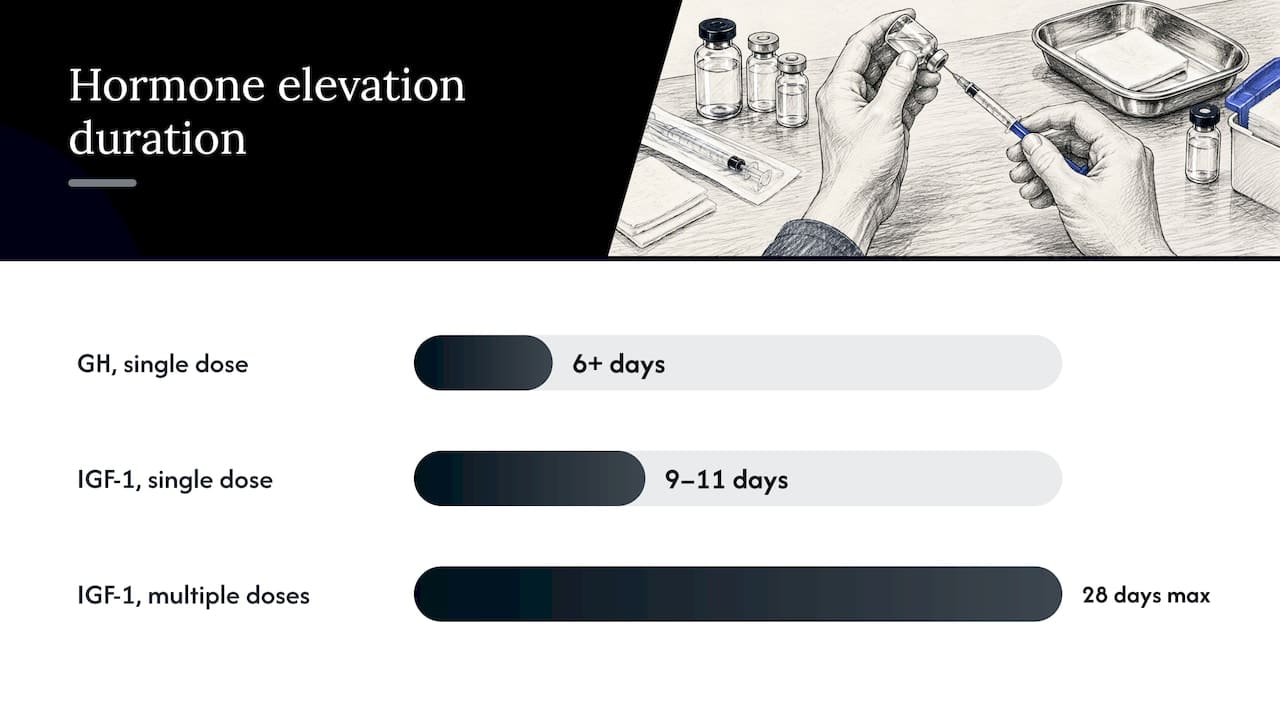
- After one DAC injection, growth hormone (GH) stayed raised 2- to 10-fold for 6 days or more, and IGF-1 stayed raised for 9 to 11 days.
- Half-life is not the same as “how long it works”. Effects on body composition and recovery are inferred from the hormone rise, not directly proven in controlled trials.
- In Canada, Health Canada lists CJC-1295 among unauthorized injectable peptides. Know the rules and report any adverse reaction.
Table of Contents
- The short answer: two molecules, two half-lives
- Where the 5.8 to 8.1 day figure comes from
- Why DAC changes everything
- How long does CJC-1295 last in practice?
- GH pulses and the “bleed” question
- What half-life does not tell you
- Choosing between the two forms
- Canadian rules and safe use
- Our perspective
- Where to find CJC-1295 and the supplies to use it
- FAQ
- Sources
The short answer: two molecules, two half-lives
When people search for CJC-1295, they are looking at two compounds sold under one label:
| Feature | CJC-1295 without DAC | CJC-1295 with DAC |
|---|---|---|
| Also called | Modified GRF 1-29 | CJC-1295 DAC |
| Approximate half-life | About 30 minutes | 5.8 to 8.1 days |
| What drives it | Short-lived GHRH analogue, cleared quickly | Covalent binding to albumin |
| GH pattern | Short pulse after each dose | Sustained elevation over days |
| Typical dosing rhythm discussed in research | Frequent, short intervals | Spaced out over a week or more |
The roughly 30 minute versus 5.8 to 8.1 day contrast is described in the FDA’s 2024 Pharmacy Compounding Advisory Committee briefing document. If you want the full profile of each form, we cover them separately in our guides to CJC-1295 without DAC and CJC-1295 with DAC.
Where the 5.8 to 8.1 day figure comes from
The number traces back to a 2006 study by Teichman and colleagues in the Journal of Clinical Endocrinology & Metabolism. Healthy adults received a single subcutaneous injection of CJC-1295 in a randomised, placebo-controlled, double-blind, ascending-dose design. The authors estimated the half-life at 5.8 to 8.1 days.
Two details from the same paper help you read that figure correctly:
- Peak timing. Maximum concentrations were typically reached within 2 hours of injection, followed by a slow exponential decline over several days.
- Dose independence. The same paper reports that disappearance rates did not depend on the dose. A bigger dose raised the peak and the exposure, but it did not change how fast the peptide cleared.
That last point matters. Half-life is a property of the molecule, not a dial you turn by changing the amount.
Why DAC changes everything
DAC stands for drug affinity complex. In practice it is a chemical handle: a maleimidopropionic acid group attached to the peptide. Once injected, it reacts with a free thiol on cysteine 34 of human serum albumin and forms a covalent bond that is essentially irreversible, as the FDA committee document describes.
The numbers in that document and in the original trial paint a clear picture:
- At least 90% of CJC-1295 binds covalently to albumin, with trace amounts on fibrinogen and IgG.
- Albumin is a large, long-lived blood protein. Riding on it reduces kidney filtration and protects the peptide from enzymatic breakdown.
- In an in-vitro experiment cited in the FDA document, albumin-bound CJC-1295 DAC was far more resistant to the enzyme DPP-IV than the native GHRH 1-29 fragment. About 90.3% of the bound peptide was still intact at the end of incubation, while no intact GHRH 1-29 could be detected after 24 hours.
The version without DAC has no such anchor. It is broken down by the same enzymes within minutes, which is why it is discussed in terms of short, repeated pulses rather than a long continuous signal.
How long does CJC-1295 last in practice?
Half-life tells you how fast the molecule disappears. Readers asking how long CJC-1295 “lasts” usually mean how long the hormonal signal continues. For the DAC form, the trial data give a direct answer.
After a single injection of CJC-1295 DAC:
- Mean plasma GH concentrations rose 2- to 10-fold for 6 days or more.
- Mean plasma IGF-1 concentrations rose 1.5- to 3-fold for 9 to 11 days.
After multiple doses:
- Mean IGF-1 stayed above baseline for up to 28 days.
- There was a cumulative effect. Peak concentration and 24-hour exposure were 17% greater on day 7 and 30 to 70% greater on day 14 compared with day 0.
The University of Calgary’s clinical pharmacology team summarizes the same picture: a half-life of 5.8 to 8.1 days with GH and IGF-1 elevation persisting for 6 to 11 days.
A worked timeline for the DAC form
Using the trial figures above, here is how a single dose plays out:
- Within about 2 hours: peak blood concentration of the peptide.
- Days 1 to 6: the peptide declines slowly while GH stays elevated.
- Days 6 to 11: GH is drifting back toward baseline, while IGF-1 remains raised until around day 9 to 11.
- Around 5.8 to 8.1 days: roughly half of the peptide is still circulating at the half-life mark, which is why repeat dosing builds up.
Because five half-lives are needed to clear most of a compound, a 5.8 to 8.1 day half-life implies the peptide itself can remain detectable for weeks. That is simple pharmacokinetic arithmetic, not a result from the trial, but it explains why the repeat-dose IGF-1 effect was seen for up to 28 days.
The without-DAC timeline
With a half-life near 30 minutes, the peptide is mostly gone within a few hours. The GH response to each dose is a short pulse. People who prefer this form generally value that shorter, more controllable signal, and it is often discussed alongside a second peptide in combination protocols. Our CJC-1295 and ipamorelin timeline walks through how people track IGF-1 over the first weeks.
GH pulses and the “bleed” question
A common concern is whether a long half-life flattens the natural rhythm of growth hormone release. The evidence here is reassuring on one point. In a 2006 study by Ionescu and Frohman, CJC-1295 increased trough GH levels by 7.5-fold and mean GH by 46%, and IGF-1 by 45%, while GH pulsatility persisted, with unchanged pulse frequency and magnitude.
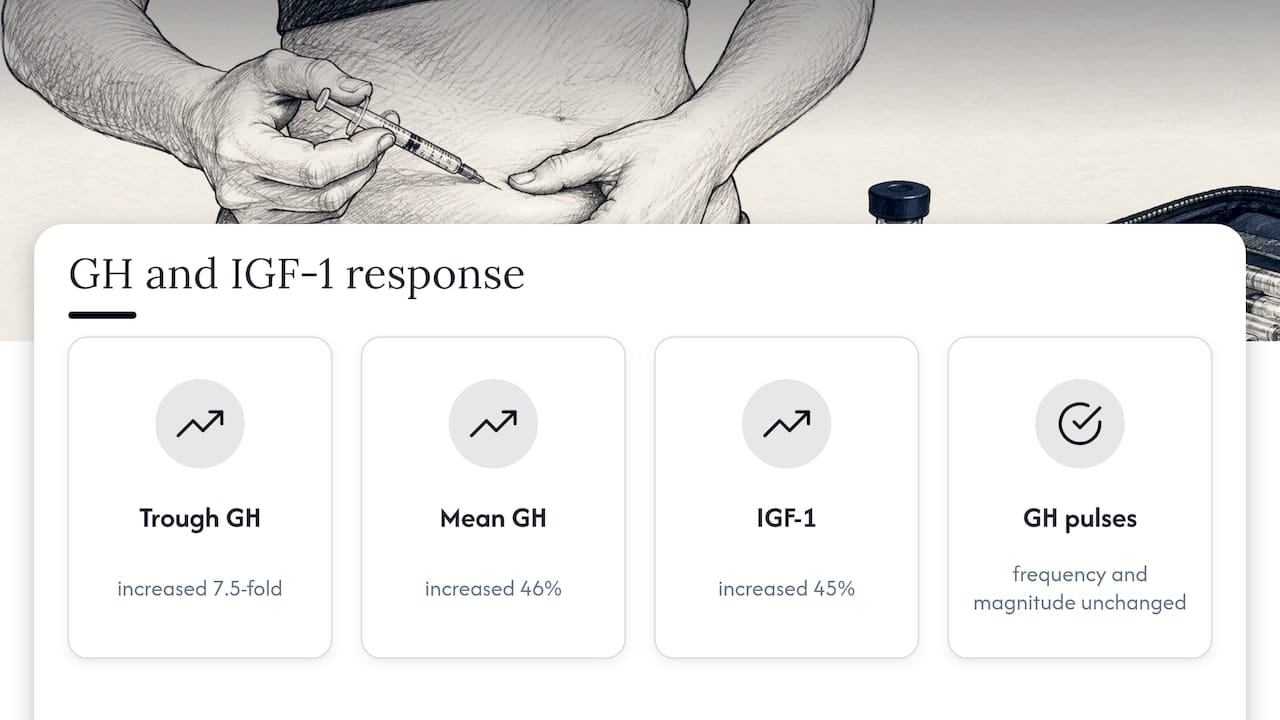
The same paper noted that the IGF-1 rise did not correlate with any measured parameter of GH secretion. The authors pointed to the marked lift in trough GH from continuous GHRH stimulation as an important driver of the IGF-1 increase.
What half-life does not tell you
A long half-life is a pharmacokinetic fact. It is not a promise of a specific physical result. The 2026 Frontiers in Endocrinology review of performance-enhancing peptides states that the best human evidence comes from ascending-dose trials in healthy adults showing dose-dependent GH and IGF-1 increases, while the marketed effects on body composition and recovery are inferred from the hormone rise rather than shown directly in controlled trials.
For the non-DAC form, the same review describes the human literature as thin, with claims about pulsatility and body composition largely extrapolated from related compounds.
What this means for you in practical terms:
- Treat the half-life as a guide to how long the hormonal signal stays raised, not as a prediction of how you will look or perform.
- Track what you can measure, such as IGF-1 through bloodwork arranged with your physician, rather than guessing from how you feel.
- Our CJC-1295 results guide and overview of the evidence on benefits go through what people typically look for and over what timeframe.
Choosing between the two forms
The half-life is the first thing to weigh when choosing a form. A few questions help:
- How often do you want to inject? A multi-day half-life means fewer injections and a steady signal. A 30 minute half-life means a short pulse each time.
- Do you want a steady or a pulsed pattern? The DAC form produces sustained elevation. The non-DAC form produces brief spikes.
- How much do you want to stack with other peptides? Many people pair the shorter-acting form with a second GH-releasing peptide. Our guide to peptides for growth hormone compares the main options.
- How do you want to read your results? Because the DAC form builds up with repeat doses, a bloodwork check after the first few weeks is easier to interpret.
Canadian rules and safe use
This is the part of the half-life discussion that readers in Canada most need in front of them. Health Canada has named CJC-1295 among unauthorized injectable peptide drugs. Its public advisory says unauthorized drugs are illegal in Canada and have not been assessed for safety, efficacy or quality. Health Canada has also seized unauthorized injectable peptides including CJC-1295 from a wellness clinic in Calgary, warning of infection, allergic reactions and contaminant risks.
At Pure Peptide, our products are sold as high-purity research-grade peptides, and our positioning is that each is backed by a third-party lab certificate of analysis. Whatever you choose, these points apply to anyone handling injectable peptides:
- Know the status. CJC-1295 is not an authorized drug in Canada. Read Health Canada’s notices yourself so you understand the position.
- Long half-life means long exposure. If you react badly to the DAC form, the peptide does not clear in hours. The Calgary pharmacology team notes that prolonged monitoring may be required for patients who have used unauthorized injectable peptides. Tell your physician exactly what you used and when.
- Watch for injection-site problems. Injection-site reactions, sometimes with local hives, were the most frequently reported adverse events in the 2006 trials, along with flu-like symptoms, headaches, irritability, anxiety and nausea. No serious adverse reactions were reported in those trials. Seek urgent care for severe swelling, spreading redness, fever or intense pain in a limb. The Calgary summary describes a published case of compartment syndrome after a peptide injection into the thigh.
- Cardiac history matters. A 2006 Phase II trial in 192 HIV patients reported one death from myocardial infarction, which the attending physician attributed to unrelated coronary artery disease. If you have heart disease or risk factors, speak with your physician before using any GH-axis peptide.
- Long-term data are limited. The 2026 review notes a theoretical mitogenic concern via IGF-1, no direct evidence of carcinogenesis in clinical studies, and no long-term safety data. If you have a personal or family history of cancer, discuss it with your physician first.
- Report problems. Adverse reactions to unauthorized injectable peptides can be reported to Health Canada through the Canada Vigilance Program, as the University of Calgary summary explains.
- Use sterile technique. Reconstitution with bacteriostatic water, new syringes and alcohol pads for every injection is basic hygiene. We stock these ancillaries alongside our peptides.
Our perspective
We get the half-life question constantly, and we think it deserves a straight answer because it decides how everything else about CJC-1295 is used.
The DAC form and the non-DAC form are, for practical purposes, different tools. One keeps a signal on for days. The other gives a short pulse. Neither is “better” in the abstract. The right one depends on your schedule, your goal and how you plan to monitor your response.
What we care about most is that the peptide in the vial is what the label says. That is why our products are backed by third-party lab certificates of analysis and formulated to exceed 99% purity through advanced purification methods. When a compound has a half-life measured in days, consistency matters even more, because there is no quick way to undo what you have taken.
Our advice is to match the form to your pattern, keep your physician in the loop, track your IGF-1 with bloodwork, and treat hygiene as non-negotiable. Read our guides for each form, then choose with confidence.
Pure Peptide
Where to find CJC-1295 and the supplies to use it
If you have decided which form fits your goal, you can browse our full range, including peptides for weight loss, muscle growth, recovery, anti-aging and libido, plus bacteriostatic water, syringes and alcohol pads, on the Pure Peptide store. If you are comparing options within the growth hormone category first, start with our growth hormone peptide guide.
FAQ
What is the half-life of CJC-1295 without DAC?
It is about 30 minutes, according to the FDA committee briefing. Because it is cleared so quickly, the GH response to each dose is a short pulse. The 2026 Frontiers review notes this form is still poorly characterised in peer-reviewed human studies.
How long does CJC-1295 with DAC stay in your system?
The estimated half-life is 5.8 to 8.1 days, so the peptide itself can remain detectable for weeks. After a single dose, GH stayed raised for 6 days or more and IGF-1 for 9 to 11 days. After repeat doses, IGF-1 stayed above baseline for up to 28 days.
Does a longer half-life mean stronger results?
Not necessarily. A longer half-life means a longer, steadier hormonal signal. The 2026 Frontiers review says effects on body composition and recovery are inferred from the GH and IGF-1 rise rather than demonstrated directly. Your own results depend on dose, consistency, training, sleep and nutrition.
Is CJC-1295 legal in Canada?
Health Canada lists it among unauthorized injectable peptide drugs and says unauthorized drugs are illegal in Canada and have not been assessed for safety, efficacy or quality. Read the current notices on Health Canada’s site and speak with your physician about your situation. Report any adverse reaction through the Canada Vigilance Program.
Sources
- Prolonged stimulation of growth hormone and IGF-I secretion by CJC-1295 (J Clin Endocrinol Metab, 2006)
- Teichman et al. 2006, PubMed record
- Ionescu and Frohman 2006: pulsatile GH secretion persists during CJC-1295
- FDA Pharmacy Compounding Advisory Committee briefing document, December 4, 2024
- FDA presentation: Selected Peptides and Small Molecules
- Frontiers in Endocrinology, 2026: the emerging landscape of performance-enhancing peptides
- University of Calgary Clinical Pharmacology & Toxicology Pearl: unauthorized injectable peptides
- Health Canada advisory on injecting peptides bought online
- Health Canada: unauthorized injectable peptide drugs seized in Calgary