






Yes, you can freeze peptides, but powder and solution are not treated the same way. Lyophilized (freeze-dried) powder is built for cold storage. A reconstituted solution can be frozen only if you split it into single-use aliquots first, so each portion thaws once and is never refrozen. Repeated freeze-thaw cycles are the habit that does the damage.
This guide explains what happens inside a vial when it freezes, how to store powder and solution, how to thaw safely, what to do after an accidental freeze, and what Canadian readers should know about the regulatory status of peptides.
TL;DR
- Lyophilized powder tolerates freezing. For storage beyond about six months, published guidance points to −20 °C or lower.
- Reconstituted solution is more fragile. Freezing it in single-use aliquots is better than freezing and thawing one vial again and again.
- Repeated cycles can promote oxidation, aggregation, adsorption and pH shifts, and a vial can look normal while it has changed.
- Let a cold vial reach room temperature before you open it, so moisture does not condense on the powder.
- In Canada, injectable peptides are drugs, and a research-use label does not change that. Read the Health Canada guidance below before you use any peptide.
Table of Contents
- What actually happens when a peptide freezes
- Powder or solution: how to store each
- How to thaw peptides
- What if your peptides froze by accident?
- Refrigerator, freezer or room temperature?
- A habit checklist that prevents most problems
- Canadian safety and regulatory facts you should know
- Quality starts before the freezer
- FAQ
- Sources
What actually happens when a peptide freezes
Freezing is not simply “very cold”. When water in a solution turns to ice, the dissolved material does not freeze evenly. Salts, buffers and the peptide itself are pushed into the remaining liquid. A peer-reviewed paper on peptide handling lists the consequences: ice formation, concentration gradients, pH shifts, interfaces, oxidation and aggregation. That is why freezing a solution is not automatically harmless, even though it can extend storage in validated laboratory protocols.
Lyophilized powder has almost no water to separate, so the problem mostly disappears. What matters for powder is moisture, light and temperature, not ice crystals.
Why one cycle is not the same as five
Each cycle repeats the stress. A study using lysozyme as a model found that more freeze-thaw cycles increased aggregate-associated signal and changed secondary structure. The same work reports that freezing and thawing rates matter, and that earlier research found slower thawing produced more aggregation, made worse by fast freezing and by going from one cycle to three.
Lysozyme is a protein, not a short peptide, so treat the numbers as an illustration of the mechanism rather than a rule for your vial. The same caution applies to a monoclonal antibody study, which reported aggregation rising from 0.6% to 5.3% and potency falling over ten weeks of freeze-thaw exposure. Those figures describe an antibody. What carries over is the direction: repeated cycling changes molecules, and the change is not always visible.
What decides how much a peptide is affected
No two peptides respond identically. Physical stability depends on sequence, concentration, pH, net charge, excipients, chemical modification, surfaces and interfaces, impurities, temperature, agitation and lyophilization. A short, simple sequence in a well-buffered solution behaves differently from a longer one with oxidation-prone residues. This is also why the safest default is the same for everything: freeze once, thaw once.
Powder or solution: how to store each
| Lyophilized powder | Reconstituted solution | |
|---|---|---|
| Freezing | Suitable. Guidance for storage beyond six months is −20 °C or lower | Possible only as single-use aliquots |
| Typical colder option | −20 °C, or colder for long storage | −70 °C or colder for calibrator-type solutions in validated work |
| Refrigerator | Fine for short periods | Short term only |
| Main risks | Moisture, light, repeated opening | Aggregation, oxidation, pH shift, adsorption, contamination |
| Thaw rule | Warm to room temperature before opening | Thaw one aliquot, use it, discard the rest of that aliquot |
The research paper above recommends keeping dry peptide powder at −20 °C or lower for storage beyond six months. For re-solubilized peptide solutions it describes sealed tubes at −70 °C or colder, with working solutions prepared close to use and held for no more than three months. That is a laboratory calibrator protocol, so use it as a benchmark for how conservative careful handling is, not as a shelf-life promise for your own vial.
For a deeper look at temperature choices, see our guide on when to use −20 °C versus −80 °C, and for how long unopened and reconstituted vials typically last, our page on peptide shelf life.
Storing powder well
- Keep the vial tightly capped, upright, and away from bright light.
- Keep it dry. Moisture is the main enemy of powder, which is why opening a cold vial is a mistake (see the thawing section).
- Minimise how often you open it. Every opening is a chance for air and humidity to get in.
- Put it in the coldest stable spot you have, ideally in a freezer that holds its temperature and is not opened constantly. A frost-free freezer that cycles warm to defrost is a poor choice for peptides, because the warming cycles act like small freeze-thaw events.
Storing solution well
The cleanest approach is to reconstitute only what you plan to use soon. If you must keep a solution longer, divide it into aliquots in sealed, clean containers sized for a single use, label each with the date and concentration, and freeze them promptly. Then take out one aliquot at a time. If you are new to mixing, our peptide reconstitution how-to guide walks through the process step by step.
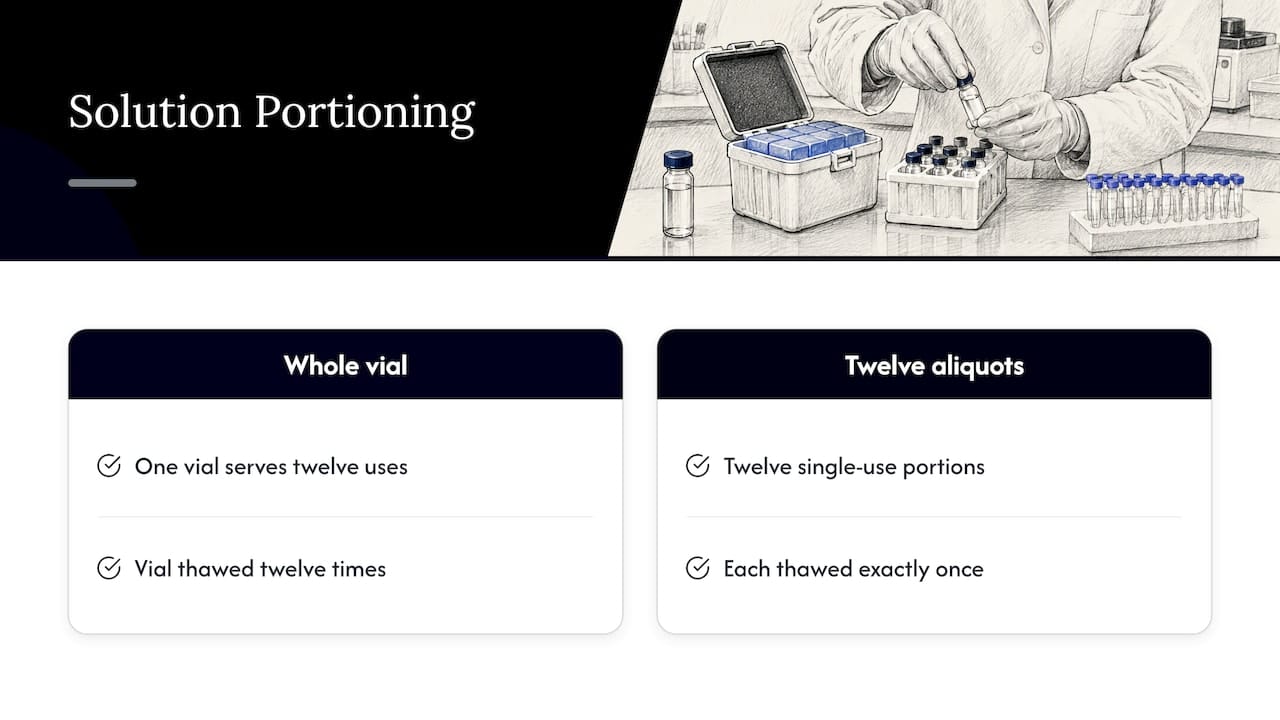
A practical example: a vial holds enough solution for twelve uses. Instead of freezing the vial and thawing it twelve times, you draw the amounts into twelve aliquots. Each is thawed exactly once. The molecule goes through one freeze and one thaw instead of twelve.
How to thaw peptides
The right method depends on whether you are warming powder or thawing a solution.
Frozen powder
Take the vial out of the freezer and leave it sealed until it reaches room temperature. Opening it cold lets water vapour condense on the powder, which is exactly the moisture you were trying to keep out. Published handling guidance for lyophilized peptides says the same, and it is the single most common avoidable error.
Frozen solution
Thaw a single aliquot, gently and fully, then use it. Practical points:
- Do not use heat. Skip hot water, microwaves and warm surfaces. Local overheating can speed up degradation.
- Do not shake. Agitation creates interfaces, one of the stability factors listed above. Swirl or invert gently to mix.
- Leave enough time. A small aliquot usually thaws in a short time at room temperature or in the refrigerator, but exact times vary with volume and container, so wait until no ice remains rather than watching a clock.
- Do not refreeze. Use what you need, and treat any remainder according to your protocol rather than returning it to the freezer.
Some sources suggest a quick, cool water bath for a fast thaw. If you do that, remove the container as soon as the ice is gone. Slow, uncontrolled thawing is the pattern the aggregation research links to more damage, so aim for a controlled, prompt thaw rather than leaving a vial half-frozen for hours.
What if your peptides froze by accident?
A single accidental freeze is not automatically a ruined product, but it is a reason to think before using it.
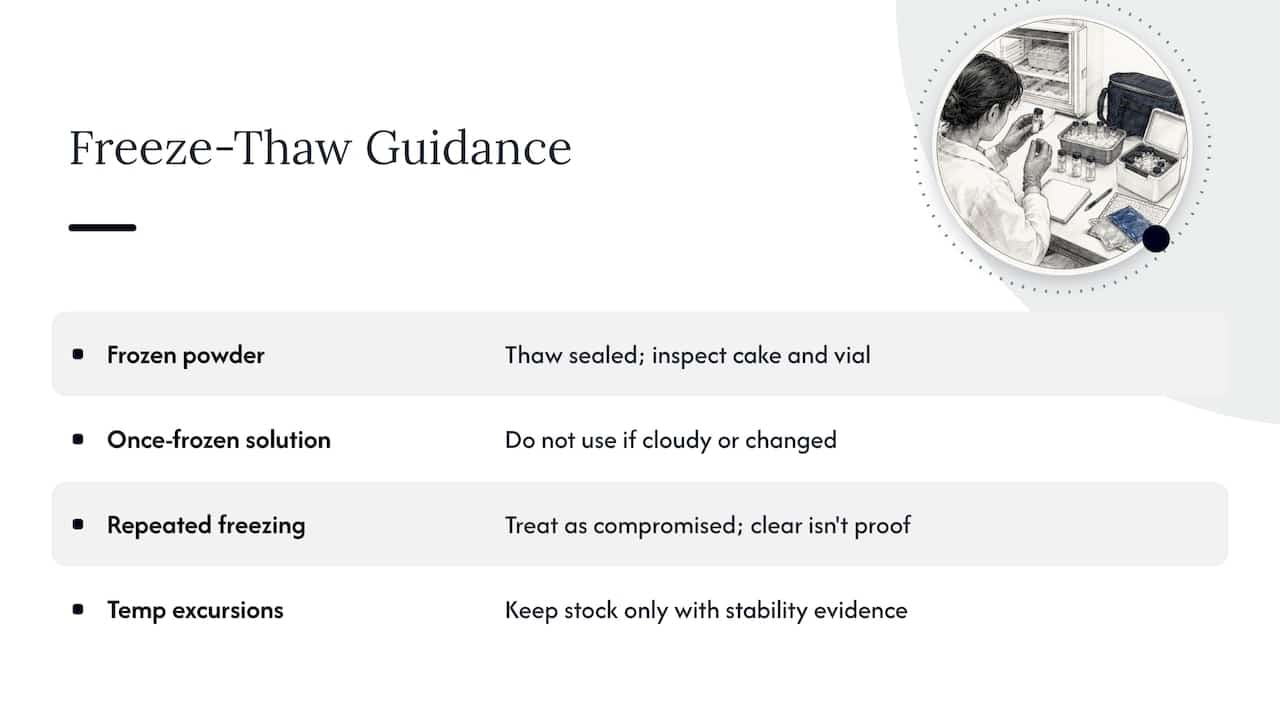
Powder that froze. Powder is designed to survive cold. Let it come to room temperature sealed, check that the cake and vial look as expected, and store it as usual.
Solution that froze once. Thaw it gently, inspect it, and do not freeze it again. Look for cloudiness, particles, discolouration or anything that was not there before. If you see any of these, do not use it.
Solution that froze several times. Treat it as compromised. Protein studies show that aggregation and activity can change even when appearance is normal, so a clear liquid is not proof of stability. Laboratories confirm stability with reverse-phase or size-exclusion HPLC, mass spectrometry, spectroscopy and potency assays. Those are laboratory tools, and you cannot replicate them at home, so the sensible rule is simple: when in doubt, replace it.
The same logic applies to temperature excursions in general. Health Canada’s guidance for drug products says that temperature excursions need stability evidence or technical justification before affected stock is kept. It also recommends calibrated, continuously monitored refrigerators and freezers with alarms for critical storage. A simple min-max thermometer in your own freezer is a small version of the same idea.
Refrigerator, freezer or room temperature?
A few rules of thumb cover most situations:
- Days to a few weeks, solution: the refrigerator, in a sealed container, protected from light. Published handling guidance puts solution stability at roughly a week at 4 °C for general peptides, so longer than that calls for aliquots in the freezer.
- Months, powder: the freezer. Cold, dry and dark.
- Transit: cold packs and insulation. Our pages on peptide shipping temperatures and the cold chain explain what to look for when a parcel arrives, including a sealed vial that has been briefly warm.
Also watch the sequence. Peptides containing cysteine, methionine or tryptophan are more prone to oxidation, so keep their air exposure low and avoid repeated openings.
A habit checklist that prevents most problems
- Label every vial and aliquot with the name, date and concentration.
- Reconstitute small amounts, close to when you need them.
- Aliquot before freezing, never after.
- Warm sealed vials to room temperature before opening.
- Use clean, sterile ancillaries every time. Bacteriostatic water, syringes and alcohol pads are part of storage hygiene as much as of dosing.
- Keep a log of any unplanned warm or frozen periods.
Our perspective
Most storage problems we hear about are not about the peptide. They come from handling: a vial opened cold, a solution frozen and thawed a dozen times, a freezer that cycles warm.
That is why we put so much weight on purity and documentation. Our products are backed by third-party lab certificates of analysis, and our formulations are designed to exceed 99% purity through advanced purification methods. A high-purity starting material gives you the best chance of staying in good condition if you store it properly. Cold storage cannot add quality that was never there, and it cannot restore what poor handling takes away.
Our advice is simple: store powder cold, dry and dark, reconstitute only what you need, aliquot anything you want to freeze, and thaw each portion once.
Pure Peptide
Canadian safety and regulatory facts you should know
Storage advice is only part of using peptides responsibly, and Canadian readers face a specific regulatory picture. Health Canada states that injectable peptides are always classified as drugs under the Food and Drug Regulations, and that the classification of any peptide product depends on its use, composition and route of administration. The same page says unauthorized peptide products lack a DIN or NPN and have not been assessed for safety, efficacy or quality.
Health Canada also lists possible risks of unauthorized peptides, including infection, allergic reactions, blood clots, mood or hormonal changes, blood-sugar imbalance, liver or kidney damage and growth of cancerous tumours. And its bodybuilding guidance says that a “For Research Use Only” label does not make an injectable peptide legal or exempt it from Canadian requirements.
The practical conclusion: talk to a physician or pharmacist about any peptide you are considering, especially if you have a medical condition, take medication or are pregnant. Sterile technique, correct storage and reliable documentation all matter, and none of them replace medical advice. Our page on peptide safety covers what to know before injecting anything, and our research peptides guide explains how research-grade material is described and tested.
Quality starts before the freezer
Good storage protects what you buy, so what you buy matters. Documented purity, a third-party certificate of analysis and a clear batch record let you judge a peptide before it ever reaches your freezer. Our page on 99% purity explains what that standard means, and our overview of laboratory standards and testing describes how quality is checked.
If you are ready to stock up, you can browse peptides for weight loss, muscle growth, recovery, anti-aging and libido on the Pure Peptide shop, along with the reconstitution ancillaries (bacteriostatic water, syringes and alcohol pads) that you need to handle them cleanly.
FAQ
Can you freeze peptides?
Yes. Lyophilized powder is suited to freezer storage, and guidance for long-term storage points to −20 °C or colder. Reconstituted solutions can be frozen too, but only as single-use aliquots, because repeated freeze-thaw cycles can promote aggregation, oxidation and pH changes.
Is it bad if my peptides froze?
It depends on the form. Powder that froze is normally fine once it warms to room temperature sealed. A solution that froze once should be thawed gently, inspected and not refrozen, and one that has been through several cycles is best replaced, since damage can occur without any visible change.
How long do frozen peptides take to thaw?
There is no single time, because it depends on the volume and the container. A small aliquot typically thaws within a short time at room temperature or in the refrigerator. Wait until no ice remains, avoid heat and shaking, and use the aliquot once.
What happens if I don’t refrigerate my peptides?
Sealed lyophilized powder is more tolerant of short periods out of the cold than a solution is. A reconstituted solution left warm is more exposed to degradation and contamination, so keep it in the refrigerator for short-term use or frozen in aliquots, and replace it if it has been out for an unplanned period.
Sources
- Recommendations for the generation, quantification, storage and handling of peptides (PMC)
- ATR-FTIR spectroscopy and spectroscopic imaging of freeze-thaw protein aggregation (PMC)
- Factors affecting the physical stability (aggregation) of peptide therapeutics (PMC)
- Freeze thaw and lyophilization induced alteration in mAb (ScienceDirect)
- Guidelines for Temperature Control of Drug Products during Storage and Transportation (Health Canada)
- Peptides: Regulations and enforcement (Health Canada)
- Peptides: Health risks (Health Canada)
- Using bodybuilding products (Health Canada)