






Mass spectrometry weighs molecules. For a peptide, it tells a lab whether the molecules in a sample have the mass expected for the intended sequence, and with a second fragmentation step it can support the sequence itself. Paired with liquid chromatography (LC-MS), it also helps reveal impurities that a purity number alone can hide. This guide explains how that works, what a lab report can and cannot tell you, and how to read one as a buyer in Canada.
TL;DR
- Mass spectrometry measures mass-to-charge ratio, so it can confirm that a peptide’s mass matches what the label says. Tandem MS (MS/MS) adds fragment data that supports the sequence.
- LC-MS pairs a chromatography column, which separates the components, with a mass detector that identifies them. Identity and purity are two different questions, answered by different parts of the report.
- A purity percentage describes one method on one sample. It does not show vial quantity, sterility or safety.
- A useful certificate of analysis (COA) names the lab, the lot, the methods and the results, and can be verified with the lab that issued it.
- In Canada, Health Canada has said that third-party testing alone cannot verify safety or effectiveness, so read test reports as quality information, not as authorization.
Table of Contents
- What mass spectrometry does to a peptide
- How LC-MS peptide testing works, step by step
- What a mass spec result can tell you
- What purity percentages really mean
- How to read a certificate of analysis
- Why two reports on the same peptide can differ
- Choosing a testing laboratory in Canada
- Our perspective
- Where to find our tested peptides
- FAQ
- Sources
What mass spectrometry does to a peptide
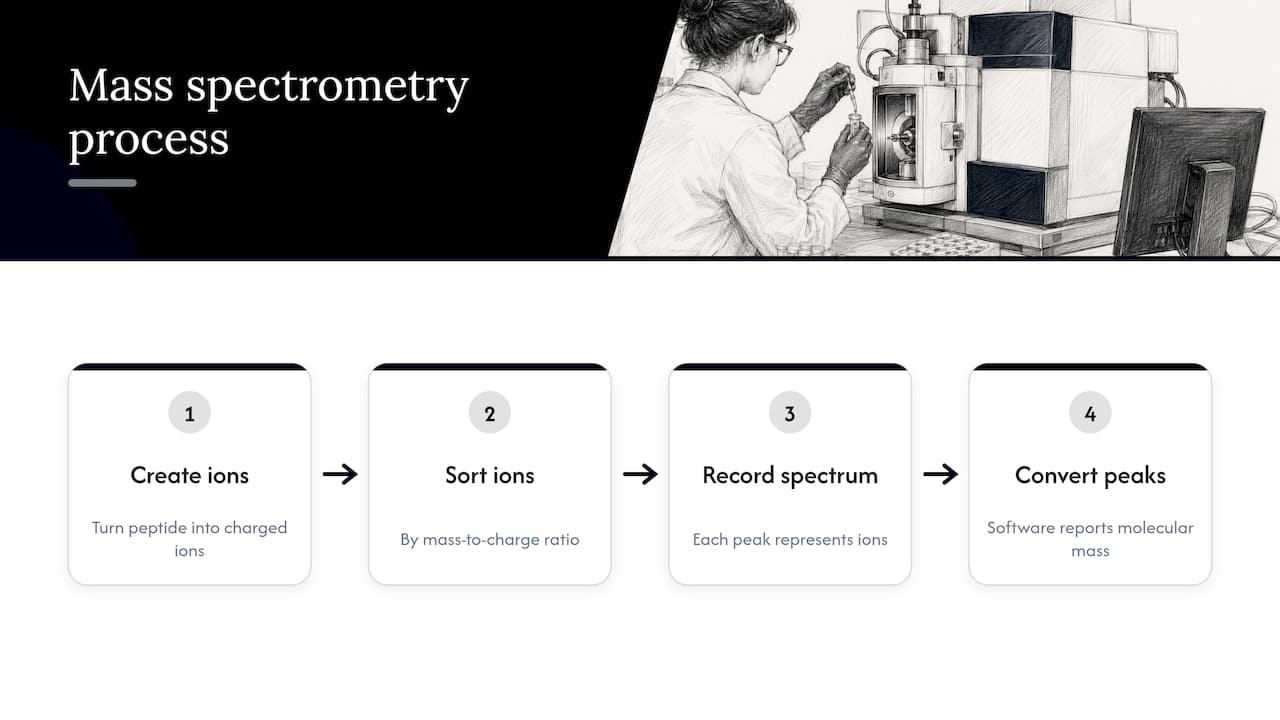
Mass spectrometry is an analytical technique that detects, identifies and quantifies molecules by their mass-to-charge ratio. The instrument turns the peptide into charged ions, sorts them by mass-to-charge ratio and records a spectrum. Each peak in that spectrum is a population of ions at a particular mass.
For a peptide, the result is straightforward to interpret in principle. Every peptide has a theoretical mass that follows from its amino acid sequence. If the dominant ion in the spectrum matches that mass within the instrument’s accuracy, the sample is consistent with the expected peptide. If it does not, something else is in the vial: a different sequence, a modified version, or a truncated product.
Peptides often pick up several charges in the instrument, so one compound can appear as a series of peaks. The lab software converts that series back to a single molecular mass, which is the number you will usually see on a report.
From mass to sequence: tandem MS
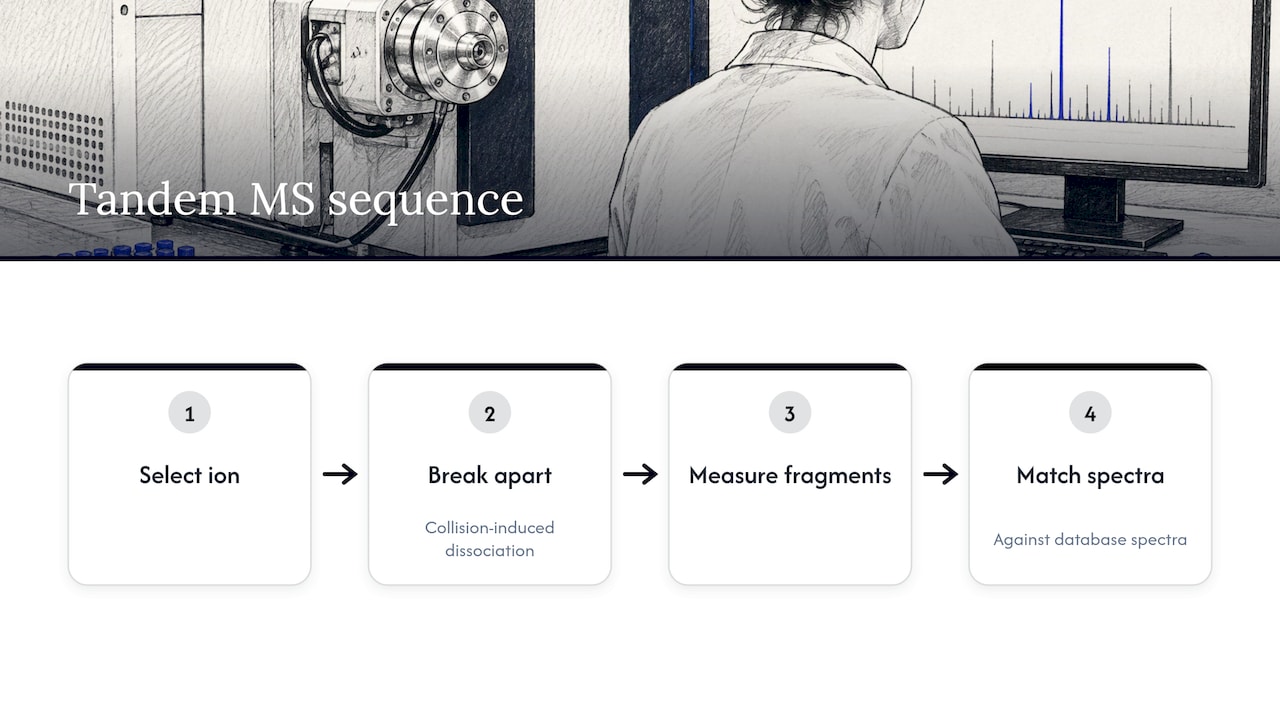
A matching mass is strong evidence, not proof of sequence. Two different peptides can share a mass. This is where tandem mass spectrometry comes in. The instrument selects one peptide ion, breaks it apart (commonly by collision-induced dissociation) and measures the fragments. Those fragment spectra can be matched against database spectra to identify the sequence.
The same source notes a built-in limit: leucine and isoleucine have the same mass, so fragment data alone cannot tell them apart. That is one reason a thorough report states what the method did and did not confirm.
How LC-MS peptide testing works, step by step
LC-MS combines two instruments in one workflow. Liquid chromatography separates the sample; the mass spectrometer identifies what comes out.
- Sample preparation. A small amount of the lyophilized peptide is dissolved in a suitable solvent at a known concentration. Preparation choices matter because every later step builds on this one.
- Chromatographic separation. The solution is pushed through a column, usually reversed-phase, where components leave at different times depending on how strongly they interact with the column. The full potential of advanced mass spectrometers depends on efficient reversed-phase chromatography.
- Ionization. In LC-MS with electrospray ionization, the liquid leaving the column is sprayed under high voltage to produce charged peptide ions.
- Mass analysis. The instrument records the mass-to-charge ratio of each ion, scan after scan, as the sample elutes.
- Data processing. Software assembles a chromatogram (signal against time) and a mass spectrum for each peak, then reports the measured mass, often alongside the percentage of the total peak area.
The reason to run both parts is that they answer different questions. Chromatography shows how many components there are and how much of the signal each one holds. Mass detection says what each component is. Accurate mass and fragmentation add molecular and structural information that a chromatogram alone cannot give, and high-resolution LC-MS can detect peptide impurities that co-elute, meaning they leave the column at the same moment as the main peptide and would be invisible on a plain UV trace.
What a mass spec result can tell you
A well-run LC-MS analysis can speak to three things.
Identity
MS can show whether the measured molecular mass is consistent with the expected peptide. With MS/MS, it can provide sequence-supporting fragments and help identify modifications. This is the part of the report that answers: is the compound in this vial what the label says?
Purity and related impurities
Synthetic peptides are built one amino acid at a time, and the process leaves characteristic by-products. LC-MS/MS can detect and characterize deletion or truncation products, insertions, oxidation and other side-chain reactions. A peer-reviewed high-resolution study showed that one experiment can identify a peptide, confirm its composition and sequence, and quantify related impurities, including co-eluting ones. In that study’s calcitonin method, impurities below 0.1% of the active ingredient concentration were detected under the reported conditions.
Not every impurity is a peptide, though. Health Canada’s quality guidance treats residual solvents, reagents, catalysts, elemental impurities and isomeric impurities as separate control concerns, each needing its own testing. LC-MS is a core tool, not the only one.
Consistency with a reference
Because each lot is tested on its own, a report lets you compare lots over time. A mass and a purity profile that stay stable from lot to lot are a sign of a controlled process.
What purity percentages really mean
A figure such as 99% is easy to read as “99% of what is in the vial is the peptide.” The real definition is narrower. A purity percentage is the target peak’s share of the total integrated area detected under one method at one wavelength. Anything the method does not detect does not count in the denominator.
Three practical consequences follow:
- Purity is not content. Peptides are often supplied as TFA salts, and the counter-ion and moisture add to the weight, so vial weight does not establish net peptide content. A vial labelled 5 mg does not necessarily hold 5 mg of peptide. Our article on how 98% purity can mask a true 89.6% value walks through the arithmetic.
- HPLC purity is not identity. An HPLC trace shows one clean peak, but it does not by itself say what the peak is. Mass spectrometry supplies that.
- Identity is not sterility or a full impurity profile. LC-MS identity does not establish sterility, endotoxin status or every possible contaminant. Those need separate tests.
For a longer treatment of the number itself, see our guide to peptide purity testing and what buyers should check first and our overview of purity standards and testing methods.
How to read a certificate of analysis
A COA is only as good as the details on it. A trustworthy one should identify the laboratory, the sample and lot, the dates, the methods, the results and the limitations, and give a report number or a way to verify it.
Use this checklist when a report lands in your inbox:
| Check | What you want to see |
|---|---|
| Laboratory | A named lab, with contact details, that is not simply the seller’s own letterhead |
| Lot match | The lot number on the report matches the lot number printed on the vial |
| Dates | A test date that fits the production date of the lot |
| Identity | A measured mass compared with a theoretical mass, ideally with MS/MS support |
| Purity | The method stated (column, gradient, detection wavelength) and the percentage of peak area |
| Content | A separate net peptide content figure, if you need dosing accuracy |
| Sterility and endotoxin | Reported as their own tests, never implied by the purity figure |
| Verification | A report number or a way to confirm it directly with the issuing lab |
Two habits make the difference. First, verify the report with the laboratory that issued it. Second, keep identity, area purity, content and sterility apart in your head: a report that proves one does not prove the others.
A reference on COA tests that show a lot is what it claims to be is a good companion when you are working through a report line by line.
Why two reports on the same peptide can differ
LC-MS is precise, but it is not a single fixed procedure. Ionization efficiency, chromatographic conditions, instrument range and data-processing settings all affect what gets detected and reported, and a result applies to the tested sample and the identified batch only.
Sample handling counts too. In proteomics, robust and reproducible sample processing is a key step, and preparation methods differ in how well they recover particular features. Errors or biases from the first step can carry through the whole experiment. For a buyer, the lesson is practical: compare reports that use the same type of method, and treat small differences between labs as expected rather than alarming.
Choosing a testing laboratory in Canada
A few Canadian specifics are worth knowing.
- Accreditation is not a Health Canada stamp. For product certification in Canada, the Standards Council of Canada (SCC) sets requirements under which facilities used for testing must meet the relevant ISO/IEC 17025 requirements, through SCC accreditation, an SCC mutual-recognition arrangement or an evaluation by the certification body. ISO/IEC 17025 is the standard for testing-lab competence, so asking whether a lab holds it is a fair question.
- Mass spectrometry is a recognized technique. Health Canada’s quality guidance says peptide identity and structure are supported by techniques including mass spectrometry, while impurities from synthesis, manufacture and degradation must be discussed separately, with specific attention to isomeric impurities.
- A lab report does not authorize a product. Health Canada states that third-party testing alone cannot verify safety, effectiveness, authorization or production to quality standards. It also warns that unauthorized peptides can be contaminated, incorrectly labelled, or contain too much, too little or none of the active ingredient.
That last point is about safe use. If you are considering any peptide for yourself, read Health Canada’s guidance, talk with your physician or pharmacist before using one, and review our pages on peptide safety and peptide legality in Canada. Health Canada has also issued a public alert that unauthorized injectable drug products sold online may not have been assessed for safety, efficacy or quality, and may contain high-risk ingredients, additives or contaminants. Know what you are buying and why, and keep the paperwork for every lot.
Our perspective
We built Pure Peptide around a simple idea: a purity claim should come with evidence you can read. That is why our products are backed by third-party lab certificates of analysis, and why we focus on formulations that exceed 99% purity through advanced purification methods.
We also think buyers should know how to read that evidence. A mass and a purity figure are most useful when you understand what each one measures. Identity, area purity, content and sterility are separate questions, and a clear report keeps them separate.
Our aim is for every customer to be able to match a lot to a report, understand the method behind it and decide with confidence. We are happy to see readers who ask hard questions about testing, because those are the customers who value rigorous quality.
Pure Peptide
Where to find our tested peptides
If you have read your way through a COA and want to put the knowledge to use, our full range of peptides and ancillaries covers weight loss, muscle growth, recovery, anti-aging and libido, along with reconstitution supplies such as bacteriostatic water, syringes and alcohol pads. Each product is backed by third-party lab certificates of analysis. Our laboratory standards guide explains the testing behind them, and our Canada buying guide covers quality and compliance.
FAQ
What is the difference between HPLC and LC-MS for peptides?
HPLC separates the components of a sample and shows how much signal each produces, which gives an area-based purity figure. LC-MS adds a mass detector, so each separated component also gets a measured mass. That mass is what supports identity, and it can reveal co-eluting impurities that an HPLC trace alone would miss.
Does a 99% purity result mean the vial holds 99% peptide?
No. The figure is the main peak’s share of the detected peak area under one method. It does not account for the counter-ion, moisture or anything the method cannot see, so it does not tell you net peptide content. Ask for content and sterility results separately if they matter to you.
Can mass spectrometry tell me a peptide is safe?
No. It can support identity and help characterize impurities, but it does not establish sterility, safety or effectiveness. Health Canada says third-party testing alone cannot verify those things, so talk with a physician or pharmacist before using any peptide.
How do I know a COA is real?
Match the lot number on the report to your vial, check that it names the laboratory and methods, and confirm it using the report number or contact route with the issuing lab. A report that cannot be traced to a lab and a lot is only a number on a page.
Does the same peptide always give the same LC-MS result?
Close, but not identical. Ionization, column conditions, instrument range and software settings all influence the output, and a result applies only to the tested sample. Small differences between labs are normal when the same type of method is used.
Sources
- Overview of Mass Spectrometry, Thermo Fisher Scientific
- Protein Mass Spectrometry Made Simple
- Liquid Chromatography-High Resolution Mass Spectrometry for peptide drugs and impurities
- Reversed-Phase Liquid Chromatography of Peptides for proteomics
- In Search of a Universal Method: A Comparative Survey of sample preparation
- HPLC vs Mass Spectrometry for Peptide Purity Testing
- LC-MS Peptide Testing: Understanding Identity Results
- Lab Tested Peptides Canada: HPLC and MS
- Peptide Testing FAQ Canada
- Health Canada: Quality (Chemistry and Manufacturing) guidance document
- Health Canada: Peptides, health risks
- Health Canada: Unauthorized injectable drug products sold online
- SCC Requirements and Guidance for certification bodies