







Measuring a peptide dose correctly means working through three steps in order: calculate the solution’s concentration, calculate the injection volume for your target dose, then convert that volume to syringe units. Mixing up milligrams and micrograms is the single most common source of dangerous errors, so convert units before you calculate anything, not after. Before drawing up any dose, Health Canada warns that many injectable peptides sold online are unauthorized, so verify the product itself before you trust your own math.
TL;DR:
- Converting units correctly before calculations prevents dangerous dosage errors caused by mixing milligrams and micrograms.
- Final solution concentration should always be measured accurately after reconstitution, considering the actual liquid volume in the vial.
- Using the appropriate syringe size and reading precise units reduces the risk of under- or over-dosing, especially for small doses.
- Only use authorized, properly tested peptide products with documented purity, and verify their approval before injection.
- Proper storage practices, gentle mixing, and thorough math checks before injection enhance dose accuracy and peptide stability.
Table of Contents
- Calculator logic and worked examples for common vial sizes
- Step-by-step reconstitution and measuring concentration safely
- Choosing the right syringe and reading units accurately
- Common measurement errors and how to verify your calculation
- Health and regulatory warnings relevant to injectable peptides
- Publisher-backed tips for reconstitution, storage and technique
- Methods for ensuring dosing accuracy beyond syringe reading
- Storage and handling that protect potency and dose accuracy
- How purity and stability affect your calculated dose
- Adjusting doses for individual factors like weight and condition
- What the math can’t fix about peptide dosing
- Where Pure Peptide fits once you’re ready to buy
- Sources
- FAQ
Calculator logic and worked examples for common vial sizes
Two formulas handle almost every dosing question. Concentration in micrograms per millilitre equals the peptide mass in milligrams, multiplied by 1,000, divided by the diluent volume in millilitres. Injection volume in millilitres equals your desired dose in micrograms, divided by that concentration, according to a peptide dosing guide.
Three examples using common vial sizes show how this plays out:
- A 5 mg vial reconstituted with 2 mL of diluent yields a concentration of 2,500 mcg/mL; a 250 mcg dose then requires 0.1 mL, or 10 units on a U-100 syringe.
- A 2 mg vial reconstituted with 2 mL yields 1,000 mcg/mL; a 100 mcg dose requires 0.1 mL, or 10 units.
- A 10 mg vial reconstituted with 2 mL yields 5,000 mcg/mL; a 500 mcg dose requires 0.1 mL, or 10 units, while a 250 mcg dose requires 0.05 mL, or 5 units.
On a U-100 syringe, 1 unit equals 0.01 mL, which is why 10 units always equals 0.1 mL regardless of what peptide you’re measuring. The syringe marks volume, never mass or concentration, so skipping the concentration step and guessing at a unit mark is how tenfold errors happen.
Step-by-step reconstitution and measuring concentration safely
Reconstitution turns a lyophilized (freeze-dried) powder into an injectable solution, and doing it carefully protects both the peptide and your dosing accuracy.
- Wipe the vial top with an alcohol pad and let it dry.
- Draw the intended volume of bacteriostatic water into a syringe.
- Insert the needle at an angle and let the water run down the inside wall of the vial slowly.
- Swirl or gently roll the vial to mix. Never shake or vortex, since agitation can damage the peptide’s structure.
- Let the powder fully dissolve before drawing any dose.
Once dissolved, concentration in mg/mL equals total peptide mass divided by diluent volume, and converting to mcg/mL just means multiplying by 1,000 (1 mg equals 1,000 mcg). The figure you actually need for dosing is the concentration in mcg/mL, since most doses are prescribed in micrograms.
One detail trips people up: the final liquid volume in the vial can exceed the volume of solvent you added, because the dry powder itself takes up space. Measuring the actual final volume, rather than assuming it equals the diluent you drew up, keeps your concentration calculation accurate.
Pro Tip: After reconstitution, draw the full liquid volume back into a syringe and read the markings to confirm the real final volume before calculating concentration.
Choosing the right syringe and reading units accurately
A U-100 syringe is calibrated so that 100 units equals 1.0 mL, meaning each unit mark is 0.01 mL. Converting a calculated volume to units is simple multiplication: multiply millilitres by 100.
- For doses under 0.3 mL, a 0.3 mL insulin syringe gives the clearest, lowest-error reading.
- For doses between 0.3 and 0.5 mL, a 0.5 mL barrel keeps the mark in the middle of the scale rather than at its crowded low end.
- For doses approaching 1.0 mL, use a 1.0 mL syringe, and consider a finer needle gauge (such as 29 to 31 gauge) for subcutaneous comfort.
- Always check the barrel printing before drawing: a U-40 syringe uses a different scale than U-100, and confusing the two is a well-documented cause of serious overdose or underdose.
Picking a barrel size where your target dose sits mid-scale, rather than at the very bottom, reduces the percentage error of a slightly imprecise read. Our guide to insulin syringe sizes covers gauge and length selection in more detail, and our page on injection sites covers comfortable subcutaneous locations.
Common measurement errors and how to verify your calculation
Most dosing mistakes trace back to one of a few repeatable errors: mixing up milligrams and micrograms, drawing up a dose on the wrong syringe scale, a simple arithmetic slip, or assuming the final vial volume matches the diluent added rather than measuring it.
A short verification routine catches most of these before the needle goes in:
- Recalculate the concentration from scratch, independent of your first attempt.
- Confirm every figure is in the same unit (mcg or mg, not a mix of both).
- Measure the actual final volume in the vial rather than assuming it.
- Check the syringe barrel is printed U-100, not U-40 or another scale.
- If anything feels uncertain, have a pharmacist or clinician check the math before injecting.
A useful dry run is to draw air to the expected unit mark first, compare it visually to the liquid volume you expect to see, then draw the actual dose and check it against that reference. If a dose calculates to more than roughly 1 to 1.5 mL for a single subcutaneous site, splitting it across two injection sites improves comfort and avoids pooling under the skin.
Health and regulatory warnings relevant to injectable peptides
Many injectable peptides sold online have not been assessed for safety, quality or effectiveness. Health Canada warns that unauthorized products, including those sold for anti-aging, bodybuilding or general wellness, can cause hormonal disruption, organ harm and clotting problems. The agency has taken enforcement action over this: it obtained a permanent injunction against one vendor’s illegal sale of injectable peptides, reiterating that these products are regulated as prescription drugs requiring authorization before sale.
Unauthorized injectable peptide products are unassessed for safety and may contain contaminants, incorrect doses, or ingredients not listed on the label.
Health Canada
An authorized drug carries an eight-digit Drug Identification Number that you can check in Health Canada’s Drug Product Database. Before using any injectable peptide, confirm its authorization status, talk to a licensed healthcare professional, and dispose of any suspect product safely rather than using it anyway.
Publisher-backed tips for reconstitution, storage and technique
A few habits make the difference between a precise dose and a guess. Label every reconstituted vial with the date, diluent volume and calculated concentration immediately, since memory is an unreliable record a week later. Store reconstituted solutions refrigerated and away from direct light, as both heat and light exposure can degrade a peptide faster than expected.
- Choose a syringe barrel sized to your typical dose, not the largest one available.
- Use sterile bacteriostatic water and a fresh needle for each reconstitution to avoid contamination.
- Keep a simple log of batch number, reconstitution date and volume for every vial you open.
- Recheck your concentration math any time you change vial size, diluent volume or target dose.
Pro Tip: Write the concentration directly on the vial label in mcg/mL, since that is the unit you will actually use at dosing time.
Methods for ensuring dosing accuracy beyond syringe reading
Syringe graduations are good enough for most routine doses, but they have real limits. A U-100 syringe’s smallest readable increment is one unit, or 0.01 mL, and visually splitting that further introduces guesswork. For very small doses, or for anyone who wants tighter control than a syringe line allows, a digital milligram scale used when weighing the dry peptide powder itself, before reconstitution, removes one layer of estimation entirely.
Micropipettes, the kind used in laboratory settings, offer finer liquid-volume control than a syringe barrel, but they require their own calibration check and are rarely necessary for home dosing once concentration is calculated correctly. The bigger accuracy gain usually comes from process, not equipment: always calculating concentration before choosing a syringe, always measuring final reconstituted volume rather than assuming it, and always double-checking unit conversions on paper before drawing anything up.
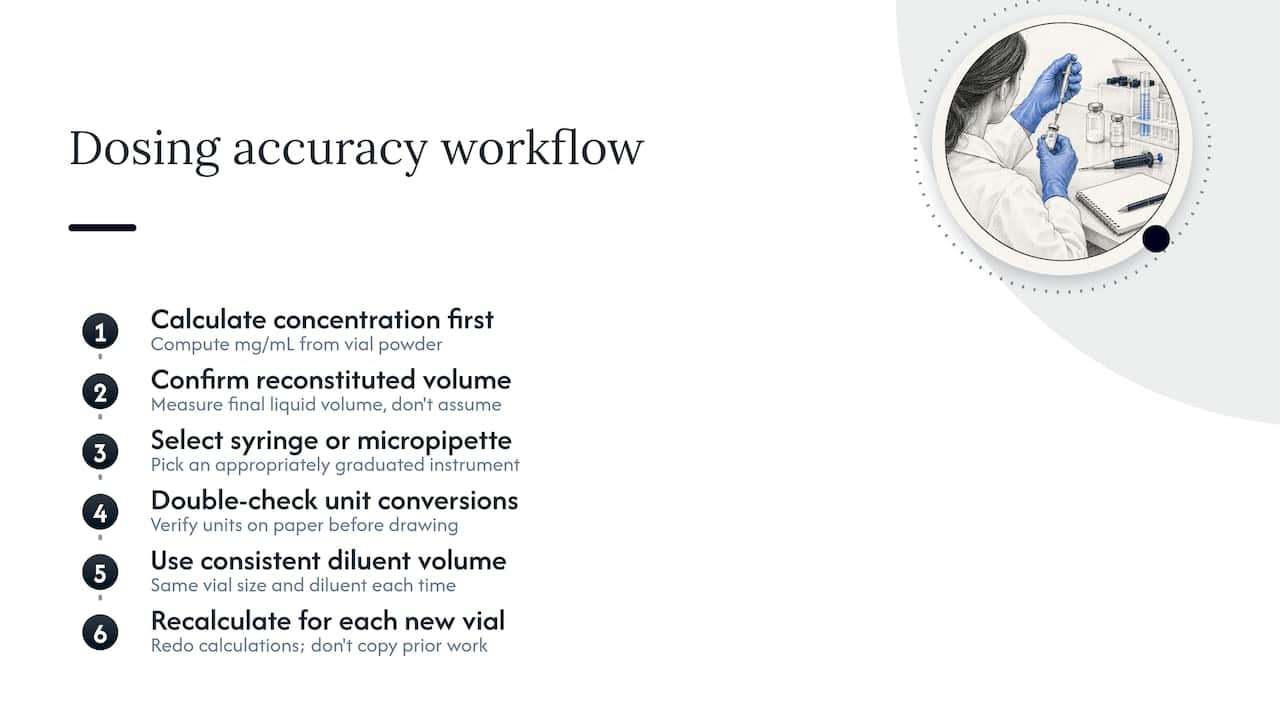
Consistency between doses matters as much as precision in any single dose. Reconstituting the same vial size with the same diluent volume every time removes a variable, and recalculating from scratch for every new vial, rather than copying a previous calculation, catches transcription errors before they reach the syringe.
Storage and handling that protect potency and dose accuracy
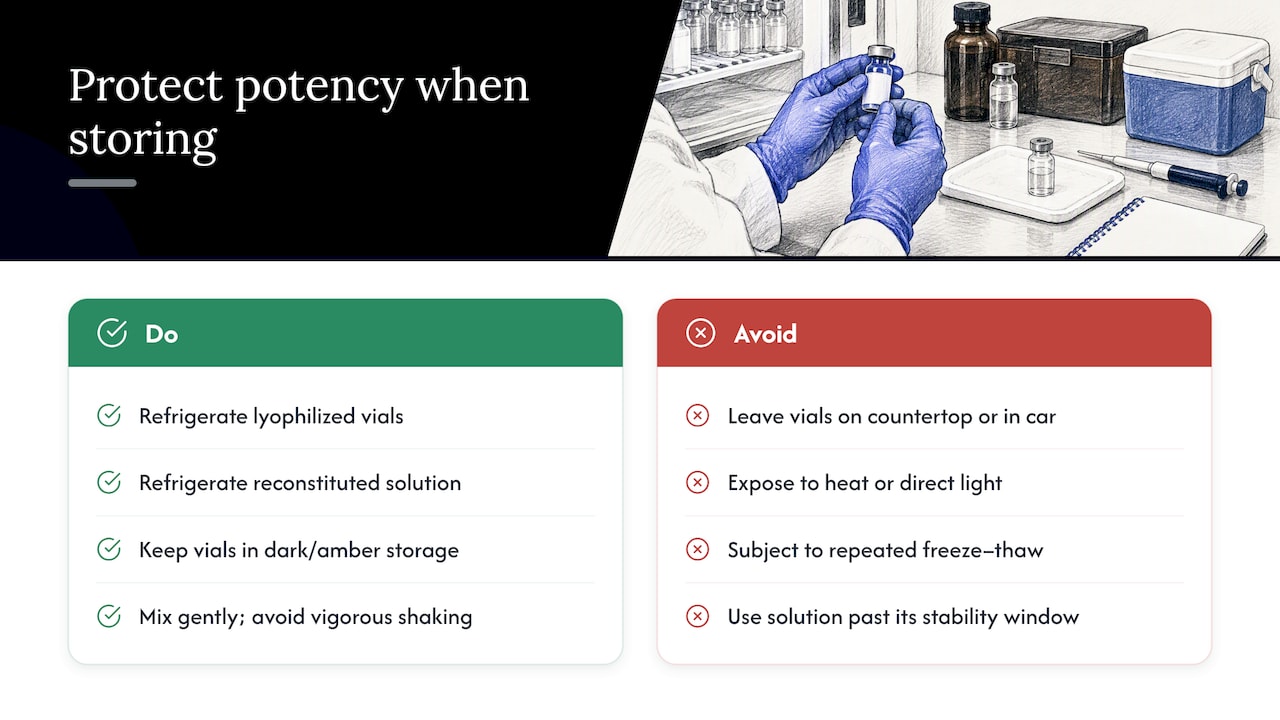
A peptide’s potency, and therefore the accuracy of every dose calculated from it, depends on how it’s stored both before and after reconstitution. Lyophilized (freeze-dried) powder is relatively stable and is typically kept refrigerated or frozen, away from light, until you’re ready to reconstitute it.
Once mixed with bacteriostatic water, a peptide solution is considerably more fragile. Heat speeds degradation, so reconstituted vials belong in the refrigerator, not on a countertop or in a car. Light, particularly UV light, can also break down peptide bonds over time, which is why most vials are amber-tinted or stored in a dark space. Repeated freeze-thaw cycles and vigorous shaking both stress the peptide structure unnecessarily, so gentle mixing and stable refrigerated storage between doses protect the concentration you calculated at reconstitution.
If a solution has been mishandled, exposed to heat, frozen and thawed repeatedly, or kept well past its expected stability window, the actual concentration in the vial may no longer match your original calculation, even though the math on paper is still correct. There’s no reliable way to measure potency loss at home, which is another reason careful storage matters as much as careful arithmetic.
How purity and stability affect your calculated dose
Every formula in this guide assumes the labelled peptide mass in the vial is accurate and that the peptide hasn’t degraded. That assumption is only as good as the product behind it.
Stability compounds this. A peptide that has partially degraded in storage, whether from heat, light or age, delivers less active substance than the label and your formula suggest, even when you’ve reconstituted and measured everything perfectly. This is one reason third-party testing and clear purity documentation matter for anyone trying to dose accurately: the formula only output is only as reliable as its input.
Because potency loss isn’t something you can see or measure without lab equipment, the practical safeguard is choosing products with documented purity and following storage guidance closely, rather than trying to compensate for suspected degradation by adjusting your own dose upward.
Adjusting doses for individual factors like weight and condition
Peptide dosing guidance in the sources behind this article focuses on the calculation itself, computing concentration and injection volume, rather than on how to adjust a dose for an individual’s body weight, health condition or goal. That adjustment is a clinical judgment, not an arithmetic one, and it depends on factors a formula can’t account for: body composition, kidney and liver function, other medications, and the specific reason someone is considering a peptide in the first place.
Where dose adjustment is genuinely warranted, for example, a smaller individual or someone with a relevant health condition, it should come from a licensed healthcare professional who can weigh those factors directly, not from scaling a standard dose by body weight using a rule of thumb. The calculation workflow in this guide tells you how to accurately deliver whatever dose has been determined; it doesn’t tell you what that dose should be for your specific situation.
What the math can’t fix about peptide dosing
The arithmetic in this guide is simple, and that’s exactly the problem: it’s easy to trust a clean-looking number without questioning what fed into it. The conventional advice tends to stop at “here’s the formula,” as if a correct calculation guarantees a correct dose. It doesn’t, if the vial’s actual peptide content, purity or stability doesn’t match its label.
What gets underestimated is how much of dosing accuracy happens before the syringe ever comes out: sourcing a product with documented purity, storing it correctly, and measuring the real final volume after reconstitution instead of assuming it. A flawless unit conversion applied to a degraded or mislabelled product still produces the wrong dose in the body, even though the math on paper is perfect.
If you take one thing from this guide, prioritize verifying what’s actually in the vial before you trust any number you calculate from it. Get the inputs right, then the formula does its job.
— Pure Peptide
Where Pure Peptide fits once you’re ready to buy
Once you understand the calculation, the product behind it is what determines whether that calculation means anything. Pure Peptide supplies peptides across weight loss, muscle growth, recovery, anti-aging and libido categories, along with ancillaries like bacteriostatic water and syringes, each backed by third-party lab certificates of analysis for purity. Our peptide safety page and buyer’s guide walk through lawful purchasing and reconstitution in more detail. Whatever you buy, verify its authorization status and talk to a healthcare professional before using any injectable product.
This article is general information, not a substitute for advice from a qualified doctor. Consult a qualified healthcare professional about your own circumstances before acting on anything here.
Sources
- Think twice before injecting peptides bought online: unauthorized products can seriously harm you — Canada.ca
- Peptide dosing guide: Units, calculations & protocol design — CompoundGuide
- Canada
FAQ
How long will a 10 mg vial of peptide last?
It depends entirely on your dose size and reconstitution volume, since a vial’s lifespan is a function of concentration, not a fixed number. A 10 mg vial reconstituted with 2 mL yields 5,000 mcg/mL, so a 500 mcg dose uses 0.1 mL, based on the concentration formula.
How do I know how big my peptide vial is?
The vial size, meaning the diluent volume you plan to add, is a choice you make at reconstitution, not a fixed property of the powder itself. Check the peptide’s labelled mass in milligrams, decide how much bacteriostatic water to add, then measure the actual final liquid volume in the vial once mixed rather than assuming it matches the diluent added exactly.
What are common mistakes in peptide dosing?
The most frequent and dangerous mistake is confusing milligrams with micrograms, which can cause a thousand-fold dosing error. Other common issues include reading the wrong syringe scale (U-40 versus U-100), simple arithmetic slips, and assuming the final reconstituted volume equals the diluent added instead of measuring it directly.
How are peptides measured?
Peptides are measured by first calculating the solution’s concentration in micrograms per millilitre, then dividing the desired dose by that concentration to get an injection volume in millilitres, according to the standard dosing formula. That volume is then converted to syringe units, where on a U-100 syringe, 10 units equals 0.1 mL.