







To find the syringe units to draw, divide the vial’s milligrams by the diluent volume to get concentration, convert your target dose from micrograms to the same unit, then multiply by 100 to read it on a U-100 syringe. Remember that 1 mg equals 1,000 mcg and that each U-100 mark equals 0.01 mL. This guide walks through the full formulas, worked examples, sterile technique, and the Health Canada guidance every reader preparing a peptide needs to check before drawing a dose. Tested compounds are supplied; a licensed clinician sets the actual dose.
TL;DR:
- More diluent increases the volume of draw, making small doses easier to measure but reducing concentration, which can cause errors if vial concentrations change.
- Always recalculate the concentration and units-to-draw when switching vial sizes or reconstitution volumes to avoid silent dose doubling.
- Use a separate, sterile insulin syringe for each injection and match the syringe’s capacity to the dose size to minimize measurement errors.
- Verify that peptides have proper regulatory approval and an authentication number before using, as unauthorized online products can cause serious harm.
- Store reconstituted peptides in refrigeration, label with reconstitution date, and discard if they show cloudiness or particulate matter to ensure safety and efficacy.
Table of Contents
- Core formulas and quick reference
- Worked examples: common vial sizes and doses
- Step-by-step reconstitution and sterile technique
- Choosing syringes, needles and measurement strategies
- Safety and regulatory guidance readers must not ignore
- Publisher guidance and practice-level checks
- Calculating dosage based on body weight or body surface area
- Adjusting peptide dose for concentration and volume differences
- Common dosing protocols for different peptides
- Potential side effects related to dosing errors and overdose prevention
- Considerations for storage and peptide stability after reconstitution
- Author perspective: accuracy plus clinician oversight
- How Pure Peptide can help with tested peptides and supplies
- Sources
- FAQ
Core formulas and quick reference
Every peptide calculation reduces to three pieces of arithmetic: concentration, unit conversion, and units to draw. Get these right and the rest of the process, from reconstitution to injection, becomes a matter of following the number on the syringe.
Concentration in milligrams per millilitre equals the vial’s total peptide mass divided by the volume of diluent added. From there, converting to micrograms and reading a U-100 insulin syringe follows a fixed sequence, as shown by public dosing calculators.
- Concentration (mg/mL) equals vial mg divided by diluent mL.
- Unit conversion treats 1 mg as 1,000 mcg, so a 5 mg vial holds 5,000 mcg total.
- Syringe scale on a U-100 barrel sets 1 unit equal to 0.01 mL, or 100 units per millilitre.
- Units to draw equals (target mcg divided by (vial mg multiplied by 1,000)) multiplied by diluent mL multiplied by 100.
- Doses per vial equals (vial mg multiplied by 1,000) divided by target mcg, rounded down to a whole number of doses.
Rounding matters more than it looks. A units-to-draw result of 24.6 should be treated as 25 units only when the syringe has no finer gradation; a 0.3 mL insulin syringe with half-unit markings lets you keep the decimal and draw closer to the true target.
Worked examples: common vial sizes and doses
The formulas above are easiest to trust once you have run them against a few real vial sizes. Here are four scenarios covering the diluent volumes most reconstitution guides recommend, typically 1 to 3 mL.
- 5 mg vial with 2 mL of bacteriostatic water. Concentration is 5 mg divided by 2 mL, or 2.5 mg/mL, which equals 2,500 mcg/mL. On a U-100 syringe, 100 units hold that full millilitre, so each unit carries 25 mcg. A 250 mcg target dose needs (250 divided by 5,000) multiplied by 2 multiplied by 100, which comes to 10 units.
- 5 mg vial with 1 mL of diluent. Concentration doubles to 5 mg/mL, or 5,000 mcg/mL, meaning each unit now carries 50 mcg. The same 250 mcg dose needs only 5 units, a smaller draw that is harder to read precisely on a standard 1 mL insulin syringe.
- 10 mg vial with 3 mL of diluent. Concentration is 10 mg divided by 3 mL, roughly 3.33 mg/mL, or about 3,333 mcg/mL. Each unit delivers approximately 33.3 mcg, so a 300 mcg dose needs about 9 units, a number worth double-checking with the exact formula rather than the rounded per-unit figure.
- 10 mg vial with 2 mL of diluent. Concentration is 5 mg/mL, or 5,000 mcg/mL, giving 50 mcg per unit. A 500 mcg dose lands exactly on 10 units, a clean mark that is easy to verify visually.
The pattern across these examples is straightforward: more diluent lowers the concentration and raises the number of units needed for the same microgram dose, which spreads the dose across more of the syringe barrel and makes small doses easier to see. Less diluent concentrates the peptide into fewer units, saving vial life but shrinking the visible draw and raising the chance of a measurement error on a coarse syringe scale. Choosing the diluent volume is as much about matching your syringe’s precision as it is about total vial capacity.
Step-by-step reconstitution and sterile technique
Reconstituting a lyophilised peptide is a short process, but the order of steps and the tools you use affect both accuracy and contamination risk. Set up a clean, well-lit workspace before opening anything.
- Gather bacteriostatic water, alcohol swabs, a larger syringe (3 mL or similar) for adding diluent, and fresh insulin syringes reserved only for drawing individual doses.
- Wipe the vial stoppers on both the diluent bottle and the peptide vial with an alcohol swab before every entry.
- Draw the calculated diluent volume into the larger syringe and inject it slowly down the inside wall of the vial rather than directly onto the powder.
- Avoid shaking the vial: swirl it gently until the peptide fully dissolves, which protects the peptide’s structure.
- Refrigerate the reconstituted vial and keep a written note of the reconstitution date so you can track its usable window.
- Use a new insulin syringe for every injection, never the syringe used to add diluent, to keep the vial’s remaining contents sterile.
This two-syringe approach, one syringe strictly for water and a separate fresh syringe for each dose, is standard practice for reducing contamination risk when a vial will be used repeatedly over several weeks. It also protects against dosing errors, since a diluent syringe and a dosing syringe often carry different markings.
Plan around the vial’s dead volume, the small amount of liquid that clings to the stopper and walls and never draws up. A 2 mL fill in a vial with 0.1 mL of dead volume means your last dose or two may come up short, so build that margin into how many total doses you count on getting.
Pro Tip: Label the vial with the reconstitution date and the concentration in mg/mL the moment you finish mixing it, since that number is easy to forget after a few days in the refrigerator.
Choosing syringes, needles and measurement strategies
The syringe you draw with matters as much as the math behind the dose. A U-100 insulin syringe is calibrated so that 100 units equal 1 mL, meaning each unit is exactly 0.01 mL, but the barrel size changes how easy that mark is to read.
- A 1 mL U-100 syringe covers the full 100-unit range and suits doses of 20 units or more, where a single-unit error has less relative impact.
- A 0.5 mL syringe spreads the same 50-unit range over a longer barrel, making mid-size doses easier to see precisely.
- A 0.3 mL syringe, often marked in half-unit increments, is the better choice for very small doses where even a two-unit swing changes the dose meaningfully.
- Keep a separate needle for drawing diluent into the vial and a fresh, single-use needle for every injection, since needles dull and can carry contamination after repeated vial entry.
- If your calculated dose lands on an awkward mark like 7.4 units, adjusting the diluent volume slightly (say from 2 mL to 2.5 mL) can shift the concentration so the same target dose falls on a cleaner, easier-to-read tick.
Matching syringe size to dose size is one of the simplest ways to cut measurement error before it happens.
Safety and regulatory guidance readers must not ignore
The arithmetic above only matters if the product in the vial is what the label claims. Health Canada has repeatedly warned that unauthorized injectable peptide products sold online can cause serious harm, since these products bypass the review process that checks safety, efficacy, and quality before a drug reaches consumers.
Authorized prescription drugs in Canada carry an eight-digit Drug Identification Number (DIN). That number is your first check before assuming any calculation applies to a legitimate product, and its absence is a warning sign on its own.
- Confirm any product’s DIN, DIN-HM, or Natural Product Number (NPN) before use and cross-check it against Health Canada’s public drug databases.
- Avoid any injectable peptide labelled “For Research Use Only, Not for Human Consumption” if the intent is personal use.
- Health Canada has named specific unauthorized peptides seized from online sellers and continues to pursue enforcement, including a 2026 permanent injunction preventing one operator from manufacturing and distributing unauthorized injectable peptides.
- Get your actual dose and protocol from a licensed clinician rather than a calculator or an online forum.
- If you experience an adverse reaction, seek medical attention and report the product to Health Canada.
- Dispose of any suspected unauthorized product rather than continuing to use it, and keep the packaging in case a report is needed.
Unauthorized products lack standardized dosing and titration data, which means the same calculated dose can produce unpredictable results from one batch to the next. Our guide to buying peptides walks through how to verify a product’s regulatory status before you ever pick up a syringe.
Publisher guidance and practice-level checks
Accurate math depends on starting with a peptide of known, verified purity.
Beyond the lab data, a few practical resources make the preparation process safer to follow step by step:
- Consult a dedicated reconstitution walkthrough for photos and pacing beyond the checklist in this article.
- Review guidance on injection sites and administration once your dose is drawn.
- Read a broader safety primer before your first preparation.
Before drawing any dose, run through a short pre-use checklist: verify the COA and any applicable DIN, confirm the dose with a licensed clinician, assemble sterile supplies in advance, and label the vial with its reconstitution date the moment you finish mixing it.
Calculating dosage based on body weight or body surface area
Some peptide protocols scale dose to the individual rather than using a flat microgram target, particularly in clinical contexts where body composition affects how a compound distributes and clears. Two approaches show up most often: dosing by body weight (mcg per kilogram) and, less commonly for peptides, dosing by body surface area.
Weight-based dosing multiplies a prescribed mcg-per-kg figure by the patient’s weight in kilograms to get a total target dose in micrograms, which then feeds into the same units-to-draw formula used for a flat dose. For example, a protocol calling for 2 mcg/kg for a 70 kg individual gives a target of 140 mcg, and from there you would apply the vial concentration to find the syringe reading exactly as shown in the worked examples above.
Body surface area dosing, more common with certain therapeutic peptides than with wellness compounds, uses a calculated surface area in square metres rather than raw weight, since some pharmacokinetics correlate more closely with surface area than mass. Because the underlying pharmacology and appropriate scaling method vary by peptide and by individual physiology, clinical references on peptide pharmacology note that dosing variability between individuals is a real factor, not a rounding error to ignore.
Whichever scaling method a protocol specifies, it should come from a licensed clinician who has reviewed your case, not from a generic weight-based rule applied without context.
Adjusting peptide dose for concentration and volume differences
Two vials of the same peptide will not always carry the same concentration, and a change in diluent volume changes every unit-to-mcg conversion that follows. This is where dosing errors most often creep in when someone switches suppliers, vial sizes, or reconstitution habits without recalculating.
If you previously reconstituted a 5 mg vial with 2 mL, giving 2,500 mcg/mL and 25 mcg per unit, and your next vial is 10 mg reconstituted with the same 2 mL, the concentration doubles to 5,000 mcg/mL and each unit now carries 50 mcg. Drawing the same number of units you used before would silently double your dose.
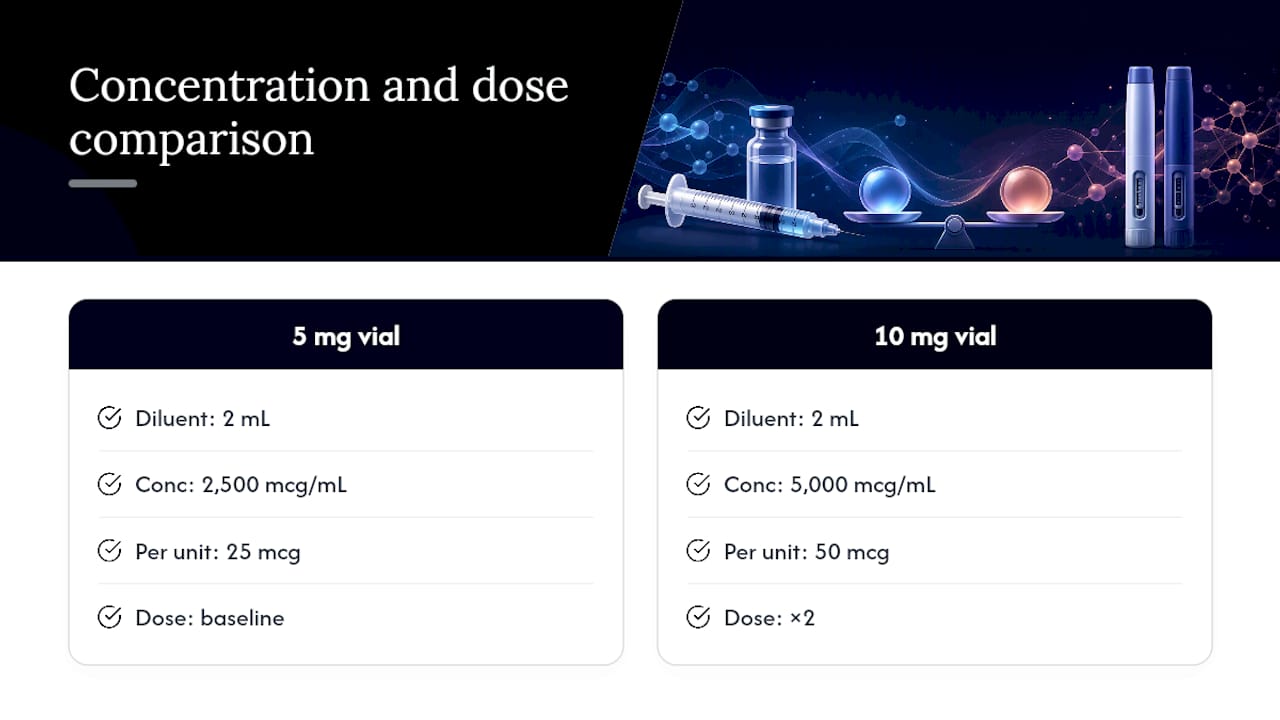
The fix is procedural, not mathematical: recalculate concentration and mcg-per-unit every time a vial’s mass or diluent volume changes, and never assume a previous unit count still applies to a new vial. Writing the new concentration on the vial label immediately after mixing, as covered in the reconstitution steps earlier, prevents this specific error from happening at the point of drawing a dose weeks later.
Common dosing protocols for different peptides
Dosing protocols vary considerably across peptide categories, and the frequency, cycle length, and target range are set by the specific compound and its intended use rather than by a single universal rule. Some peptides follow daily dosing schedules, others are dosed several times weekly, and some follow defined cycle lengths with planned breaks.
What stays constant across categories is the need to source the actual dose range and schedule from a licensed clinician or from the peptide’s own prescribing information rather than from a generic online table. Clinician-focused dosing tools document dose ranges for reference, but stress pairing that information with professional oversight because appropriate ranges differ by individual, by goal, and by the specific peptide’s pharmacology.
Rather than list specific protocol numbers here, the safer approach is procedural: confirm the frequency and range for your specific compound with a clinician, recalculate your units to draw whenever your vial concentration changes, and treat any published protocol as a reference point to discuss rather than a number to follow unverified.
Potential side effects related to dosing errors and overdose prevention
A calculation error at the reconstitution or drawing stage does not just shift a dose slightly, it can multiply it several times over if a decimal point or a unit conversion is missed. The most common error is confusing milligrams with micrograms, since a target written as “250 mcg” mistakenly drawn as “250 mg equivalent” represents a thousand-fold overdose.
Overdose risk from a dosing error can include unpredictable physiological responses, since unauthorized and improperly dosed peptide products have not been assessed for safety at scale the way approved drugs have. Symptoms following a significant dosing error can range from injection site reactions to more serious systemic effects, depending on the specific peptide and the size of the error.
Preventing these errors comes down to slowing down at three points: double-check the concentration calculation after reconstitution, verify the units-to-draw number against the formula rather than memory, and confirm the syringe barrel size matches the precision your dose requires. If an error does occur or you notice unexpected symptoms after an injection, seek medical attention promptly rather than waiting to see whether symptoms resolve.
Considerations for storage and peptide stability after reconstitution
Reconstituting a peptide starts a clock. Most lyophilised peptides are stable for years in powder form when stored correctly, but once mixed with bacteriostatic water, they typically remain stable for a much shorter window measured in weeks rather than months, and that window depends on the specific peptide and storage conditions.
Refrigeration, generally between 2°C and 8°C, is the standard storage condition for a reconstituted vial, and the vial should be protected from light and temperature swings between uses. Avoid leaving a reconstituted vial at room temperature for extended periods, and never freeze a reconstituted peptide, since freezing and thawing can degrade the peptide structure.
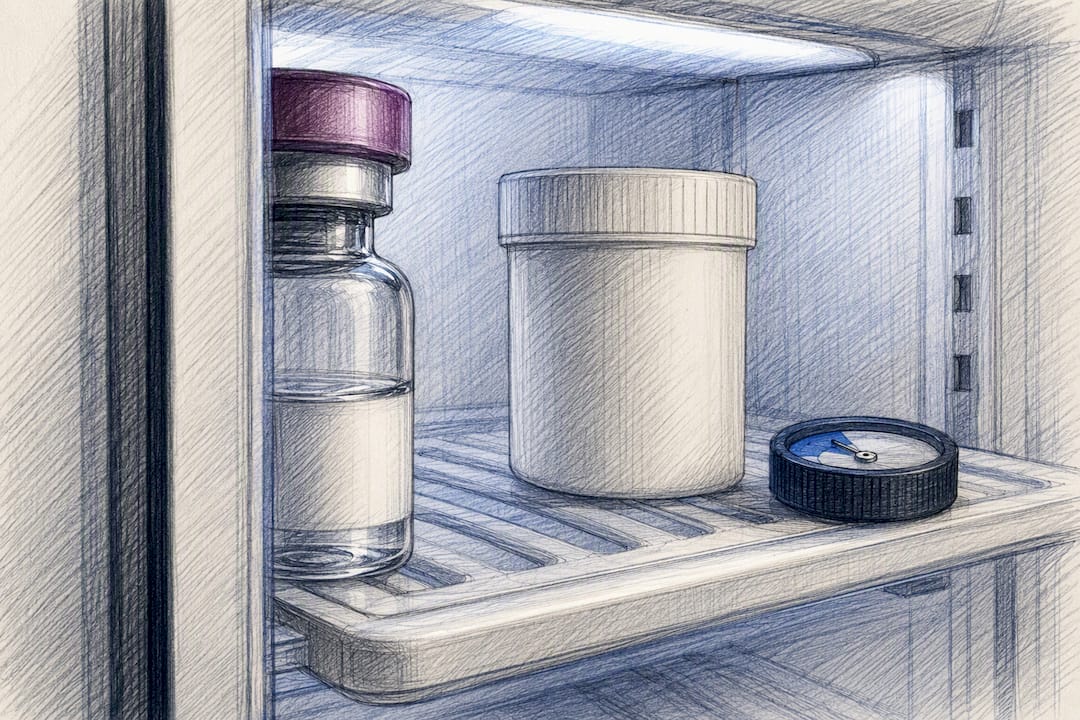
Writing the reconstitution date on the vial the moment you finish mixing, a step already covered in the reconstitution checklist, gives you a clear reference point for tracking how long a vial has been in use. If a vial shows cloudiness, discolouration, or any visible particulate that was not present at mixing, treat that as a sign the peptide may have degraded and discard it rather than risk an unpredictable dose.
Author perspective: accuracy plus clinician oversight
The math in this guide is exact, but exact math is not the same as a safe dose. A calculator will tell you precisely how many units to draw for a given target, and getting that arithmetic right matters, but it says nothing about whether that target is appropriate for you.
It is important to verify a product’s purity and certificate of analysis before you calculate anything, then get your actual dose and protocol from a licensed clinician. The formula solves for units on a syringe. It does not solve for whether a dose, frequency, or compound is right for your situation, and no amount of precision at the syringe substitutes for that judgment.
— Pure Peptide
How Pure Peptide can help with tested peptides and supplies
Getting the math right depends on starting with a peptide of known, verified concentration, which is where sourcing matters as much as arithmetic.
- Browse the full product catalogue across weight loss, muscle growth, recovery, anti-aging, and libido categories.
- Check tirzepatide-specific dosing information if that compound matches your protocol.
- Pick up reconstitution ancillaries alongside your order so you have sterile supplies on hand before mixing.
Every product page links its available lab documentation, so you can check purity data before running the calculations in this guide. Visit the Pure Peptide catalogue to see current products and their testing documentation.
Sources
Cross-check any calculation against a public dosing calculator or a clinician-focused tool that documents its formulas. Verify any product’s legal status against Health Canada’s alerts and its Drug Product Database before assuming a DIN or dosing protocol applies. For hands-on mixing technique, a step-by-step bacteriostatic water guide covers the process in more visual detail.
This article is general information, not a substitute for advice from a qualified doctor. Consult a qualified healthcare professional about your own circumstances before acting on anything here.
- Think twice before injecting peptides bought online: unauthorized products can seriously harm you – Canada.ca
- Canada
- Peptide Dosage Calculator — Rite Aid
- Free Peptide Dosage Calculator (2026) — PTK
FAQ
What is the formula for peptide dosage calculation?
Concentration in mg/mL equals the vial’s total milligrams divided by the diluent volume in millilitres. From there, units to draw equals the target dose in micrograms divided by (vial mg multiplied by 1,000), multiplied by the diluent volume and by 100 to read on a U-100 syringe.
How many units on a syringe equal 1 mL?
A standard U-100 insulin syringe holds 100 units per millilitre, so 1 unit equals 0.01 mL. This scale is what makes the units-to-draw formula convert directly onto a syringe reading.
How much bacteriostatic water should I use to reconstitute a peptide?
Most reconstitution guides use between 1 and 3 mL of bacteriostatic water per vial, with the exact amount depending on the vial’s mass and how precisely you need to measure small doses. Adding less water raises concentration and shrinks the syringe draw, while more water spreads the same dose over more units for easier reading.
Are peptides bought online legal in Canada?
Injectable peptides are regulated as prescription drugs in Canada, and Health Canada has warned that many unauthorized injectable peptides sold online can cause serious harm and have not been assessed for safety or quality. Authorized products carry an eight-digit DIN, which buyers should verify before use.
How long does a reconstituted peptide stay stable?
Reconstituted peptides are typically stable for a period of weeks when refrigerated between 2°C and 8°C, though the exact window depends on the specific peptide. Discard any vial showing cloudiness or particulate matter, and always label the vial with its reconstitution date to track its usable window.