





Yes, but usually indirectly. GLP-1 receptor agonists like semaglutide and tirzepatide, along with growth-hormone-related peptides such as MK-677 and tesamorelin, are the two classes most linked to thyroid-related lab changes. Most consumer peptides sold for recovery or anti-aging have no human thyroid data at all. If you’re on levothyroxine or another thyroid medication, get your labs checked before and after starting a metabolic peptide, and steer clear of unauthorized injectables entirely.
TL;DR:
- Most thyroid lab changes from peptides are due to weight loss or metabolic effects, not direct thyroid damage, especially in GLP-1 users.
- GLP-1 receptor agonists like semaglutide have strong evidence linking weight loss to reduced TSH, but they do not appear to cause thyroid disease.
- Unauthorized online peptides lack regulatory approval and carry risks of contamination, inaccurate dosing, and unknown effects on thyroid health.
- If on thyroid medication, get baseline labs before starting peptides and recheck within 6 to 12 weeks to monitor for shifts affecting medication needs.
- Always verify peptide quality with third-party certificates of analysis and consult a clinician before use, especially if managing thyroid conditions.
Table of Contents
- How peptides might alter thyroid markers and metabolism
- What the clinical evidence says by peptide class
- Safety, legality, and Health Canada signals to know first
- Monitoring your thyroid if you’re on replacement therapy
- How to evaluate peptide quality and safety before you buy
- Our take: quality testing isn’t optional when metabolism is involved
- Where Pure Peptide fits if you’ve already decided to use peptides
- Sources
- FAQ
How peptides might alter thyroid markers and metabolism
Not every shift in your thyroid panel means the peptide is attacking your thyroid gland directly. Most of what shows up on a lab report after starting a weight-loss peptide traces back to the weight loss itself, not a drug acting on thyroid tissue.
When you lose a meaningful amount of body fat, your body adjusts its energy budget. TSH often drops somewhat, and the ratio of T4 converting to the more active T3 can shift. This is a normal adaptive response to a smaller body needing less thyroid hormone to run, not evidence of thyroid damage.
Growth hormone and GH-releasing peptides work through a different route. GH interacts with the hypothalamic-pituitary-thyroid (HPT) axis and can alter T4 levels and peripheral T4-to-T3 conversion, while also increasing resting energy expenditure. That’s a mechanical effect on how your body burns fuel, separate from anything happening at the thyroid gland itself.
There’s a third, murkier pathway: immunometabolic signalling. GLP-1 drugs influence inflammation and adipokine activity, and some researchers have raised questions about whether that could touch thyroid autoimmunity indirectly. The honest answer is that this link remains theoretical and under-studied.
Three broad patterns worth knowing:
- Weight-loss-mediated: TSH and T4/T3 ratios shift as a byproduct of losing fat, not from direct thyroid action.
- HPT-axis interaction: GH and secretagogues can change hormone conversion rates and calorie burn.
- Immunometabolic: GLP-1s may influence inflammatory pathways with unclear downstream thyroid effects.
Direct toxic injury to thyroid tissue from these peptides is rare in the human data available. Most of what gets flagged on a lab report is adaptive, not damaging.
Pro Tip: If your TSH drops after a peptide-driven weight loss, don’t panic and don’t assume thyroid disease. Bring the full picture, weight change, timing, and symptoms, to whoever is reading your labs.
What the clinical evidence says by peptide class
The strength of the evidence varies enormously depending on which peptide you’re talking about, and that gap matters more than most marketing copy admits.
GLP-1 receptor agonists. This is where the data is strongest. Clinical research has tied semaglutide-driven weight loss to reductions in serum TSH in people with obesity. Separately, animal studies flagged thyroid C-cell tumours at high doses, which is why product safety labelling carries that warning. Regulators haven’t confirmed that risk translates to humans, but it’s noted for a reason, and it’s part of why these drugs are prescription-only.
Growth-hormone-related peptides and secretagogues. GH itself has a well-documented effect on thyroxine metabolism and energy expenditure. But the peptides marketed to consumers, MK-677, tesamorelin, ipamorelin, and similar GH secretagogues, don’t have the same depth of trial data behind them. The evidence is real but inconsistent.
Other consumer peptides. BPC-157, TB-500, CJC-1295, and thymosin-family peptides are popular for recovery and anti-aging, but human thyroid data on them is close to nonexistent. That’s not a subtle caveat, it’s an information vacuum.
A few things stand out across all three categories:
- GLP-1s have the most robust human evidence, largely because they’re studied as approved medications.
- GH secretagogue evidence is mixed, with results depending heavily on dose, agent, and trial design.
- Recovery-focused peptides (BPC-157, TB-500, CJC-1295) carry essentially no dedicated thyroid research.
- No peptide in wide consumer use has been through a large, dedicated, thyroid-focused randomized controlled trial.
If a seller tells you a peptide is “thyroid-safe” without citing anything, that claim usually reflects an absence of study, not a clean safety record.
Safety, legality, and Health Canada signals to know first
Before anything else, you need to know what’s actually legal to buy in Canada, because that status affects both safety and quality.
Health Canada has authorised prescription GLP-1s like semaglutide and tirzepatide, and even approved the first generic semaglutide for weight management. Those drugs go through formal review and carry a Drug Identification Number (DIN). Almost every other injectable peptide sold online, GH secretagogues, BPC-157, TB-500, and the rest, lacks that authorization entirely.
That’s not a technicality. Health Canada has repeatedly seized unauthorized injectable peptide shipments and issued direct public warnings that injecting peptides bought online can cause serious harm, because these products haven’t been assessed for safety, efficacy, or quality.
Here’s what that means practically:
- Check for a DIN. If a product is marketed as a medical treatment but has no Drug Identification Number, treat that as a red flag, not a technical footnote.
- Assume contamination risk is real. Unauthorized products can carry undisclosed active ingredients, incorrect dosing, or contaminants that could plausibly affect metabolism or thyroid function.
- Know which agents are regulated. Semaglutide and tirzepatide are prescription drugs with clinical oversight; most other consumer peptides are not.
- Prefer supervised care. A clinician-supervised prescription route beats a self-sourced vial every time safety is the question.
Monitoring your thyroid if you’re on replacement therapy
If you’re taking levothyroxine or liothyronine and thinking about a weight-loss or performance peptide, this is the section that matters most for you specifically.
Get baseline labs first: TSH, free T4, and thyroid peroxidase (TPO) antibodies if your history suggests autoimmune thyroid disease. Do this before you start the peptide, not after you notice something feels off.
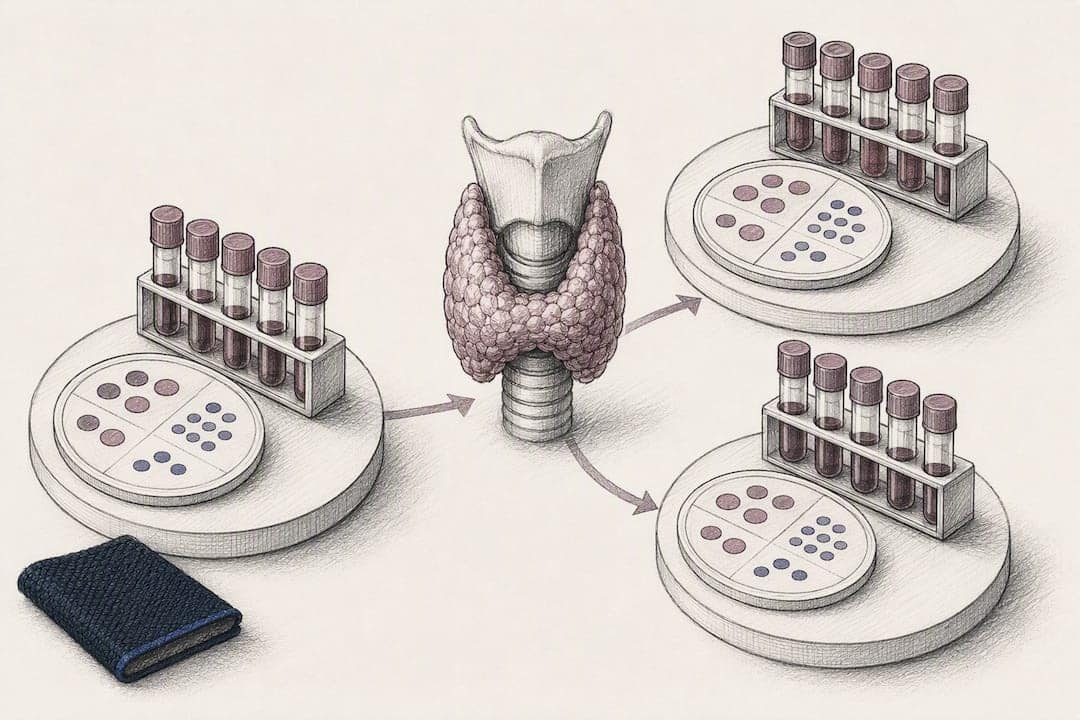
Recheck those labs after a clinically meaningful weight change, or within 6 to 12 weeks of starting a peptide that’s likely to cause weight loss. That window gives your body time to adapt without letting a real problem go unnoticed for months. Significant weight loss can change how much thyroid hormone your body needs, so a dose adjustment to your replacement medication may be necessary, and only your prescriber should make that call.
Watch for these red flags and treat them as reasons to call your doctor, not adjust your own dose:
- New or worsening fatigue, cold intolerance, or unexplained weight gain despite continued peptide use.
- Heart palpitations, tremor, or unexplained anxiety that appears after starting a peptide.
- Any symptom that feels like it came out of nowhere within weeks of a dose change.
Pro Tip: Keep a simple log of every peptide dose change alongside your lab dates. When you show up to an appointment with a timeline instead of a vague “I think it started a few months ago,” your clinician can actually connect the dots.
How to evaluate peptide quality and safety before you buy
Quality control is where most of the real risk in this category lives, and it’s also the part buyers have the most control over.
- Check for authorization status. If a product is being marketed with medical claims, look for a DIN. Its absence, combined with disease-treatment language, is a serious warning sign.
- Demand a real certificate of analysis. A legitimate COA should show the assay method, batch number, identity confirmation, purity percentage, and contaminant testing, including sterility testing for anything injectable. Vague or missing documentation is a practical red flag, not a minor gap.
- Watch for “research use only” doublespeak. A vendor labelling a product research-only while actively marketing it for human wellness benefits is misrepresenting what it’s selling.
- When in doubt, go the clinician-supervised route. A prescribed, regulated option or a licensed compounding pharmacy operating under recognized standards will always beat an unverified online seller for anything you’re putting in your body.
Our peptide safety guide walks through injection technique and vendor screening in more detail if you want the full checklist.
Our take: quality testing isn’t optional when metabolism is involved
The peptide space has a trust problem, and thyroid safety is exactly where it shows up. Too many sellers treat “research use only” as a legal shield rather than an honest description of what they’re offering, and that gap between labelling and marketing is where real risk lives.
Pure Peptide tests every batch for purity above 99% and makes third-party certificates of analysis available on request, because a purity number without independent verification is just a claim. We tell customers plainly: if you’re using anything that affects metabolism, especially GLP-1s or GH-related peptides, get your thyroid labs checked and loop in a clinician before you start and again a few weeks in. That’s not a disclaimer we add to cover ourselves. It’s the same advice we’d give a friend who asked.
Request a COA before you buy anything, read the Health Canada guidance on unauthorized products, and treat your bloodwork as part of the protocol, not an afterthought.
— Pure Peptide
Where Pure Peptide fits if you’ve already decided to use peptides
If you’ve weighed the risks and decided a peptide fits your goals, the question becomes where you source it. Pure Peptide focuses on categories readers in this exact situation are shopping for: weight loss, muscle growth, recovery, and anti-aging, backed by third-party lab certificates confirming purity above 99% for every batch. High-quality documentation is important to demand from any peptide seller for safety reasons.
Before you order anything, talk to a clinician, especially if you’re managing thyroid disease, and request the COA for the specific product you’re considering. Browse the weight loss and recovery peptide range to see what’s available, or go straight to the tirzepatide peptide page if a GLP-1 agent is what you’re evaluating. Either way, start with the paperwork, not the purchase button.
This article is general information, not a substitute for advice from a qualified doctor. Consult a qualified healthcare professional about your own circumstances before acting on anything here.
Sources
- Canada approves first generic semaglutide for weight loss
- Review of GH effects on metabolism and thyroid interactions
FAQ
Can peptides cause hypothyroidism?
Most consumer peptides have no confirmed link to causing hypothyroidism directly. GLP-1 drugs and GH-related peptides can shift TSH and T4/T3 conversion as a side effect of weight loss or metabolic change, which is different from causing thyroid failure.
Does semaglutide lower TSH?
Clinical research has linked significant weight loss after semaglutide to reductions in serum TSH in people with obesity. The change appears tied to the weight loss itself rather than a direct toxic effect on the thyroid gland.
Is it safe to take peptides while on levothyroxine?
There’s no blanket safety guarantee, but the practical approach is to get baseline thyroid labs, start the peptide under a clinician’s awareness, and recheck labs within 6 to 12 weeks. Significant weight change can shift how much thyroid medication your body needs.
Are online injectable peptides legal in Canada?
Prescription GLP-1s like semaglutide and tirzepatide are legally available with a valid Drug Identification Number and clinical oversight. Most other injectable peptides sold directly to consumers online lack that authorization, and Health Canada has warned that buying them carries serious health risks.
How do I know if a peptide product is high quality?
Check for a third-party certificate of analysis showing identity, purity above 99%, and contaminant testing, since vague or missing documentation is a warning sign. It’s recommended to request certificates of analysis (COAs) for weight loss, recovery, and muscle growth peptides before purchase to verify quality.