






Keep lyophilized peptides refrigerated at 2 to 8°C or frozen at negative 20 to negative 80°C, and treat reconstituted peptides as strictly 2 to 8°C, used only within the validated in-use window. The single priority on arrival is checking the shipment against a validated cold chain, meaning you compare the logger record to the product’s actual stability data rather than assuming “cold enough” is good enough. Every accept or reject decision should rest on product-specific evidence, not general assumptions.
TL;DR:
- Lyophilized peptides can tolerate brief room temperature exposure during shipping but should be stored at 2 to 8°C immediately after receipt to maintain stability.
- Reconstituted peptides must stay at 2 to 8°C and are only stable for a limited time, with the exact window specified by the manufacturer’s data.
- Shipment packaging should be validated for performance, as passive cooling options like ice packs are time-limited, while active and phase-change shipments support longer transit resilience.
- Acceptance or rejection relies on reviewing data logger records against specified stability ranges, not just visual inspection or assumptions.
- Always request and securely store the certificate of analysis, stability summaries, packing images, and logger files for reliable quality control.
Table of Contents
- Numeric temperature ranges and time windows for peptides
- Packaging and cold chain options: how to choose and what to expect
- Accepting shipments: inspection, data logger review and excursion response
- Post-delivery handling: storage, aliquoting and avoiding freeze-thaw damage
- Why temperature matters: degradation mechanisms and formulation factors
- Testing, documentation and quality controls labs should demand
- Pure Peptide’s approach: conservative defaults and supplier documentation
- A researcher’s take on shipping temperature discipline
- Get peptides shipped with the documentation your lab needs
- Sources
- FAQ
Numeric temperature ranges and time windows for peptides
Lyophilized (freeze-dried) peptides tolerate brief excursions to room temperature far better than reconstituted ones. NIBSC handling guidance states that dry peptides are stable at room temperature for short periods during shipping, but should move to 4°C or colder for preservation once received, with negative 20 to negative 80°C reserved for longer-term inventory. General lab storage practice, as summarized in Indiana University’s protein storage notes, treats refrigerated storage at refrigerator temperature or below as suitable for days to weeks, while frozen storage extends usable life considerably.
Reconstituted peptides behave differently once they are in solution. They belong at 2 to 8°C, and the in-use window depends entirely on the specific product, buffer and concentration, so a supplier’s own data sheet should set the limit rather than a generic rule.
When supplier data are missing, a conservative approach helps:
- Keep sealed lyophilized vials refrigerated at 2 to 8°C for short-term use.
- Move to negative 20°C for storage measured in months.
- Reserve negative 80°C for extended archival storage or unusually sensitive peptides.
- Treat reconstituted material as use-within-weeks unless the manufacturer states otherwise.
Choosing between negative 20 and negative 80°C usually comes down to how long the material will sit before use: negative 20°C suits active inventory, negative 80°C suits long-term backstock.
Packaging and cold chain options: how to choose and what to expect
Packout choice determines whether a shipment actually holds its target range for the full transit time, not just at the moment it leaves the warehouse. A peer-reviewed formulation review notes that therapeutic peptides generally require cold-chain transport, and that thorough packaging design reduces the risk of excursions, while passive ice packs are time-limited and can fail under hot ambient conditions.
- Passive ice packs are inexpensive and common, but they exhaust their cooling capacity faster in warm climates or long transit legs.
- Dry ice holds a much lower temperature and suits frozen shipments, but it sublimates steadily and requires venting.
- Refrigerated (active) shippers maintain a set range electronically and suit long or unpredictable routes, at higher cost.
- Phase-change materials hold a narrower band for longer than standard gel packs, useful for 2 to 8°C shipments crossing several days.
Thermal mass matters because a small volume of product surrounded by a large insulated payload changes temperature slowly, which can buy time during a delay, but it also means a logger placed against the outer wall of a box may not reflect the actual product temperature.
Pro Tip: Ask suppliers for a packaging validation summary, not just a “temperature-controlled” label, since a range with no numbers attached tells you nothing about performance.
Dry ice ships under specific carrier and transport rules that vary by carrier and route; confirm requirements with your carrier and supplier rather than assuming standard parcel service applies.
Accepting shipments: inspection, data logger review and excursion response
The first few minutes after a package arrives matter as much as the transit itself. Start with a visual check: intact seals, no condensation inside the vial packaging, a legible shipping label, and a manifest that matches what was ordered.
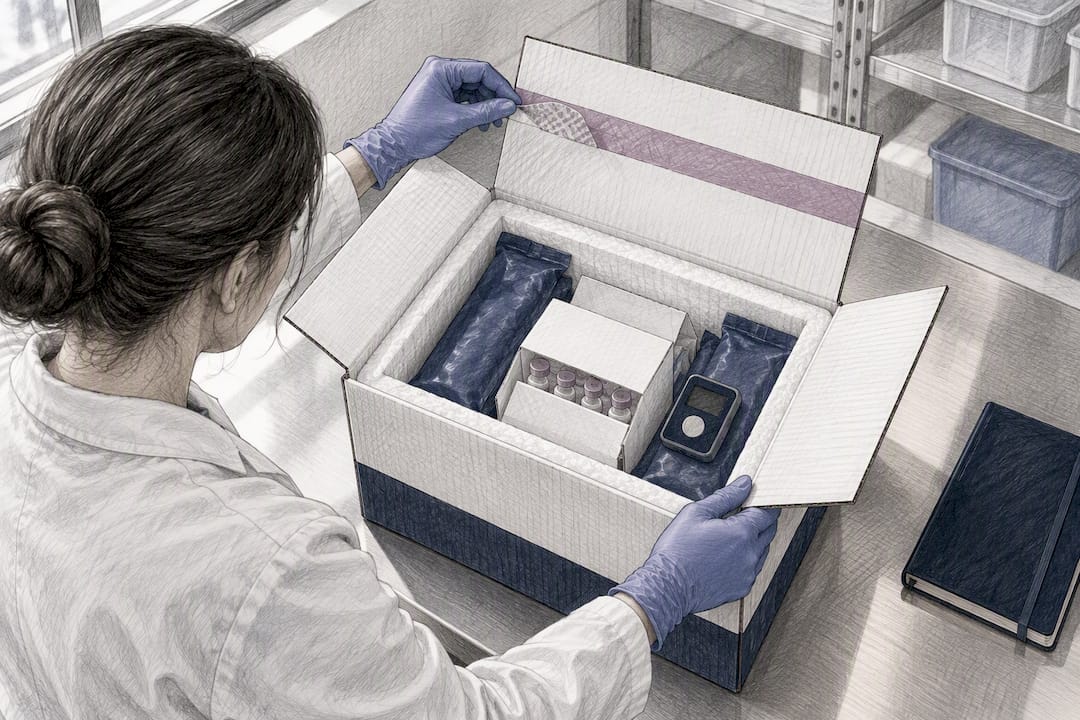
Next, pull the data logger and read it properly. A single brief spike above range is not the same as hours spent warm: peer-reviewed sources note that a logger peak outside the validated range does not automatically mean the product degraded, and that decisions should weigh both the magnitude and the duration of the excursion against the stability profile.
From there, apply a simple decision flow:
- Accept and store normally when the logger stays within the validated range throughout transit.
- Quarantine and request testing when the excursion is brief or borderline against the product’s known tolerance.
- Reject and document when the excursion clearly exceeds validated limits or duration.
Keep the logger file, certificate of analysis, receiving photos and any supplier correspondence together in one record, and notify the supplier promptly when something looks off.
Post-delivery handling: storage, aliquoting and avoiding freeze-thaw damage
Let a sealed lyophilized vial come to room temperature before opening it, since opening a cold vial can draw in condensation that introduces moisture. Once equilibrated, move it straight to its recommended storage condition and avoid leaving it on the bench.
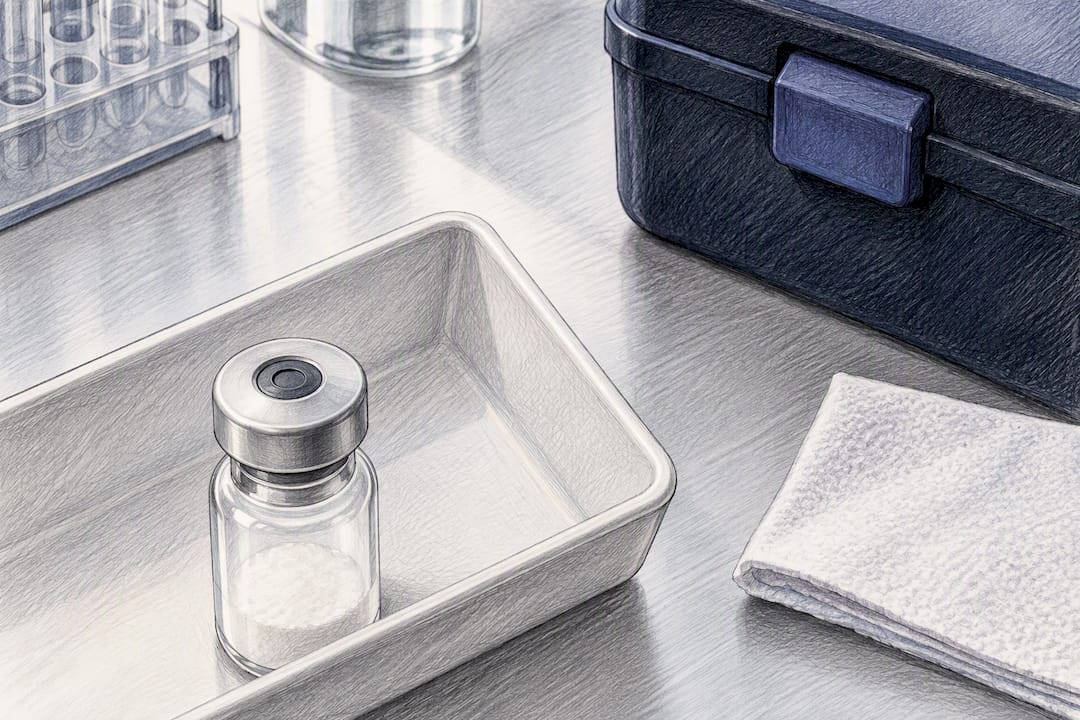
Reconstitution deserves its own care. Use the solvent the manufacturer specifies, add it gently down the side of the vial rather than injecting it forcefully, and avoid shaking, since agitation can promote aggregation. Keep reconstituted vials away from direct light and away from repeated temperature swings.
Aliquoting matters more than most labs realize:
- Split reconstituted peptide into single-use volumes immediately after mixing.
- Avoid refreezing or rewarming the same aliquot more than once.
- Store each aliquot at 2 to 8°C unless the supplier specifies otherwise.
- Label every aliquot with the reconstitution date, concentration and expected expiry.
Repeated freeze-thaw cycles reduce protein and peptide stability over time, which is part of why the Indiana University storage notes recommend aliquoting as standard practice rather than an optional step. A well-labelled freezer box saves a lot of guesswork three weeks later.
Why temperature matters: degradation mechanisms and formulation factors
Heat accelerates the chemical reactions that break peptides down. Deamidation, oxidation and hydrolysis all speed up as temperature rises, and a formulation-development study found that thermal stress and oxygen exposure generate measurable degradation impurities, while low-temperature processing and oxygen exclusion reduced that damage.
Buffer choice interacts directly with temperature sensitivity. The same peer-reviewed review notes that pH control, often in the pH 3 to 5 range, reduces deamidation and oxidation for many peptides in solution, though product-specific exceptions apply and a given peptide’s optimal pH should come from its own data.
Excipients, oxygen exclusion and light protection work alongside temperature control rather than replacing it. None of these measures substitutes for a validated, product-specific stability study, which should be the actual basis for any storage or shipping decision.
Testing, documentation and quality controls labs should demand
A defensible acceptance decision depends on paperwork as much as on the shipment itself. At minimum, ask suppliers for validated storage ranges, a certificate of analysis, and any accelerated stability data behind their recommendations.
Keep four documents on file for every shipment:
- The certificate of analysis for that lot.
- The packing list matching the order.
- The complete data logger file, not just a summary screen.
- The carrier’s shipping manifest with timestamps.
Run acceptance testing, such as HPLC purity checks, when a shipment’s logger history is ambiguous or borderline, and retain a small sample from each lot for later comparison if stability questions come up. A workable SOP defines quarantine criteria, an investigation timeline, a clear disposition (accept, retest or reject) and a step for notifying the supplier, so the same excursion is not litigated from scratch every time it happens.
Pure Peptide’s approach: conservative defaults and supplier documentation
Our default policy treats reconstituted peptides as 2 to 8°C in-use material and stores lyophilized peptides at 2 to 8°C for short-term handling or frozen for longer-term inventory, unless a supplier’s own data justify a different approach.
Before accepting any shipment, request the certificate of analysis, a stability summary, packing photos and the logger file, and keep all four together for audit purposes. Our peptide laboratory standards page walks through how we validate stability profiles and set our own accept and reject criteria.
A researcher’s take on shipping temperature discipline
The numbers are simple: lyophilized peptides tolerate a brief ambient stretch, reconstituted peptides do not, and 2 to 8°C is the safe default until a supplier’s data say otherwise. Build a short SOP around those two facts, ask suppliers for their stability evidence before you need it, and when a logger reading looks ambiguous, call the manufacturer rather than guessing.
— Pure Peptide
Get peptides shipped with the documentation your lab needs
Sourcing peptides is only half the job when stability depends on paperwork as much as packaging. Pure Peptide supplies weight loss, muscle growth, recovery, anti-aging and libido peptides, each backed by a certificate of analysis confirming purity above 99%, so you are never guessing about what arrived.
Our support team can walk you through packing options and documentation before you order, and our reconstitution guide covers the in-use handling steps that keep a peptide stable after it lands on your bench. Browse the full catalogue to see current certificates and place an order.
Sources
For deeper technical background, see the peer-reviewed review on formulation strategies for peptide stability, the study on thermal stress and degradation in peptide formulations, NIBSC’s peptide handling and storage guidance, and Indiana University’s protein storage notes. A partner overview of shipping temperature requirements for skincare peptides offers a useful adjacent perspective.
This article is general information, not a substitute for advice from a qualified doctor. Consult a qualified healthcare professional about your own circumstances before acting on anything here.
- Designing formulation strategies for enhanced stability of therapeutic peptides in aqueous solutions: a review — PMC
- Peptide Handling, dissolution & Storage — NIBSC
- Protein stability and storage — Indiana University lab notes
FAQ
What happens if peptides get warm during shipping?
A brief warm spell during transit does not automatically ruin a peptide, since the risk depends on both peak temperature and how long it lasted, not the peak alone. Review the data logger record against the product’s stability profile before deciding whether to accept, quarantine or reject the shipment.
Will peptides go bad in heat?
Sustained heat accelerates degradation reactions like deamidation, oxidation and hydrolysis, and a formulation study found thermal stress generates measurable impurities in peptide products. Lyophilized peptides tolerate brief warm periods far better than reconstituted ones, which should stay at 2 to 8°C.
How long can BPC 157 be out of the fridge?
Specific in-use tolerance depends on the product’s own validated stability data, which your supplier should provide. As a conservative default, treat sealed lyophilized vials as tolerant of short ambient transit periods, then refrigerate at 2 to 8°C immediately on receipt, since general dry-peptide guidance supports short room-temperature windows for shipping only.
Do peptides go bad if not refrigerated?
Lyophilized peptides can withstand short periods without refrigeration during shipping, but prolonged exposure to room temperature or heat increases the risk of degradation over time. Reconstituted peptides are far more sensitive and should be kept at 2 to 8°C, since protein storage literature treats refrigeration as the standard for short-term handling of peptides in solution.