






Peptide onset generally follows a pattern: acute or neuropeptide effects can show up within days, recovery and sleep changes emerge over 1 to 2 weeks, skin and structural repair take 4 to 12 weeks, and metabolic or body composition changes typically need 8 to 16 or more weeks. Before any of that matters, know that unauthorized injectable peptides carry real risk, and Health Canada warns against buying them online.
TL;DR:
- Skin peptides like GHK-Cu show hydration improvements within 4 to 6 weeks, but measurable effects on wrinkles and elasticity may take 8 to 12 weeks.
- Recovery peptides such as BPC-157 and TB-500 can reduce inflammation and soreness within 1 to 2 weeks, while structural tissue repair typically takes 4 to 8 weeks.
- Metabolic peptides like semaglutide and tirzepatide begin suppressing appetite within 1 to 2 weeks, but significant body composition changes often require 8 to 16 weeks.
- Injectable peptides reach systemic circulation faster than oral or topical methods, with purity and proper storage significantly affecting actual timelines.
- Authenticity and regulation matters: only purchase peptides through licensed pharmacies with traceable documentation, especially in Canada, where unauthorized products pose serious health risks.
Table of Contents
- Timelines by category: what changes first and what takes longer
- Named peptide timelines you can use as checkpoints
- What actually changes how fast you’ll see results
- How to track progress without fooling yourself
- Regulatory reality: what Health Canada says about unauthorized peptides
- How Pure Peptide approaches purity and predictable timelines
- Do other supplements or medications change the timeline
- Short-term effects versus results that actually last
- Side effects that can distort how you judge progress
- Why patience matters more than the first two weeks
- Where Pure Peptide fits once you’re ready to start
- Sources
- FAQ
Timelines by category: what changes first and what takes longer
Peptides don’t work on a single clock. The category tells you far more about timing than the marketing copy does, because the tissue and mechanism involved dictate how fast a change can physically happen.
Skin and collagen peptides, such as GHK-Cu or Matrixyl (palmitoyl pentapeptide-4), tend to show hydration improvements first. Topical collagen research points to noticeable hydration gains around 4 to 6 weeks, while objective measures of wrinkle depth and elasticity often need 8 to 12 weeks to reach a measurable difference. Skin looks and feels different well before a photograph can prove it.
Recovery and healing peptides move faster at the start. BPC-157 and TB-500 are the two names most people ask about, and both are associated with early reductions in inflammation or soreness within the first one to two weeks, based on preclinical work and scattered human reports. Structural repair, the kind that actually rebuilds tendon or ligament tissue, is a slower process that unfolds over weeks rather than days.
Metabolic and weight-loss peptides, including semaglutide and tirzepatide, separate cleanly into two phases. Appetite suppression and shifts in metabolic markers show up within the first one to two weeks of dosing. Meaningful body composition change, the number on the scale or the fit of your clothes, is a longer story that plays out over 8 to 16 weeks or more, largely because titration schedules delay full dosing and because fat loss itself is a gradual physiological process.
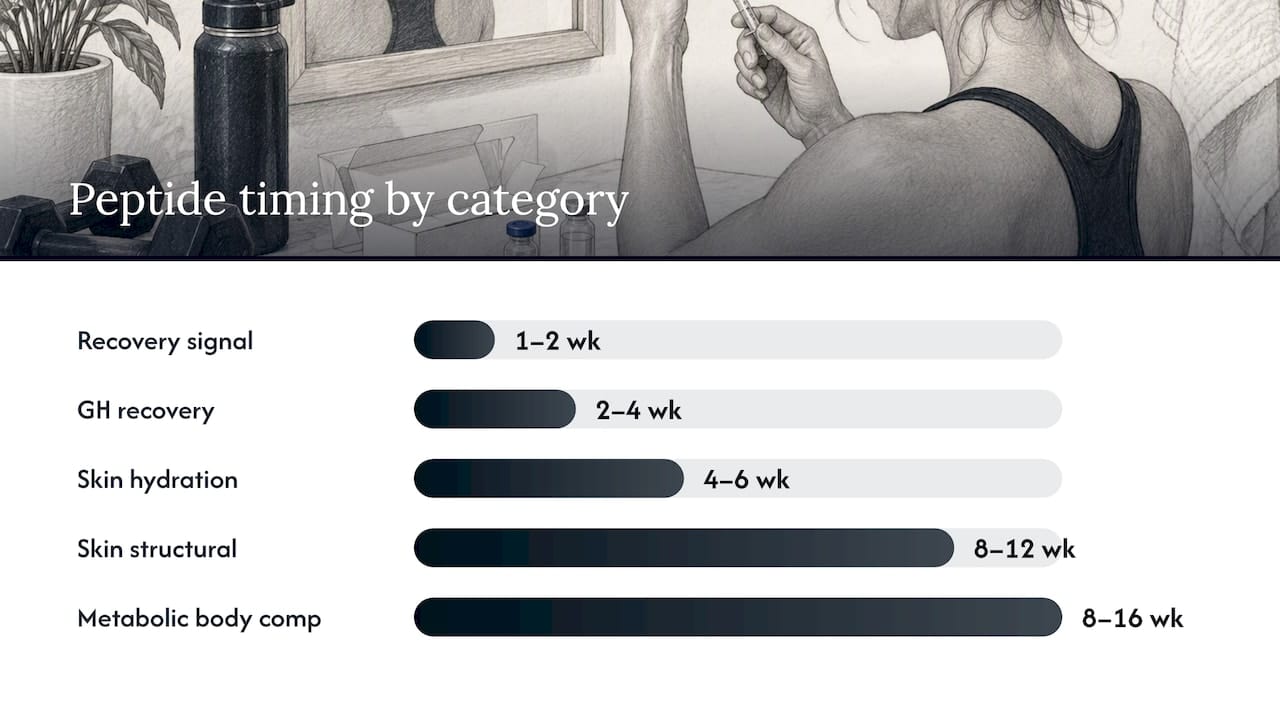
Growth hormone secretagogues, such as CJC-1295 and ipamorelin, work in layers. The GH pulse itself happens within minutes of dosing, since that’s the direct pharmacological action. Sleep quality and subjective recovery often improve within 2 to 4 weeks. Visible changes in muscle or body composition are a months-long outcome, not a weeks-long one.
Sexual and cognitive peptides, like Bremelanotide (PT-141), tend to sit at the fast end of the spectrum because they act on receptors tied to an immediate physiological response, with effects reported within minutes to a few days of use.
A few patterns repeat across every category:
- First signal almost always precedes meaningful endpoint by weeks or months.
- Subjective measures (energy, mood, soreness) shift before objective ones (imaging, lab values, photos).
- The faster a peptide acts on a receptor or acute pathway, the sooner you’ll notice something.
- The more a result depends on tissue remodelling, the longer the wait, regardless of category.
Named peptide timelines you can use as checkpoints
Category windows are useful, but most people want a concrete answer for the specific compound they’re considering. These are general windows drawn from category-level evidence, not guarantees for any individual.
- BPC-157: Early GI comfort or reduced localized inflammation is sometimes reported within 3 to 10 days. Tendon or ligament-related changes, where relevant, are generally not evaluated before 4 to 8 weeks of consistent use.
- TB-500: Early shifts in mobility or inflammation can appear within 1 to 2 weeks. Structural gains tied to soft-tissue repair are usually assessed at the 4 to 6 week mark.
- GHK-Cu and Matrixyl (topical use): Hydration improves within 2 to 4 weeks. Visible changes in collagen density or skin texture typically require 6 to 12 weeks of consistent application.
- Semaglutide and tirzepatide: Appetite suppression is usually noticeable within 1 to 2 weeks. Meaningful weight or body composition change is generally measured at 8 to 16 weeks, once titration has reached a maintenance dose.
- CJC-1295 with ipamorelin: Sleep and recovery quality often shift within 2 to 4 weeks. Body composition outcomes typically take several months to become apparent.
These windows assume consistent dosing, a legitimate product, and a realistic endpoint. Skipping doses, using an underdosed product, or expecting week-two results to match week-twelve results will set you up for disappointment.
What actually changes how fast you’ll see results
The peptide itself is only part of the equation. Several variables shift the timeline in either direction, and most of them are within your control.
- Route of administration: Injectable peptides generally reach systemic circulation faster than oral or topical formats, which changes both onset speed and total bioavailability.
- Dose and titration: Many protocols, including GLP-1 style dosing, escalate gradually to reduce side effects. That escalation period is part of the treatment timeline, not a delay before it starts.
- Purity and storage: A peptide that has degraded from poor storage or started below stated purity will underperform regardless of the published timeline for that compound.
- Endpoint selection: Symptom relief and structural change are measured on different clocks. Deciding which one you’re actually tracking changes what “working” means.
- Individual biology: Age, existing health conditions, concurrent medications, and simple adherence to the protocol all move the timeline earlier or later.
Pro Tip: Write down the specific outcome you’re tracking before you start. “I feel better” isn’t a checkpoint; “resting soreness drops from a 6 to a 3 on a 10-point scale by week three” is.
How to track progress without fooling yourself
Vague impressions are the easiest way to misjudge whether something is working. A short log solves most of that problem.
- Pick one or two measurable endpoints tied to your goal: a hydration or wrinkle photo log for skin peptides, a pain or mobility score for recovery peptides, or body weight and a tape measurement for metabolic peptides.
- Set checkpoints at week 2, week 6, and week 12. Week 2 usually shows early, subjective signals at most. Week 6 is where skin and recovery peptides often show their first objective movement. Week 12 is closer to a meaningful endpoint for most categories.
- Keep a simple log: dose, lot number, storage temperature, and injection or application date. This is the only way to tell whether a stalled result is the peptide or the protocol.
- Watch for red flags: injection-site infection, unusual swelling, chest pain, or a rapid, unexplained change in mood or blood sugar. These warrant a conversation with a healthcare professional, not a wait-and-see approach.
Review safe injection technique and site rotation before starting any injectable protocol, since technique errors can distort both safety and results.
Regulatory reality: what Health Canada says about unauthorized peptides
Marketing timelines and clinical evidence are not the same thing, and Canadian regulators have been explicit about the gap.
Health Canada has warned that unauthorized injectable peptides bought online may never have been assessed for safety, efficacy, or quality, and the agency advises buying any prescription peptide only through a licensed pharmacy. Separately, Health Canada reported seizures of unauthorized injectable peptide products sold online, naming multiple peptide products and urging anyone who used them to speak with a healthcare professional.
Injectable peptides are regulated as prescription drugs in Canada, which means a legitimately authorized product carries an eight-digit Drug Identification Number, an NPN, or a DIN-HM that you can verify in Health Canada’s databases before purchase.
A few practical filters:
- Treat “For Research Use Only, Not for Human Consumption” labelling as a warning sign, not a technicality, when the product is being sold for personal use.
- Avoid unverified online sellers with no traceable manufacturing or testing documentation.
- Buy prescription-grade peptides through a licensed pharmacy when a prescription applies.
- Store and handle any peptide with sterile technique, and consult a licensed prescriber for anything requiring a prescription.
Read more in our guide to peptide safety before you inject anything.
How Pure Peptide approaches purity and predictable timelines
That matters for timelines specifically: a peptide that varies in concentration from batch to batch makes it nearly impossible to know whether a slow result is biology or product inconsistency.
Higher, verified purity narrows that variable, which is why documentation should be a baseline expectation, not a bonus feature, when you’re trying to judge whether a protocol is working on schedule. Product-specific clinical trials, where they exist, remain the real source of truth for timelines, and prioritizing authorized, studied products over unverified sellers is the more reliable path to a predictable result.
Do other supplements or medications change the timeline
Combining peptides with other supplements or medications can shift how fast effects appear, though the direction of that shift depends heavily on what’s being combined and why.
Metabolic peptides like semaglutide and tirzepatide are often used alongside other medications for blood sugar or blood pressure, and concurrent use can change how appetite or metabolic markers are experienced week to week, which is part of why a prescriber needs the full picture before dosing starts. Recovery peptides taken alongside anti-inflammatory medications may show blunted or altered early signals, since both are acting on overlapping inflammatory pathways at once. Growth hormone secretagogues combined with other hormonal support can compound both benefits and side effects in ways that are hard to separate from the peptide alone.
The practical issue is attribution: when you introduce a peptide while also changing diet, starting a new supplement, or adjusting an existing prescription, you lose the ability to tell which variable produced which result. That’s a tracking problem as much as a safety one. Anyone on existing medication, particularly for blood sugar, blood pressure, or hormonal conditions, should talk to a healthcare professional before adding a peptide, both to check for interactions and to keep the timeline interpretable.
Short-term effects versus results that actually last
A distinction worth holding onto: the early signal you feel and the outcome you’re actually after are often not the same event, and mistaking one for the other is where most disappointment comes from.
Short-term effects, appetite suppression, reduced soreness, better sleep, a subjective mood lift, tend to appear early and can fade if dosing stops or is inconsistent. They’re real, but they’re not the endpoint. Long-term results, tendon remodelling, sustained body composition change, measurable improvements in skin structure, require sustained exposure over months, and they tend to hold up better once achieved because they reflect actual tissue-level change rather than a temporary receptor effect.
This is why a peptide that “stopped working” after a few weeks often hasn’t failed. It’s more likely that the short-term signal plateaued, as expected, while the longer structural process is still underway. Judging a 12-week metabolic protocol by its second week, or judging a tendon-repair protocol by day ten, sets an unfair bar. The practical takeaway is to separate what you expect to feel soon from what you expect to be true months from now, and to track both, with different checkpoints, rather than treating an early plateau as an endpoint failure.
Side effects that can distort how you judge progress
Side effects don’t just carry their own risk. They can also make it harder to accurately judge whether a peptide is working, because discomfort or unexpected symptoms often get read as “it’s not working” when they’re actually a separate issue.
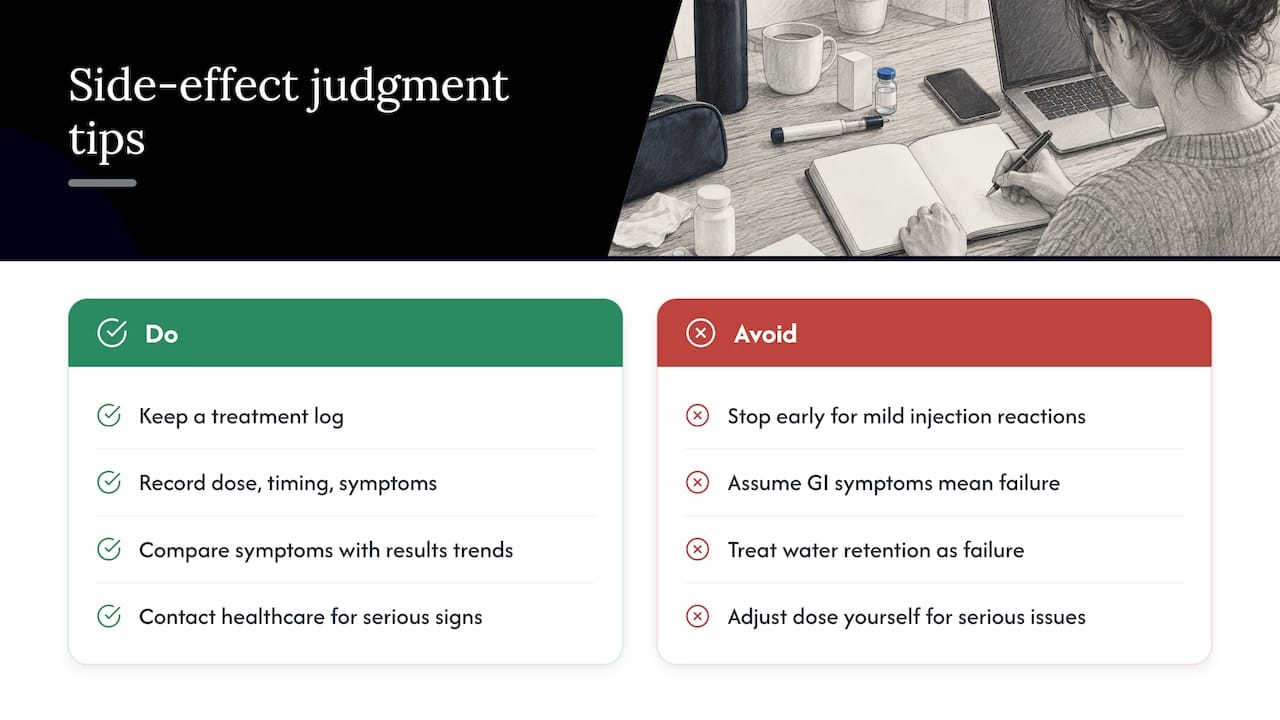
Injection-site reactions, redness, swelling, or mild irritation, are common with injectable peptides and can make someone stop a protocol early, before a real result had time to show up. Gastrointestinal symptoms, particularly with metabolic peptides like semaglutide and tirzepatide, can mask whether appetite suppression is happening for the intended metabolic reason or is simply nausea. Growth hormone secretagogues can cause temporary water retention or joint discomfort that’s sometimes mistaken for a lack of progress rather than an expected transient effect.
More serious reactions, including signs of infection at an injection site, unusual swelling, chest pain, or significant mood or blood sugar changes, are not something to track through and wait out. Those warrant contacting a healthcare professional directly rather than adjusting the dose on your own. Because side effects and true results can overlap in how they feel, keeping the treatment log described earlier, dose, timing, and symptoms side by side, is one of the few reliable ways to tell the two apart.
Why patience matters more than the first two weeks
The honest problem with peptide timelines isn’t the biology, it’s the temptation to judge a 12-week protocol by day 10. Early signals are real, but they’re not the endpoint, and stopping or switching too soon is the most common way people waste both time and money.
Harm reduction matters just as much as patience: verify authorization, involve a clinician where a prescription applies, and track objective measures instead of impressions. Match your expectations to the specific peptide and the specific endpoint you’re actually after.
— Pure Peptide
Where Pure Peptide fits once you’re ready to start
Once you’ve settled on a realistic timeline, the next decision is sourcing, and that’s where documentation stops being optional. Pure Peptide carries peptides across weight loss, muscle growth, recovery, anti-aging, and libido, along with reconstitution ancillaries like bacteriostatic water and syringes, all backed by third-party certificates of analysis confirming purity above 99%.
That documentation exists because a peptide’s real-world timeline only matches the research when the product itself matches what the label claims.
- Explore weight-loss peptide options if appetite and metabolic timelines are your priority.
- Review recovery-focused peptides for soft-tissue and inflammation goals.
- Check CJC-1295 dosing and timeline data before starting a GH secretagogue protocol.
For anything requiring a prescription, talk to a licensed healthcare provider first. Every product page on our site links its certificate of analysis so you can verify purity before you buy.
FAQ
How quickly can you see results from peptides?
It depends entirely on the category: recovery and neuropeptides can show early signals within days to two weeks, while skin peptides need 4 to 12 weeks and metabolic peptides need 8 to 16 weeks for meaningful body composition change. Early signals like reduced soreness or appetite change are not the same as a clinically meaningful endpoint.
What is the most risky peptide to use without medical guidance?
Any unauthorized injectable peptide carries meaningful risk, since Health Canada has specifically warned that these products may not have been assessed for safety, efficacy, or quality. Products labelled “for research use only” but sold for personal injection are a particular concern because they bypass any authorization process entirely.
How can I tell if a peptide is actually working?
Track one or two specific, measurable endpoints tied to your goal, such as a hydration score, a pain scale, or body weight, and check them at set intervals like week 2, week 6, and week 12 rather than relying on how you feel day to day. A treatment log noting dose, timing, and storage helps you separate a real result from an inconsistent protocol.
Is it normal for early effects to fade before the real result shows up?
Yes, short-term effects like appetite suppression or reduced soreness can appear early and even plateau while the longer structural process, like tendon remodelling or fat loss, is still underway. This is a known pattern across categories and isn’t necessarily a sign the peptide has stopped working.
How do I check if a peptide product is authorized in Canada?
Look for an eight-digit Drug Identification Number, an NPN, or a DIN-HM and verify it in Health Canada’s public databases before purchasing. Health Canada has advised buying prescription peptides only through licensed pharmacies rather than unverified online sellers.