







A peptide vial size such as 3 mL describes the capacity of the glass, not how much peptide is inside and not one exact shape. Most vials sold for peptides are 2 mL, 3 mL, 5 mL or 10 mL. A 3 mL vial is typically about 16 to 17 mm wide and 35 to 40 mm tall, a 10 mL vial is typically about 24 mm wide and 45 mm tall, and the number of doses depends on the milligrams of peptide and your dose, not the millilitres on the glass.
TL;DR
- Vial size in mL is the nominal capacity of the container. The peptide amount is labelled separately in mg.
- A “3 mL” vial is not one standard shape: published configurations range from 15 × 40 mm to 17 × 37 mm and 16 × 35 mm.
- Typical 10 mL vials are 24 mm wide and 45 mm tall, but some are taller, so measure before you buy labels or storage cases.
- Doses per vial = milligrams in the vial ÷ dose per shot, rounded down. Dead space and shelf life reduce what you actually use.
- Check the vial’s mg, the lot’s certificate of analysis, and your storage space before you compare prices between sizes.
Table of Contents
- What the mL on a peptide vial actually tells you
- Common peptide vial sizes and their real dimensions
- Why “3 mL” is not one exact size
- 10 mL vials: how much bigger?
- How many doses are in a peptide vial?
- Choosing a vial size: a practical decision guide
- Vial dimensions and label fit
- How to check a vial before you buy
- Our perspective on vial sizes
- Shop peptides and reconstitution supplies
- FAQ
- Sources
What the mL on a peptide vial actually tells you
Two numbers matter on any peptide product, and people mix them up constantly.
Millilitres (mL) is the nominal volume the glass container is made to hold. It is a property of the vial.
Milligrams (mg) is the mass of peptide in the vial, usually supplied as a freeze-dried (lyophilized) powder. It is a property of the product.
A 3 mL vial can contain 2 mg, 5 mg or 10 mg of peptide. The powder is a small cake at the bottom of the glass. The mL figure only becomes useful when you add liquid for reconstitution, because it caps how much fluid the vial can physically hold. Vials are normally not filled to the brim, so the nominal capacity is an upper limit, not a target.
The practical consequence: when you compare two products, compare mg per vial first, then price per mg, and only then think about whether the vial size suits your fridge shelf, case or label.
Common peptide vial sizes and their real dimensions
Manufacturers publish exact dimensions for named vial configurations, and they do not all agree. Here is what the published specifications show.
| Nominal size | Example configuration | Body diameter | Overall height |
|---|---|---|---|
| 2 mL | West nested vial | 16.00 mm | 35.00 mm |
| 3 mL | SCHOTT adaptiQ ISO 2R | 16 mm | 35 mm |
| 3 mL | Nalgene PETG serum vial | 17 mm | 37 mm |
| 3 mL | DWK WHEATON V vial | 20 mm | 46 mm |
| 5 mL | West configuration | 22.00 mm | 38.50 mm |
| 10 mL | West nested vial | 24.00 mm | 45.00 mm |
A few things stand out.
The 2 mL and 3 mL vials can have the same 16 mm body and 35 mm height in the figures above. The extra capacity of a vial that size comes down to which standard it follows, which is one reason you cannot tell volume from a ruler alone.
The 5 mL entry is wider but shorter than the 3 mL ones. Capacity is a product of width and height, so a squat, wide vial can hold more than a tall, thin one.
The 3 mL row alone spans 16 to 20 mm in width and 35 to 46 mm in height. That is the point to take away: the same label “3 mL” covers noticeably different glass.
Why “3 mL” is not one exact size
The most searched question is the size of a 3 mL vial, and the honest answer is a range. A standard 3 mL ISO 2R vial is 35 mm high with a 16 mm body outside diameter, with a 13 mm crown outside diameter and a 7 mm inner diameter at the opening. Serum-vial suppliers list 3 mL configurations of 16 × 35 mm and 17 × 37 mm, both with a 13 mm crimp finish, and also a taller amber configuration at 15 × 40 mm.
So when someone tells you a 3 mL vial is “about 17 mm by 40 mm”, that is a fair rule of thumb, not a specification. If a measurement matters to you (a vial case, a fridge organiser, a label), measure the vial in your hand.
The 13 mm closure is worth noting. The cap and stopper size is more consistent than the body, which is why 13 mm crimp caps turn up across several 3 mL configurations above.
10 mL vials: how much bigger?
A common manufacturer specification for a 10 mL vial is a 24 mm body outside diameter and 45 mm overall height. The same manufacturer also lists a 24 mm × 52.20 mm configuration, so the height can differ by several millimetres even when the diameter matches. Confirm the height for the vial you actually have.
Compared with a typical 3 mL vial, a 10 mL vial is roughly 7 mm wider and 5 to 10 mm taller. That sounds modest, but it decides whether a vial stands in a case built for 3 mL vials. It usually will not.
How many doses are in a peptide vial?
People often ask how many shots are in a vial, and vial size cannot answer it. Doses depend on the mass of peptide and the dose per administration:
Doses per vial = mg in the vial ÷ dose in mg, rounded down.
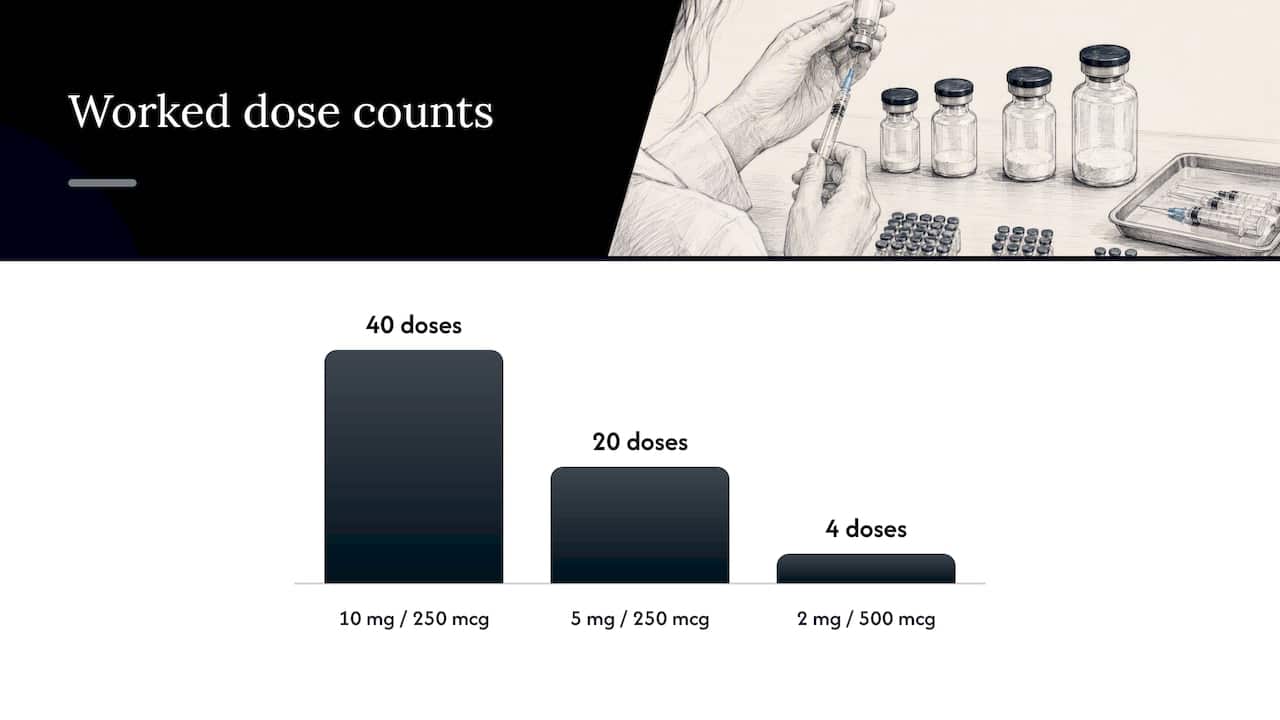
Worked examples (arithmetic only, not dosing advice):
- A 10 mg vial at 250 mcg (0.25 mg) per dose: 10 ÷ 0.25 = 40 doses.
- A 5 mg vial at 250 mcg per dose: 20 doses.
- A 2 mg vial at 500 mcg per dose: 4 doses.
Notice that none of these used the millilitre capacity of the vial. It only affects how much liquid you can add when reconstituting, and therefore the concentration.
The theoretical number is a ceiling. A little product stays in the syringe hub and the vial, and a reconstituted vial has a limited usable life. Our guide to peptide shelf life explains the difference between unopened and reconstituted stability, which often means a bigger vial is not better value if you cannot finish it in time.
Concentration depends on the liquid you add, not the vial
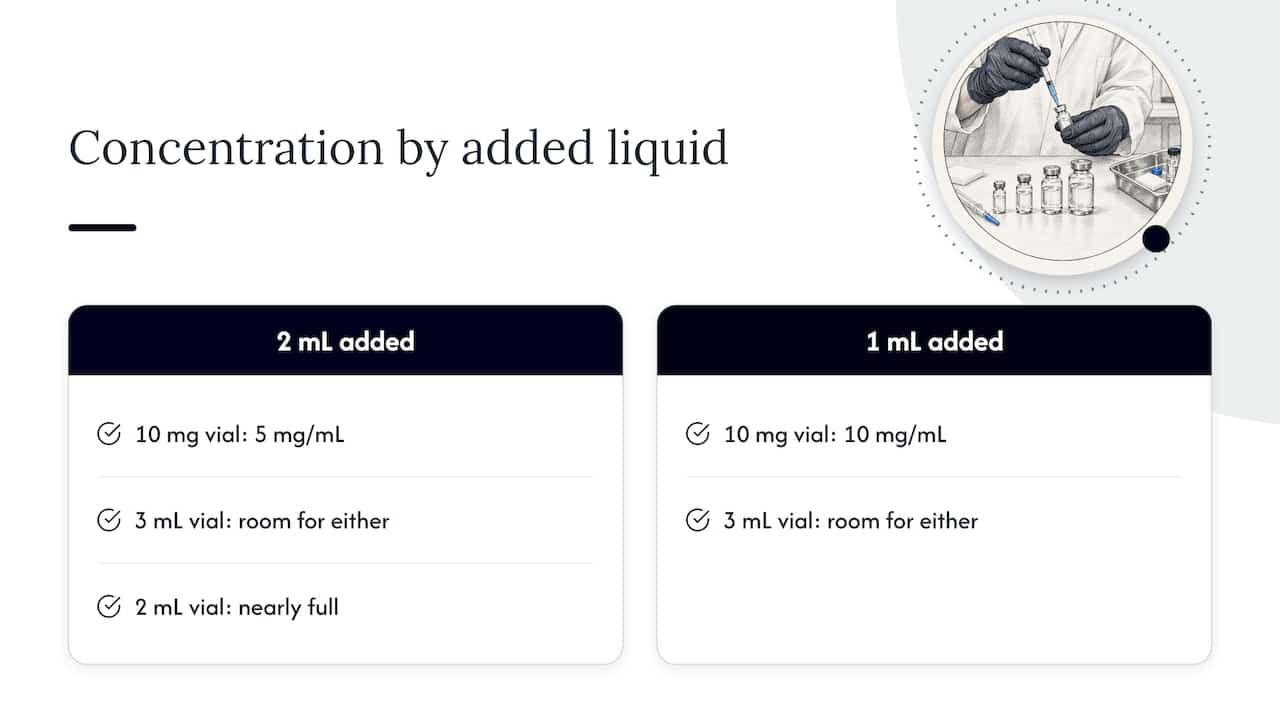
If you add 2 mL of bacteriostatic water to a 10 mg vial, the concentration is 5 mg per mL. Add 1 mL and it becomes 10 mg per mL. A 3 mL vial has room for either. A 2 mL vial would be nearly full with the first. Whatever you choose, the concentration decides how many syringe units equal one dose, and a mistake there is the usual cause of dosing errors.
Before you draw anything, work through the numbers with our peptide calculator, and read 3 worked examples for measuring peptide doses in Canada so you can check the result by hand. If you use insulin-type syringes, the U-100 maths and DIN checks page covers the unit conversion, and the peptide syringes guide helps you match syringe size to the volume you will draw. Anything involving your own dose should be agreed with your physician or pharmacist.
Choosing a vial size: a practical decision guide
The right size depends on how you will use the product, not on which number sounds bigger.
- Small amounts, short protocols. A 2 mL or 3 mL vial with a small mg amount keeps waste low. You finish it before the reconstituted product ages.
- Larger amounts or shared supply. A 5 mL or 10 mL vial holds more liquid, which helps when the mg amount is large and you want a lower concentration for easier measuring.
- Storage space. Count your fridge shelf. A row of 10 mL vials needs roughly 24 mm of width each. A row of 3 mL vials needs 16 to 20 mm.
- Price. Compare cost per milligram, not cost per vial. A peptide price list showing cost per mg makes it easier to see that a bigger vial is only cheaper if the mg content is larger and you will use it all.
- Shelf life. Match the quantity to how long you will keep the vial once it is opened.
Our peptide liquid guide is useful if you are deciding between powder and pre-mixed products, since that choice changes what vial size means for you.
Vial dimensions and label fit
If you label your own vials (for a home inventory, a clinic or a lab), dimensions matter more than capacity. Health Canada’s labelling guidance notes that package design affects the size of inner and outer labels and recommends considering it early. The same 2019 guidance says very small prescription products, such as vials of 2 mL or less, should use key type at least 1.5 mm high. That is a real constraint on a 16 mm-wide vial, where the printable area is tiny.
Label suppliers publish nominal sizes. One printer lists 2.125 × 1 inch for a 2 mL vial, 2.125 × 1 inch for a 3 mL vial, 3 × 1 inch for a 5 mL vial and 3 × 1 inch for a 10 mL vial. Their 2 mL label wraps a 16 mm body with about 1/8 inch of overlap, while a 3 × 1 inch label gives about 1/4 inch overlap on a 22 mm body, and runs edge to edge on a 24 to 25 mm body.
Two tips follow:
- Label height is limited by the straight wall. The usable height is the tallest label that stays on the straight sidewall without touching the shoulder. Tall labels that cross the curve wrinkle.
- Measure, don’t assume. Vial moulders can vary by a millimetre or more, so cut labels to the measured outside diameter. Another label guide notes that maximum usable label sizes are approximate and vary by vial brand, and that they reflect the circumference and height of the cylindrical portion.
A quick check: wrap a strip of paper around the body, mark where it meets, and measure the length. That is your circumference. Divide by 3.14 to confirm the diameter.
How to check a vial before you buy
Use this short list every time, whatever the supplier.
- mg per vial is clearly stated, not just the mL size.
- Certificate of analysis for the specific lot, from a third-party lab. Our peptide laboratory standards guide explains what to look for in purity and testing data.
- Closure type. A 13 mm crimp cap is common on 3 mL vials, but confirm what fits your reconstitution supplies.
- Vial dimensions if you use cases, racks or labels.
- Shipping and cold-chain handling. See our guidance on peptide shipping temperatures, since a vial that arrives warm is a problem regardless of size.
- Packaging quality. For how packaging is judged, our packaging standards article covers the principles.
Our perspective on vial sizes
We sell peptides and the ancillaries that go with them, and the most common mistake we see is a customer choosing by the number on the glass. A 10 mL vial of a 5 mg product is mostly empty space. A 3 mL vial of a 10 mg product may be the better buy. We encourage customers to start from the milligram amount and their intended dose, work out the doses per vial, and only then think about the container.
We also stand behind third-party lab certificates of analysis for our products, because purity is a property of the lot, not of the vial size. Whatever size you pick, ask for the document, read the purity figure, and make sure the lot number on the vial matches the one on the certificate.
— Pure Peptide
Shop peptides and reconstitution supplies
If you already know the amount you need, browse our range of weight loss, muscle growth, recovery, anti-aging and libido peptides, along with ancillaries such as bacteriostatic water, syringes and alcohol pads. Each product page lists the milligram amount per vial and links to its lab documentation, so you can compare sizes on the figures that count.
FAQ
What is the most common peptide vial size?
3 mL and 10 mL are the sizes most often seen, with 2 mL and 5 mL also in use. The vial size only tells you the container capacity. Always read the mg of peptide on the label to know what you are buying.
What are the dimensions of a 10 mL vial?
A common specification is a 24 mm body outside diameter and a 45 mm overall height. Manufacturers also list a 52.20 mm tall version with the same 24 mm diameter, so measure your own vial if the height matters for a case or label.
How many shots are in a peptide vial?
Divide the milligrams in the vial by the dose per shot, and round down. A 10 mg vial at 0.25 mg per dose gives 40 theoretical doses. Dead space in the syringe and the usable life after reconstitution can reduce that number, so ask your pharmacist or prescriber how long an opened vial should be kept.
Does a bigger vial mean more peptide?
No. A larger vial only means a larger container. A 10 mL vial can hold the same 5 mg of powder as a 2 mL vial. Compare mg per vial and price per mg instead.
Sources
- Fisher Scientific Canada: DWK WHEATON V vial, crimp top
- Fisher Scientific Canada: Thermo Scientific Nalgene PETG serum vials
- West Pharmaceutical Services: SCHOTT adaptiQ 3, 8 and 10 mL vials
- West Pharmaceutical Services: Daikyo Crystal Zenith vials
- VGD USA: 3 mL vials
- Health Canada: Good label and package practices guide for prescription drugs
- Tex’s Prints: Vial label sizes compared
- Tex’s Prints: Peptide vial labels
- Label size guide for vials and tubes