






The peptides with the strongest human evidence for knee pain are oral collagen peptides. Several randomized trials of people with knee osteoarthritis (OA, the gradual wearing of joint cartilage) report less pain and better function. Signalling peptides such as BPC-157 are earlier-stage research. In Canada, injectable peptides are regulated as prescription drugs, so the safest route to any peptide is one that fits that rule. This guide covers what has been tested, what the numbers say and how to use that information well.
TL;DR
- Oral collagen peptides have the most human trial data for knee OA, including a 2025 meta-analysis of 11 trials with 870 participants that found better pain and function scores.
- BPC-157, thymosin-β4 and other signalling peptides are studied mainly in animals, cells and small clinical reports, with no agreed dose.
- Health Canada says injectable peptides are generally prescription drugs, and an authorized product carries an 8-digit DIN or NPN.
- Peptides sit beside, not in place of, physiotherapy, weight management and your doctor’s plan for your knee.
- If you use research-grade peptides, purity documentation and careful handling matter. Read our peptide safety guide first.
Table of Contents
- What “peptides” means when your knee hurts
- Collagen peptides: the strongest human evidence
- Signalling peptides studied for knees
- What Canadian rules say
- How peptides compare with standard knee OA care
- A practical way to approach this
- Pure Peptide for recovery goals
- FAQ
- Sources
What “peptides” means when your knee hurts
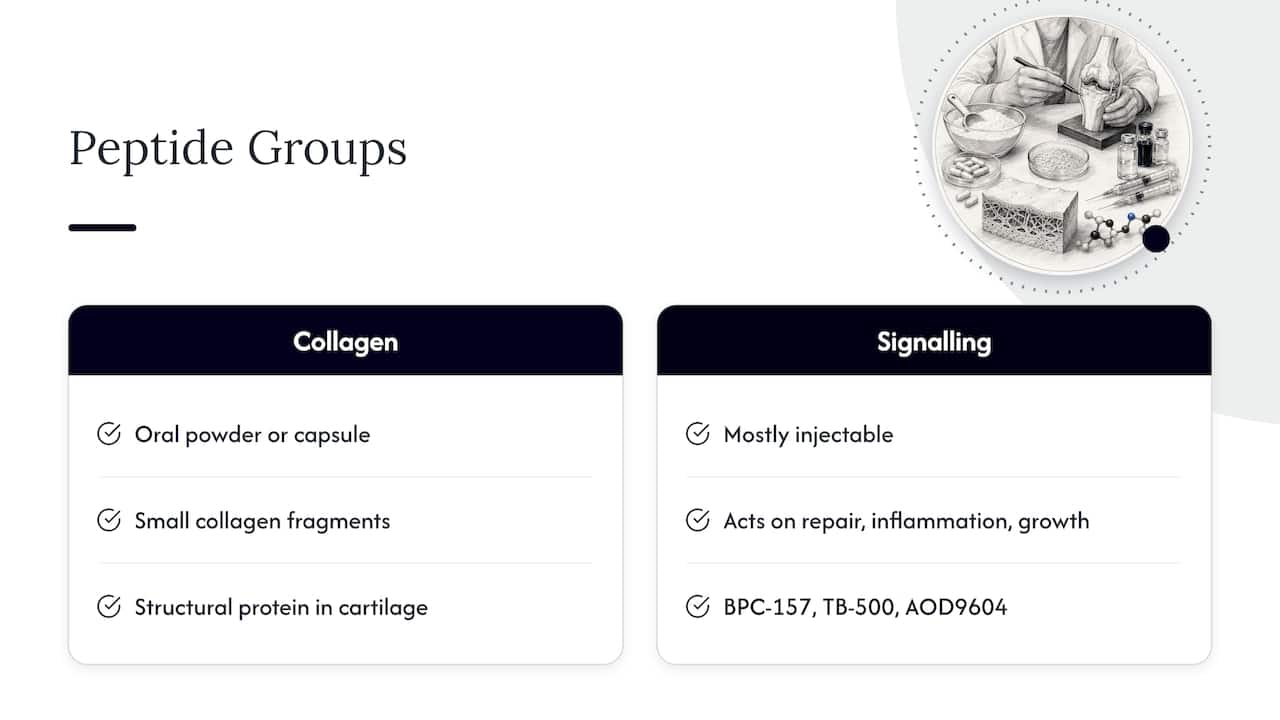
A peptide is a short chain of amino acids, the building blocks of proteins. Search results for knee pain mix two very different groups under that one word.
Collagen peptides are collagen broken into small fragments so the body absorbs them. They are taken by mouth as a powder or capsule. Collagen is the main structural protein in cartilage, tendons and ligaments, which is why researchers tested it for joint problems.
Signalling peptides are short chains that act on specific pathways involved in repair, inflammation or growth. BPC-157, thymosin-β4 (TB-500), AOD9604 and others fall here. Most are discussed in injectable form.
They differ in evidence, in how they are taken and in how Canadian law treats them. Keeping them apart is the most useful thing you can do before comparing studies.
Collagen peptides: the strongest human evidence
If your goal is less knee pain from osteoarthritis, this is where the controlled trials are. Four sets of results stand out.
| Study | Who | What was tested | Main finding |
|---|---|---|---|
| Meta-analysis, 2023 | 507 people with knee OA, four trials | Collagen peptide vs placebo | Pain lower with collagen (SMD −0.58, p=0.004) |
| Meta-analysis, 2025 | 870 participants, 11 trials | Oral collagen supplements | Better function and pain scores |
| Randomized trial, 2025 | 80 adults, grade I–II knee OA | 3,000 mg/day low-molecular-weight collagen peptides, 180 days | Lower WOMAC pain, better function |
| Randomized trial, 2024 | Adults aged 30–81, grade II–III knee OA | 10 g/day collagen peptides, six months | Pain scores fell far more than with placebo |
WOMAC and VAS are standard pain questionnaires: you rate your own pain and function, and researchers compare the change between groups.
What the numbers mean for you
In the 2024 Spanish trial, the collagen group’s pain score on a 100 mm scale fell from 62.6 to 35.5 over six months. The placebo group barely moved, and the gap between groups was 22.6 mm. The same study reported lower inflammatory markers and no adverse effects. In the 2025 Korean trial, one unrelated skin reaction was the only adverse event, and none were serious.
Two practical points follow. First, these effects built up over months, not days, so a 24-week window is the realistic way to judge any result. Second, the doses studied are daily and sizeable (3 to 10 g), so consistency matters more than any single serving. The trial authors describe collagen peptides as a nutrition-based option for people seeking something complementary to long-term anti-inflammatory medication. In the Korean trial, scans showed no change in the joint space, so the benefit was in symptoms rather than in visible cartilage.
The 2023 meta-analysis rated its evidence as moderate quality and noted that the included trials had design weaknesses. Larger, better-designed trials are the next step for the field. Our own summary of this research is in our guide to joint repair peptides, and our peptides for joint pain page covers the 12 to 24 week timelines trials use.
Signalling peptides studied for knees
This is the research behind most online talk about peptides for knee pain, and it is at an earlier stage.
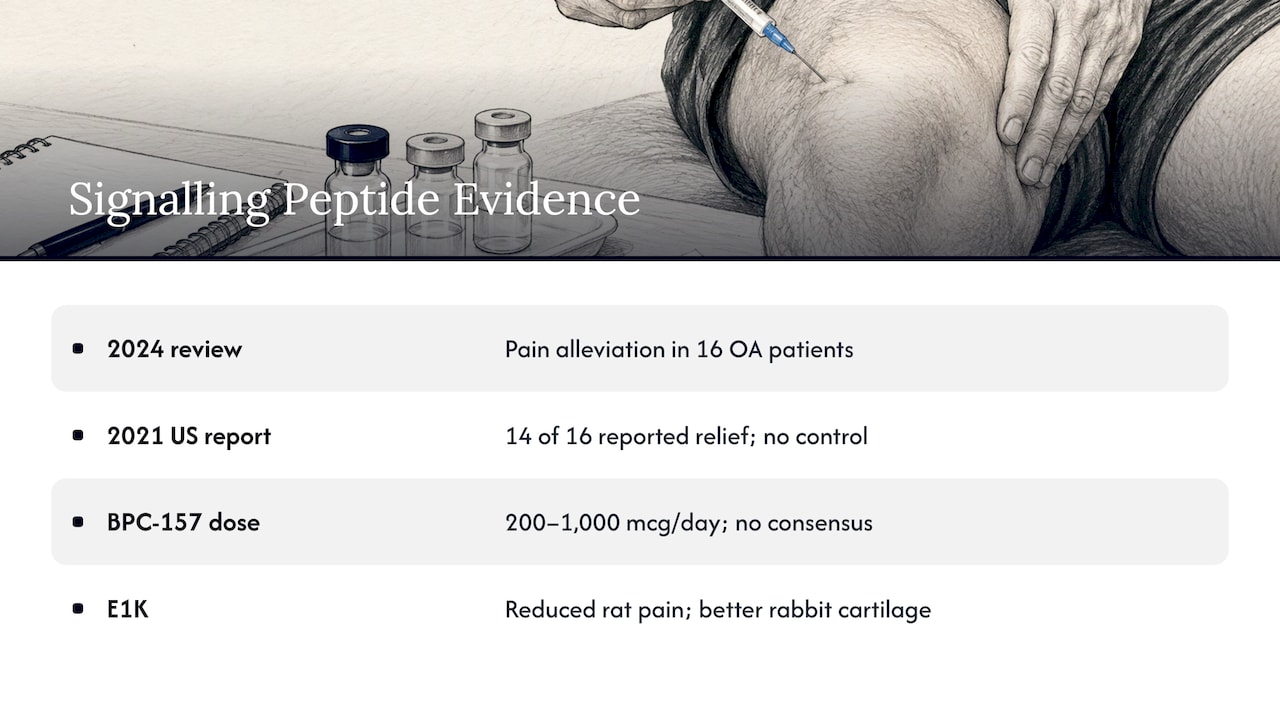
BPC-157. A 2024 review of peptides for cartilage describes BPC-157 as alleviating knee pain in 16 OA patients. A 2021 US clinic report found that 14 of 16 patients with various types of knee pain reported relief after injections of BPC-157 alone or with thymosin-β4. That study had no control group and no standard outcome measures, so it shows interest rather than proof. A 2026 orthopaedic review notes that reported BPC-157 doses range from 200 to 1,000 mcg a day, with no consensus.
AOD9604 and thymosin-β4. The same 2024 review describes AOD9604 enhancing cartilage regeneration in a rabbit knee-OA model, and thymosin-β4 raising a cartilage-related enzyme in laboratory work.
New candidates. A 2025 study on a short peptide called E1K reported reduced pain behaviour in rats and better cartilage in rabbits with OA. It is a preclinical drug candidate, meaning it has not yet been tested in people.
The 2026 orthopaedic review sums up the field: most peptide literature rests on animal models, small cohorts and case series, with very few randomized trials, and clinical use should be seen as exploratory. That is a research frontier, and it explains why dosing, timing and product quality questions come up so often. If you are weighing this category for recovery, our peptides for recovery and peptides for healing guides go deeper on what is studied.
What Canadian rules say
This part is not optional reading. Health Canada states that before a drug is authorized for sale, it reviews the manufacturer’s submission for safety, efficacy and quality. Authorized peptide products carry an 8-digit Drug Identification Number (DIN) or Natural Product Number (NPN). Unauthorized peptide products have neither and have not been assessed.
In a November 2026 advisory, Health Canada said injectable peptides are generally regulated as prescription drugs. It said they should be used only under the care of a licensed healthcare professional, such as a doctor, to treat specific conditions.
The College of Physicians & Surgeons of Alberta’s October 2026 peptide companion adds that Health Canada has issued several advisories since early 2025 about possible serious adverse effects from unauthorized injectable peptides. It also notes that unauthorized injectables can contain contaminants such as solvents, heavy metals, bacteria and endotoxins.
What this means in practice:
- A knee injection is a medical decision. See your doctor or a sports medicine physician, especially if the pain is sharp, the knee swells or locks, or you cannot bear weight.
- Check any peptide product for a DIN or NPN before you treat it as an approved health product. Our guide to peptide legality in Canada explains the numbers.
- If you are pregnant, take prescription medicines or have a chronic condition, speak to your doctor or pharmacist before adding any supplement.
How peptides compare with standard knee OA care
Standard care for knee OA is well established. A Canadian review of knee OA in primary care notes that anti-inflammatory drugs (NSAIDs) are highly effective for OA pain but need caution because of risks to the stomach, kidneys, blood pressure and heart. It also reports that guidelines recommend starting at the lowest dose and avoiding long-term use. That same review reports that the American Academy of Orthopaedic Surgeons found essentially no evidence that glucosamine or chondroitin reach meaningful benefit against placebo.
That context is why collagen peptides drew research attention: a daily, long-term, food-style option for people who cannot or prefer not to rely on NSAIDs for months. The 2026 orthopaedic authors also say clinicians offering peptides outside approved uses should explain the regulatory status and describe the standard alternatives: physical therapy, NSAIDs, platelet-rich plasma (PRP), hyaluronic acid injections and surgery. Treat peptides as one part of a plan, not a replacement for strengthening, weight management and medical follow-up.
A practical way to approach this
- Get the diagnosis first. Knee pain has many causes: OA, a meniscus tear, tendon irritation, patellofemoral pain. Peptide studies in OA do not apply to every one.
- Match the peptide to the evidence. For osteoarthritis pain, oral collagen peptides in the 3 to 10 g/day range have the human trials. Signalling peptides remain research topics.
- Judge on a 12 to 24 week window. The trials above ran 6 months. Track pain and stairs or walking tolerance monthly in a simple notebook.
- Keep the rest of the plan going. Strengthening the muscles around the knee and managing body weight work alongside any supplement.
- Handle products as the label and law require. If you work with injectable research peptides, read our guides on syringes, measuring doses and injection sites, and see a licensed professional for anything you inject.
- Stop and get medical help if you notice flushing or other reactions, fever, spreading redness or swelling at the knee.
Our view on peptides for knee pain
Readers ask us which peptide is best for a sore knee. The honest answer starts with the trials: the best human data belongs to oral collagen peptides, and the research on signalling peptides is growing. We think that clarity helps you choose well.
What we can speak to is quality. Our products are research-grade peptides with documented purity above 99%, and every one is backed by third-party lab certificates of analysis. For anyone in recovery or training, that documentation is the foundation, because the dose you calculate is only as meaningful as the material behind it.
We also stand behind the Canadian rules. Authorized products carry a DIN or NPN, and injectables belong in the hands of a licensed professional. That is why we publish guides on legality and safety next to our product information.
Pure Peptide
Pure Peptide for recovery goals
If knee pain is limiting your training and you are building a recovery routine, our Recovery range is where to start. We supply high-purity research-grade peptides with purity above 99% and third-party certificates of analysis, plus the ancillaries that go with them: bacteriostatic water, syringes and alcohol pads. Our Canadian buying guide explains quality and compliance before you order.
FAQ
Do peptides help osteoarthritis in the knee?
Oral collagen peptides have the most human evidence. A 2023 pooled analysis of four trials found less pain than placebo, and a 2025 analysis of 11 trials found better pain and function scores. The trials were small, and results build over months.
Is BPC-157 good for knee pain?
BPC-157 has been reported to relieve knee pain in small clinical reports and in animal studies. A 2026 orthopaedic review says published doses range from 200 to 1,000 mcg a day without consensus. Injectable peptides are regulated as prescription drugs in Canada, so involve a licensed healthcare professional.
How long do collagen peptides take to work on knees?
The trials above ran from 180 days to six months, and improvements were measured over that period. Plan on a 12 to 24 week window and track your own pain and function monthly. Keep up your strengthening exercises throughout.
How do I know if a peptide product is authorized in Canada?
Look for an 8-digit DIN or NPN on the label. Health Canada says authorized peptide products carry one of the two and unauthorized ones have neither. Our legality guide walks through how to read them.
Can peptides replace NSAIDs or other knee treatments?
Researchers describe collagen peptides as a complementary option, not a substitute. Talk to your doctor before changing or stopping any medicine for your knee.
Sources
- Analgesic efficacy of collagen peptide in knee osteoarthritis, meta-analysis (2023)
- Effect of collagen supplementation on knee osteoarthritis, meta-analysis (2025)
- Efficacy and safety of low-molecular-weight collagen peptides, Frontiers in Nutrition (2025)
- Oral administration of hydrolyzed collagen alleviates pain in knee osteoarthritis (2024)
- Peptides for targeting chondrogenic induction and cartilage regeneration (2024)
- Intra-articular injection of BPC 157 for multiple types of knee pain (2021)
- E1K, a disease-modifying drug candidate for knee osteoarthritis (2025)
- Therapeutic Peptides in Orthopaedics: Applications and limits (2026)
- Peptides: Regulations and enforcement, Health Canada
- Health Canada warns about unauthorized peptides (November 2026)
- Peptide Drugs, CPSA Prescribing Companion (October 2026)
- Knee osteoarthritis: Therapeutic alternatives in primary care (2017)