



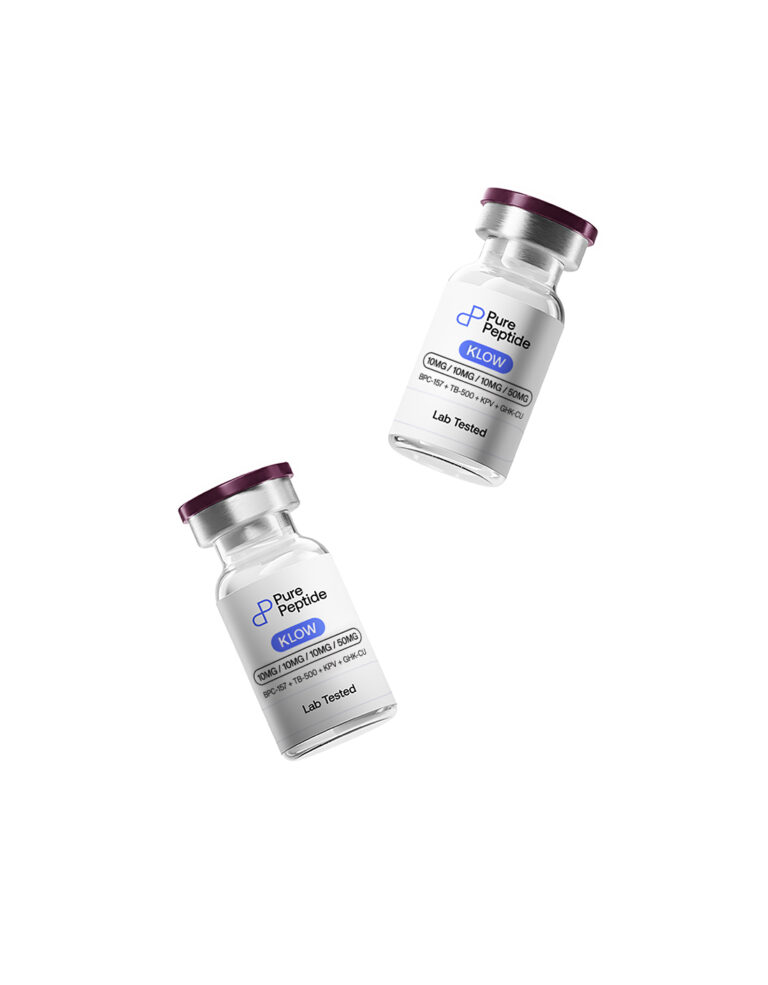

A peptide parcel entering Canada is not judged by the label on the vial. It is judged by what the product is: an authorized drug with an eight-digit DIN (Drug Identification Number), or an unauthorized product. The Canada Border Services Agency (CBSA) can detain a parcel and refer it to Health Canada, which decides whether the goods are admissible. If you are weighing a purchase, the useful question is what a shipment faces on the way in, and what that means for how you use anything you receive.
This guide explains the process in plain terms for people buying peptides for muscle, weight, recovery or anti-aging goals. It covers who may import, what customs can do, what Health Canada said in its most recent advisories, and how to buy with your eyes open.
TL;DR
- CBSA can detain peptide parcels and send them to Health Canada, whose inspectors can open, test, sample or seize them and recommend whether they may enter.
- Under CBSA’s guidance, Canadian residents may not import prescription drugs by mail or courier. Commercial importers of human drugs need a Drug Establishment Licence.
- Health Canada warned in November 2026 that a “For Research Purposes Only” label does not make a product legal or suitable for human use.
- Injecting anything without an eight-digit DIN is a health decision to take to your doctor or pharmacist first.
- Choose suppliers that publish third-party certificates of analysis, and keep your order records.
Table of Contents
- Who decides what at the border
- Who may import prescription drugs into Canada
- Mail and courier: what the rules say
- What Health Canada said most recently
- What happens when a parcel is stopped
- Before you inject anything: the health side
- Reading a supplier the way a customs officer reads a parcel
- Keep records, whatever you order
- Our perspective
- Browse our range
- FAQ
- Sources
Who decides what at the border
Three questions get mixed up when people talk about peptides and customs, and they have different answers.
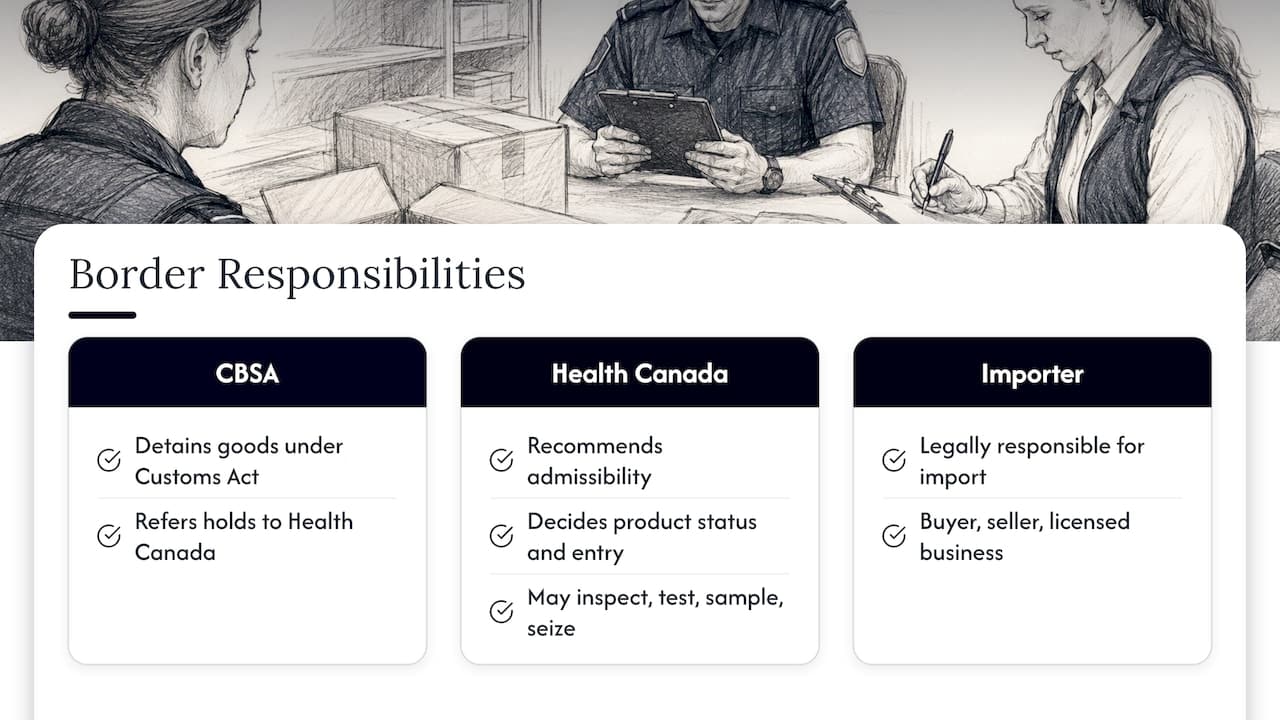
CBSA is the agency at the border. It enforces rules on behalf of other departments, including Health Canada. Its officers can detain goods under the Customs Act.
Health Canada administers the Food and Drugs Act. It decides whether a product counts as a drug, whether it is authorized for sale, and whether a detained item may enter. A product that Health Canada has authorized carries a DIN on its label.
The importer is whoever is legally responsible for bringing the goods in: you, the seller, or a licensed business. That role matters more than most buyers realize, as the next section shows.
CBSA’s own memorandum on how it administers Health Canada’s laws, Memorandum D19-9-1, sets out this division of work. When CBSA detains goods, it refers them to Health Canada for an admissibility recommendation and a decision on what happens to them. Health Canada inspectors may examine, open, test, photograph, sample or seize what has been held.
Who may import prescription drugs into Canada
Many injectable peptides are treated as drugs. Section C.01.045 of the Food and Drug Regulations restricts who may import prescription drugs, and the CBSA memorandum lists the permitted groups: practitioners, drug manufacturers, wholesale druggists, pharmacists, and foreign-country residents visiting Canada. CBSA’s guidance also says Canadian residents may not import prescription drugs by mail or courier.
Two practical points follow from this.
- A private buyer is not on the list. Ordering for personal use does not turn a parcel into a permitted import.
- Commercial importers need a licence. The same memorandum says commercial importers of human drugs and human drug active ingredients must hold the applicable Drug Establishment Licence, and the foreign manufacturing site must be listed on that licence.
That is why a buyer should read a supplier’s shipping and compliance information closely, and why we publish our own guidance on peptide legality in Canada, including why an eight-digit DIN matters before anyone injects a peptide.
Mail and courier: what the rules say
Shipping peptides to Canada by Canada Post, a courier or a freight forwarder does not change the legal status of the contents. The classification of the product as a drug or another product category decides which rules apply, and CBSA reviews parcels by their contents, not by the carrier.
A few distinctions help:
| Situation | What the CBSA guidance indicates |
|---|---|
| Canadian resident ordering a prescription drug by mail or courier | Not permitted under the guidance |
| Visitor or non-resident bringing medication | Treated separately from residents |
| Business importing human drugs or active ingredients | Needs the applicable Drug Establishment Licence and a listed foreign site |
| Product classed as something other than a drug | Different rules apply, depending on the category |
If you are unsure which category a product falls into, the answer is not on the vial. Health Canada decides, and its position on injectable peptides is set out below.
What Health Canada said most recently
Health Canada has been active on this topic. In April 2026 it warned people not to buy or use unauthorized injectable peptide drugs marketed for body image and wellness goals, and it has seized products from online sellers before.
In November 2026 it went further. Reuters reported that laboratory testing found bacterial contamination in one injectable peptide product seized from an Ottawa wellness store. Some seized vials were labelled “For Research Purposes Only”. Health Canada said that label does not make a product legal or exempt it from regulatory requirements, and that such products had not been made or tested to the quality standards for human-use health products.
A separate report on the same advisory says Health Canada seized more than 11,400 vials and shut down two Canadian websites that resold the products.
What this means for you as a buyer:
- Customs is not the only checkpoint. Health Canada also acts on retailers and websites inside Canada.
- A research-use label describes the intended market for the product. It does not give the product a human-use authorization.
- Product quality is the real subject of the warning. Contamination is a quality problem, and quality is something you can ask a supplier about before you pay.
What happens when a parcel is stopped
The sequence follows the CBSA memorandum.
- Detention. A CBSA officer holds the parcel under the Customs Act.
- Referral. The goods go to Health Canada for an admissibility recommendation and a disposition decision.
- Examination. Health Canada inspectors may open the package, photograph the contents, take samples and test them.
- Decision. The goods may be released, returned, destroyed or seized, depending on the outcome.
If you receive a detention or seizure notice, read it fully. The notice names the officer or office handling the file and states the next steps and deadlines. Respond within those deadlines, and keep your order confirmation, invoice and tracking number, because those are the documents the file will ask for.
A detained parcel can also mean a delay of days or weeks, a lost order, or a refund conversation with the seller. Each seller handles that differently, so read refund and reshipment terms before ordering, not after.
Before you inject anything: the health side
Customs is a paperwork problem. Injection is a body problem, and it deserves more care than a shipping route does.
Injectable products have to be sterile. Health Canada’s November 2026 finding of bacteria in a seized vial is a clear example of why that matters. Anyone considering an injectable product for muscle growth, fat loss, recovery or skin should do three things first:
- Talk to your doctor or pharmacist. This is the right step if you have a medical condition, take medication, are pregnant or breastfeeding, or are under 18. They can tell you whether an authorized, DIN-labelled treatment fits your goal.
- Look for the DIN. An eight-digit DIN means Health Canada has authorized the product for a specific use. Our guide to why peptides need an eight-digit DIN explains how to read it.
- Never improvise sterile technique. Handling, reconstitution and dose measurement are the places where errors happen. See our worked examples for measuring peptide doses for the safety-first basics.
Athletes should also check the rules of their sport. Many peptides appear on anti-doping lists, and a positive test does not care where the product was bought.
Reading a supplier the way a customs officer reads a parcel
You cannot control what CBSA does, but you can judge what a supplier tells you. These checks cost nothing and take minutes.
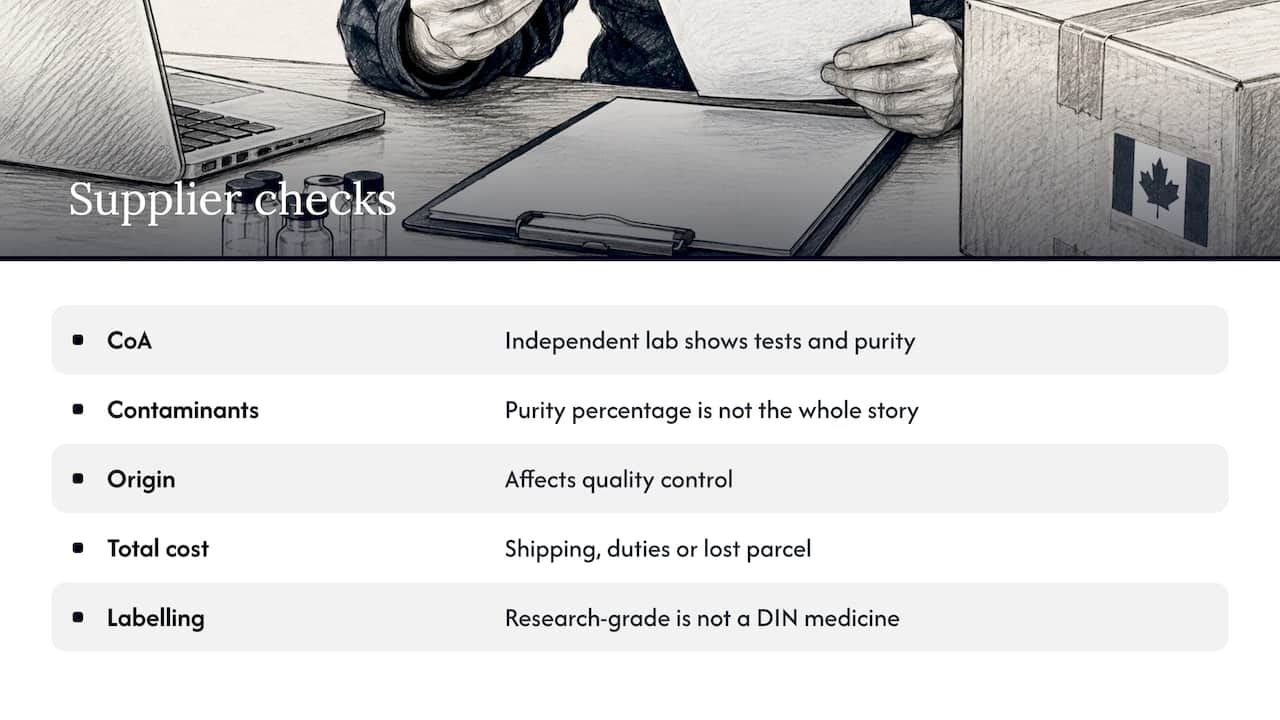
Third-party certificates of analysis (CoAs). A CoA from an independent lab shows what was tested and the measured purity. Our products come with third-party lab certificates of analysis, and our formulations are made with advanced purification methods that exceed 99% purity. Our page on research-grade peptides and how to verify 99% purity shows how to read a CoA line by line.
Heavy metals and contaminants. Purity percentage is not the whole story. Our guide to heavy metals testing for peptides explains what those results show.
Origin and standards. Where and how a product is made affects quality control. We cover this in our overview of peptides made in the USA.
Total cost. A low sticker price can hide shipping, duties or a lost parcel. Our breakdown of what peptides really cost in Canada shows how to compare like with like.
Honest labelling. A reputable supplier says plainly what a product is and is not. Research-grade means the product is made for laboratory research. It is not a substitute for a DIN-labelled medicine, and you should treat it with that in mind.
Keep records, whatever you order
If a parcel is ever questioned, paperwork settles most things quickly. Keep:
- The order confirmation and invoice, with product names and quantities
- The tracking number and carrier
- The supplier’s CoA for each batch
- Any correspondence with CBSA or Health Canada
This also helps your own planning, since you can see what you ordered, when, and from which lot.
Our perspective
Most people who ask us about customs are really asking whether they can trust what ends up in the vial. We think the two questions belong together. A parcel can clear the border and still be a poor product, and a good product still has to be handled with respect for Canadian rules.
That is why we put quality evidence first. Every product we sell is backed by third-party lab certificates of analysis, and our formulations are made with advanced purification methods that exceed 99% purity. We believe a buyer should see that evidence before ordering, in plain numbers, and not take our word for it.
We also publish our Canadian guidance openly: what a DIN is, why it matters before anyone injects, and how to read a CoA. Whether your goal is muscle growth, fat loss, recovery or skin, we want you to make the decision knowing the rules, the quality evidence and the questions for your doctor or pharmacist.
Pure Peptide
Browse our range
Our catalogue covers weight loss, muscle growth, recovery, anti-aging and libido peptides, along with ancillaries such as bacteriostatic water, syringes and alcohol pads. Each category is backed by third-party certificates of analysis. You can see the full range on the Pure Peptide home page, and our guide to buying peptides in Canada walks through quality and compliance before you order.
FAQ
Can Canadian customs seize peptides?
Yes. CBSA may detain goods under the Customs Act and refer them to Health Canada, whose inspectors can open, test, sample or seize them and recommend whether they may enter. Whether a particular parcel is held depends on what it contains and how it is classified.
Can I import peptides into Canada for personal use?
CBSA’s guidance says Canadian residents may not import prescription drugs by mail or courier, and the permitted importers of prescription drugs are specific groups such as pharmacists, practitioners and licensed businesses. Because the rules depend on classification, check the status of any product before ordering, and ask your doctor or pharmacist about authorized options.
Does “for research purposes only” make a peptide legal to use?
No. In its November 2026 advisory Health Canada said that label does not make a product legal or exempt it from regulatory requirements. Products labelled this way were not made or tested to the standards for human-use health products. Treat the label as a description of the intended market, not as permission for human use.
What should I do if my peptide shipment is detained?
Read the notice carefully, note the office and deadlines it names, and respond on time. Keep your order confirmation, invoice and tracking details, and contact the supplier about its refund or reshipment terms.
Is it safe to inject peptides that do not have a DIN?
Health Canada has warned against injecting unauthorized peptide drugs, and found bacterial contamination in a seized injectable product in 2026. If you are considering injection for any goal, speak to your doctor or pharmacist first, and read our guide on why an eight-digit DIN matters.
Sources
- CBSA Memorandum D19-9-1: The Administration of Health Canada Acts and Regulations
- Reuters via Yahoo: Health Canada warns after bacteria found in unauthorized peptides
- ThinkPol: Health Canada finds bacteria in injectable peptides sold online, seizes 11,400 vials