





For most lyophilized peptides, bacteriostatic water is the standard diluent. It is sterile water with 0.9% benzyl alcohol added as a preservative, so it contains no salt. Saline is 0.9% sodium chloride in water. It suits a smaller set of cases: a protocol that calls for an isotonic solution, or a manufacturer’s sheet that names it. The two are not interchangeable, and the label on the bottle matters more than the name you remember.
This guide covers what is in each bottle, how they behave in a vial, where “bacteriostatic saline” fits, and what Canadian readers should check before buying or mixing anything.
TL;DR
- Bacteriostatic water is sterile water plus 0.9% benzyl alcohol. Saline is 0.9% sodium chloride. Bacteriostatic saline is saline that also carries the preservative.
- The preservative is what allows repeated draws from one vial. Unpreserved saline or sterile water is meant for single use.
- When a peptide’s documentation is silent, bacteriostatic water is the usual default. When it names a diluent, follow that.
- Benzyl alcohol carries real warnings for neonates and infants in Canada. It is not a diluent for children, and not a substitute for medical advice.
- Check the label for the exact diluent, the volume and the opening date, and discard on schedule.
Table of Contents
- What is actually in each bottle
- Why the preservative matters in a peptide vial
- Bacteriostatic water vs saline: how they differ in use
- What about bacteriostatic saline?
- Which should you use? A short decision path
- Benzyl alcohol and Canadian safety points
- Where we stand
- How to reconstitute step by step
- Common mistakes
- Where to find what you need
- FAQ
- Sources
What is actually in each bottle
The confusion starts with names. Four liquids get mixed up, and each is a different product.
| Liquid | Contains | Preservative | Typical use |
|---|---|---|---|
| Sterile water for injection | Water only | None | Single use, then discard |
| Bacteriostatic water | Water + 0.9% benzyl alcohol | Yes | Multi-dose diluent for drugs needing an aqueous vehicle |
| Saline (0.9% sodium chloride) | Water + salt | None in the plain form | Single-use injections, isotonic dilution |
| Bacteriostatic saline | Water + salt + benzyl alcohol | Yes | Multi-dose isotonic dilution |
The U.S. DailyMed label for bacteriostatic water describes it as designed solely for parenteral use after adding drugs that need dilution or an aqueous vehicle. Note “solely”: it is a vehicle, not something you inject on its own. Pfizer’s patient information says the same, and adds that it is indicated for diluting or dissolving drugs according to the drug maker’s instructions.
The concentration of benzyl alcohol is usually 9 mg/mL, which is the 0.9%. Some products use 11 mg/mL. You can see a Canadian listing for a multidose-vial product on the Health Canada Drug Product Database. If you want the chemistry of that preservative in more depth, we cover it in our page on 0.9% benzyl alcohol in bacteriostatic water.
Why the preservative matters in a peptide vial
A lyophilized peptide is a dry powder. Once you add liquid, it is a solution that bacteria can grow in, and every time a needle pierces the stopper it can carry something in. Benzyl alcohol is bacteriostatic: it inhibits growth rather than sterilizing. That is why bacteriostatic water is labelled for multiple withdrawals, generally within 28 days of first use, per the Health Canada product record and related US data summarized in our research.
This has a practical effect. Peptides are often dosed in small amounts over days or weeks, so a vial gets punctured many times. With unpreserved saline or sterile water, the vial is a single-use item. Reuse it and you are depending on luck and technique.
Two cautions follow:
- Bacteriostatic does not mean the liquid can sit forever. The 28-day figure is a ceiling for the diluent bottle once opened, not a promise about how long a reconstituted peptide stays potent. Peptide stability depends on the compound and on storage, which we discuss in our note on peptide storage temperature.
- A preservative does not fix poor technique. Wipe the stopper with an alcohol pad every time, use a fresh sterile syringe, and never touch the needle to anything.
Bacteriostatic water vs saline: how they differ in use
Chemical simplicity
Bacteriostatic water has a short ingredient list. There is no salt to interact with the peptide, and no buffer. According to Peptides.wiki, that simple composition is why it is the standard choice and why it works with nearly all peptides. Saline adds sodium and chloride ions. Some peptides dissolve fine in it. Others can be slower to dissolve or behave differently, which is why saline tends to be a deliberate choice rather than a casual swap.
Matching the body
Saline is isotonic: it matches the body’s salt balance. That is the reason it is a common clinical diluent. Water on its own is not isotonic, though the small volumes used for peptide doses are generally a minor consideration for most readers. If you are reconstituting a peptide for which the maker’s sheet specifies saline, the isotonic argument is the likely reason. Follow the sheet.
Multi-dose use
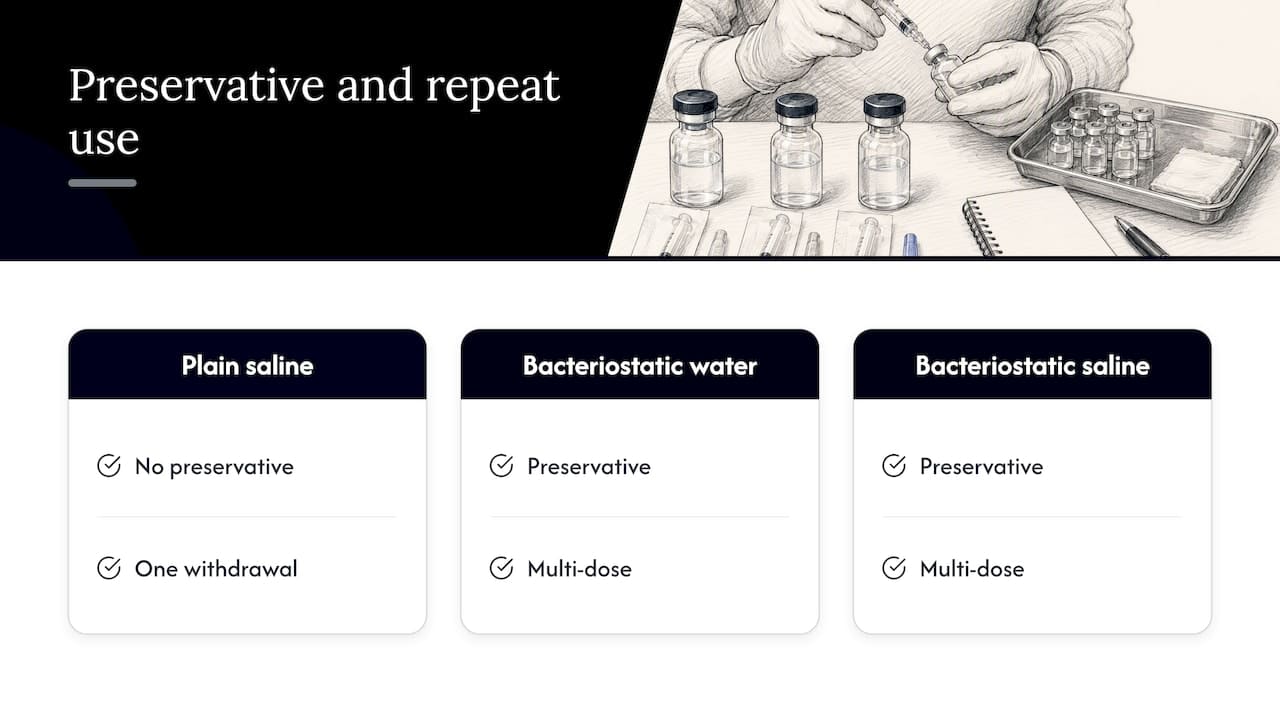
This is the clearest split. Plain saline from a single-use ampoule is for one withdrawal. Bacteriostatic water and bacteriostatic saline are the multi-dose versions. If you plan to draw from a vial over several days, the preserved version is the sensible one, and the choice then becomes water or saline rather than preserved or not.
Stinging and comfort
Some people notice that benzyl alcohol stings slightly on injection. Saline is often described as gentler. That is a comfort point, not a safety verdict, and it does not outweigh the preservative advantage for multi-dose vials. If stinging is a real problem, raise it with your pharmacist or prescriber rather than switching on your own.
What about bacteriostatic saline?
Readers often ask about “bacteriostatic sodium chloride” as if it were a third path. It is the preserved version of saline: sodium chloride 0.9% with benzyl alcohol. It behaves like bacteriostatic water for multi-dose purposes, but with the salt included. A Pfizer-type product of this kind is described in Canadian retail listings as sodium chloride 9 mg/mL with a preservative.
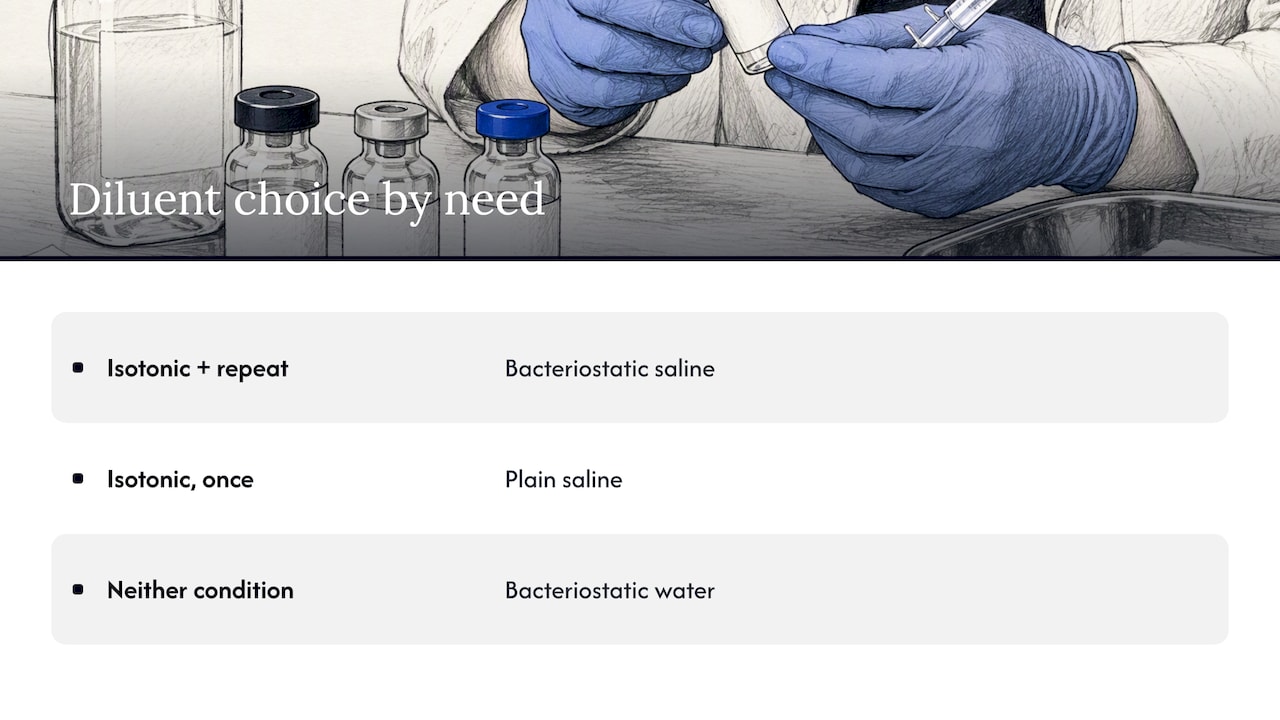
It is a fit when two things are true: your protocol wants an isotonic diluent, and you want to draw from the vial more than once. If only the first is true and you will use the vial once, plain saline is enough. If neither is true, bacteriostatic water is the simpler choice.
Which should you use? A short decision path
- Read the peptide’s own documentation first. If the manufacturer or the product sheet names a diluent, use that one. Practitioners quoted by Peptides.wiki stress that the peptide’s solubility information outranks general advice.
- If the sheet is silent, bacteriostatic water is the usual default for stable, multi-dose storage.
- If the sheet says saline or isotonic, use saline, and choose the bacteriostatic version only if you will draw more than once.
- If you are tempted to use sterile water to save money, treat the vial as single-use and plan to finish it at once, since there is no preservative.
- If the person using it is an infant or child, stop. See the next section.
Benzyl alcohol and Canadian safety points
Benzyl alcohol is well tolerated by most healthy adults in the small amounts in a diluent. It is not harmless for everyone. Health Canada has issued a notice on a specific drug, BLINCYTO and benzyl alcohol toxicity in pediatric patients, warning that serious and fatal reactions, including “gasping syndrome”, can occur in neonates and infants given products containing benzyl alcohol as a preservative. The notice concerns that drug, but the underlying point applies to any preserved diluent: for neonates and infants, clinicians use preservative-free solutions.
What that means for you:
- Never use bacteriostatic water or bacteriostatic saline for an infant or young child.
- If you are pregnant or nursing, have a known sensitivity to benzyl alcohol, or have a medical condition, talk to your physician or pharmacist before using any injectable product.
- Do not substitute one liquid for another on a forum’s say-so. Ask a pharmacist, who can check the label against your situation.
On the legal side, Canadian rules on injectable products and on who may sell and prescribe them are set by Health Canada and the provinces. Check the current position for your product with your pharmacist or the Drug Product Database. This article is educational and is not medical advice.
Where we stand
We sell research-grade peptides and the ancillaries that go with them, so we see the same mistakes repeatedly. People buy a peptide and a bottle of saline because the word “sterile” sounds enough. Then they use the vial for two weeks. The preservative is the feature they skipped.
Our view is plain. Pick the diluent before you pick the vial size, because it decides how many times you can use the vial. For the great majority of peptides we would reach for bacteriostatic water first, and use saline only when the documentation says so. We pair our peptides with third-party lab certificates of analysis, because purity at the powder stage is wasted if the mixing step is careless. The reverse also holds: the cleanest technique cannot rescue a poor powder.
We also suggest keeping a label on every vial with the date you opened the diluent and the date you reconstituted the peptide. It takes ten seconds and ends most arguments about whether something is still good.
— Pure Peptide
How to reconstitute step by step
This is a general outline, not a protocol for any particular compound. Use your product’s own instructions where they exist. Our longer walkthrough is Peptide reconstitution: the complete how-to guide, and the page on bacteriostatic water use covers the safety side.
- Wash your hands and clear a clean surface.
- Check that the diluent label reads what you expect, and note its opening date.
- Wipe the rubber stoppers of both vials with a fresh alcohol pad and let them dry.
- Draw the volume of diluent you planned. Decide this beforehand, because the volume sets your dosing math.
- Inject the diluent slowly down the inside wall of the peptide vial, not straight onto the powder.
- Let it dissolve. Swirl gently rather than shaking, since vigorous shaking can damage some peptides.
- Label the vial with date and concentration, then store it as directed.
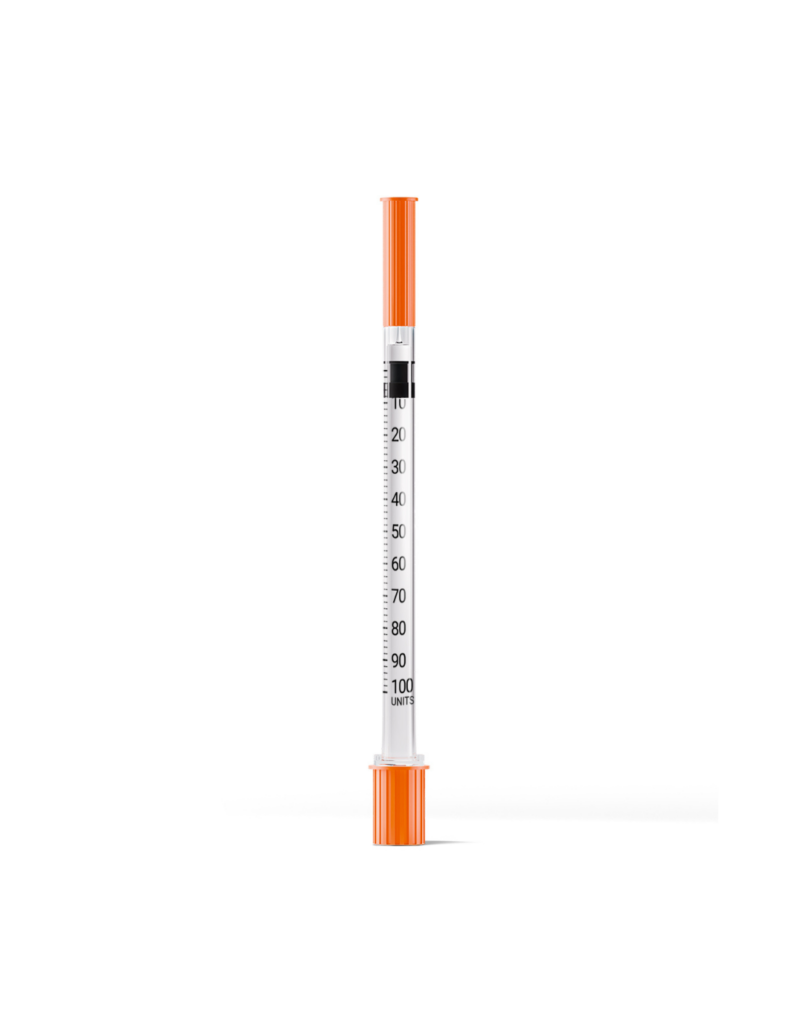
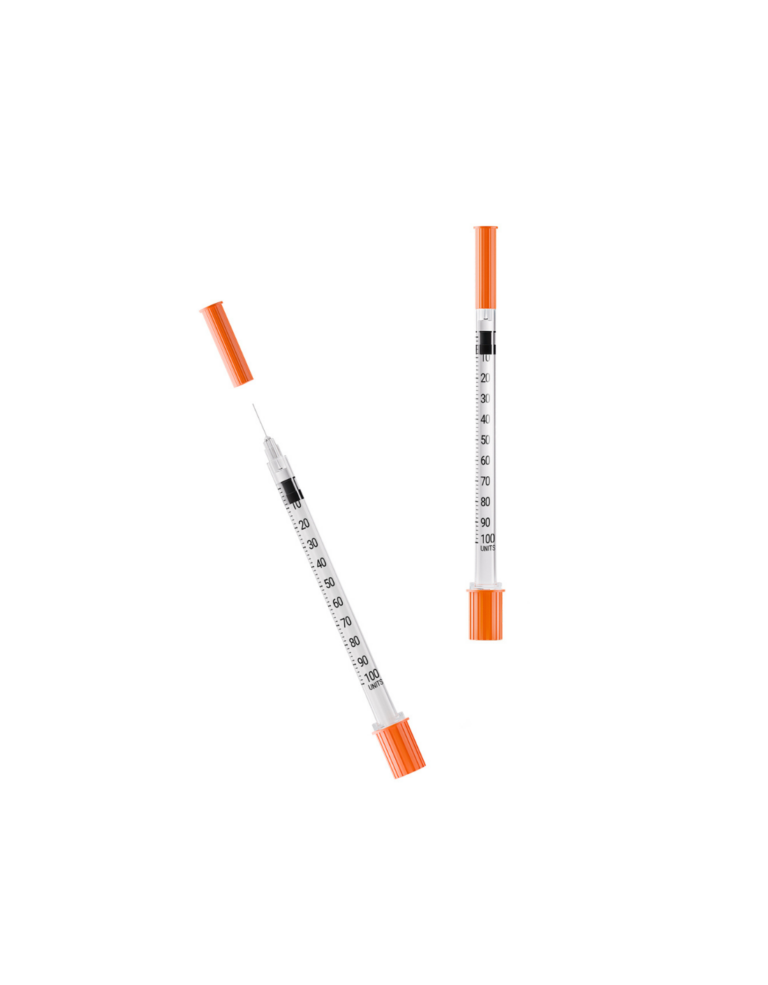
The volume of liquid you add changes the concentration, and with it every syringe reading. Use the peptide calculator to avoid arithmetic errors, and see our worked examples for measuring peptide doses and the guide to peptide syringes for Canadian beginners. Dosing errors, not diluent choice, are the more common source of trouble.
Common mistakes
- Treating saline as the safer option. Plain saline is gentle, but without a preservative it is single-use. In a multi-dose vial it is the riskier choice.
- Using sterile water for a vial you will keep. One of the top-ranked pages for this topic frames it as a vial with a very short window. Whatever the exact figure, no preservative means no repeat-use margin.
- Reusing an old bottle of diluent. Bacteriostatic water is for roughly 28 days after opening. Past that date, discard it.
- Assuming “bacteriostatic” means sterile forever. It inhibits growth. It does not undo contamination.
- Skipping the label. If you cannot say when you opened the bottle, treat it as expired.
- Guessing at volumes. More diluent means weaker concentration and larger injection volumes. Do the math first.
Where to find what you need
If you are setting up for the first time, you need four things together: the peptide, the right diluent, sterile syringes and alcohol pads. We stock peptides across weight loss, muscle growth, recovery, anti-aging and libido categories, along with bacteriostatic water, syringes and alcohol pads, so the whole kit can come from one order. Browse the range at Pure Peptide, and match the diluent to your peptide’s documentation before you check out. For recovery-focused compounds, our peptides for recovery page is a reasonable place to begin.
FAQ
Is bacteriostatic water the same as saline?
No. Bacteriostatic water is sterile water with 0.9% benzyl alcohol and contains no salt. Saline is 0.9% sodium chloride. Plain saline has no preservative, so it is meant for a single use.
Can I use saline instead of bacteriostatic water for peptides?
Only if the peptide’s documentation calls for it or your clinician advises it. Saline is the specialist option, while bacteriostatic water is the usual default when the sheet says nothing. If you use plain saline, treat the vial as single-use. Choose bacteriostatic saline if you need salt and repeat draws.
What is the difference between bacteriostatic water and sterile water?
The preservative. Sterile water has nothing added and is for one use. Bacteriostatic water contains benzyl alcohol, which inhibits bacterial growth and permits multiple withdrawals from the same container.
How long does bacteriostatic water last once opened?
It is generally labelled for multiple withdrawals for up to 28 days after first use, according to the Health Canada product data and US labelling summarized in our research. Write the opening date on the bottle and follow the product’s own label. How long a reconstituted peptide lasts is a separate question.
Is bacteriostatic water safe for babies?
No. Benzyl alcohol is linked to serious and fatal reactions in neonates and infants, as Health Canada’s notice on a related drug explains. Clinicians use preservative-free solutions for these patients. Ask a pharmacist or physician about anything for a child.
Sources
- DailyMed: Bacteriostatic Water injection label
- Pfizer Medical: Bacteriostatic water for injection, patient information
- Health Canada Drug Product Database: product information
- Health Canada Drug Product Database: sodium chloride search results
- Health Canada: BLINCYTO and benzyl alcohol toxicity for pediatric patients
- Peptides.wiki: Bacteriostatic water vs saline for peptide reconstitution