





Yes, alcohol pads expire. The date printed on the box and on each foil pouch is the manufacturer’s limit for how long the pad is guaranteed to hold its labelled alcohol strength and keep the inside of the pouch sterile. A pad that still feels wet after that date is not proven safe. If you use pads before injections, replace anything past its date and anything with a damaged pouch.
This guide explains what the date covers, how long unopened pads usually last, how to check a pad at home, and how to buy and store them so you rarely have to throw any away.
TL;DR
- Alcohol prep pads carry an expiry date because the alcohol can evaporate through the seal and the sterile barrier can fail, even when the pad feels damp.
- Unopened pads typically last about 1.5 to 3 years from manufacture, but the only reliable number is the one printed on your pouch.
- Check the date on each individual pouch, not just the outer box, and discard any pouch that is torn, puffy, dry or leaking.
- If you inject once a week or less, buy small boxes. A 100-count box can outlast its date.
- Store pads at room temperature, away from heat, sunlight and fire, and never reuse an opened pad.
Table of Contents
- What the expiry date actually guarantees
- How long do unopened alcohol pads last?
- How to check your pads in under a minute
- Is it ever okay to use an expired pad?
- Why the technique matters as much as the date
- How to buy pads you will actually finish
- Storing pads so they last to the date
- What about opened pads and wipes you have already unwrapped?
- Our view: treat the date as part of the dose
- Stocking your injection kit
- FAQ
- Sources
What the expiry date actually guarantees
Many people assume the date is about moisture: wet means good, dry means expired. It is more than that. Alcohol prep pads are regulated as medical products, and the date reflects three things the maker has tested for: the alcohol concentration (usually 70% isopropyl), the integrity of the packaging, and sterility.
A typical product label describes the pad as a sterile product for preparing the skin before an injection, and warns that it is for external use only and flammable. You can read an example on the DailyMed label for sterile alcohol prep pads, which also lists when to stop use.
After the date, the manufacturer no longer stands behind any of those three things. Two failures matter most:
- Evaporation. Isopropyl alcohol is volatile. Over time it can escape through the seal or through tiny punctures in the foil. The pad may still feel damp, but the mix inside may be weaker than the label says. Healthline explains that isopropanol evaporates while the water stays behind, so the percentage of alcohol falls and the product becomes less effective at killing germs.
- Sterile barrier failure. A pad that is sealed in foil is meant to be clean when you open it. If the pouch has aged or been damaged, that promise is gone. For an injection, where the needle breaks the skin, you want a pad you can trust.
This is why a damp pad past its date is not a reassuring sign. Dampness tells you there is liquid in the pouch. It does not tell you the strength or the sterility.
How long do unopened alcohol pads last?
Most unopened pads are given a shelf life somewhere between 1.5 and 3 years from the date of manufacture. The range depends on the formulation, the foil or film used and the maker’s testing. Do not assume yours sits at the long end. A box bought from a shelf that has sat for a year may have only a few months left.
For comparison, bottled rubbing alcohol is generally given 2 to 3 years from manufacture. Pads are a different product: the alcohol is spread across a small amount of fabric inside a thin pouch, so there is less liquid to lose and a larger surface through which it can escape.
| Product | Typical unopened shelf life | What fails first |
|---|---|---|
| Individually wrapped prep pads | About 1.5 to 3 years | Alcohol strength, pouch seal, sterility |
| Bottled rubbing alcohol | About 2 to 3 years | Alcohol strength (evaporation) |
| Opened single pad | Use immediately | Contamination and evaporation within minutes |
The range for pads comes from supplier guidance, and it is a guide only. Clinics rotate stock on a first-expire, first-out basis for exactly this reason: shelf life varies by maker and package, so the printed date is the figure that counts.
How to check your pads in under a minute
You do not need a lab. You need good light and a habit.
- Read the date on the pouch. Boxes often show the date, but pouches can get separated from the box. Look for an expiry date or a manufacture date plus the stated shelf life. If the pouch has no date at all, treat it as unusable for injections.
- Look at the seal. Throw it out if the foil is torn, creased open, punctured, stained or leaking.
- Feel the pouch. It should feel evenly moist when you press it lightly. A stiff, flat or dry pad has lost its liquid.
- Smell the pad when you open it. A weak or absent alcohol smell is a warning. A strong smell does not prove the pad is in date, so the date still decides.
- Use it once. Open it just before you need it and discard it after a single use.
If any step fails, bin the pad. A box of pads costs little next to an infection at an injection site.
Is it ever okay to use an expired pad?
For wiping a countertop or cleaning a phone, a slightly out-of-date alcohol wipe is a low-stakes choice. For skin preparation before an injection, the standard is stricter. Healthcare guidance is clear that expired antiseptic products should not be relied on for clinical skin preparation, and Canadian health authorities apply the same logic to supplies in general. Health Canada says take-home naloxone kits should be replaced before the expiration date so the contents work when needed. The same habit makes sense for the pads in your injection kit.
If you are out of in-date pads and need to inject on a prescribed schedule, do not skip the dose in a panic. Call your pharmacist, who can sell you a box or advise you on the safest option, or speak to the prescriber for your medication. If you have signs of infection at a past injection site, such as spreading redness, warmth, pus or fever, see a doctor or go to urgent care.
Why the technique matters as much as the date
A perfectly in-date pad still has to be used properly. WHO procedure guidance on skin preparation for blood sampling describes cleaning with alcohol and letting it dry before piercing the skin, and clinical practice commonly uses a single outward wipe followed by about 30 seconds of air-drying. You can read the WHO standard operating procedure for the original wording. There is ongoing debate over whether swabbing clean, intact skin before every injection is necessary, but if you do swab, a weak or contaminated pad defeats the purpose.
Two habits that help:
- Wipe in one direction, from the centre outward, rather than scrubbing back and forth.
- Let the alcohol dry completely. Injecting through wet alcohol can sting and reduces the contact time that does the work.
We cover the full routine, including concentration and drying time, in our guide to alcohol wipes before injection.
How to buy pads you will actually finish
The most common reason people end up with expired pads is simple arithmetic. If you inject once a week, a 100-count box lasts nearly two years. InjectCompass notes that this is a common pattern with weekly medications, and that smaller packs make more sense when your frequency is low.
When you shop, look for:
- 70% isopropyl alcohol. This is the strength most injection guidance describes for skin preparation.
- Individually foil-wrapped, sterile pads. Loose or bulk-packed wipes are fine for surfaces, not for injections.
- A visible expiry date on the pouch or box, with at least a year remaining where possible.
- A quantity that matches your use. Count your injections per month and multiply by the months until the date.
A quick example: if you inject twice a week, you use about 8 to 9 pads a month. A box of 100 lasts around 11 to 12 months, comfortably inside a 2-year shelf life. If you inject once a month, a box of 100 will outlive its date several times over, so buy 20 to 30 instead.
If you also need to dispose of syringes, remember that the pad is only one part of a safe routine. Our page on where to return used syringes in Canada covers disposal, and the peptide syringes guide and insulin syringe sizes help you pick the right barrel and needle.
Storing pads so they last to the date
Storage will not extend a date, but poor storage can shorten it. Follow these rules:
- Keep pads at room temperature in a dry drawer or kit box. A bathroom or a car glovebox swings too far in temperature, and Canadian winters and summers make a parked vehicle a poor storage place.
- Keep them away from heat, sunlight and flame. The pads are flammable.
- Do not crush or fold pouches. Creases are where micro-punctures form.
- Keep pads in a clean kit with your other supplies rather than loose in a bag, where keys and zippers can puncture the foil.
- Write the purchase date and the expiry date on the box if the print is faint, and put the oldest box in front.
For the products you inject, storage matters even more. See our storage instructions for how to keep vials, and plan your kit so everything in it is in date at the same time.
What about opened pads and wipes you have already unwrapped?
An opened single-use pad has no shelf life. Use it right away, and discard it afterwards. Never put a used pad back in the pouch or box, and never use a pad you opened earlier and left on a table. Alcohol evaporates within minutes, and the pad can pick up bacteria from surfaces and hands.
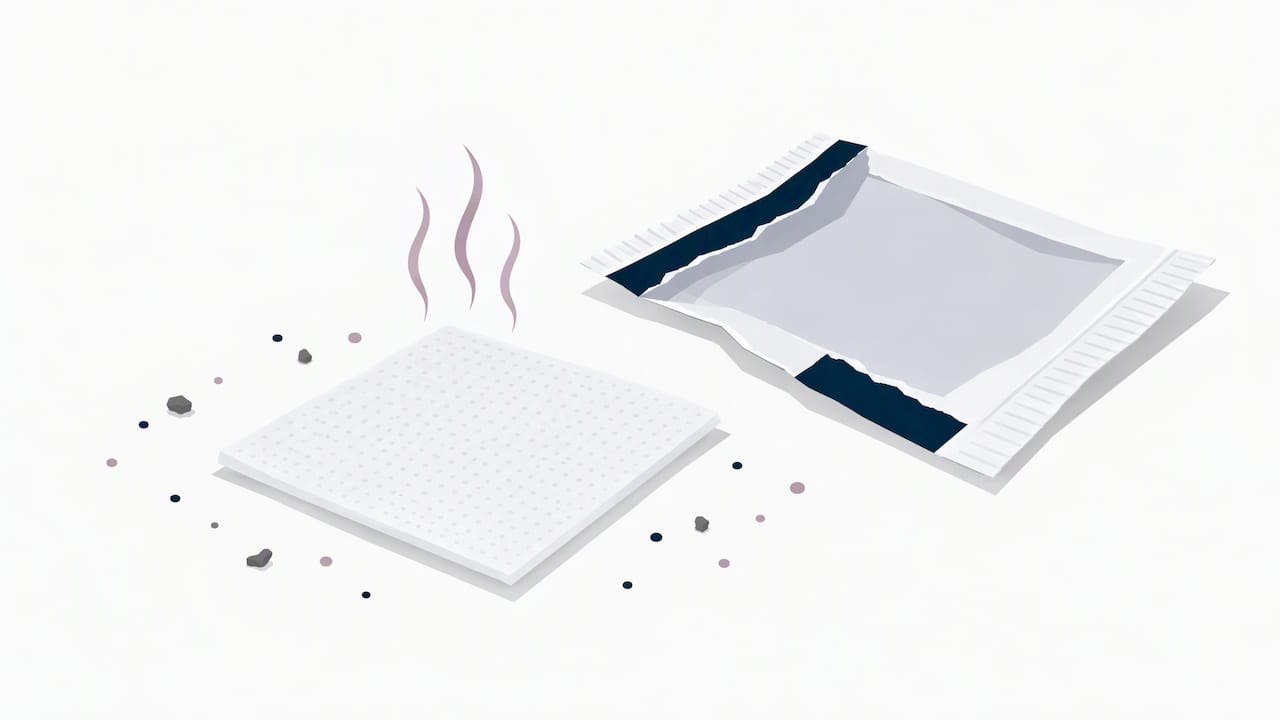
The same goes for tubs of multi-use wipes. Those are designed for surfaces and hands, not for sterile prep, and the lid does not keep them sterile once opened.
Our view: treat the date as part of the dose
We sell research-grade peptides and the supplies that go with them, including bacteriostatic water, syringes and alcohol pads. Our customers are usually careful about purity: they want third-party lab certificates of analysis and products above 99% purity. We think the same attitude belongs on the cheapest item in the kit.
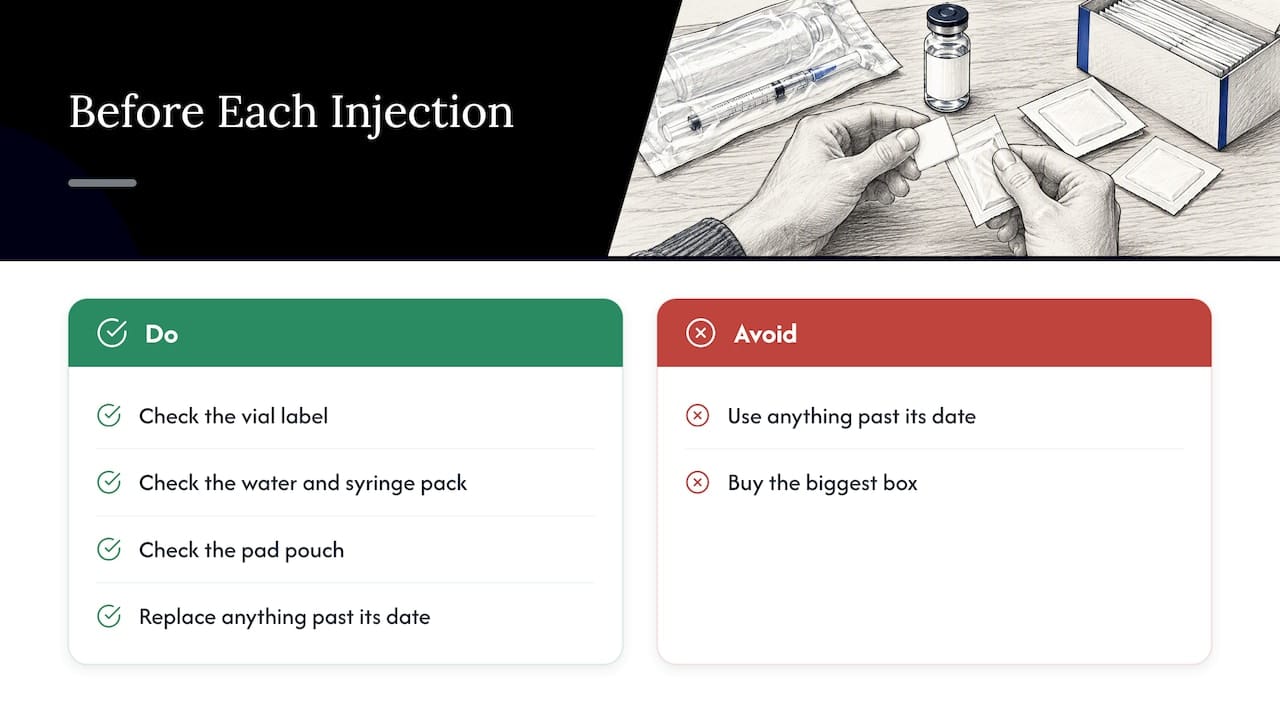
A vial can be perfectly pure and still be injected after a wipe from a pad that is two years out of date. Purity at the vial does nothing for the skin step. So we suggest a simple rule: before every session, check the vial label, the water, the syringe pack and the pad pouch. If any date has passed, replace it.
We also suggest buying ancillaries in quantities that match your schedule, not the biggest box on the shelf. Peptide users often inject several times a week, so a mid-sized box is usually used well within its date, but someone on a weekly schedule should buy less. And because peptide products are regulated in Canada, read our note on why an eight-digit DIN matters before you buy anything for injection.
— Pure Peptide
Stocking your injection kit
If you want pads, bacteriostatic water and syringes from one place, our ancillaries range sits alongside our weight loss, muscle growth, recovery, anti-aging and libido categories. Check the dates on arrival, as you would with any medical supply, and store the kit in one dry place so you can see everything at a glance.
FAQ
Is it okay to use expired alcohol pads?
For surface cleaning, a slightly expired pad is unlikely to cause harm, though it may clean less well. For skin preparation before an injection, replace it. After the date, neither the alcohol strength nor the sterility of the pouch is guaranteed, and a damp feel does not prove either.
Do alcohol prep pads have an expiration date?
Yes. Look for it on the outer box and on the individual pouch. Unopened pads commonly last about 1.5 to 3 years from manufacture, depending on the product. If a pouch has no date, do not use it for injections.
How can I tell if an alcohol pad has gone bad?
Check the date first, then the pouch. A torn, leaking, puffy or stained pouch, a dry or stiff pad, or a faint smell are all reasons to discard it. A pad can fail without any of these signs, so the printed date always wins.
What should I look for in the best alcohol pads for injections?
Choose sterile, individually wrapped pads containing 70% isopropyl alcohol, with a clear expiry date at least a year away. Pick a box size that fits how often you inject, so the last pad is used before the date. If you are unsure which product suits you, ask a pharmacist.
Can I keep pads in the fridge to make them last longer?
There is no need. Room temperature, away from heat and sunlight, is the usual storage guidance, and cold storage will not extend the printed date. Follow the storage line on your product’s packaging.
Sources
- Does Rubbing Alcohol Expire and Is It Safe to Use? (Healthline)
- Sterile Alcohol Prep Pads label (DailyMed)
- Naloxone: Save a Life fact sheet (Health Canada)
- Collection of finger-prick blood, standard operating procedure (WHO)
- The Best Alcohol Prep Pads for Injections (InjectCompass)