






The results reported for BPC-157 come from two places: rodent injury models, where tendon, ligament and muscle healing improved, and a very small set of human reports, where participants described less pain or fewer symptoms. Reported changes in animals were measured within days to weeks. In the human reports they were described from about two weeks to several months. Here is what each study found, how fast, and what Canadian readers should know before acting on any of it. If recovery is your goal, our recovery peptides range is where we start.
TL;DR
- BPC-157 is a synthetic peptide of 15 amino acids, first isolated from gastric juice. Athletes seek it for injury prevention, recovery and tissue repair.
- Animal studies track tendon and ligament healing across days 1 to 21 and up to 90 days. Human data amounts to three publications and about 30 participants.
- Early symptom change in the one bladder study was reported as soon as 2 weeks after treatment. Knee pain relief was reported at 6 months to a year.
- In Canada, Health Canada has not authorized BPC-157, and no human dosing protocol is established. Talk to your doctor before using any peptide, especially if you compete in tested sport, are pregnant or have a medical condition.
Table of Contents
- What BPC-157 is and what people want from it
- What animal studies report
- What human reports show
- How long people report waiting for results
- Safety: what is and is not known
- BPC-157 in Canada: legal status
- Why results differ so much between people
- Where to start if recovery is your goal
- Our view
- FAQ
- Sources
What BPC-157 is and what people want from it
BPC-157 is a synthetic pentadecapeptide, a chain of 15 amino acids, originally isolated from gastric juice. According to a 2025 narrative review, athletes look to it for injury prevention, better exercise recovery and tissue repair.
The results readers search for fall into four groups:
- Tendon and ligament healing (Achilles, knee, elbow)
- Muscle recovery after hard training
- Joint pain relief
- Gut and bladder comfort
What the studies report differs in each group, so we take them one at a time.
What animal studies report
Most of the BPC-157 data comes from rodents. A January 2026 sports medicine update from AOSSM summarizes the findings. In animal models BPC-157 has been associated with enhanced angiogenesis (new blood vessel growth), modulation of nitric oxide pathways, better fibroblast migration and more organized collagen deposition. In rodents this translated to improved healing in tendon, ligament, muscle and nerve injuries.
The two models most often cited for timelines are these:
| Model | What was measured | Reported result |
|---|---|---|
| Rat Achilles tendon transection (Staresinic et al., 2003) | Healing at days 1, 4, 7, 10, 14 and 21 | Treated animals showed better biomechanical properties, greater tensile strength and better collagen fibre organization at each time point |
| Rat medial collateral ligament transection (Cerovecki et al., 2010) | Healing over 90 days, with 10 mcg/kg daily intraperitoneally or applied locally | Better ligament healing throughout, with stronger biomechanics and organized collagen on histology |
Both are summarized here. The practical point is that in these models the difference showed up early and continued for weeks. Rats are not people, and the dose in the table is a rodent dose per kilogram of body weight. It is not a guide for human use.
A 2013 rat study also reported that BPC-157 reduced liver lesions after chronic alcohol administration, with less fat accumulation, less inflammation and lower liver enzymes, per a research guide. That is an animal finding and says nothing yet about humans. Long-term human safety data are lacking, so the question of liver effects in people has no established answer.
What human reports show
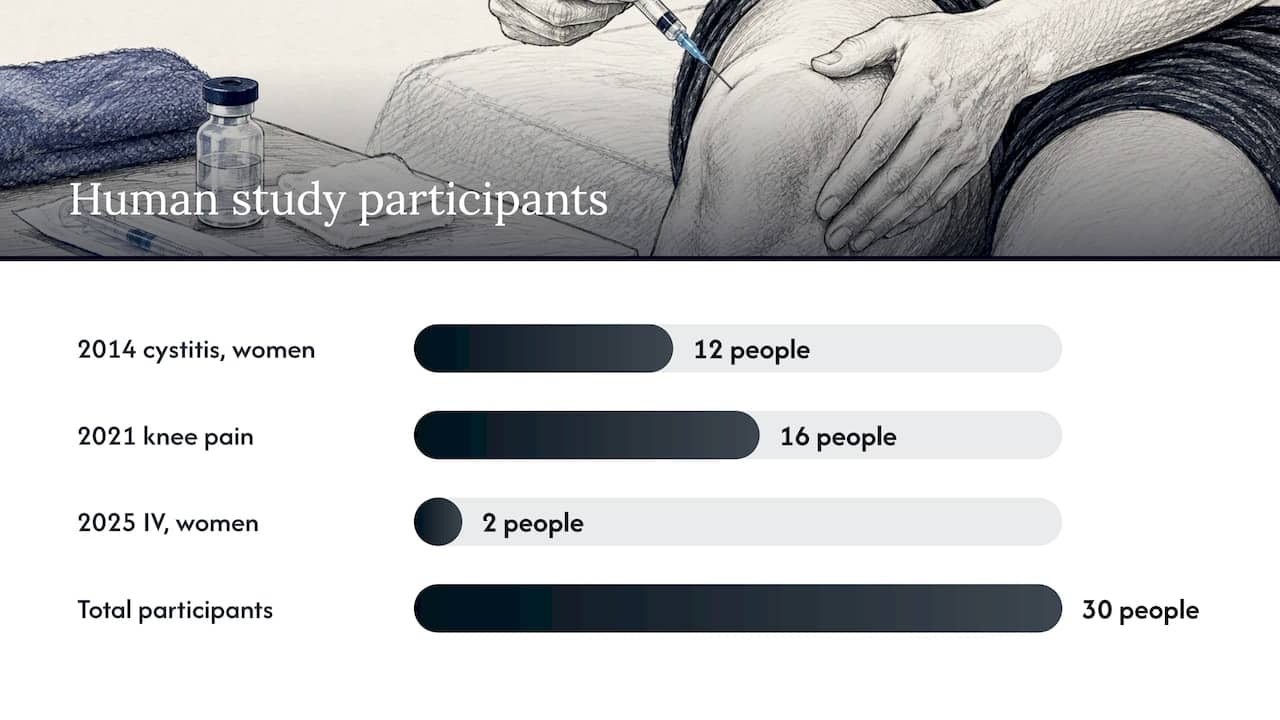
The human record is short. As of March 2026, McGill University’s Office for Science and Society counted three publications on BPC-157 in humans: a 2021 retrospective study of 16 patients with knee pain, a 2014 study of 12 women with interstitial cystitis, and a 2025 study of intravenous BPC-157 in two women.
Knee pain
In the 2021 study by Lee and Padgett, 14 of 16 patients (87.5%) reported significant pain relief between 6 months and a year after intra-articular BPC-157 injections. Outcomes were gathered by patient phone recall. One sports medicine review describes 7 of 12 people with chronic knee pain feeling relief lasting over six months after a single knee injection.
Interstitial cystitis
In a 2024 pilot study, 12 women aged 39 to 76 had not responded to pentosan polysulfate. Each received a single 10 mg intravesical (bladder) BPC-157 injection. Ten reported complete resolution of symptoms, and the other two rated their success at 80%. No adverse events were reported. A 2026 systematic review noted symptom improvement as early as 2 weeks after treatment.
Intravenous use
In the 2025 pilot, two healthy adults received infusions of up to 20 mg. It was well tolerated with no adverse events, and plasma concentrations returned to baseline within 24 hours. That fast clearance is one reason timelines in the literature are discussed in terms of repeated exposure rather than a single dose. Our page on BPC-157 half-life covers the duration question in more detail.
The combined picture
The 2026 systematic review found that all three included human studies, covering 30 participants, reported favourable outcomes. The same review rated the studies as poor quality and noted that two of the three used BPC-157 from unnamed compounding pharmacies. McMaster University’s Dr. Phillips told CBC in July 2026 that published human efficacy trials are basically absent, with one trial only beginning enrolment in February 2026. For you, this means results described online are individual reports. Nobody has yet set a standard human outcome.
How long people report waiting for results
The question “how long does it take?” has no single answer, because no human protocol has been set. Here is what the published material supports:
| Timeframe | What was reported | Where |
|---|---|---|
| Days 1 to 21 | Progressive tendon strength and collagen organization | Rat Achilles model |
| About 2 weeks | Early symptom improvement in bladder pain | Human cystitis pilot, via systematic review |
| Up to 90 days | Sustained ligament healing | Rat ligament model |
| 6 months to 1 year | Knee pain relief recalled by patients | Human knee study |
Online guides often describe a pattern of less discomfort in week one, better mobility in weeks two to four and better function after that. Treat those as anecdotes. The table above is the published record. Healing speed also depends on the injury: tendons have a poor blood supply and remodel slowly, whatever you use. Our tendon healing page goes through the research on that tissue.
Safety: what is and is not known
The 2025 narrative review reports no adverse effects in the three completed human studies. It also says large trials are lacking and lists proposed possible unwanted effects: pathologic angiogenesis, toxic metabolite formation and overproduction of nitric oxide.
AOSSM adds that most risks come from the absence of clinical trial data. Without those trials, appropriate dosing, long-term safety and adverse event profiles cannot be established. The Cleveland Clinic says BPC-157 is an experimental compound not approved by the FDA for humans.
Safe use starts with the basics of injectable products:
- Anyone with allergies, a history of cancer, a pregnancy or a planned pregnancy, or a chronic condition should speak to their doctor first.
- Anyone on prescription medication should ask a pharmacist or doctor about interactions, because no human interaction data exist for BPC-157.
- Sterile technique matters. Injecting peptides carries infection risks, and reconstitution needs sterile water and clean equipment. Our ancillaries range covers bacteriostatic water, syringes and alcohol pads for that reason.
- Contaminants and coupling agents from manufacturing can trigger allergic reactions, including anaphylaxis, so product quality records matter.
On dose, Health Canada has said there is a lack of established human dosing protocols. No cycle length is established as safe or effective, and any figure you read online is not a standard. Our summary of what the dosage research shows lays out what has been used in studies.
BPC-157 in Canada: legal status
Health Canada has stated that BPC-157 has not been authorized, that its safety, efficacy and quality have not been assessed, and that limited scientific evidence supports its use. ConsumerLab states that BPC-157 cannot legally be sold in Canada as a dietary supplement ingredient and is not approved as a drug.
For readers, the working rules are these:
- Treat BPC-157 as a research material, not a medicine or supplement.
- Do not expect a Natural Product Number or a DIN on a label.
- Athletes in tested sport should check the current prohibited list with their sport’s anti-doping body before any use.
McGill’s Office for Science and Society also notes that the unregulated market can leave buyers with no guarantee of what a vial contains. That makes batch documentation the key quality question. Peptides labelled for research purposes should come with third-party certificates of analysis that you can read before you order.
Why results differ so much between people
Two people with the same diagnosis can report very different outcomes. The main reasons:
- Product identity and purity. Results can only be compared if the vial contains what the label says, at the stated amount.
- Injury type and age. A fresh muscle strain and a chronic tendinopathy follow different timelines.
- Rehab and load management. Physiotherapy, sleep and progressive loading drive tissue repair, and they are the baseline against which any peptide is judged.
- Expectation. Knee pain and bladder studies relied on self-reported symptoms, which are sensitive to expectation.
- Stacking. Many people combine BPC-157 with another peptide, which makes it hard to know what caused a change. See our guides to BPC-157 and TB-500 and how the two compare.
A simple log helps: record the date, injury, pain score out of 10 and function (for example, stairs or a training lift) weekly. It gives you and your doctor or physiotherapist a real timeline instead of memory.
Where to start if recovery is your goal
Our Recovery range covers peptides for muscle and tissue repair, and our ancillaries range covers the reconstitution supplies. Our products come with third-party lab certificates of analysis, and our formulations are made with purification methods that exceed 99% purity. You can browse everything from the Pure Peptide shop.
Our view
Readers who ask about BPC-157 results usually want one thing: a clear picture of what has been seen, and how soon. The animal work shows early, measurable changes in tendon and ligament models. The human reports are short and favourable. That combination is why interest in recovery peptides keeps growing among athletes and training enthusiasts.
What separates a good experience from a poor one starts before the first dose. Know the compound, keep a record, respect sterile technique and read the certificate of analysis for every batch. We supply our peptides with third-party lab certificates of analysis, and we make our formulations to exceed 99% purity, because a result only means something if the product is what it says it is.
Our recovery range is built for people with a specific goal: a tendon that keeps flaring, a training block to get through, a body that needs to bounce back. We support them with the ancillaries they need to prepare products cleanly, and we point them to the research behind each compound so they can judge it themselves.
Pure Peptide
FAQ
How long does it take to notice results from BPC-157?
There is no established human timeline. In the one bladder study, improvement was reported as early as 2 weeks after treatment, and in the knee study relief was recalled at 6 months to a year. In rat tendon models, differences appeared within the first 21 days.
Can BPC-157 cause liver damage?
No human study has reported liver harm, and the 2025 review found no adverse effects in the three completed human studies. A 2013 rat study reported reduced alcohol-related liver lesions. Long-term human safety data are lacking, so anyone with liver disease or on liver-affecting medication should ask their doctor first.
What happens to your body when you take BPC-157?
In animals it has been linked to new blood vessel growth, nitric oxide pathway changes and more organized collagen. In the 2025 human infusion pilot, concentrations in the blood returned to baseline within 24 hours. No standard human effect profile exists yet.
How long should you run a cycle of BPC-157?
No cycle length is established. Health Canada has said there are no established human dosing protocols. Studies used single injections in humans and daily dosing for up to 90 days in rats. A doctor familiar with your situation is the right person to ask.
Is BPC-157 legal in Canada?
Health Canada has not authorized it, and it cannot legally be sold as a supplement or approved drug. Our peptides are sold as research materials, so read the label and certificate of analysis for each batch.
Sources
- Regeneration or Risk? A Narrative Review of BPC-157
- Human evidence for BPC-157 in orthopaedic and regenerative medicine
- Effect of BPC-157 on Symptoms in Patients with Interstitial Cystitis
- BPC-157, No Proof Required, McGill Office for Science and Society
- AOSSM Sports Medicine Update, Spring 2026
- CBC News: doctors using a regulatory gap to prescribe BPC-157
- Cleveland Clinic: What Is BPC-157 Peptide?
- ConsumerLab: BPC-157 and TB-500 uses and safety
- Tendon and ligament timelines in rat models
- BPC-157 research supplement guide
- Performance-boosting, anti-ageing drugs or dangerous snake oil