






Most peptide injection pain comes from a handful of things you can control: the needle, the volume, the speed, the site and the solution itself. Short, thin needles, small volumes, a slow push and a room-temperature solution make the biggest difference. A sting that fades within minutes is a different thing from pain, redness or swelling that grows, or any fever. The second group needs a medical check the same day. This guide covers both, in the order you will meet them. For purity and consistent supplies, we start at the source: Pure Peptide supplies research-grade peptides with third-party lab certificates of analysis, along with the syringes, bacteriostatic water and alcohol pads used to prepare them.
TL;DR
- Pain depends on needle length and gauge, injection volume, speed, site, and the solution’s pH, tonicity and preservatives.
- Go slow, keep volumes small, let the solution reach room temperature and use a fresh, thin needle each time.
- A brief sting or small mark is common. Spreading redness, growing swelling, worsening pain, fever or chills are not.
- In Canada, peptides are generally regulated as prescription drugs, so product quality and a clean technique both matter for comfort and safety.
- Our certificates of analysis and ancillary supplies are there to take guesswork out of the preparation steps.
Table of Contents
- Why peptide injections hurt
- The factors you can control
- Technique: a step-by-step routine that keeps pain low
- What is a normal reaction and what is not
- Product quality and the pain you feel
- What we do about purity and preparation
- Browse by goal
- FAQ
- Sources
Why peptide injections hurt
Pain from an injection under the skin is not one thing. A literature review of subcutaneous injection lists the drug itself, needle features, injection site, volume, speed, osmolality (how concentrated the dissolved particles are), viscosity, pH and excipients (the non-active ingredients) as influences on pain. In plain terms: the needle goes through skin that is full of nerve endings, then you push fluid into a small pocket of fat, and both the pressure and the chemistry of that fluid are felt.
Two kinds of discomfort are worth separating:
- During the injection. A prick on insertion, then pressure or stinging as the fluid goes in. This is mostly about the needle, your technique and the solution’s pH and make-up.
- After the injection. A small red patch, a tender spot, a little itching or a pea-sized lump. A systematic review of injection site pain notes that the buffer’s chemical composition is a crucial factor in how painful an injection feels, and that persistent pain can reduce how well people stick to a treatment.
Peptides add a wrinkle. A 1998 paper on pain upon injection of drugs, filed with the US patent office, states that aggregation of proteins and particulates in general may contribute to pain. It also says buffers, cosolvents, preservatives and chelating agents may in some cases be linked to injection site pain. A peptide that is poorly dissolved, or a solution that has been shaken hard, can therefore sting more than one that is mixed gently and fully clear.
The factors you can control
Here is how each factor works and what to do about it.
| Factor | What the evidence says | What you can do |
|---|---|---|
| Needle | Short, thin, sharp needles are generally used to minimize pain (Usach et al., 2019) | Use a new, sharp needle every time. Never reuse one |
| Volume | Up to 0.5 to 0.8 mL is not expected to add much pain from insertion. About 1.5 mL is the generally accepted maximum | Keep volumes small. Split larger doses only on professional advice |
| Speed | Slow pushing is recommended. Rapid injection is no longer recommended by Alberta Health Services | Depress the plunger steadily |
| Site | The abdomen is recommended in the review. Nova Scotia Health advises abdominal fat for volumes over 1 mL | Choose a fleshy area with enough fat. Rotate spots |
| Temperature | Room-temperature solutions are recommended to reduce pain | Let a refrigerated vial sit out briefly before drawing up |
| Solution chemistry | Isotonic solutions (about 300 mOsm/kg), no more than 600 mOsm/kg, and a pH near physiological are recommended | Mix gently and use the diluent suited to the product |
| Preservative | Among preservatives in multi-dose preparations, m-cresol seems more painful than benzyl alcohol and phenol | Know which preservative is in your diluent |
The figures above come from the same review. It also says phosphate buffer should be limited to 10 mM and citrate buffer kept below 7.3 mM to avoid added pain, and that a pH above 9 is related to tissue damage while a pH below 3 can cause pain and phlebitis (inflamed veins). You cannot adjust a buffer at home, which is one reason a consistently made product matters. It is also why diluent and preparation steps are worth getting right.
Technique: a step-by-step routine that keeps pain low
The steps below follow Canadian health authority guidance for subcutaneous injection, adapted for a self-injector. Your prescriber or pharmacist can show you the technique in person, and that is worth doing if you are new to it.
1. Prepare a clean workspace
Wash your hands, set out a fresh syringe, an alcohol pad and your vial, and check that the liquid is clear and free of particles. Particles are a cause of pain and a reason to stop. Our syringe guide for Canadian beginners explains how syringe markings work, because a misread unit is a common source of an unexpectedly large volume, and large volumes hurt more.
2. Bring the solution to room temperature
Cold liquid is felt more. Take the vial out of the fridge a little before you draw up, as the review recommends room-temperature solutions. Do not warm it with heat sources.
3. Draw up the right volume
Measure carefully. Smaller volumes are gentler: the review reports no substantial extra insertion pain up to about 0.5 to 0.8 mL. If your dose maths is the weak link, our worked examples for measuring peptide doses walk through it step by step.
4. Pick and clean the site
Use the fatty tissue of the abdomen when you can. Nova Scotia Health’s injection guidelines say the fatty tissue over the abdomen should be used for volumes over 1 mL to reduce discomfort. Wipe with an alcohol pad and let the skin dry fully. Wet alcohol carried in by the needle stings. Our guide to injection sites shows where and how to rotate.
5. Pinch, insert, push slowly
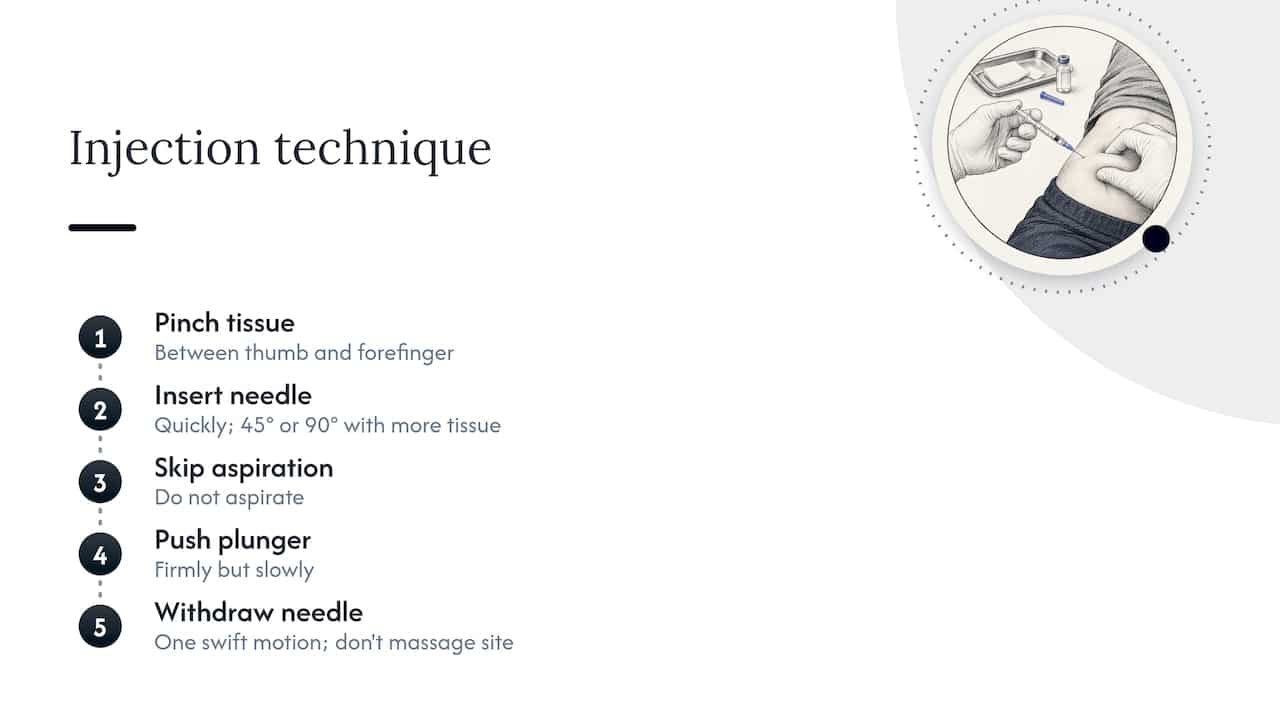
The Alberta Health Services standard describes pinching up the subcutaneous tissue between thumb and forefinger, then inserting the needle quickly and firmly at a 45-degree angle (90 degrees for larger people with more tissue). It says not to aspirate, to push the plunger down firmly but slowly, to withdraw the needle in one swift motion and not to massage the site. A quick, committed insertion hurts less than a hesitant one.
6. Dispose of the needle safely
Use a sharps container. Never recap and reuse.
7. Use your head too
The same Alberta standard recommends neutral, positive wording during injections, such as expecting “some pressure” rather than a “sting”, and a calm expression to lower anxiety and perceived pain. Self-talk and a steady breath are legitimate tools: anxiety raises how painful an injection feels.
Subcutaneous or intramuscular?
Most peptide routines use the subcutaneous route. For intramuscular injections, Nova Scotia Health advises injecting slowly over 5 seconds with a narrow 25-gauge needle to reduce pain and muscle trauma, and notes viscous products need a 22-gauge or larger needle. Which route suits a given product is covered in our comparison of subcutaneous versus intramuscular.
What is a normal reaction and what is not
Injection site reactions are a recognized effect of injectable peptides. The University of Calgary’s Clinical Pharmacology and Toxicology Pearl lists them as a known adverse effect of growth hormone secretagogues such as CJC-1295, ipamorelin and tesamorelin. Typical mild signs are a brief sting, slight redness, a small bump or a little itching around the spot.
Nova Scotia Health advises that if leakage or reactions occur at the injection site, reduced volumes should be considered for later injections. That is a practical first adjustment, ideally made with your prescriber.
The following are different, and are not something to wait out:
- Redness, swelling or pain at the site that is spreading or getting worse
- Fever or chills
- Feeling generally unwell
- Trouble breathing or chest pain
- A hard, very tense or intensely painful limb
Health Canada’s November 6, 2026 advisory says that if you have used an unauthorized injectable peptide drug and develop redness, swelling, pain at the injection site, fever, chills or feel unwell, you should seek medical attention immediately, as these may be signs of a serious infection. The Calgary pearl recommends calling emergency services if there is any instability in airway, breathing or circulation. It also describes a published case of compartment syndrome in the thigh that needed surgery after a peptide cocktail injection, so severe limb pain after an injection is an emergency. Go to an emergency department or call 911.
If you want to understand a warm, flushed feeling after injection, which is a separate topic from pain, see our 30 minute safety check for peptide flushing.
Product quality and the pain you feel
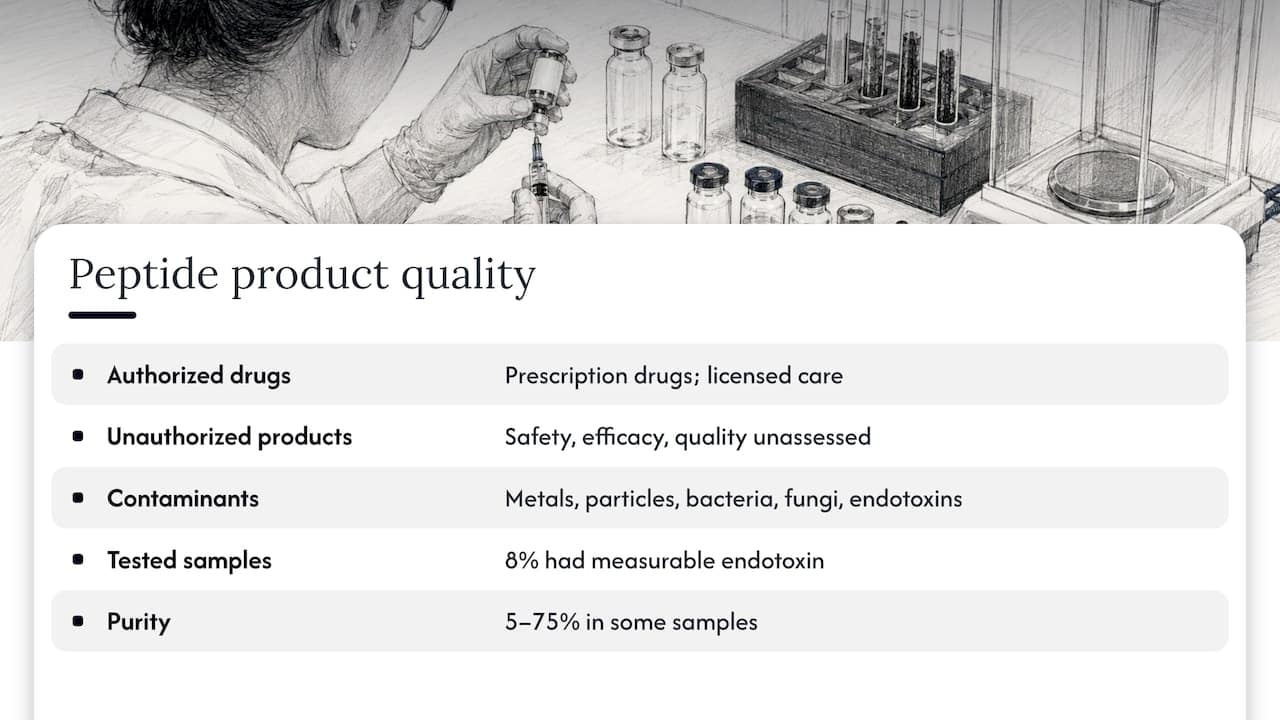
Pain is not always technique. What is in the vial matters, and in Canada this is a safety question as much as a comfort one. Health Canada’s April 2026 public advisory states that peptides are generally regulated as prescription drugs in Canada, that authorized peptide drugs should be used only under the care of a licensed healthcare professional, and that unauthorized products have not been assessed by Health Canada for safety, efficacy and quality. Health Canada’s page on peptide health risks adds that unauthorized peptides may contain contaminants such as heavy metals, particles and microbes including bacteria, fungi and endotoxins.
Endotoxins are fragments of bacteria that can cause fever and chills when injected. The Calgary pearl reports that 8% of tested unauthorized peptide samples had measurable endotoxin at levels capable of causing fever, chills or septic shock, and that purity in some samples was as low as 5 to 75%. The College of Physicians and Surgeons of Alberta advises doctors to ask patients about non-prescribed injectables, to check products in Health Canada’s Drug Product Database or Licensed Natural Health Product Database, and notes that prescription medications can only be legally sold by licensed pharmacies.
So a stinging, red or lumpy injection can come from how you inject, from what you inject, or from both. Talk to a doctor or pharmacist about any reaction that keeps repeating, and tell them exactly what you used. That helps them treat you accurately. Our pages on peptide safety and contamination risks and what a certificate of analysis shows go deeper on this, and our Canadian legality guide explains the DIN, the eight-digit number Health Canada assigns to authorized drugs.
If you have a product you no longer want to use, Health Canada’s advisory says to follow municipal or regional guidance for hazardous waste or take it to a local pharmacy. Side effects can be reported to Health Canada.
What we do about purity and preparation
Our products are backed by third-party lab certificates of analysis, and our formulations are made with advanced purification methods that exceed 99% purity. We say this because a cleaner, better-characterized product is one fewer unknown when you are trying to work out why a site is sore. We also supply the ancillaries used to prepare a dose, including bacteriostatic water, syringes and alcohol pads, so the whole routine above can come from one place.
We hear the same question from fitness enthusiasts, athletes and people using peptides for weight loss, recovery or anti-aging: why does it sting?
Our view is that injection comfort starts with two things, a product you can trust and a routine you can repeat. A purified peptide with a third-party certificate of analysis removes one variable. A fresh needle, a measured volume, a slow push and a rotated site remove most of the others.
That is why we offer the ancillaries alongside the peptides: bacteriostatic water, syringes and alcohol pads. A calm, consistent routine is easier to keep when everything you need is at hand, and consistency is what keeps both pain and mistakes down. If a reaction looks like infection, the right move is medical care at once, and we say so plainly on our safety pages.
Pure Peptide
Browse by goal
If you are ready to choose, our categories cover weight loss, muscle growth, recovery, anti-aging, libido and ancillaries. You can see them all on the Pure Peptide home page, or start with our peptides for recovery guide if soreness and healing are your focus. Each product comes with a third-party certificate of analysis, and the ancillaries category has what you need for reconstitution and injection.
FAQ
Is subcutaneous injection painful?
For most people it is a brief prick followed by mild pressure. Short, thin, sharp needles, small volumes, room-temperature solution and a slow push keep it that way. The injection site and the solution’s pH, tonicity and preservative also influence how it feels.
Why does my peptide injection sting?
Stinging usually comes from the solution or the speed. Acidic or strongly buffered liquids, certain preservatives such as m-cresol, cold liquid, alcohol that was still wet on the skin and a fast push can all add to it. Check that the solution is fully dissolved and clear, and slow down.
How long should a lump or redness last?
Small, mild marks are a known site reaction and often settle on their own. The research here gives no fixed time, so do not wait it out if the area spreads, swells, gets more painful or comes with fever or chills. Seek medical attention immediately in that case, as Health Canada advises.
Does injection volume change how much it hurts?
Yes. Volumes up to about 0.5 to 0.8 mL are not expected to add much pain from insertion, and around 1.5 mL is the generally accepted maximum. Nova Scotia Health advises abdominal fat for volumes over 1 mL and smaller volumes if leakage or site reactions occur.
When should I see a doctor?
See a doctor or go to emergency care for spreading redness, swelling, worsening pain, fever, chills or feeling unwell after an injection. Call 911 for breathing trouble, chest pain or a limb that becomes very tense and painful. Tell the clinician exactly what you injected, including the product and the diluent.
Sources
- Subcutaneous Injection of Drugs: Literature Review of Factors Influencing Pain Sensation at the Injection Site
- A Systematic Literature Review of Injection Site Pain
- Alberta Health Services, 06.100 Standard for the Administration of Immunizations
- Nova Scotia Health, Guidelines for Subcutaneous and Intramuscular Injection
- Health Canada, advisory on contaminated unauthorized injectable peptides
- Health Canada, Peptides: Health risks
- Health Canada, public advisory on injecting peptides bought online
- University of Calgary, Clinical Pharmacology and Toxicology Pearl on unauthorized injectable peptides
- CPSA, Unauthorized injectable peptides and their potential serious health risks