






For systemic anti-aging and performance goals, oral or topical retinol carries more direct human trial evidence than systemic copper peptides like GHK-Cu, whose research base is mostly preclinical. Before buying either, verify that any injectable peptide product is authorized, since Health Canada warns that many injectable peptides sold online, including GHK-Cu, are unauthorized and can seriously harm users. Check the comparison below, then confirm authorization before you spend a dollar.
TL;DR:
- Human trials of topical retinol measure fine wrinkles and skin repair, not strength or fat loss; systemic copper peptides lack controlled trials on those outcomes.
- In Canada, check the Drug Identification Number in Health Canada’s database and review recall notices; purity certificates do not establish authorization.
- Adults should keep preformed vitamin A at or below 3,000 mcg RAE daily; higher doses require clinical supervision, especially during pregnancy.
- Topical retinol’s wrinkle improvements develop over weeks to months, and gradual introduction a few nights each week can help manage irritation.
Table of Contents
- Quick comparison: route, evidence, and regulatory risk
- What research shows about systemic copper peptides for performance and anti-aging
- What research shows about systemic retinol for anti-aging and related outcomes
- Canadian safety checklist before buying copper peptides or high-dose vitamin A
- Buyer due diligence: reading COAs and questions for your clinician
- How copper peptides and retinol work at the cellular level
- Comparing strengths and limits across use cases
- Using both together: synergy, conflict, or no interaction at all
- How long each approach takes to show results
- Building a routine around either approach
- Our view on purity, testing, and clinical evidence
- Where to find verified, high-purity options
- FAQ
- Sources
Quick comparison: route, evidence, and regulatory risk
The two approaches differ in how they enter the body, which changes what each can realistically deliver. Copper peptides marketed for systemic use are typically injected or ingested as research compounds, while retinol for anti-aging is available as a topical cream or, in clinical trials, an oral high-dose drug. Route determines the type of evidence you should expect to see before trusting a claim.
- Administration: systemic copper peptides are usually injected or taken orally as unregulated research products, while retinol is applied topically for cosmetic use or studied orally in clinical settings.
- Evidence strength: peptide data for systemic outcomes like muscle growth or fat loss leans on animal and in vitro work, while topical retinol has randomized trial evidence for fine wrinkles and dermal matrix changes.
- Regulatory risk: many injectable peptides sold online lack Canadian authorization, while oral vitamin A has defined upper limits and documented pregnancy risks rather than an outright ban.
- Typical endpoints: peptide trials rarely report strength, lean mass, or recovery time directly in humans, while retinol trials report measurable skin scores or, at high oral doses, cancer-prevention markers.
The practical takeaway: match the claim to the evidence. A product promising systemic anti-aging or muscle gains needs human trial data on those exact endpoints, not a borrowed skin study or an animal result.
What research shows about systemic copper peptides for performance and anti-aging
GHK-Cu and related copper peptides have a research history rooted mostly in cell culture and animal models, with far less data in living humans for the systemic outcomes fitness buyers care about. Early work on GHK-Cu examined wound healing and collagen signalling in tissue samples, not strength, fat loss, or whole-body recovery in trial participants.
- Preclinical studies describe GHK-Cu’s role in tissue repair signalling, but these findings come from cell and animal models, not controlled human trials on muscle growth or fat loss.
- Human data on systemic GHK-Cu dosing for performance outcomes is limited, so claims about recovery speed or muscle gain are largely extrapolated from unrelated mechanisms.
- Recovery and anti-aging marketing for copper peptides often borrows language from topical skin studies, which measure a different outcome entirely from systemic performance.
Health Canada’s recall of GHK-Cu & BPC-157 powder listed specific affected lot numbers, including 73417, 73609, 73926, 73927, and 74120, classified as a Type I recall. That classification signals a situation where use could cause serious health consequences.
This matters for buyers because a certificate of analysis showing purity does not establish legal authorization. Health Canada’s advisory names GHK-Cu specifically among unauthorized injectable peptide drugs and states these products have not been assessed for safety, efficacy, or quality by the regulator, regardless of what a seller’s lab report claims. A product can be chemically pure and still be unauthorized for human use in Canada, and the recall history shows that unauthorized injectable peptides have already reached consumers through online channels. Anyone considering a systemic copper peptide for anti-aging or performance should treat the authorization question as separate from, and more important than, the purity question.
What research shows about systemic retinol for anti-aging and related outcomes
Retinol’s strongest evidence base sits with topical use, not systemic dosing, which matters if you are weighing it as a performance or whole-body anti-aging intervention. A randomized clinical trial published in JAMA Dermatology found topical retinol improved fine wrinkle scores and increased markers of dermal matrix repair in aged skin, but that trial measured skin appearance, not systemic outcomes like strength or body composition.
- Topical retinol trials measure wrinkle depth and collagen-related markers in skin, which is a different endpoint from muscle, fat loss, or whole-body recovery.
- Oral vitamin A has been studied at much higher doses for specific medical purposes, such as actinic keratosis treatment, under direct clinical monitoring rather than for general anti-aging use.
- Systemic vitamin A supplementation carries defined safety limits rather than being treated as a casual wellness additive.
The adult tolerable upper intake level for preformed vitamin A is 3,000 mcg RAE per day, with pregnancy risks flagged at high doses. That ceiling exists because vitamin A accumulates in the body and excess intake has known toxicity and birth defect risks, so oral dosing above typical dietary levels belongs under clinical supervision, not self-directed experimentation.
Canadian safety checklist before buying copper peptides or high-dose vitamin A
Verifying authorization takes a few minutes and is the single most useful step before purchasing a systemic peptide or high-dose vitamin A product. Health Canada advises consumers to check the eight-digit Drug Identification Number against the Drug Product Database and to buy prescription drugs only from licensed pharmacies.
- Search the product name and active ingredient in the Health Canada Drug Product Database to confirm an active DIN exists.
- Check Health Canada’s recall and advisory pages for the specific product or lot number before ordering.
- Treat a missing DIN, a “for research use only” label, or a foreign-only seller with no Canadian contact as red flags rather than minor details.
- Confirm the seller provides a lot-matched certificate of analysis, not a generic purity statement.
Pro Tip: Bookmark the Health Canada Drug Product Database and the recalls page: a five-minute check before ordering is faster than dealing with a recalled or unauthorized product later.
Unauthorized injectables are hazardous because they bypass the safety, efficacy, and quality assessment that legitimate drugs go through, and dosage or contamination problems are not always visible on a label.
Buyer due diligence: reading COAs and questions for your clinician
A certificate of analysis is only useful when it matches the exact lot you are buying, so start there. Look for the peptide’s identity confirmation, a stated purity percentage, the assay method used, the testing lab’s name, and a lot number that matches the product packaging in hand.
- Confirm the COA’s lot number matches the product you received, not a generic sample from the manufacturer’s website.
- Ask whether the testing lab is independent from the seller, since third-party verification carries more weight than in-house testing.
- Bring specific questions to a clinician: what indication supports this use, what monitoring is needed, and whether it interacts with current medications.
- Raise pregnancy status explicitly if you are considering oral vitamin A, given the documented risks at high doses.
Pro Tip: If a seller cannot produce a lot-matched COA on request, treat that as a reason to walk away rather than ask twice.
Licensed pharmacies and prescription routes remain the safest path for anything requiring systemic dosing, since they carry authorization and pharmacist oversight that direct-to-consumer research sellers do not.
How copper peptides and retinol work at the cellular level
Copper peptides like GHK-Cu are thought to influence tissue remodelling by interacting with copper-dependent enzyme systems involved in collagen and elastin turnover, based largely on cell culture and animal research. This signalling role is where the “anti-aging” association originated, though it was studied in skin tissue models rather than through systemic human trials measuring whole-body aging markers.
Retinol works through a different, better-documented pathway. Once absorbed, retinol converts to retinoic acid, which binds nuclear retinoic acid receptors that regulate gene expression tied to skin cell turnover and collagen production. This receptor-based mechanism is why topical retinol trials consistently report increased procollagen and glycosaminoglycan markers alongside visible wrinkle improvement, a far more mapped-out pathway than copper peptide signalling.
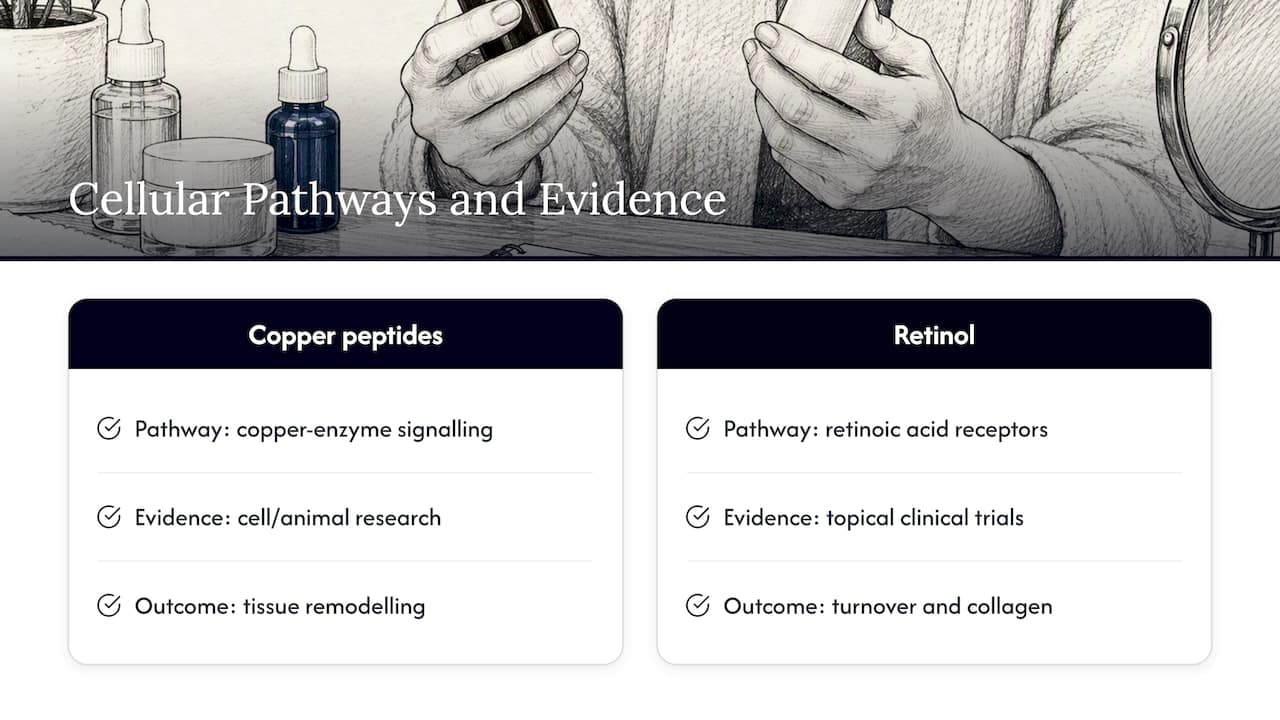
The practical difference matters for anyone shopping with performance or systemic anti-aging goals in mind. Retinoic acid’s receptor pathway has decades of pharmacology behind it, including the dose-response relationships that let researchers study it safely at both topical and oral strengths. Copper peptide mechanisms, by contrast, remain described mostly in general terms because the human dose-response data needed to confirm systemic effects at muscle or fat-loss endpoints has not been established the way it has for retinoids. That gap is exactly why systemic copper peptide marketing tends to borrow language from skin studies rather than citing performance trials directly.
Comparing strengths and limits across use cases
Neither compound is a universal answer, and the gap between them is mostly about what has actually been measured in humans. Retinol’s topical evidence covers a broad range of skin presentations, from fine wrinkles to uneven texture, with dosing and irritation profiles that are well characterized across skin types through repeated clinical study. That gives it a practical edge for anyone whose primary goal is visible skin change, since the expected timeline and likely side effects are documented.
Systemic copper peptides are marketed more broadly, covering muscle recovery, fat loss, and anti-aging in the same breath, but the evidence supporting those specific systemic claims in humans is thin. What exists are mechanistic studies in tissue models, not trials measuring lean mass, strength, or fat loss directly in people using GHK-Cu. For someone whose goal is strictly performance or body composition, that evidence gap is the limitation to weigh most heavily, separate from the authorization question covered above.
Skin type and condition also shape which option makes sense within its own evidence base. Retinol’s irritation potential is well documented and manageable with gradual introduction, while copper peptide topical formulations are sometimes positioned as a gentler alternative for sensitive skin, though that comparison applies to cosmetic use rather than the systemic goals this article addresses. For systemic performance and anti-aging goals specifically, the honest comparison favours retinol’s topical evidence base over copper peptides’ largely preclinical systemic data.
Using both together: synergy, conflict, or no interaction at all
Claims that copper peptides and retinol work better combined, or conversely that they cancel each other out, are not supported by controlled systemic trials; most of what circulates online draws on general skin biology reasoning rather than direct comparative studies. In topical cosmetic contexts, some formulators space copper peptide and retinoid products apart in a routine out of caution about pH sensitivity and potential irritation, but that is a cosmetic formulation practice, not evidence of a systemic interaction.
For systemic use, the more important consideration is not whether the two interact pharmacologically but whether either one is authorized and appropriately dosed in the first place. Combining an unauthorized injectable peptide with a high-dose oral retinol regimen compounds risk rather than compounding benefit, since you would be layering an unverified product onto one that already carries defined upper limits and monitoring needs. Anyone considering both together should raise that combination directly with a clinician rather than assuming the two simply add up, since no systemic human trial data describes what happens when they are used concurrently at performance-relevant doses.
How long each approach takes to show results
Expected timelines differ sharply because the two approaches are backed by different kinds of evidence. Topical retinol’s clinical trial data gives a documented timeline: visible improvement in fine wrinkles and skin matrix markers over a period of weeks to months of consistent use, based on the trial protocol itself. That timeline is specific to skin appearance outcomes, not systemic performance.
Systemic copper peptides do not have an equivalent human trial timeline for muscle growth, fat loss, or recovery speed, because the human data needed to establish one does not exist for those endpoints. Any timeline claim you see for systemic copper peptide use in a fitness context is necessarily anecdotal rather than drawn from a controlled trial, which is an important distinction to hold onto when a seller promises results within a specific number of weeks. Separately, in the cosmetic peptide space, third-party research on collagen tripeptides has reported visible skin improvement within an 8 to 12 week window, a useful point of comparison for how long topical interventions generally take to show measurable change, though that figure describes a different ingredient category than systemic GHK-Cu.
Building a routine around either approach
A sound routine starts with authorization, not ingredients. Before adding either a systemic peptide or a high-dose vitamin A product to a routine, confirm it is legally available through the checks described above, then bring the specific product and intended use to a clinician for a monitoring plan. This sequencing matters more than which product goes first.
For topical retinol specifically, a gradual introduction schedule, such as starting a few nights a week and increasing frequency as tolerated, is standard practice supported by the trial evidence on irritation and adaptation. Systemic interventions require a different kind of planning: baseline bloodwork, a clear indication, and a defined monitoring schedule rather than a trial-and-error approach. Route matters here too. A product applied to skin carries different risk than one injected or ingested, so a routine that treats both the same way is missing the point. Whatever you choose, pair it with ancillary hygiene basics such as proper reconstitution water, sterile syringes, and alcohol pads if an injectable product is involved and properly authorized, since contamination risk compounds the regulatory risk already discussed.
Our view on purity, testing, and clinical evidence
We build our catalogue around formulations that exceed 99% purity, verified through third-party certificates of analysis, because a purity claim means little without independent confirmation behind it. Clinical evidence, regulatory compliance, and clinician involvement guide what we make available, and we expect buyers to pair any product with their own authorization check and medical guidance rather than treating purity alone as a green light.
— Pure Peptide
Where to find verified, high-purity options
We carry categories built around weight loss, muscle growth, recovery, anti-aging, libido, and the ancillaries that go with them, such as bacteriostatic water, syringes, and alcohol pads. Every product line is backed by a third-party certificate of analysis, so you can match purity and identity claims to the lot in hand before you commit to a purchase.
Our recommended sequence stays consistent with everything above: confirm authorization status for your category of interest, request the lot-matched COA, and talk to a clinician about indication and monitoring before use. If recovery is your focus, our peptides for recovery page walks through the options and documentation available. For muscle-focused goals, our best peptides for muscle growth guide is a practical starting point for comparing what is available and verifying it properly before you order.
This article is general information, not a substitute for advice from a qualified doctor. Consult a qualified healthcare professional about your own circumstances before acting on anything here.
FAQ
Is copper peptide safe for systemic or injectable use?
Safety depends heavily on authorization status: Health Canada warns that many injectable copper peptide products sold online, including GHK-Cu, are unauthorized and have not been assessed for safety, efficacy, or quality. A purity percentage on a certificate of analysis does not establish legal authorization or safety for human use, so verifying DIN status comes first.
Can I use copper peptides and retinol together?
No controlled systemic human trial has tested combining them, so claims of synergy or conflict are not established by direct evidence. For systemic use, the more pressing concern is confirming each product’s authorization and dosing individually before considering combined use, ideally with a clinician’s input.
How long does retinol take to show anti-aging results?
In the clinical trial measuring topical retinol, improvements in fine wrinkle scores and dermal matrix markers were documented over a period of consistent weekly use, rather than after a single application. Results build gradually and are specific to skin appearance outcomes measured in that trial.
What is the safe upper limit for vitamin A supplementation?
The tolerable upper intake level for preformed vitamin A in adults is 3,000 mcg RAE per day, according to the NIH Office of Dietary Supplements. Exceeding this without clinical supervision carries toxicity risk, and pregnancy adds further caution at high doses.
How do I check if a peptide product is legally authorized in Canada?
Search the product name or active ingredient in the Health Canada Drug Product Database using its eight-digit Drug Identification Number, as Health Canada advises for verifying prescription and over-the-counter drug authorization. A missing DIN or a “for research use only” label on a product marketed for human use is a clear warning sign.
Sources
- Think twice before injecting peptides bought online: unauthorized products can seriously harm you – Canada.ca
- Topical retinol randomized clinical trial (JAMA Dermatology)
- Vitamin A – NIH Office of Dietary Supplements (consumer fact sheet)