






Creatine monohydrate has one of the best evidence bases in sports nutrition. Peptides are a loose category of very different molecules. So “creatine with peptides” means three different things depending on who says it: a creatine powder with collagen or plant-protein peptides added, creatine chemically bound to amino acids, or creatine taken alongside a research peptide. Only the first is a common retail product, and none of the three has been shown to beat plain creatine monohydrate taken daily with resistance training.
This guide sorts out which combination is which, what you can reasonably expect, how to dose it, and what to check before you buy in Canada.
TL;DR
- Creatine monohydrate at 3 to 5 g a day, taken consistently, is the proven part. Timing around your workout matters far less than showing up every day.
- Added peptides (collagen, fava-bean hydrolysate) are a different tool with different goals. No direct randomized trial shows the combination outperforms creatine alone.
- A quick 1 to 3 kg scale jump in the first week is mostly water, not fat.
- In Canada, look for an active Natural Product Number (NPN), the exact creatine dose per serving, and a clean recall record. A certificate of analysis alone does not make a product authorized for sale.
- Research peptides and creatine are not interchangeable. Do not treat one as a shortcut for the other.
Table of Contents
- What people mean by “creatine with peptides”
- What creatine actually does
- Do added peptides help?
- How to take it: dose, loading and timing
- “Why did I gain 10 pounds?”
- Downsides and who should be careful
- Buying creatine safely in Canada
- Where research peptides fit
- Our perspective
- If you are exploring peptides
- FAQ
- Sources
What people mean by “creatine with peptides”
Creatine plus collagen or protein peptides in one tub
This is what most Canadian shoppers find first. Typical formulas pair 5 g of creatine monohydrate with about 2.4 g of a branded fava-bean protein hydrolysate and suggest one serving daily, often after training, according to The Workout Mag’s review of creatine peptides. Others add a couple of grams of collagen peptides. The same review points out that the product claims describe intended benefits, not independent proof that the mix outperforms monohydrate.
Creatine bound to peptides
Some products bond creatine to short amino acid chains, with the theory that this improves solubility or absorption. The International Society of Sports Nutrition (ISSN) review notes that creatine salts, creatine complexed with other nutrients and creatine dipeptides have all been marketed as superior to monohydrate, and then examines the evidence. Its 2021 review of common creatine questions is the best place to read that discussion in full. A plausible mechanism is not the same as a human outcome trial, and for these forms the independent trial evidence is thin.
Creatine alongside a research peptide
This is a separate idea: taking creatine for the energy system while using a peptide aimed at recovery or growth signalling. The two do not interact in any way that has been tested together in a trial we can point to. They also sit in very different regulatory and evidence categories, which we come back to below.
What creatine actually does
Muscle stores creatine as phosphocreatine. During short, hard efforts such as heavy sets, sprints and jumps, that store donates phosphate so your cells can remake ATP quickly. Topping up the store lets you squeeze out a little more work per session, and over months that extra work adds up to more strength and lean mass.
The ISSN review supports creatine for repeated brief, high-intensity exercise. Health Canada’s licensed creatine entries point the same way: the Natural Health Products Database listing for a licensed creatine powder lists 5 g per serving for adults, with increased strength, power and lean mass alongside resistance training as the intended uses.
Note what that means for the “with peptides” question. The benefit you can count on comes from the creatine. Anything else in the scoop has to earn its place with its own evidence.
Do added peptides help?
Collagen peptides: a different job
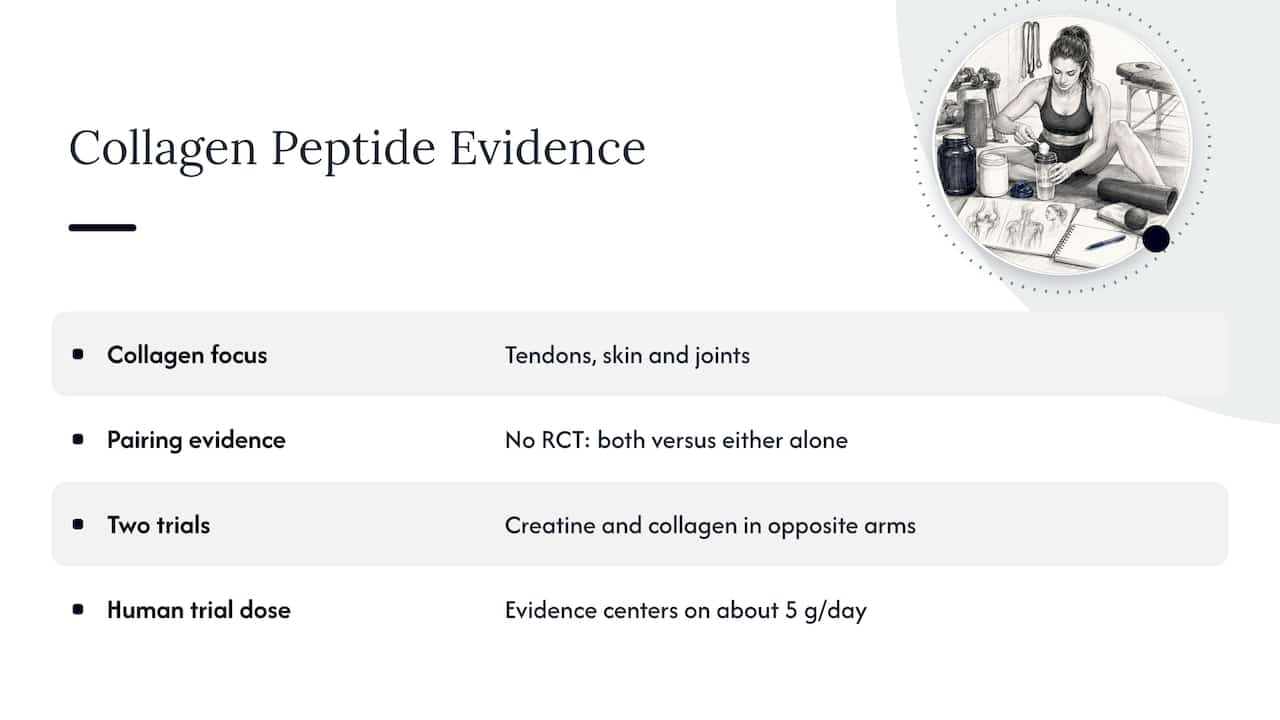
Collagen peptides are usually studied for connective tissue, such as tendons, skin and joints, not for building contractile muscle. A review of the literature on creatine and collagen peptides together found no randomized trial that gave the two together against either alone. In the two trials that used both, they sat on opposite arms of the study. So the honest answer to “can I take creatine and collagen peptides together?” is yes, there is no known reason they clash, but nobody has shown that the pair adds up to more than the parts.
If your goal is joints and tendons, the more relevant question is which collagen peptide, at what dose. We cover that in our guide to oral collagen peptides and joint repair, where the human trial evidence centres on about 5 g a day.
Creatine may also matter for tissues beyond muscle. If you are curious about creatine’s possible role in bone health alongside mechanical loading, this overview of creatine for bone health and osteogenic loading is a useful starting point, though bone outcomes are a separate topic from the muscle question here.
Protein hydrolysates: a small extra
A 2.4 g serving of hydrolysed plant protein is nutritionally modest. It may be a fine addition, but it is a minor amount next to the protein in a normal meal or shake. Treat it as a convenience feature, not a performance upgrade.
The comparison at a glance
| Option | What it is | Evidence strength for muscle/strength | Main caution |
|---|---|---|---|
| Creatine monohydrate alone | 3 to 5 g daily | Strong, long human track record | Early water weight, GI upset with big single doses |
| Creatine plus collagen or protein peptides | Blend, about 5 g creatine plus a few grams of peptide | Creatine part strong; blend advantage unproven | Paying more for an unproven extra |
| Creatine bound to peptides or amino acids | Chemically complexed forms | Insufficient independent evidence of superiority | Marketing claims outrun the trials |
| Creatine plus a research peptide | Two separate products | Creatine strong; peptide evidence varies by molecule | Regulatory status and quality of the peptide |
How to take it: dose, loading and timing
Daily dose
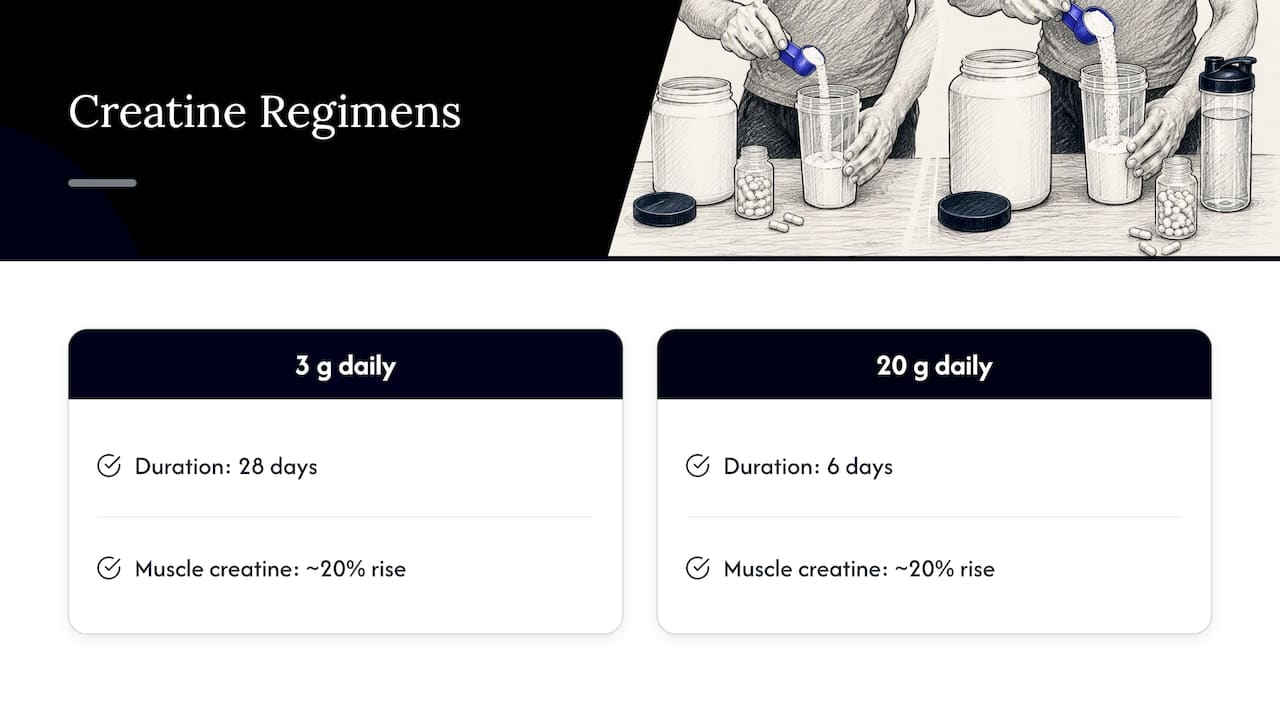
The ISSN review describes 3 to 5 g a day as the standard approach, which raises muscle stores gradually. In the comparison it cites, muscle creatine rose by roughly 20% after either 3 g a day for 28 days or 20 g a day for 6 days. Same destination, different speed.
Loading is optional
A loading phase uses 20 to 25 g a day for 5 to 7 days, split into smaller servings. The review notes that single doses above about 10 g may increase stomach distress, which is why the split matters. For most people a steady daily scoop is simpler and avoids the sharper early jump in weight.
Before, during or after training?
The ISSN authors’ practical message is that benefits depend on saturating muscle stores, not on a workout-window ritual. If a post-workout shake fits your routine, take it then. If you drink your coffee at 7 a.m., take it with that. The best time is the one you will not forget.
Practical steps
- Pick one creatine monohydrate product with the dose clearly stated per serving.
- Take 3 to 5 g daily, with food or fluid, at the same point in your routine.
- Skip loading unless you want faster saturation and can tolerate divided doses.
- Judge results over four weeks or more, using training logs rather than the scale.
- If you add a peptide, change one thing at a time so you know what is doing what.
“Why did I gain 10 pounds?”
A big scale jump after starting creatine usually alarms people, but it is rarely fat. The ISSN review reports that a 20 g a day loading phase commonly produces a 1 to 3 kg increase in body mass, mostly from net water retention. In a randomized study of acute creatine loading in men and women, 20 g a day for 5 days increased fat-free and total mass without increasing body fat.
Two things follow. First, a rapid change in the first week is a water story, not a muscle story. Second, if you gained a lot more than 3 kg, look at food intake and everything else that changed, because creatine alone does not explain it. Track waist measurement, training numbers and longer-term body composition. Gradual use at 3 to 5 g a day tends to produce a slower, smaller shift.
Downsides and who should be careful
The main drawbacks are early water-weight gain and stomach upset, especially with large single doses. Beyond those:
- Kidney disease. Health Canada’s licensed creatine entries tell people with kidney disease to consult a health professional before use.
- Pregnancy and breastfeeding. At least one licensed creatine product record says not to use it during pregnancy or breastfeeding. Ask your doctor or midwife.
- Blood tests. Creatine can raise serum creatinine without meaning your kidneys filter less well. If you have kidney-related bloodwork coming up, tell your doctor or pharmacist that you take creatine.
- Product quality. This is the risk people underrate, and it gets its own section next.
If you take prescription medication or have a medical condition, check with your pharmacist or physician before adding any supplement.
Buying creatine safely in Canada
Creatine monohydrate sold as a natural health product in Canada is meant to carry a licence. “Studied” does not make every tub equivalent. Health Canada has suspended and recalled creatine products before. One example is the licence suspension and all-lot recall of a creatine powder in 2021, which meant the product could no longer legally be sold. Other creatine products have been pulled for being out of specification.
A short checklist
- NPN. Confirm an active Natural Product Number, then look it up in the Health Canada database. Licence status can change, and some entries are marked discontinued or not marketed.
- Exact creatine dose. The label should state grams of creatine monohydrate per serving, not just a “proprietary blend” total.
- Peptide identity. Know which peptide, from what source, and how many grams. “Peptide complex” tells you nothing.
- Lot-specific testing. Ask for testing tied to the lot in your hands.
- Recall notices. Search the Health Canada recalls site for the brand before you buy.
Third-party testing is useful, but it is not the same as Canadian authorization. A certificate of analysis tells you what was in a batch. It does not tell you whether a product is authorized for sale in Canada, and it says nothing about whether a substance is suitable for injection or medical use.
Where research peptides fit
This is the part where we want to be plain. Creatine is a food-style supplement with decades of human data. Research peptides such as growth-hormone secretagogues or tissue-repair peptides are individual molecules whose evidence has to be read one at a time. Results from one peptide say nothing about another, and dose, route and formulation all change the picture.
If your real interest is muscle, the sensible order is: training, protein, sleep, then creatine, and only then a conversation about peptides. Our guides on lean muscle peptides and what the evidence shows and peptides for muscle growth set out what is and is not supported. Injectable products raise legal questions in Canada, which we explain in why you should not inject peptides without a DIN.
Our perspective
We sell peptides, not creatine, so we have no reason to oversell the combination. Here is how we see it.
Creatine monohydrate is the baseline. If someone tells you a peptide-bound version is a breakthrough, ask for the human trial. The same goes for us: when we write about a peptide, we try to separate what has been shown in people from what has only been shown in cells or animals, and from what users report.
We also think purity documentation is necessary but not sufficient. Third-party certificates of analysis are the right habit for any product you put in your body, and we back our own products with them. But a certificate is not an authorization, and a high purity number is not proof of an outcome. Read both the lab report and the regulatory status, and be sceptical of any page that blurs the two.
For most people building muscle, the simplest plan is also the best one: a daily creatine monohydrate dose, a solid training block, and patience. If you later want to explore peptides, do it with the evidence for that specific molecule in front of you.
— Pure Peptide
If you are exploring peptides
If you have the basics covered and want to look at peptides for muscle, recovery or body composition, start with our muscle growth peptides overview, then browse the categories on the Pure Peptide store. Our range covers weight loss, muscle growth, recovery, anti-aging and libido, plus reconstitution supplies such as bacteriostatic water, syringes and alcohol pads. Our products are sold as research-grade, with third-party certificates of analysis. For the compliance side, read our guide to buying peptides in Canada first.
FAQ
Can I take creatine and collagen peptides together?
Yes, mixing them in one drink is generally considered fine. They do different jobs: creatine has strong evidence for strength and high-intensity work, while collagen peptides are mostly studied for connective tissue. No direct randomized trial shows the pair beats either alone, so do not expect an extra muscle effect from the collagen.
Is it better to take creatine before or after a workout?
Consistency matters more than timing. The ISSN review supports daily supplementation, with 3 to 5 g a day raising muscle stores over several weeks. Take it when you will remember it, with or without training.
What is the downside of taking creatine?
The common ones are early water-weight gain and stomach upset, mostly with large single doses. People with kidney disease, and those who are pregnant or breastfeeding, should speak to a health professional first. Product quality also varies, so check the NPN and recall notices.
Are creatine peptides better than regular creatine monohydrate?
There is no independent human evidence that they are. The ISSN review addresses marketed alternative forms and the research does not show them outperforming monohydrate. A plausible mechanism, such as better solubility, is not a substitute for a trial with real outcomes.
Sources
- Common questions and misconceptions about creatine supplementation (ISSN, Journal of the International Society of Sports Nutrition, 2021)
- Acute creatine loading increases fat-free mass (PubMed)
- Health Canada Licensed Natural Health Products Database: creatine powder, NPN 80125910
- Health Canada: licence suspended, Perfect Sports Core Series Pure Creatine
- Health Canada: Kre-Alkaline out of specification
- The Workout Mag: Creatine peptides, evidence and dosing
- MuscleLedger: Creatine and collagen peptides together