





Melanotan is not safe in any way that has been proven. In Canada, Melanotan I and Melanotan II are unauthorized injectable drugs. They have no Drug Identification Number (DIN), no approval for tanning, and no completed large-scale safety trials behind them. The documented harms include nausea, changing moles, painful prolonged erections and, in rare case reports, kidney and muscle injury. If you have used it, or are thinking about it, this guide covers what is known, what is not, and what to do next.
We sell research peptides, so we are not writing this to scare you off the whole category. We are writing it because a tanning peptide sold on social media is one of the clearest examples of a product where the marketing runs far ahead of the evidence.
TL;DR
- Melanotan I and II are unauthorized in Canada. Health Canada has warned that unapproved injectable peptides have not been assessed for safety, efficacy or quality.
- The most common effect is nausea. The most worrying are darkening or changing moles, priapism (an erection that will not go away) and rare cases of kidney injury and rhabdomyolysis.
- Gray-market vials vary in what they contain, so the dose on the label is a guess.
- If a mole changes colour, size or border, or an erection lasts more than four hours, get medical care promptly. Do not wait it out.
- For colour without the risk, use a self-tanner or spray tan and a proper sunscreen.
Table of Contents
- What melanotan is and why people use it
- Is melanotan legal in Canada?
- The documented side effects
- The product problem: what is actually in the vial?
- Who should be most cautious
- If you have already used melanotan
- Safer ways to get colour
- Our perspective
- Looking for peptides with a clearer purpose?
- FAQ
- Sources
What melanotan is and why people use it
Melanotan II is a synthetic peptide that acts on melanocortin receptors. It signals the skin to make more melanin, the pigment that darkens skin. It was first studied at the University of Arizona as a possible way to protect against skin cancer, and is now sold online mainly as a tanning shot, as CBC reported when it began showing up in British Columbia. The nickname “Barbie drug” comes from that use.
The trouble is the word “melanocortin”. Those receptors are not only in the skin. They also sit in the brain and other tissues, and they influence appetite, blood pressure and sexual arousal. A review of the compound describes it as a non-selective melanocortin receptor agonist with no FDA approval and no completed Phase III trials. Non-selective means it does more than tan. That is why users report a package of effects, not one.
For a broader background on how our team looks at the compound, see our overview of the melanotan peptide and our page on the tanning peptide category.
Is melanotan legal in Canada?
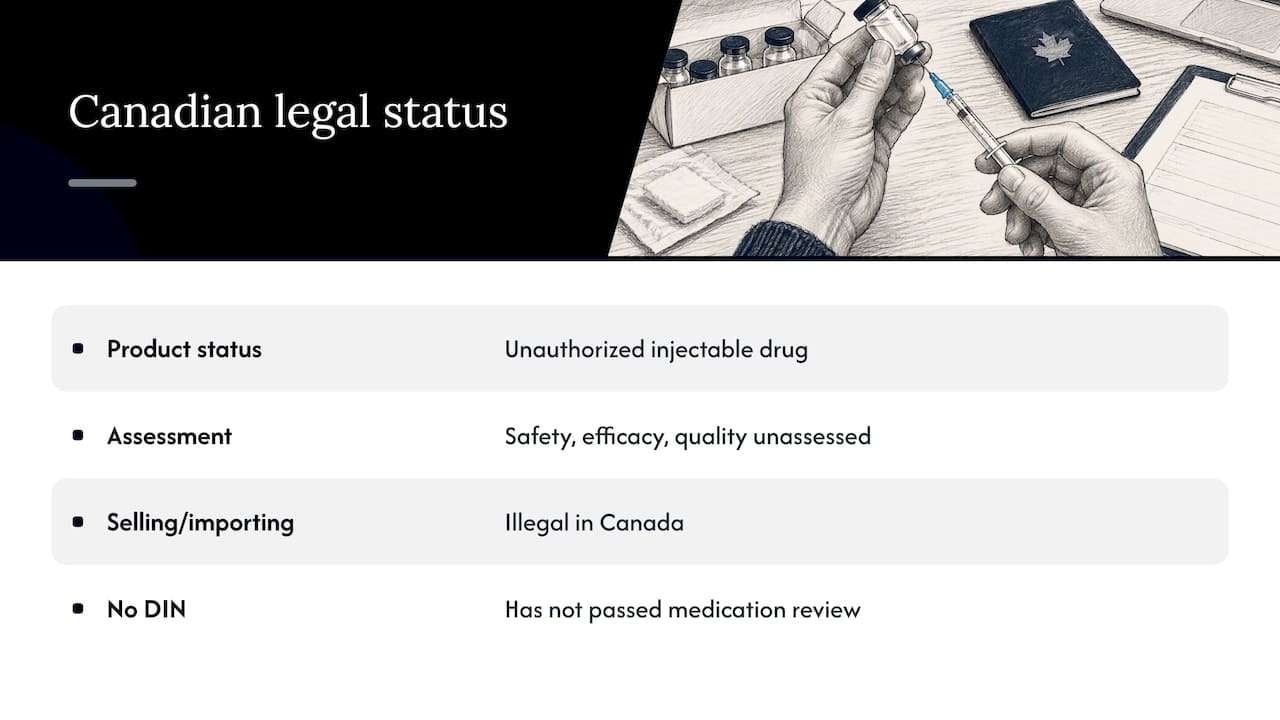
No, not as a tanning product or any other consumer product. Health Canada treats injectable melanotan as an unauthorized drug. Its public advisories, including one issued on 1 August 2025, say that unauthorized injectable peptides have not been assessed for safety, efficacy or quality, and that selling or importing them is illegal. The department’s advice is plain: do not buy or use unauthorized drugs, and consult a healthcare professional if you have used one and have health concerns.
Health Canada has also acted on the ground. It has published advisories after seizures of unauthorized injectable peptides from a wellness centre in Calgary, Alberta and from a fitness business that also sold products online. In April 2026 it published a notice urging people to think twice before injecting peptides bought online, describing unapproved products sold as anti-aging, bodybuilding or wellness aids.
What that means for you: a product with no DIN has not passed the review that a Canadian medication goes through. If you want the longer explanation of how DINs work, we cover it in why you should not inject peptides in Canada without a DIN.
The documented side effects
Not everyone gets every effect, and the evidence is a mix of small early trials and case reports. That limits how confidently anyone can state a rate. Here is what has been reported, from common to rare.
Nausea, flushing and other common effects
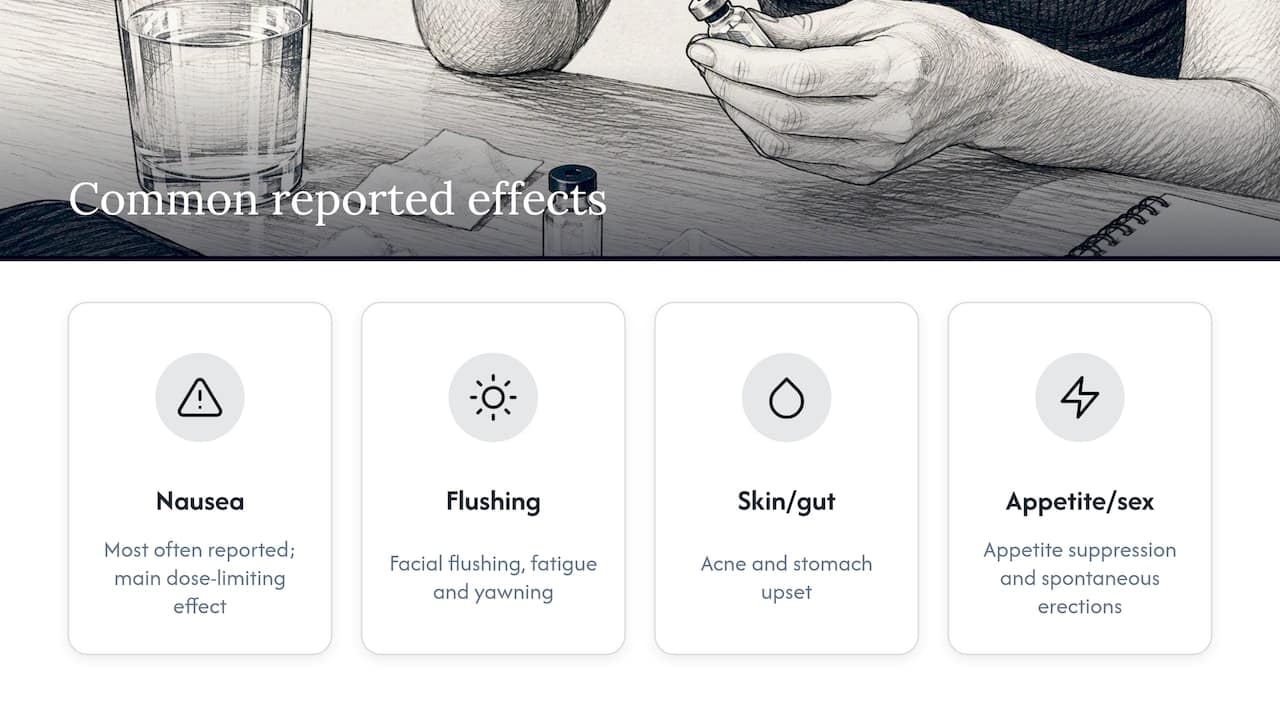
Nausea is the effect most often reported in clinical studies, and it has been the main factor limiting the dose. A research summary of the early human trials notes that nausea occurred at most dose levels in the Dorr et al. (1996) study. Other commonly listed effects are facial flushing, fatigue, yawning, acne and stomach upset, as described in a review of case reports. Many users also notice appetite suppression and spontaneous erections, which come from the same receptor pathways.
Moles, freckles and melanoma concern
This is the risk dermatologists worry about most. Melanotan can darken and enlarge existing moles. The clinical problem is twofold, according to an analysis of side effects: the drug changes how moles look, and that undermines the usual way of spotting danger, which is watching for changes in colour, size and border. A mole that was already atypical can become harder to judge.
The case reports go further. The same review that lists common effects notes that several case reports have linked melanotan II to dysplastic nevi and even melanoma. Those reports cannot prove cause, and the honest summary is that nobody has run the long-term studies needed to rule it out. The Canadian Cancer Society, quoted by CBC, warns against injectable tanning hormones for that reason.
If you have used melanotan, book a full skin check with your family doctor or a dermatologist, and tell them exactly what you used. Any mole that has changed needs prompt assessment.
Priapism
Because the compound activates pathways tied to sexual arousal, some men get erections they did not ask for. Priapism is the dangerous end of that: a prolonged, painful erection that is a medical emergency, since it needs immediate treatment. One published case report describes ischemic priapism after a melanotan injection that needed surgical decompression. If an erection lasts four hours or more, go to an emergency department. Do not wait for it to pass.
Kidney injury and rhabdomyolysis
Rare but serious: a case published in the medical literature describes melanotan II injection resulting in systemic toxicity and rhabdomyolysis, with signs of sympathetic overactivation and kidney dysfunction. A single case does not give a risk percentage, but it shows what can happen when an unregulated drug is taken without monitoring. Dark urine, severe muscle pain, weakness or very little urine after use are reasons to go to emergency care.
The product problem: what is actually in the vial?
Even if the compound itself were well studied, the gray market would still be a problem. Testing of vials sold online, reported in the Superpower review, found that the actual peptide content varied from the label. Without a regulated manufacturer, you have no assurance of dose, sterility or the absence of contaminants. Injecting a non-sterile product adds infection risk on top of the drug’s own effects.
Nasal sprays are no workaround. One overview of the nasal form lists mucosal irritation or bleeding, infections from unsterile tips and variable absorption as concerns, and that means the dose you get is even less predictable.
Who should be most cautious
No group is clearly safe, but some people have more to lose:
- Anyone with many moles, a history of atypical moles, or a personal or family history of melanoma. The mole-darkening effect matters most here.
- Anyone with kidney, heart or blood pressure problems. The drug has been reported to affect blood pressure and, in rare cases, kidney function.
- Anyone with fair skin who burns easily. A melanotan tan is not a substitute for sunscreen, and a darker skin tone does not remove the risk from UV.
- Anyone who is pregnant, trying to conceive or breastfeeding. There is no safety data to rely on.
- Men prone to erection problems or with conditions such as sickle cell disease, where priapism is already a risk. Ask a physician before anything else.
This is not a complete list. A pharmacist or physician who knows your history is the right person to ask, and you can ask without fear of judgement.
If you have already used melanotan
You are not the first, and you do not need to hide it from your doctor. Here is a sensible order of action.
- Stop using it and keep the vial or packaging. Note the source, dose and dates.
- Watch for emergencies. An erection over four hours, chest pain, dark urine, severe muscle pain or fainting means emergency care.
- Book a skin check. Ask for a full-body examination and mention the melanotan use, so the doctor interprets the moles properly.
- Photograph your moles under the same light every month, so changes are easier to see.
- Report it. Health Canada accepts reports about unauthorized health products, and its advisories invite anyone who has had a reaction to speak to a healthcare professional.
- Dispose of needles safely. Do not put used syringes in household recycling. See where to return used syringes in Canada.
For general principles that apply before injecting anything, our peptide safety guide is a good next read.
Safer ways to get colour
The Canadian Cancer Society’s position, as reported by CBC, is that there is no safe tanning drug. If your goal is simply a tanned look, the options with a known risk profile are topical.
- Self-tanner. It colours only the outer layer of skin and does not involve UV or injections. A well-written explanation of why self-tanner is replacing tanning beds covers the practical side.
- Good preparation. Even colour depends on the skin underneath. This guide to exfoliating about 24 hours before you tan is a practical way to avoid patches.
- Spray tans. Done in a salon, they give a quick result without needles.
- Sunscreen anyway. Cosmetic colour does not protect you from UV. Use broad-spectrum sunscreen on exposed skin.
None of these gives the deep, lasting colour that melanotan users chase. That trade-off is the point: the colour you can get safely is more modest, and it fades without leaving you with an unknown drug in your body.
Our perspective
We work in peptides every day, so we hold the category to a higher standard than most. Three things guide how we think about safety.
First, a peptide is not safe or unsafe because it is a peptide. What matters is whether the compound has been studied in humans for the purpose you want, whether the product matches its label, and whether you have a clinician watching for problems. Melanotan fails on the first, and the gray market typically fails on the second.
Second, purity is necessary but is not the same as safety. A vial can be accurately labelled and still contain a compound with an unproven risk profile. Third-party certificates of analysis tell you what is in a vial; they do not tell you whether it is wise to inject it. We would rather say that plainly than let purity numbers do the persuading.
Third, Canadian rules exist for a reason. We encourage readers to understand the legal status of anything they buy, which is why we publish guides such as buying peptides in Canada. If a product is promoted for tanning and you cannot find a DIN, a regulator’s page or a human trial, treat that as the answer.
— Pure Peptide
Looking for peptides with a clearer purpose?
If your goal is fat loss, muscle growth, recovery or skin aging rather than a tan, we supply peptides in those categories and the supplies that go with them, such as bacteriostatic water, syringes and alcohol pads. Our products are backed by third-party lab certificates of analysis. Browse the full range at Pure Peptide, and read the safety and legal guides first.
FAQ
Is melanotan 2 safe?
It has not been shown to be safe. It has no approval from Health Canada or the FDA, and the evidence consists of small early trials and case reports. Reported problems include nausea, changing moles, priapism and rare kidney and muscle injury.
Does melanotan 2 affect the heart?
Blood pressure effects are listed among the concerns in a summary of the compound’s safety status and the case report of systemic toxicity described signs of sympathetic overactivity. There is no good long-term cardiac data. If you have heart or blood pressure problems, speak to a physician before any unapproved drug.
Can melanotan cause skin cancer?
Nobody has proven that it does, and nobody has proven that it does not. Case reports link it to atypical moles and melanoma, and it can change how moles look, which makes early detection harder. A full skin check is sensible for anyone who has used it.
What should I do if I have side effects after using melanotan?
Stop using it and contact a healthcare professional, such as a physician, nurse practitioner or pharmacist. Go to emergency care for an erection lasting four hours or more, dark urine, severe muscle pain or chest pain.
Sources
- Health Canada: unauthorized injectable peptide drugs seized and sold by Canada Peptide
- Health Canada: seizure at Optimum Wellness Centre, Calgary
- Health Canada: unauthorized health products seized at Rize Fitness
- Health Canada: think twice before injecting peptides bought online
- CBC: injectable tanning drug raising concerns in B.C.
- Melanotan II injection resulting in systemic toxicity and rhabdomyolysis
- Melanotan Tanning Injection: A Rare Cause of Priapism
- Melanotan II: Mechanism, Safety Risks, and Status, Superpower
- Melanotan II (MT-II): Research Evidence and Safety Profile, PeptideInsight
- Melanotan II side effects: the mole problem, priapism and serious rare events
- Tanning Peptide Nasal Spray Dosage and Side Effects