






No peptide is proven to heal the gut in humans. BPC-157, the one people ask about most, has decades of animal data behind it and almost nothing in people. In Canada, injectable versions are also not authorized for sale, and Health Canada has been seizing them. This guide explains what the research does and doesn’t show, how the main peptides compare, what the legal position is, and what to do first if your gut is the problem.
We sell research-grade peptides, so you might expect a sales pitch here. You won’t get one for this topic. The honest answer is more useful to you than a promise we can’t support.
TL;DR
- BPC-157, KPV and LL-37 are the peptides most often linked to gut repair. Their gut evidence comes mainly from rodent and cell studies, not human trials.
- In Canada, Health Canada has warned that unauthorized injectable peptides, including BPC-157, have not been assessed for safety, efficacy or quality.
- Persistent bloating, pain, blood in stool or weight loss need a physician’s diagnosis before any peptide. They can signal IBD, celiac disease or other conditions.
- The only peptide approved in Canada for a gut condition is teduglutide, a prescription drug for short bowel syndrome.
- Diet, a licensed probiotic with an NPN, and medical care have a far stronger evidence base for gut health than any research peptide.
Table of Contents
- What people mean by gut healing peptides
- BPC-157 and the gut: what the research actually says
- The other peptides named for gut health
- What the law says in Canada
- Why you should see a doctor before you try anything
- The one peptide approved for a gut condition
- What has better evidence for gut health
- Our perspective
- Where our range fits
- Vetting any peptide claim before you trust it
- FAQ
- Sources
What people mean by gut healing peptides
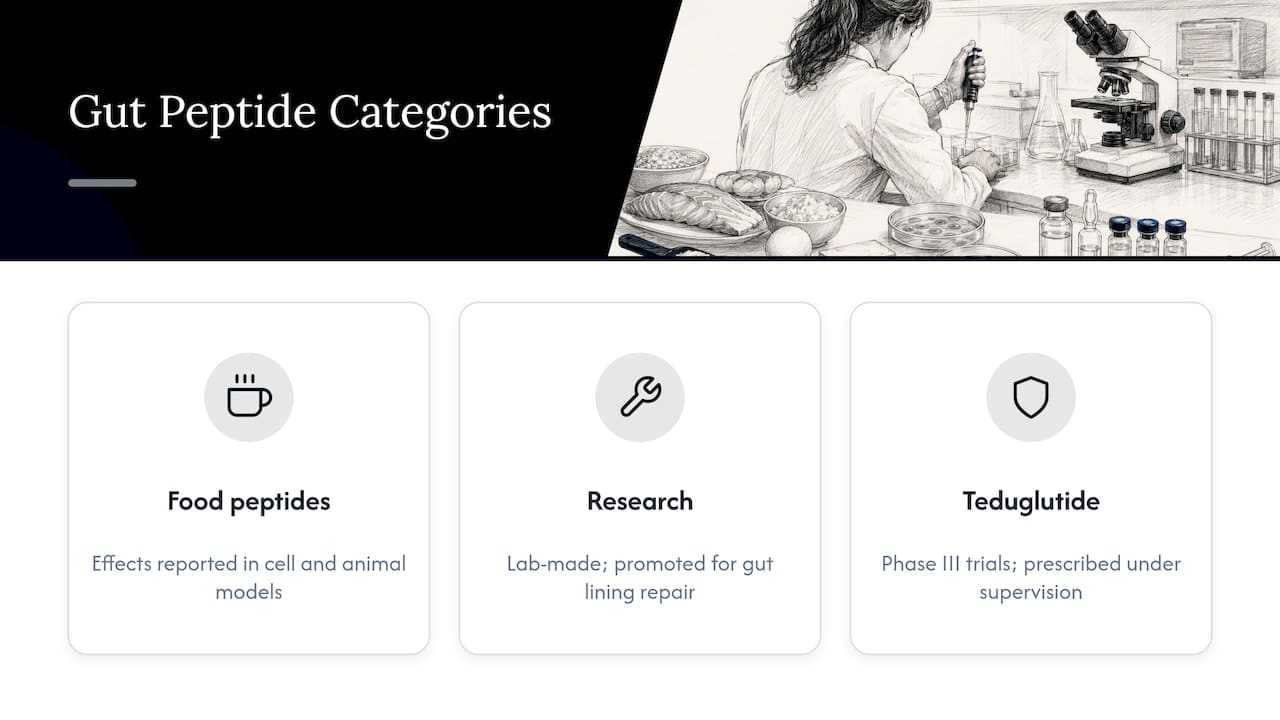
The phrase covers three very different things, and mixing them up is how most of the confusion starts.
Food-derived peptides. These are short protein fragments released when you digest or process whey, egg, soy or quinoa. A review of food protein-derived bioactive peptides describes anti-inflammatory and barrier-supporting effects in cell and animal models. Those effects involve the microbiota, cytokine signalling and the tight junctions between intestinal cells. Nothing there is an injectable product. We cover the food side in our piece on peptides in food.
Synthetic research peptides. BPC-157, KPV, LL-37 and thymosin alpha-1 sit here. They are made in a lab, usually sold as freeze-dried powder, and promoted for gut lining repair and inflammation.
Approved peptide drugs. Teduglutide is the clear example. It went through phase III trials and is prescribed under medical supervision.
When a page says “gut healing peptides,” ask which of the three it means. The evidence, the risk and the legality differ completely.
BPC-157 and the gut: what the research actually says
BPC-157 is a 15-amino-acid fragment of a protein found in human gastric juice. That origin explains why the gut is its best-studied area. PeptideTrace’s profile calls it one of the most widely discussed research peptides, especially among people interested in joint, tendon and gut recovery.
Here is the picture as we read it:
- Animal data is large. Rodent studies over many years report protective effects on stomach ulcers, colitis models and intestinal wound healing.
- Human data is thin. One review of the IBD evidence says a phase II ulcerative colitis trial under the code PL 14736 was completed, but its results were never published in a peer-reviewed journal. That is a gap, not a result.
- Rat results don’t transfer automatically. Dose, route, gut anatomy and disease biology all differ in people.
So can you say BPC-157 heals the gut? You can say it looks promising in animals. You can’t say it has been shown to heal anyone’s gut. If you want the general research picture, see our BPC-157 overview. For musculoskeletal use, there is a separate page on BPC-157 and tendon healing.
What about BPC-157 for digestion and gut inflammation?
The same limits apply. Reports of better digestion are anecdotal. Inflammation in animal colitis models is not the same as the chronic, immune-driven inflammation of Crohn’s disease or ulcerative colitis. If you have bloating or loose stools and hope a peptide will settle them, you are guessing at the cause. That is exactly the situation where a wrong guess costs time.
The other peptides named for gut health
| Peptide | Why it’s linked to the gut | Strength of evidence |
|---|---|---|
| BPC-157 | Gastric-derived; protective effects on mucosa in animal studies | Extensive animal data, almost no published human data |
| KPV | Small fragment studied for anti-inflammatory action on mucosal tissue | Mostly mouse colitis and cell work |
| LL-37 | Antimicrobial peptide made by the body | Mostly lab and animal work |
| Thymosin alpha-1 | Immune-modulating peptide | Used in some countries for other conditions; gut use is speculative |
| Teduglutide | GLP-2 analogue that promotes intestinal absorption | Phase III trials; approved for short bowel syndrome |
| Food-derived peptides | Whey, egg and quinoa fragments | Cell and animal models; early nutraceutical research |
The ranking pages that dominate search results for this topic tend to agree on one point: the gut evidence for these peptides is early. Several of them say outright that the field is still experimental, and that most products sold under the “gut healing” label are not evidence-based clinical treatments.
What the law says in Canada
This is the part many articles skip, and it matters if you live here.
Health Canada’s position is consistent across its recent notices. Unauthorized injectable peptide drugs seized from a Calgary wellness clinic in April 2025 included BPC-157. An August 2025 notice about an online seller listed BPC-157 alongside many others. In December 2025, Health Canada reported seizures tied to a fitness centre covering injectable peptide drugs, and a separate notice about two stores in Maple Ridge, BC did the same.
The common thread: these products have not been assessed for safety, efficacy or quality, and injecting something unassessed carries real risk of impurity, contamination and reactions nobody has studied.
A CBC News investigation also found that unauthorized peptides such as BPC-157 were being promoted by clinics across the country, including with claims about gut lining repair. A clinic website is not an approval. If you want the legal detail in one place, read our guide on peptide legality in Canada and the DIN requirement.
What this means in practice:
- A product labelled “for research use” is not a Health Canada-authorized treatment for anything.
- Purity figures and lab certificates tell you what is in the vial. They do not tell you the compound is safe or effective for your gut.
- If a seller or clinician says a peptide is safe for gut healing, ask for the Drug Identification Number (DIN). No DIN, no authorization.
Why you should see a doctor before you try anything
Gut symptoms overlap enormously. Bloating, cramping, urgency and loose stools can come from irritable bowel syndrome, celiac disease, small intestinal bacterial overgrowth, food intolerance, infection, inflammatory bowel disease, or something more serious. Self-treating with an unauthorized peptide can delay a diagnosis that has a proper treatment. The risk is highest when the underlying problem is inflammatory or structural, because the damage can keep progressing while you wait.
Book a visit with your family doctor or a gastroenterologist if you have any of these:
- Blood in your stool, or black, tarry stools
- Unexplained weight loss
- Diarrhea lasting more than a few weeks, or waking you at night
- Persistent abdominal pain, or pain with fever
- Trouble swallowing, or vomiting that won’t stop
- A family history of IBD, celiac disease or bowel cancer
If you already have a diagnosis such as Crohn’s disease or ulcerative colitis, talk to your gastroenterologist before adding any unapproved compound to your treatment. Interactions with immune-suppressing medication are not something to test on yourself.
The one peptide approved for a gut condition
Teduglutide (sold as Gattex or Revestive) is the clear exception to everything above. It is prescribed for short bowel syndrome, where so much intestine has been lost that a person cannot absorb enough nutrition and depends on intravenous feeding. PeptideTrace’s summary notes that it completed phase III trials and is prescription-only.
It is a useful benchmark. A peptide for a gut condition looks like this: a defined patient group, a defined dose, controlled trials, a regulator’s sign-off and a prescriber. Anything marketed for general “gut healing” without those is operating on hope.
What has better evidence for gut health
If your goal is a calmer, healthier gut, these steps carry more weight than any research peptide.
- Get the diagnosis. Ask your doctor about screening for celiac disease and inflammatory markers, especially if symptoms are persistent.
- Look at diet first. Fibre variety, fermented foods, limiting heavy alcohol use and identifying real trigger foods are the foundation of most gut advice. Large studies such as a University of Alberta trial on prebiotics and diet are testing diet-based approaches for gut barrier function in relatives of people with Crohn’s disease.
- Choose licensed products. In Canada, a natural health product with an eight-digit Natural Product Number (NPN) has been reviewed by Health Canada. For example, one licensed S. boulardii product is authorized to support intestinal health and reduce the risk of antibiotic-associated diarrhoea. Another licensed probiotic is authorized to help support gastrointestinal health.
- Support the basics. Sleep, stress management and regular activity all affect gut function.
- Ask about food-derived peptides. Whey and other protein sources are being studied for barrier support, and they come as food, not injections.
Probiotics aren’t a cure either. They are authorized for modest, specific claims, and the licence tells you exactly which.
Our perspective
We sell research-grade peptides, and we hold them to a purity standard backed by third-party lab certificates of analysis. We stand behind that. But purity and efficacy are different questions, and we think readers are better served when the two are kept apart.
Here is how we see the gut topic. A certificate of analysis can tell you that a vial contains what the label says. It cannot tell you that the compound heals a human intestine. For BPC-157 and its relatives, the honest summary is promising animal work and a missing human evidence base. We would rather say that plainly than lean on a phrase like “gut healing” that the data doesn’t support.
Our customers tend to be athletes and fitness-minded adults with a specific goal: recovery, muscle, body composition, skin. Gut symptoms are a different category. If you have them, we’d ask you to see a physician first, and to read our guides on peptide safety and peptide science before you decide anything. If you do use research peptides, know that in Canada they are not authorized for personal injection, and that decision and its risks are yours.
— Pure Peptide
Where our range fits
Our catalogue covers research-grade peptides for weight loss, muscle growth, recovery, anti-aging and libido, plus ancillaries such as bacteriostatic water, syringes and alcohol pads. We don’t offer a product for treating gut conditions, and we don’t present anything we sell as a substitute for medical care. If your interest is recovery research rather than digestion, our guides on peptides for recovery and peptides for healing are a better starting point. You can browse the full range at purepeptide.co.
Vetting any peptide claim before you trust it
Whatever you are considering, run it through a short checklist.
- Who is the evidence from? Human trials beat rodent studies. Published, peer-reviewed trials beat a company’s own summary.
- Is the claim specific? “Heals leaky gut” is a marketing phrase. “Reduced a defined marker in a defined group” is a finding.
- Is there an authorization? In Canada that means a DIN for a drug or an NPN for a natural health product.
- What does the seller gain? A page ranking peptides will often sell them. Read it with that in mind, including this one.
- What would you do if it didn’t work? If the answer is “wait longer,” and your symptoms are significant, that is the signal to see a doctor instead.
On “leaky gut” in particular: increased intestinal permeability is a real research topic, and the University of Alberta trial above studies it. But it is not a standalone diagnosis with a proven peptide fix, and symptom lists attached to it online are often vague enough to fit almost anything.
FAQ
Is there a peptide that helps with gut issues?
One peptide drug, teduglutide, is approved in Canada for a gut condition, and only for short bowel syndrome under specialist care. For other gut problems, no peptide has proven benefit in humans. BPC-157 and KPV show effects in animal models, but that is not the same as evidence in patients.
Is BPC-157 legal in Canada?
BPC-157 is not authorized by Health Canada, and the department has repeatedly flagged it in seizure notices. Selling injectable peptides for personal use without authorization is not permitted. Check the DIN or NPN on anything you are offered, and speak with your doctor or pharmacist.
Does BPC-157 help with inflammation in the gut?
In rodent colitis models it has shown protective effects. In people, we don’t have published trial results showing it reduces gut inflammation. If you have inflammatory symptoms, the first step is a diagnosis, because Crohn’s disease and ulcerative colitis need medical management.
Do supplements fix a leaky gut?
No supplement has been proven to fix it. Some Health Canada-licensed probiotics are authorized to support gut flora and gastrointestinal health, which is a modest claim. Diet, medical assessment and treating any underlying condition matter more.
Sources
- Food protein-derived bioactive peptides and chronic intestinal inflammation, PMC
- Peptides and gut health: experimental-stage overview, PMC
- BPC-157 profile, PeptideTrace
- Teduglutide profile, PeptideTrace
- BPC-157 for IBD: what the evidence shows
- Health Canada: unauthorized injectable peptides sold by an online seller
- Health Canada: injectable peptides seized in Calgary
- Health Canada: products seized at Rize Fitness
- Health Canada: products seized in Maple Ridge, BC
- CBC News: regulatory loophole and unauthorized peptides
- University of Alberta trial on prebiotics, diet and leaky gut
- Health Canada licensed product database: S. boulardii product
- Health Canada licensed product database: probiotic product