






Yes, endotoxin testing is essential for peptides used in cell based assays or any parenteral work, because chemical purity does not tell you anything about lipopolysaccharide (LPS) contamination. Compendial references such as USP Chapter <86> define how endotoxin testing should be validated, and some suppliers document purity and testing standards separately from endotoxin data. Before you trust a peptide for sensitive work, ask for a numeric endotoxin result, the test method used, and spike and recovery data.
TL;DR:
- Endotoxin testing must be performed separately from chemical purity assessments, with results including numeric values, test methods, and spike recovery data.
- Contamination sources include water, buffers, production equipment, reagents, and consumables, which can cause false positives or misleading assay results.
- Validated endotoxin detection methods include gel clot, chromogenic, kinetic LAL, recombinant factors, and monocyte activation tests, each requiring proper validation and recovery checks.
- Researchers should convert EU per mg or mL results into dose-specific exposure and apply stricter internal limits for cell culture or animal studies, due to variability in tolerances.
- High HPLC purity does not imply low endotoxin levels, so both purity and endotoxin data are essential before using peptides in sensitive biological or animal experiments.
Table of Contents
- What endotoxins are and why they matter for peptide research
- How endotoxin testing is performed on peptides
- Acceptable endotoxin levels and how to interpret EU per mg and EU per mL
- Does high HPLC purity mean low endotoxin?
- Removal and mitigation strategies for endotoxin contamination
- How to verify a supplier’s endotoxin testing before you buy
- Pure Peptide’s lab standards and what to expect from a COA
- Regulatory guidance beyond USP and Ph. Eur.
- Best practices for sample preparation before endotoxin testing
- Emerging technologies in endotoxin detection
- How endotoxin contamination affects peptide efficacy and safety
- When to demand full validation versus minimal screening
- Get peptides backed by documented purity and testing standards
- Sources
- FAQ
What endotoxins are and why they matter for peptide research
Endotoxin, more precisely lipopolysaccharide (LPS), is a structural component of the outer membrane of Gram negative bacteria. It is one of the most potent activators of innate immunity known, triggering Toll like receptor 4 (TLR4) signalling and a downstream cytokine cascade even at trace concentrations. LPS structure varies by bacterial species and by how a sample was processed, which affects both its toxicity and how easily it is detected in an assay.
For peptide researchers, the practical concern is contamination that enters during production rather than anything inherent to the peptide itself. Common sources include:
- Water systems: non-sterile or poorly maintained water for injection or lab-grade water can carry bacterial residues.
- Buffers and excipients: raw materials used in reconstitution or formulation may already carry endotoxin load.
- Production equipment: glassware, filters, and shared manufacturing lines can introduce cross-contamination between batches.
- Reagents and consumables: pipette tips, vials, and even some plasticware are not guaranteed endotoxin free unless certified.
The downstream effects show up in the data long before anyone suspects contamination. Cytokine release assays can read a false positive because the LPS itself, not the peptide, is stimulating the response. Cell viability assays can show unexplained toxicity or inflammatory signalling that has nothing to do with the compound under study. In vivo work is even less forgiving: even sub-nanogram endotoxin exposure can confound behavioural or immune readouts in small animal models, making an otherwise clean experiment impossible to interpret.
How endotoxin testing is performed on peptides
Several distinct methods exist, and knowing which one produced a reported number changes how you should interpret it.
- Gel clot LAL: the oldest limulus amebocyte lysate format, it gives a pass or fail result based on clot formation at a known dilution. It is simple and inexpensive but only semi-quantitative.
- Chromogenic and kinetic LAL: these read a colour change over time to produce a numeric endotoxin unit (EU) value, offering better sensitivity and a defensible quantitative result for a certificate of analysis.
- Recombinant Factor C (rFC) and recombinant cascade reagents (rCR): non-animal alternatives to lysate-based testing. USP Chapter <86> recognizes these as alternative methods, but they require validation and demonstrated fitness for use rather than blanket acceptance.
- Monocyte activation test (MAT): a cell based assay that measures the biological pyrogenic response, capturing endotoxin and some non-endotoxin pyrogens that LAL-based tests miss.
- Rabbit pyrogen test: the original biological pyrogen test, now largely reserved for cases where MAT or LAL are unsuitable, given the animal welfare and practical drawbacks.
A typical LAL workflow involves diluting the sample to the maximum valid dilution, running an inhibition or enhancement check to confirm the matrix doesn’t interfere with the reagent, then spiking a known amount of endotoxin into the sample to confirm recovery. Recovery outside the accepted range signals interference or masking rather than a clean result, and results are reported as EU per mg or EU per mL depending on the sample type.
Pro Tip: Always ask whether a reported endotoxin value came from a spiked sample that passed recovery criteria, not just a raw reading.
Acceptable endotoxin levels and how to interpret EU per mg and EU per mL
Endotoxin results are reported in endotoxin units (EU), most often as EU per mg for a solid peptide or EU per mL for a reconstituted solution. To translate a result into a per-dose exposure, multiply the EU/mg value by the mass of peptide used. As an illustrative example only, a peptide reporting 0.5 EU/mg dosed at 2 mg would deliver 1 EU per dose, a figure you would then weigh against your assay’s tolerance.
Compendial pharmaceutical limits exist for marketed injectable products, but these thresholds were built around specific approved formulations and dosing regimens, not general research use. For in vitro cell culture, even low endotoxin levels can skew cytokine or immune cell assays, so many labs apply a stricter internal cutoff than any compendial limit. For parenteral research use in animal models, the safety margin should be conservative, and the exact tolerance depends on the species, the assay’s sensitivity to inflammatory noise, and the total dose volume.
When in doubt, treat a reported numeric result as a starting point for your own risk assessment, not a guarantee of assay compatibility.
Does high HPLC purity mean low endotoxin?
No. HPLC purity measures chemical impurities: truncated sequences, deletion peptides, and residual solvents. It says nothing about biological contaminants like LPS, which can be pyrogenic and immunostimulatory at concentrations far below what HPLC can even detect as a distinct peak.
The two measurements come from entirely different instruments and entirely different biology: one tells you what’s chemically in the vial, the other tells you what your cells will react to. For any application involving live cells or animals, request both a purity report and a numeric endotoxin result before assuming a high-purity peptide is safe for sensitive work.
Removal and mitigation strategies for endotoxin contamination
Reducing endotoxin load, or limiting its impact on your data, comes down to a handful of proven approaches.
- Dry heat depyrogenation: effective for glassware and heat-stable materials, typically run at high temperature for an extended hold time, but it cannot be applied to the peptide itself.
- Validated single-use consumables: pre-certified low-endotoxin vials, tips, and filters remove a major contamination pathway without extra processing.
- Filtration and affinity resins: some chromatographic and affinity-based methods can strip LPS from a peptide solution, though aggressive processing risks reducing peptide yield or altering its activity, so post-treatment recovery and bioactivity should be confirmed.
- Formulation choices: buffers containing surfactants or chelating agents can mask endotoxin from detection through low endotoxin recovery (LER), so formulation and matrix design should be considered alongside removal.
Pro Tip: If a supplier’s spike recovery fails and doesn’t improve on further dilution, suspect LER or matrix masking rather than a simple detection error.
How to verify a supplier’s endotoxin testing before you buy
A certificate of analysis that only lists purity tells you half the story. Ask for these items specifically:
- Numeric endotoxin result with units (EU/mg or EU/mL), not a pass/fail statement alone.
- Test method used: LAL (gel clot, chromogenic, or kinetic), rFC/rCR, or MAT.
- Spike and recovery data: confirms the matrix does not mask true endotoxin levels.
- Lot identity, test date, and testing lab: ties the result to the exact batch you’re receiving.
- Acceptance criteria: the cutoff the supplier used to pass or fail that lot.
Spike and recovery studies matter because of low endotoxin recovery, a masking phenomenon where LPS spiked into undiluted samples cannot be fully recovered over time, particularly in matrices with surfactants or chelators. A supplier that can’t produce hold-time or spike data for its formulation hasn’t actually confirmed its endotoxin number is trustworthy. A simple request works: “Can you provide the numeric endotoxin result, test method, and spike recovery data for this lot?”
Pure Peptide’s lab standards and what to expect from a COA
Pure Peptide reports formulations exceeding 99% purity using advanced purification methods, and documents this through third-party certificates of analysis where offered. That purity figure addresses chemical impurity, which is a separate question from endotoxin load, so it should be read alongside whatever endotoxin data accompanies a given lot rather than in place of it.
Researchers running sensitive cell based or parenteral work should still map any COA received against the full verification checklist: numeric endotoxin value, test method, spike recovery, and lot-specific testing dates. Independent confirmation in-house remains good practice for any critical assay, regardless of supplier documentation, and any proprietary testing details a supplier hasn’t published should simply be requested directly.
Regulatory guidance beyond USP and Ph. Eur.
USP Chapter <85> and <86>, along with the European Pharmacopoeia, form the backbone of compendial endotoxin testing guidance, but they are not the only bodies with a stake in the topic. The World Health Organization publishes technical guidance on pyrogen testing for biological products, generally aligning with the same LAL and rabbit pyrogen principles used in USP and Ph. Eur. frameworks, though applied primarily to vaccines and biologics rather than research peptides specifically.
In the United States, the FDA’s expectations for parenteral products draw directly on USP compendial methods, and its guidance documents on alternative methods echo the same validation and fitness-for-use requirements found in Chapter <86>: a lab adopting recombinant reagents needs to demonstrate the new method performs comparably to the traditional lysate-based test for its specific matrix. None of these frameworks were written with unregulated research-grade peptides in mind, since compendial thresholds apply to approved, marketed pharmaceutical products.
That gap matters practically. A research peptide sold for laboratory use isn’t subject to the same mandatory testing regime as an approved injectable drug, which is exactly why the burden falls on the researcher to request the relevant data and apply it against a defensible internal standard, rather than assuming regulatory oversight has already handled it. Reviewing a supplier’s safety documentation, including its handling guidance, is one part of building that internal standard.
Best practices for sample preparation before endotoxin testing
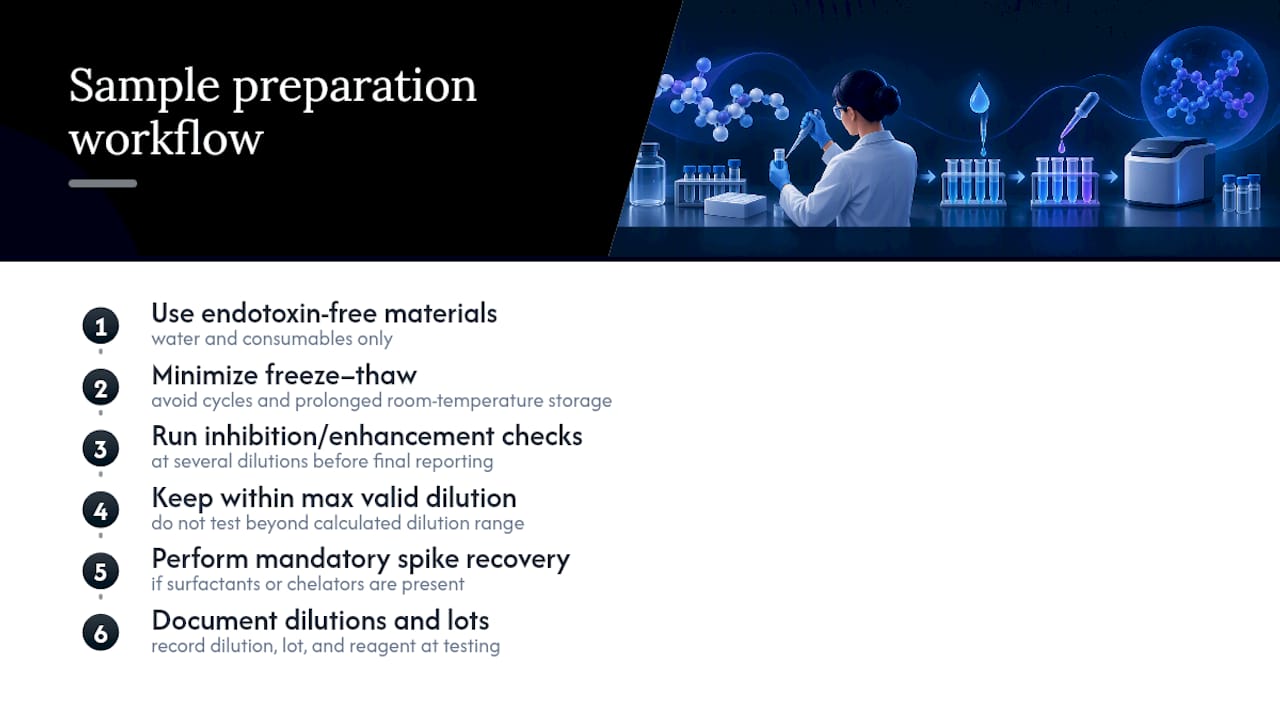
Getting an accurate endotoxin reading starts before the sample ever reaches the assay. Use certified endotoxin-free water and consumables throughout, since a contaminated diluent or pipette tip can add false signal that has nothing to do with the peptide itself.
Run a preliminary inhibition and enhancement check at several dilutions to confirm the matrix doesn’t interfere with the LAL reagent before generating the final reported value. Avoid unnecessary freeze-thaw cycles or prolonged room-temperature storage of the reconstituted sample, since some peptide matrices shift in a way that affects LPS detectability over time.
Keep the dilution series within the maximum valid dilution calculated for the sample, since testing outside that range risks both false negatives and false inhibition readings. Document every dilution, lot, and reagent used at the time of testing so any anomalous result can be traced back to a specific step rather than treated as unexplained noise. Where a formulation contains surfactants or chelating agents, treat spike recovery as mandatory rather than optional, given the established link between those additives and low endotoxin recovery.
Emerging technologies in endotoxin detection
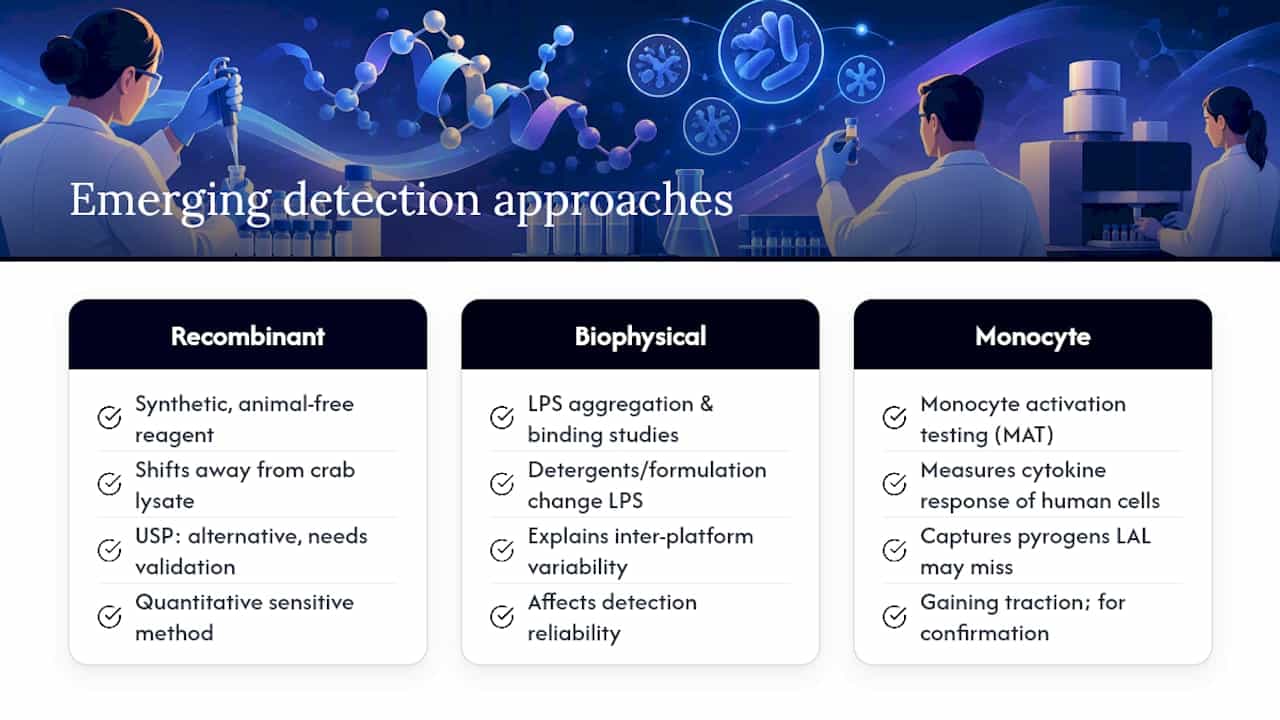
Recombinant Factor C and recombinant cascade reagents represent the clearest shift underway in endotoxin testing, moving the field away from horseshoe crab derived lysate toward a synthetic, animal-free reagent. USP guidance now formally addresses these reagents, though it still treats them as alternative methods requiring validation rather than a drop-in replacement for LAL.
Biophysical research into how LPS aggregates and binds within different formulations is also reshaping how labs think about detection reliability. Understanding that detergents and formulation choices change the physical state of LPS helps explain why the same sample can give different results across test platforms, and why a single passing result on one method doesn’t guarantee the same outcome on another.
Monocyte activation testing continues to gain traction as a biologically grounded alternative that captures pyrogens LAL-based methods might miss entirely, since it measures the actual cytokine response of human immune cells rather than a proxy clotting cascade. For peptide researchers, the practical takeaway is that no single method is likely to become a universal standard soon: the more realistic path is combining a sensitive quantitative method with periodic biological confirmation for the highest-stakes work.
How endotoxin contamination affects peptide efficacy and safety
Endotoxin contamination doesn’t just add background noise to an assay, it can actively change the biological outcome you’re measuring. Because LPS triggers TLR4-mediated cytokine release, a peptide being evaluated for an anti-inflammatory or immune-modulating effect can appear far less effective, or even counterproductive, if the sample is also delivering an inflammatory stimulus from contamination.
In efficacy studies, this creates a confound that’s easy to miss: a peptide’s true biological signal gets buried under, or falsely amplified by, the immune response to endotoxin itself. In safety-focused work, particularly anything involving cell viability, toxicity screening, or animal dosing, contamination can produce symptoms that mimic an adverse reaction to the peptide when the actual cause is the endotoxin load. This makes clean data the foundation of any efficacy or safety conclusion. A peptide’s real pharmacological profile can only be assessed once endotoxin contribution has been ruled out through appropriate testing, which is exactly why numeric endotoxin data, not just a purity figure, belongs in every serious research protocol.
When to demand full validation versus minimal screening
If your assay is highly endotoxin sensitive or the material will be used parenterally, insist on full numeric EU results, a validated method, and spike or hold-time data. For exploratory in vitro screening with a tolerant assay, a supplier’s numeric result paired with your own in-lab control is often a reasonable middle ground.
— Pure Peptide
Get peptides backed by documented purity and testing standards
Sorting through endotoxin methods and hold-time studies takes real effort, and not every research budget has room for a full in-house validation program on top of the work itself.
That still leaves the endotoxin verification steps covered above squarely in your hands: request the numeric result, the method, and the spike recovery data for any lot you’re considering, whether from Pure Peptide or any other source. Browse the current peptide categories for weight loss, muscle growth, recovery, anti-aging, and libido research, and check the documentation available for the specific compound you need before your next order.
This article is general information, not a substitute for advice from a qualified doctor. Consult a qualified healthcare professional about your own circumstances before acting on anything here.
Sources
- Low Endotoxin Recovery—Masking of Naturally Occurring Endotoxin
- Chapter <86>: Frequently Asked Questions
FAQ
What is an acceptable endotoxin level in peptides?
There’s no single universal cutoff for research peptides, since compendial limits were built for approved marketed injectables rather than lab-use compounds. Many labs apply conservative internal thresholds for cell culture and parenteral animal work, weighing the reported EU/mg or EU/mL value against their assay’s specific sensitivity to inflammatory signalling.
Can you filter endotoxins out of peptides?
Some filtration, affinity resin, and chromatographic methods can reduce endotoxin load in a peptide solution. These approaches can also reduce peptide yield or alter its activity, so recovery and bioactivity should be confirmed after any removal step.
What does endotoxin mean in peptides?
Endotoxin, or lipopolysaccharide (LPS), refers to a bacterial contaminant that can enter a peptide during production through water, buffers, equipment, or reagents. It is unrelated to the peptide’s own chemical structure and is not captured by standard HPLC purity testing.
What are the symptoms of endotoxin exposure using peptides?
In lab settings, endotoxin exposure typically shows up as unexplained cytokine release, false immunostimulation, or unexpected toxicity in cell viability assays rather than a symptom in the traditional clinical sense. In animal models, it can produce inflammatory or behavioural changes that confound the actual research question being studied.