






No peptide has been shown in human trials to improve stamina or endurance. The compounds promoted online for cardio, marathon training and endurance cycling, such as MOTS-c, CJC-1295, ipamorelin, BPC-157 and TB-500, are still investigational. In Canada, injectable versions are regulated as prescription drugs, and Health Canada says the unauthorized products sold online are illegal to sell. Athletes under anti-doping rules face extra restrictions. This guide covers what each peptide is claimed to do, what research exists, and how to handle the legal and safety side.
TL;DR
- Stamina peptides are promoted widely, but a 2026 review found most of the research is in animals and the human trials are small and poorly controlled.
- MOTS-c has the most “endurance” buzz. The strongest running data come from mice, and no human trial has tested administered MOTS-c.
- In Canada, injectable peptides are prescription drugs. Health Canada names MOTS-c, CJC-1295, ipamorelin, BPC-157 and TB-500 as unauthorized examples.
- Many of these peptides are on the WADA 2026 Prohibited List, so competitive athletes risk an anti-doping violation.
- Fuelling, carbohydrate timing, sleep and a dietitian-built plan have the best evidence for endurance.
Table of Contents
- What people mean by peptides for stamina
- What the research shows, peptide by peptide
- Which peptides are pitched for which endurance goal
- Legal status in Canada
- Health risks to know before you decide
- What this means if you compete
- What builds stamina, with evidence behind it
- Our perspective
- Where to go next
- FAQ
- Sources
What people mean by peptides for stamina
Peptides are short chains of amino acids. Your body makes thousands of them. The ones sold for stamina fall into three loose groups.
- Mitochondrial peptides, mainly MOTS-c and SS-31, promoted for energy metabolism and exercise capacity.
- Growth hormone secretagogues, such as CJC-1295, ipamorelin and sermorelin, promoted for recovery, lean mass and “vitality”.
- Repair peptides, mainly BPC-157 and TB-500, promoted for tissue healing so you can train more consistently.
None of these is a stimulant, and none works like caffeine. The pitch is indirect: better cellular energy handling, better recovery, fewer injuries. That is why the same names show up whether someone searches for cardio, marathon training or endurance cycling.
What the research shows, peptide by peptide
MOTS-c
MOTS-c is a peptide your own mitochondria encode, and it is the one most often linked to endurance. The mouse data explain why. A 2022 study in the Journal of Applied Physiology found that a single dose in untrained mice improved total running time by 12% and distance by 15% in an acute test. The same paper reported that weeks of voluntary running raised MOTS-c protein in rodent muscle. The author still cautioned against treating MOTS-c as a performance-enhancing tool.
In people, the evidence is about the body’s own levels. A 2021 study of 45 minutes of cycling at 70% of VO2max found that circulating humanin rose by 39% 30 minutes after exercise. MOTS-c showed only a trend toward an increase, with no significant difference between groups. Exercise may raise these peptides naturally. That does not show that injecting them makes you faster.
CJC-1295 and ipamorelin
These two prompt the body to release growth hormone. A 2026 evidence review reports that CJC-1295 has only phase I data, showing dose-dependent rises in growth hormone and IGF-1 after one injection in healthy adults. Ipamorelin has early clinical data, but its development was not carried through to approval. Higher growth hormone is not the same as a higher aerobic ceiling, and no trial links these two to endurance gains.
BPC-157 and TB-500
The Sports Medicine News bulletin from AOSSM reports no high-quality human clinical evidence for BPC-157. It also notes there are no large multicentre trials of safety, dosing or long-term use of injectable peptides in athletes. Online vendors have expanded faster than peer-reviewed research. If you want the recovery angle in depth, our guide on peptides for recovery goes through it.
The wider picture
A 2026 review in the Journal of Orthopaedic and Sports Physical Therapy by Tewari and colleagues found that 67% of the publications it identified used animal models. Human studies were a handful of investigations, most without robust controls. The authors concluded that the claimed benefits remain unsubstantiated by human trials. A separate structured review called regenerative peptides and growth hormone secretagogues investigational, with uncertain safety, product-quality concerns and widespread anti-doping restrictions.
The honest summary: the biology is interesting, the animal data are real, and the human proof for stamina does not exist yet.
Which peptides are pitched for which endurance goal
| Goal | Peptides usually promoted | What the research actually offers |
|---|---|---|
| General stamina and fatigue | MOTS-c, SS-31, NAD+ | Mouse running data for MOTS-c; human data show only natural exercise-linked changes |
| Cardio and aerobic capacity | MOTS-c, CJC-1295, ipamorelin | No human trial of aerobic capacity gains |
| Marathon training | BPC-157, TB-500, growth hormone secretagogues | Mostly animal studies on tissue repair; no human endurance outcomes |
| Endurance cycling | MOTS-c, repair peptides | Cycling studies measure natural peptide responses, not administered peptides |
When a blog says a peptide is one of the “best for endurance athletes”, it is usually inferring from recovery and muscle claims. That is a hypothesis, not a trial result.
Legal status in Canada
This part matters more than any dosing chart. Canada treats injectable peptides as prescription drugs. Health Canada’s April 9, 2026 advisory names BPC-157, CJC-1295, ipamorelin, MOTS-c, SS-31 and TB-500 among examples of unauthorized injectable peptide drugs. It says they are illegal to sell in Canada and have not been assessed for safety, efficacy or quality.
Two details readers often miss:
- A label reading “For Research Use Only, Not for Human Consumption” does not make a product legal or exempt it from the rules. Health Canada advises Canadians not to buy or use such products.
- Enforcement is real. Health Canada seized peptide products from a Calgary wellness centre in April 2025 and from a Vancouver fitness business in December 2025.
If you are weighing any peptide, read our page on peptide legality in Canada and the eight-digit DIN first. A DIN is the number Health Canada assigns to an authorized drug product. A prescriber working within that system is the only route that fits the regulations.
Health risks to know before you decide
Health Canada lists serious risks tied to unauthorized injectable peptides: blood clots, mood swings, hormonal imbalances, liver or kidney damage, blood sugar imbalances and growth of cancerous tumours. Products can also cause infections or allergic reactions, and can contain too much, too little or none of the active ingredient. They may hold unlisted ingredients or contaminants, be poorly stored, or interact with medications.
The AOSSM bulletin adds that without human trials nobody can set appropriate dosing, long-term safety or adverse-event profiles. The Tewari review points to cardiovascular complications and insulin resistance as documented risks.
If you have a heart condition, diabetes, a hormone-sensitive condition, or take regular medication, talk to your family physician or a sport medicine physician before considering any peptide. Do not self-inject anything because of an online protocol.
What this means if you compete
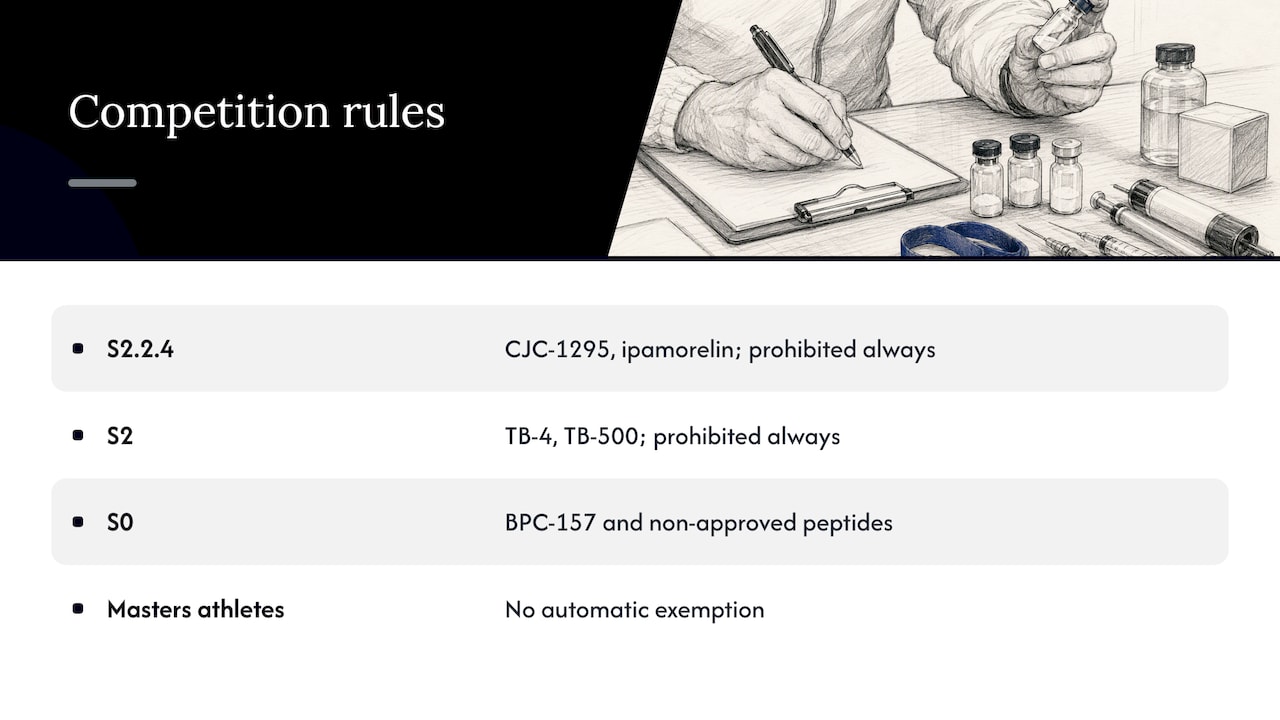
If you race in a sanctioned event, the rules are strict. The WADA 2026 Prohibited List, effective January 1, 2026, lists CJC-1295 and ipamorelin under S2.2.4, growth hormone releasing factors and secretagogues. Thymosin-beta-4 and derivatives such as TB-500 sit under S2. All are prohibited at all times, in and out of competition. Category S0 also covers drugs with no government approval for human therapeutic use.
Sport Integrity Canada issued a reminder on April 27, 2026 that BPC-157 and other non-approved peptides fall under S0. Use, administration, trafficking or possession could lead to an anti-doping rule violation under the Canadian Anti-Doping Program. Masters and age-group athletes in sanctioned events are not automatically exempt, so check with the event organizer. Our guide to peptides for endurance athletes covers the doping risk in more detail.
What builds stamina, with evidence behind it
The Canadian Olympic and Paralympic Sport Institute Network (COPSIN) position statement on supplements recommends an individualized plan from a sport-specialized Registered Dietitian. It says supplements cannot replace sound food and fluid choices, meal planning, and scheduled rest and recovery. Food is the best way to fuel training, and sleep the best way to recover.
Carbohydrate is the best-supported lever for endurance. A 2023 narrative review found that time to exhaustion was 12% greater when carbohydrate was taken before and during exercise than before only. It was 22% greater than with placebo.
A practical stamina checklist for a Canadian runner or cyclist:
- Fuel long sessions. Practise taking carbohydrate during efforts that run well past an hour, and rehearse it in training, not on race day.
- Protect sleep. Treat it as part of the plan, not what is left over.
- Build load gradually. Increase volume in small steps and include easy weeks.
- See a dietitian. A sport-specialized Registered Dietitian can tailor intake to your event and body.
- Get a medical check. COPSIN advises a nutritional and medical assessment before supplement decisions.
- Use tested sources. The same statement warns that many supplements contain prohibited substances, so choose products from safe, reliable, tested sources.
Our perspective
We hear from people who want more stamina and who have been told peptides are the shortcut. Our view is that interest in peptides should start with information, not with a checkout button.
The science is moving. MOTS-c and the growth hormone secretagogues are active areas of research, and we follow them closely. We also believe the claims around stamina run ahead of the human evidence, and that Canadian law and anti-doping rules are part of the picture. We would rather you know that before you act.
What we stand for is purity and transparency. Our products are described as exceeding 99% purity, with third-party lab certificates of analysis behind them. We think anyone who cares about what goes into their body should ask for that level of documentation, and should pair it with medical guidance and a clear understanding of the rules where they live.
For stamina specifically, we see peptides as one narrow topic inside a bigger plan: nutrition, sleep, progressive training and professional advice come first.
Pure Peptide
Where to go next
If you want to keep exploring, our compliance and quality guide for buying peptides in Canada explains how to think about documentation and regulation. You can also browse the categories on the Pure Peptide homepage, including recovery, muscle growth and ancillaries. Our team describes its products as research-grade with third-party certificates of analysis. Before any decision about personal use, read the legality page above and speak with a licensed health professional.
FAQ
Do peptides improve endurance?
Not in any way proven in humans. The best signal is a 2022 mouse study where MOTS-c improved running time and distance in an acute test. A 2026 review found human trials of peptide supplements limited and mostly poorly controlled.
Are endurance peptides legal in Canada?
Injectable peptides are regulated as prescription drugs in Canada. Health Canada says unauthorized products such as MOTS-c, CJC-1295, ipamorelin, BPC-157 and TB-500 are illegal to sell and advises against buying or using them. A research-use-only label does not change that.
Can I use peptides for marathon training or endurance cycling if I race?
CJC-1295, ipamorelin and TB-500 are prohibited at all times under the WADA 2026 list, and BPC-157 and other non-approved peptides fall under S0. Possession alone could lead to an anti-doping violation in sanctioned events. Check with your sport’s governing body before using anything.
Which peptide is best for cardio?
There is no evidence-backed answer. Online lists usually name MOTS-c or growth hormone secretagogues, but no human trial shows they improve cardio fitness. Progressive training, carbohydrate fuelling and sleep have far stronger support.
What should I do instead to boost stamina?
Book a session with a sport-specialized Registered Dietitian, practise fuelling during long efforts, and plan rest weeks. See a physician if you have unexplained fatigue, since that can have a medical cause.
Sources
- Health Canada advisory: Think twice before injecting peptides bought online
- Health Canada: Using bodybuilding products
- Health Canada: Unauthorized injectable peptide drugs seized in Calgary
- Health Canada: Unauthorized health products seized in Vancouver
- AOSSM Sports Medicine News: the boom of peptides in sports medicine
- Hyatt 2022: MOTS-c in skeletal muscle (Journal of Applied Physiology)
- von Walden et al. 2021: Acute endurance exercise and circulating mitochondrial peptides
- Tewari et al. 2026: Peptide supplements and their therapeutic applications
- Villegas Meza et al. 2026: Injectable peptides in sports medicine
- WADA 2026 Prohibited List
- Sport Integrity Canada: reminder on non-approved peptides
- COPSIN position statement on dietary supplementation
- Naderi et al. 2023: Carbohydrates and endurance exercise