







Gonadorelin and hCG both aim at the same result in men: keeping the testes working when the body’s own signal is low or suppressed. They get there from different directions. hCG imitates luteinizing hormone (LH) and stimulates the testes directly. Gonadorelin imitates the brain’s signal (GnRH) and asks the pituitary to release LH and FSH itself. In Canada, both are also bound up in a regulatory question that most online comparisons skip, and we cover it below.
This guide compares the two on mechanism, testosterone, fertility, dosing logistics, side effects and legal status. It is general information, not medical advice. Decisions about either drug belong with a physician, ideally an endocrinologist or a urologist with fertility experience.
TL;DR
- hCG acts at the LH receptor and raises testosterone made inside the testes. It is the long-established option for men on testosterone therapy or with hypogonadotropic hypogonadism.
- Gonadorelin is a GnRH analog. Given in pulses, it prompts the pituitary to release both LH and FSH, which is closer to natural signalling but usually needs a pump.
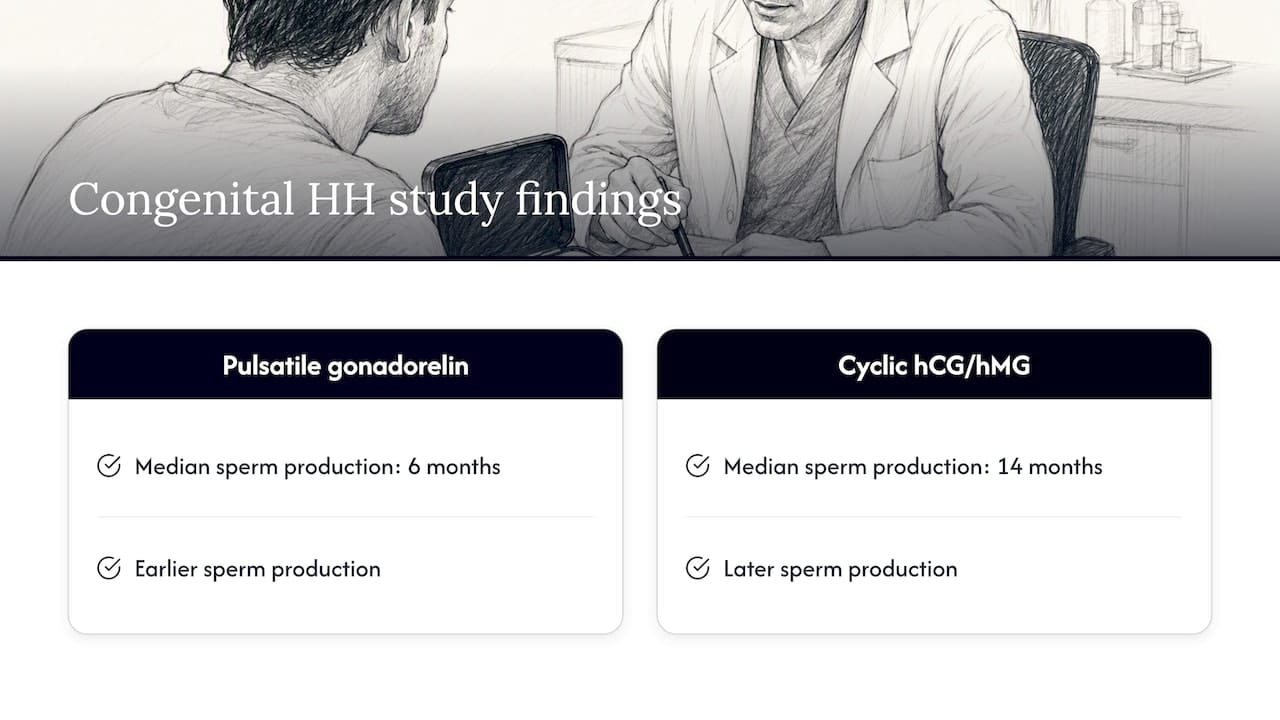
- In a comparison of men with congenital hypogonadotropic hypogonadism, pulsatile gonadorelin started sperm production sooner (median 6 months vs 14 months) than hCG/hMG therapy.
- Health Canada has called injectable peptides including gonadorelin unauthorized when sold outside licensed channels. Check for a DIN and work with a licensed prescriber.
Table of Contents
- What each one is
- Side-by-side comparison
- Testosterone and testicular function
- Fertility: what the evidence shows
- On testosterone therapy
- Can you use them together?
- Side effects and practical limits
- Legal status in Canada
- Which one fits which situation
- Our perspective
- If you are exploring peptides more broadly
- FAQ
- Sources
What each one is
hCG: the LH look-alike
Human chorionic gonadotropin is a hormone made by the placenta in pregnancy. It binds the same receptor as LH and has a longer half-life, according to a review of gonadotropins and their analogs in Endocrine Reviews. In men, LH tells the Leydig cells in the testes to make testosterone, so hCG works as an LH substitute. The two hormones share a receptor but are not identical: a paper on LH and hCG stresses that they differ in expression pattern, biopotency and regulation.
In Canada, hCG is a prescription drug with an approved product history. Health Canada’s register lists Pregnyl under DIN 02182904 as an intramuscular powder for solution.
Gonadorelin: the brain’s signal
Gonadorelin is a synthetic version of gonadotropin-releasing hormone (GnRH). When it is given in a pulsatile pattern, it stimulates the pituitary to secrete both LH and FSH, which is why it is studied as an alternative to exogenous gonadotropin therapy for male infertility, as the same Endocrine Reviews article describes.
The word “pulsatile” matters. The body releases GnRH in bursts. Continuous exposure tends to switch the system off rather than on, so how gonadorelin is delivered shapes what it does.
Side-by-side comparison
| hCG | Gonadorelin | |
|---|---|---|
| Where it acts | Testes (LH receptor) | Pituitary (GnRH receptor) |
| Hormones raised | Intratesticular testosterone, acts as LH substitute | Endogenous LH and FSH |
| Typical delivery | Injection, commonly 2 to 3 times weekly | Pulsatile pump for 12 to 24 months in clinical protocols |
| FSH needed? | Often added when fertility is the goal | Pituitary supplies it |
| Needs working pituitary? | No | Yes |
| Health Canada status | Authorized prescription products with a DIN | Sold online as unauthorized peptide; veterinary product with cancelled status in the Drug Product Database |
The dosing and delivery row comes from a 2023 review of hormone stimulation in male infertility, and the legal row from the Health Canada pages cited below.
Testosterone and testicular function
The core difference is where in the chain each drug steps in.
hCG skips the brain and goes straight to the testes. In men with hypogonadotropic hypogonadism (HH), it is commonly used as an LH analog to stimulate Leydig cells, raising intratesticular testosterone and supporting sperm production.
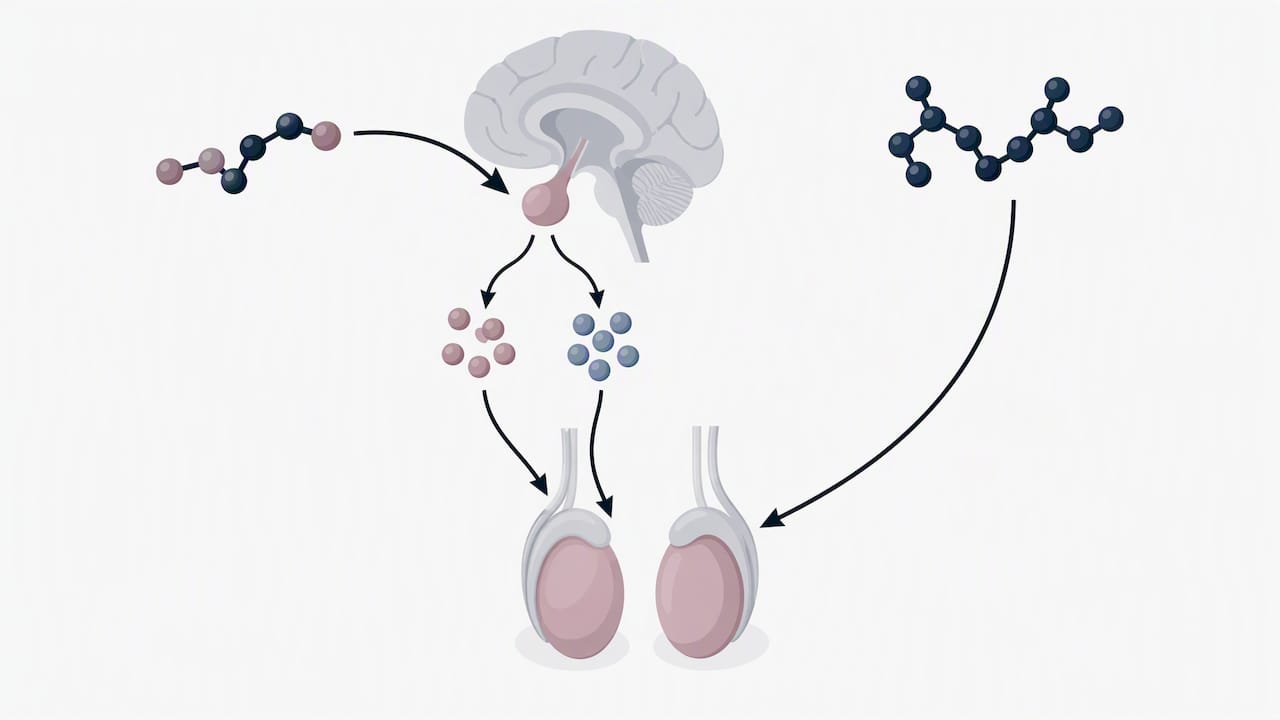
Gonadorelin works one step earlier. Because it prompts the pituitary to release both FSH and LH, it may restore spermatogenesis in a more physiological way, whereas hCG is mainly an LH substitute and is often paired with FSH to match the results of pulsatile gonadorelin.
Two practical consequences follow:
- hCG works even when the pituitary is not responding, because it bypasses it. Gonadorelin depends on a pituitary that can answer the signal.
- Gonadorelin can raise FSH without a second drug, while hCG alone does not.
Neither is a substitute for testosterone replacement when a man genuinely has low testosterone. They are used for different jobs: preserving or restoring testicular function, not replacing circulating hormone.
Fertility: what the evidence shows
For men with hypogonadotropic hypogonadism, the odds of producing sperm with treatment are good: about 75% in the Endocrine Reviews summary. Gonadotropin therapy is the standard approach for HH, but guidelines warn against using it to induce fertility in men with primary testicular failure, where the testes cannot respond.
Head-to-head data favour gonadorelin on speed. In a study of men with congenital HH, pulsatile gonadorelin led to earlier sperm production than cyclic hCG/hMG, with a median of 6 months against 14 months. An older comparison of GnRH and gonadotropin therapy reported a similar pattern: greater testicular volume and a quicker start to spermatogenesis. Read these as findings in a specific group, men with HH treated by specialists, not as proof that either drug does more for a healthy man.
The evidence base is also thin in places. A review of medical management of non-obstructive azoospermia noted that, apart from one meta-analysis, the studies reviewed were not randomized.
On testosterone therapy
This is where most readers arrive from. Exogenous testosterone shuts down the signal that tells the testes to work. The Canadian clinical practice guideline on testosterone deficiency recommends against testosterone replacement for men who prioritize fertility, because it impairs spermatogenesis. The same guideline says treatment should follow confirmed low morning testosterone and only when there are no contraindications.
For men who stay on testosterone, hCG is frequently used to preserve intratesticular testosterone and sperm production, offsetting the drop that exogenous steroids cause. Gonadorelin is promoted online for the same purpose, but the clinical literature on it is built around pulsatile pumps in HH, not the small, occasional injections discussed in forums. The evidence behind those two uses is not the same, and that is worth knowing before you compare them.
If you are weighing peptides alongside TRT, our piece on which peptides actually help men on TRT and the broader peptides for testosterone guide set out what is and is not supported.
Can you use them together?
People online often stack the two, reasoning that gonadorelin raises the pituitary signal while hCG supports the testes. We found no controlled trial testing that exact combination in men, so any claim about its benefit is a guess. What is documented is hCG combined with FSH, and pulsatile gonadorelin on its own, each under specialist supervision.
That is the reason supervision matters. Two agents acting on the same axis can overshoot, raise oestrogen through extra testicular testosterone production, and make blood work hard to interpret. A prescriber who can measure LH, FSH, testosterone, oestradiol and semen parameters before and during treatment is the person who should decide whether a combination makes sense.
Side effects and practical limits
- Acne is associated with gonadotropin use, and venous thromboembolism has been reported in patients with Klinefelter syndrome on hormone stimulation therapy, per the 2023 review. Tell your doctor if you have a clotting history.
- Logistics: pulsatile gonadorelin normally needs a dedicated subcutaneous infusion pump, a real cost and convenience burden compared with standard injections.
- Dose context: common hCG doses in the literature are 1,500 to 2,500 IU twice weekly with FSH usually added (source). These are clinical figures, not a starting point for self-treatment.
- Supervision: even the approved gonadorelin product monograph for ovulation induction says treatment should be run by physicians familiar with pulsatile GnRH delivery, with rare hyperstimulation (under 1%).
If you inject anything, safe sharps disposal and a clear plan for post-injection reactions are part of the job. Our peptide safety guide covers the basics.
Legal status in Canada
Health Canada treats this category carefully. Its overview says unauthorized synthetic peptides are widely promoted and sold online for anti-aging, weight loss, bodybuilding, injury recovery and athletic performance, and advises people to check for a DIN and talk to a licensed health care provider. It also warns that unauthorized injectable peptides can cause hormonal imbalances, liver or kidney damage and tumour growth.
Gonadorelin is named specifically. In a public notice, Health Canada described a seizure of unauthorized injectable peptides that included gonadorelin and advised buying prescription drugs only from licensed pharmacies. The Drug Product Database’s only gonadorelin entry we found is a veterinary prescription product with cancelled post-market status. hCG, by contrast, has authorized prescription products with DINs.
The infection risk is not theoretical. Researcher Timothy Caulfield told CBC Radio that peptides made in unregulated settings can introduce bacteria and lead to sepsis, and Stuart Phillips noted there are no large-scale human efficacy or safety trials for unregulated injectable peptides. The same piece notes the World Anti-Doping Agency has banned many injectable peptides for professional athletes, so tested athletes should check the prohibited list before any use.
Which one fits which situation
| Situation | Where the evidence points |
|---|---|
| Man with HH who wants fertility | Specialist-run gonadotropin therapy (hCG, usually with FSH) or pulsatile GnRH; the latter started sperm production earlier in one comparison |
| Man on TRT who wants to protect testicular function | hCG has the longer clinical record; discuss it with your prescriber. Better still, discuss whether TRT suits you if fertility matters |
| Man with primary testicular failure | Neither is likely to induce fertility |
| Healthy man seeking muscle, fat loss or anti-aging | No sound evidence for either; see a physician for any symptom of low testosterone |
Our perspective
We sell high-purity research peptides and ancillaries, with third-party certificates of analysis behind our products. That makes us careful about where a comparison like this one stops. A purity number tells you what is in the vial. It does not tell you whether a hormone is the right treatment for you, or whether it is legally prescribed in Canada.
Gonadorelin versus hCG is a clinical decision about a specific axis, specific lab values and sometimes fertility goals. We would rather you walk into a physician’s office with good questions than copy a forum protocol. Read the label, look for a DIN where a drug claims a medical purpose, and treat anything marketed for personal use as your own responsibility to understand first.
— Pure Peptide
If you are exploring peptides more broadly
Hormone-axis drugs are a different category from the growth-hormone and recovery peptides most of our customers ask about. If your goal is muscle, recovery or body composition, start with our guides to peptides for muscle growth and peptides for recovery, or browse the full range of categories and ancillaries on the Pure Peptide homepage.
FAQ
Is gonadorelin better than hCG?
Not across the board. In men with congenital hypogonadotropic hypogonadism, pulsatile gonadorelin started sperm production sooner than hCG/hMG in one comparison. But it generally requires a pump and specialist care, while hCG has the longer record and works even when the pituitary is impaired.
Is gonadorelin the same as hCG?
No. hCG mimics LH and acts directly on the testes. Gonadorelin mimics GnRH and acts on the pituitary, which then releases both LH and FSH.
Can I buy gonadorelin legally in Canada?
Health Canada has described injectable peptides including gonadorelin as unauthorized when sold outside licensed channels, and advises buying prescription drugs only from licensed pharmacies. Check for a DIN and speak to a licensed prescriber first.
Do I need hCG or gonadorelin on testosterone therapy?
Only if your prescriber agrees it fits your goals. Exogenous testosterone impairs sperm production, and Canadian guidelines advise against it for men prioritizing fertility. hCG is the option most often used to preserve testicular function during TRT.
Sources
- Gonadotropins and Their Analogs: Current and Potential Clinical Applications (Endocrine Reviews)
- Luteinizing hormone and human chorionic gonadotropin: distinct physiologic roles
- Indications for the use of human chorionic gonadotropin in men
- The use of hormone stimulation in male infertility
- The Pulsatile Gonadorelin Pump Induces Earlier Spermatogenesis
- Medical management of non-obstructive azoospermia
- Diagnosis and management of testosterone deficiency syndrome in Canada
- PrLUTREPULSE product monograph
- Pregnyl, Drug and Health Product Register
- Peptides: Overview, Health Canada
- Using bodybuilding products, Health Canada
- Unauthorized injectable peptide drugs seized, Health Canada
- Injectable peptides touted as new fountain of youth, CBC Radio