






Kisspeptin and hCG both end up raising the same hormones, but they start at different points. Kisspeptin works high up, in the brain, prompting your own GnRH release. hCG skips that step and acts directly on LH receptors in the gonads, and it lasts much longer in the body. They are not interchangeable, and in Canada the legal route to each is also different: hCG is a prescription drug with an authorized product, while kisspeptin has no authorized product that we found.
This guide explains where each one acts, what human studies show for men and for fertility, and how to think about the choice without guessing.
TL;DR
- Kisspeptin stimulates the hypothalamus to release GnRH, which then drives LH. hCG mimics LH and acts further down the chain, with a longer half-life.
- hCG has a long clinical record: it is used in men with hypogonadotropic hypogonadism and to trigger final egg maturation in IVF.
- Kisspeptin is studied as a more physiological trigger, and small trials link it to fewer signs of ovarian hyperstimulation (OHSS). It is not yet an established replacement for hCG.
- In Canada, Health Canada has warned about unauthorized injectable kisspeptin. Talk to a physician before using either.
Table of Contents
- Where each one acts in the hormone chain
- Side-by-side comparison
- What hCG is used for in men
- What the kisspeptin evidence shows
- Fertility and ovulation: where the comparison is closest
- So which one fits your situation?
- Safety and the Canadian rules
- Our perspective
- Where to go next
- FAQ
- Sources
Where each one acts in the hormone chain
The reproductive system runs as a relay. The hypothalamus releases GnRH, the pituitary responds with LH and FSH, and the gonads (testes or ovaries) respond to LH by making sex steroids and supporting sperm or egg development.
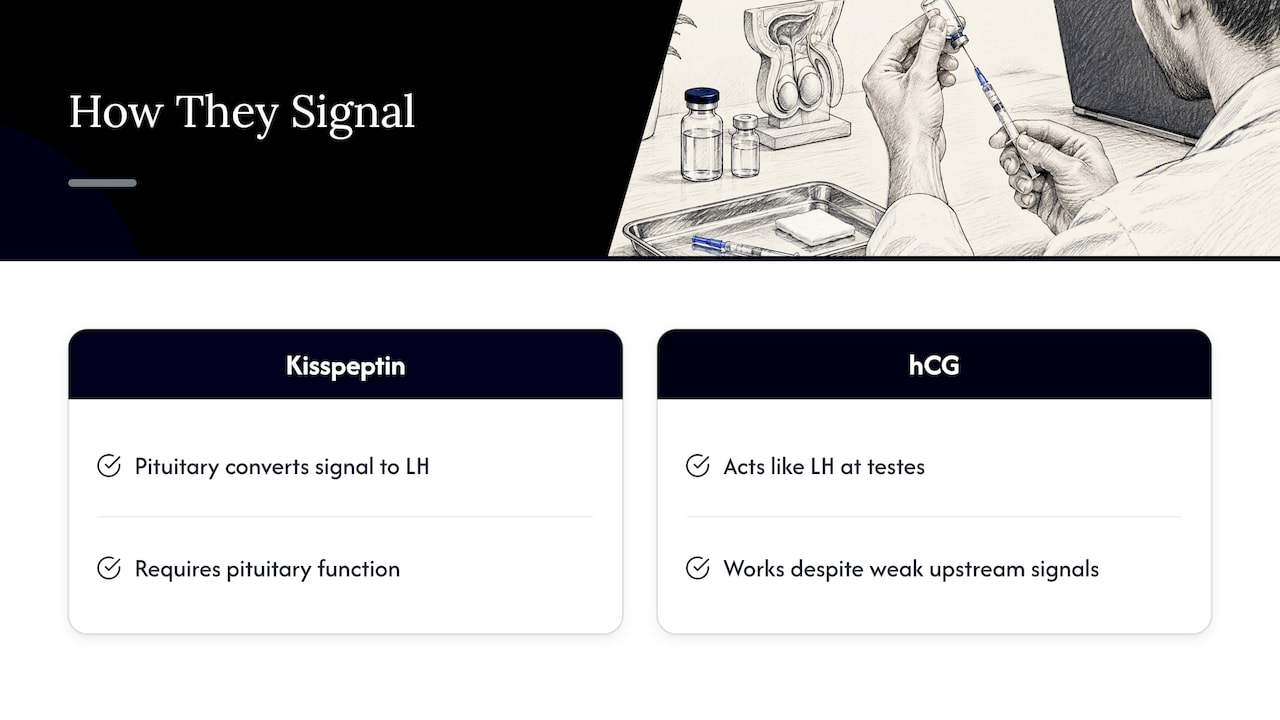
Kisspeptin sits at the top of that relay. According to a review of oocyte maturation protocols, kisspeptin stimulates the hypothalamus to release endogenous GnRH, whereas hCG acts directly at ovarian LH receptors and has a longer half-life and greater steroidogenic action.
That single difference explains most of what follows:
- Kisspeptin depends on a working pituitary and gonads. It asks your own system to respond, so the pulses and feedback loops stay in play.
- hCG does not need the brain or the pituitary to be involved. It stands in for LH, which is why it works in men whose own LH output is low.
Why “hCG alternative” is a loose phrase
People often ask whether kisspeptin is a peptide that mimics hCG. It is not. hCG imitates LH at the end of the chain. Kisspeptin is a signalling peptide that acts several steps earlier. The two can sometimes produce a similar downstream result, a rise in LH and, in men, in testosterone, but they get there by different routes, on different timelines. Some online guides group kisspeptin with gonadorelin, clomiphene and hCG as options for the same job. The more careful way to read that is that they work at different points, so the right one depends on which step in your own chain is the problem. A physician can find that out with blood work.
Side-by-side comparison
| Feature | Kisspeptin | hCG |
|---|---|---|
| Where it acts | Hypothalamus, triggering GnRH release | Gonadal LH receptors directly |
| Mimics | Upstream signal that drives LH | LH itself |
| Duration in the body | Shorter acting, per the same review’s comparison | Longer half-life, greater steroidogenic action |
| Needs a working pituitary | Yes | No |
| Established clinical uses | Under study (fertility triggers, LH stimulation) | IVF trigger, male hypogonadotropic hypogonadism |
| OHSS signal in IVF research | Fewer signs and symptoms reported in women at risk | Known risk linked to long half-life |
| Canadian status | Named by Health Canada among unauthorized injectable peptides | Pregnyl is a marketed prescription product |
On the last row, Health Canada’s Drug Product Database lists Pregnyl as marketed in Canada with DIN 02182904 and prescription status.
What hCG is used for in men
In men, hCG is used clinically to treat hypogonadotropic hypogonadism. As described in a 2018 review by Lee and Ramasamy, it replaces LH to maintain intratesticular testosterone and support spermatogenesis, especially in men whose natural production is impaired.
That last point matters for anyone comparing the two. hCG does the work of LH even if the signals above it are weak or absent. A man whose hypothalamus or pituitary is not sending the message can still get a testicular response from hCG. Kisspeptin cannot do that on its own, because it relies on the pituitary to turn its signal into LH.
What the kisspeptin evidence shows
The human data on kisspeptin are real, but they come from short, tightly controlled studies rather than long treatment programs. Two papers that rank for this search are worth knowing by name:
- A 2011 study from Jayasena and colleagues examined kisspeptin-10 and reproductive hormones, reporting that it stimulates gonadotropin release in men and in women during the preovulatory phase.
- A 2011 study from George and colleagues found that kisspeptin-10 boluses potently evoke LH secretion in men, and that continuous infusion increases testosterone, LH pulse frequency and pulse size.
Both tell you the same thing: kisspeptin is a potent stimulator of the LH axis in a lab setting, under medical supervision. They do not tell you how to dose it at home, how long effects last across months, or how it compares head to head with hCG for a man on testosterone therapy. Anyone who offers you a tidy protocol is going beyond the published evidence.
For a plain-language overview of what the peptide is and how it behaves, see our page on the kisspeptin peptide.
Fertility and ovulation: where the comparison is closest
The most direct comparison between the two sits in assisted reproduction, where hCG has been the standard trigger for final egg maturation for years.
hCG as the established trigger
The same oocyte maturation review describes hCG as an established agent in IVF that acts directly on ovarian LH receptors. The trade-off is its long half-life, which is associated with a risk of ovarian hyperstimulation syndrome (OHSS).
Kisspeptin as a physiological trigger
Kisspeptin has been used to induce oocyte maturation, including in women at increased risk of OHSS, where it induced fewer signs and symptoms of the condition, per that review. Work out of Imperial College London has also looked at a second kisspeptin dose: small phase 2 trials indicate it can improve oocyte yield without raising OHSS incidence compared with a single dose.
The fair reading: kisspeptin is a promising, more physiological option being tested in clinics, and hCG remains the one with the long track record. Neither is something to self-manage. Egg-retrieval timing is measured in hours, and it is decided by a fertility team.
So which one fits your situation?
The useful question is not which is better. It is which step in your hormone chain needs support.
- Your pituitary and testes respond normally, and you want to stimulate natural signalling. This is the scenario kisspeptin research is built around. The evidence is short term and clinical.
- Your own LH signal is low or absent, and you need a direct testicular effect. This is the classic hCG case, handled by a physician, for example in hypogonadotropic hypogonadism.
- You are in fertility treatment. Your clinic chooses the trigger. Risk of OHSS is part of that decision.
- You are not sure. Start with blood work (LH, FSH, total and free testosterone, and for women cycle-timed hormones) and a physician who can read it. Choosing a compound before you know where the problem sits is the most common mistake.
Safety and the Canadian rules
This is the part to read before you buy anything.
Health Canada has warned that kisspeptin is among the unauthorized injectable peptide drugs seized from an online seller. Those products have not been assessed for safety, efficacy or quality, and the notice says unauthorized drugs may carry serious health risks. In a separate notice, Health Canada states that selling unauthorized health products is illegal, advises people not to buy or use them, and says to consult a health care professional if concerned. It lists infection, allergic reactions and unknown interactions with other medications as the risks of unauthorized injectables.
What that means in practice:
- hCG is a prescription product. Get it through a physician and a licensed pharmacy, and read the label to confirm it is authorized. Our guide to peptide legality in Canada explains why an eight-digit DIN matters.
- Kisspeptin has no authorized product we could find in Canada. If you are in a study or under a physician’s care, follow their instructions to the letter.
- Never combine compounds on your own, especially if you are on testosterone therapy or fertility medication. Interactions are exactly what the warnings describe.
Peptides get discussed for many goals, from hormones to the role of peptides in hair health, and the same habit applies to all of them: know what is in the vial, who made it, and whether a clinician knows you are using it.
If you handle any injectable, basics matter too. Our pages on peptide safety, injection sites, measuring doses and syringe disposal in Canada cover what a careful person checks before and after.
Our perspective
We get this question from people who have read that kisspeptin and hCG “do the same thing”. They do not, and we think that is the most useful thing to understand before anyone orders a vial.
Kisspeptin is interesting precisely because it works upstream. It asks the body’s own signalling system to respond, which is why researchers keep studying it as a physiological way to move LH and testosterone. We built our range around high-purity peptides for exactly this kind of careful, goal-specific interest, and we back each product with third-party lab certificates of analysis, because purity is the first thing you cannot judge by eye.
Our standard is that a peptide should arrive with documentation you can read, and that the person using it should understand what it is designed to do. Our formulations are designed to exceed 99% purity through advanced purification, and we encourage everyone to read the certificate for the specific batch they receive.
If you are weighing kisspeptin against hCG, learn the mechanism first, get your bloodwork done, and bring your physician into the plan. Our guides are written to make that conversation better informed.
Pure Peptide
Where to go next
If kisspeptin is the compound you are researching, our guide to buying kisspeptin covers quality and safety checks, such as reading the certificate of analysis. For the wider picture of hormone-related interest, see our pieces on peptides for testosterone and peptides for men. You can browse our full range of high-purity peptides and ancillaries on the Pure Peptide store.
FAQ
Is kisspeptin the same as hCG?
No. Kisspeptin stimulates the hypothalamus to release GnRH, which then raises LH. hCG acts directly on LH receptors in the gonads and lasts longer in the body. They can lead to a similar downstream effect, but through different steps.
Can kisspeptin replace hCG?
In research settings, kisspeptin has been used to trigger egg maturation and to raise LH in men, but hCG remains the established clinical option. Kisspeptin needs a working pituitary, which hCG does not. Any switch is a decision for your physician or fertility team.
What is hCG used for in men?
Physicians use hCG in men with hypogonadotropic hypogonadism. It replaces LH, which helps maintain intratesticular testosterone and supports sperm production, particularly when natural production is impaired.
Is hCG available in Canada?
Yes, as a prescription product. Health Canada’s Drug Product Database lists Pregnyl with a DIN and prescription status. Obtain it through a physician and a licensed pharmacy, and confirm the label shows it is authorized.
Is kisspeptin legal to use in Canada?
Health Canada has named kisspeptin among unauthorized injectable peptide drugs and advises people not to buy or use unauthorized health products. If you have questions or concerns about your own use, speak to a health care professional.
Sources
- Endocrine Requirements for Oocyte Maturation Following hCG, GnRH agonist and kisspeptin trigger (PMC)
- Indications for the use of human chorionic gonadotropin in men (PMC, 2018)
- Kisspeptin as a novel physiological trigger for oocyte maturation (Imperial College London)
- Health Canada: unauthorized injectable peptide drugs seized and sold online
- Health Canada: unauthorized health products sold online and seized
- Health Canada Drug Product Database: Pregnyl