






Controlled trials do not show that sermorelin reliably improves sleep, and the largest one, in older adults, found no benefit and slightly worse sleep scores. The question exists because growth hormone release is tied to deep slow-wave sleep. Health Canada also warns that sermorelin has no DIN, so safety and sourcing matter as much as the science. The evidence section below sets out the details.
TL;DR:
- The positive sleep finding came from brief overnight intravenous pulses in young men, unlike the older adult trial’s bedtime subcutaneous injections.
- A single bedtime injection only roughly imitates repeated natural growth hormone pulses, and it cannot address sleep apnea or fragmented sleep.
- Health Canada lists sermorelin as unauthorized and without a Drug Identification Number; anyone considering it should seek clinician oversight and ask about regulated sourcing.
- Because combination research is limited, people taking sleep aids, diabetes or thyroid medicines, or other growth hormone peptides should review every product with a clinician.
- For insomnia lasting more than a few weeks, seek assessment and prioritize cognitive behavioral therapy for insomnia before considering an injectable peptide.
Table of Contents
- How is sermorelin supposed to affect sleep?
- What did the clinical studies find about sermorelin and sleep?
- What do people report, and how long does it take?
- What timing and administration factors matter for sleep?
- Is sermorelin legal and safe in Canada?
- How do we think about sermorelin and quality?
- Can sermorelin interact with other sleep aids or medications?
- Who should avoid sermorelin for sleep?
- An honest take on sermorelin as a sleep strategy
- If you are exploring peptides, how can we help you source safely?
- FAQ
- Sources
How is sermorelin supposed to affect sleep?
Your body releases growth hormone (GH) in pulses, and the biggest pulse of the day usually arrives shortly after you fall asleep. Researchers have long noted that growth hormone secretion is closely tied to early slow-wave sleep, the deepest stage, also called N3. That link is the whole reason people ask whether boosting GH could deepen sleep.
Sermorelin is an analogue of growth hormone-releasing hormone (GHRH). It does not supply GH itself. It signals the pituitary gland to release your own GH, in pulses that follow the body’s normal rhythm. That is a different route from injecting GH directly.
The same review describes GHRH as promoting non-REM and slow-wave sleep through central mechanisms in the brain. This is where the story gets more complicated than “more GH, better sleep.” Three ideas are worth separating:
- Central effects: GHRH signalling in the brain appears to influence sleep regulation directly.
- Peripheral effects: GH and IGF‑1 act on tissues throughout the body, and that action does not obviously feed back into sleep architecture.
- Direction of influence: the same research notes that stimulating slow-wave sleep pharmacologically raises GH release, so deep sleep drives GH at least as much as GH drives deep sleep.
Biological link: GHRH can promote NREM and slow-wave sleep through central mechanisms, but raising GH in the blood is not the same thing as improving how you sleep.
What did the clinical studies find about sermorelin and sleep?
The evidence comes from two very different kinds of study, and they point in different directions.
The infusion study. In a laboratory study of young, healthy men, researchers gave GHRH intravenously in pulses during a night’s sleep. Deep N3 sleep increased. That result is the foundation for the sleep claims you see online, and it is real. But it involved young men with normal sleep, a drip delivered in pulses, and a brief period.
The trial in older adults. A randomized, placebo-controlled trial run in Seattle gave sermorelin to older adults for an extended period, with dosing about an hour before bed. The treatment raised GH and IGF‑1, as expected. It did not improve sleep scores, and in some analyses scores were slightly worse than with placebo. You can find related trial records on Clinicaltrials, and the wider literature on GH secretagogues is indexed on PubMed.
A short summary of why those results diverge:
- Age of participants: young men have robust slow-wave sleep to build on, while older adults have much less of it to begin with.
- Route and timing: intravenous pulses during the night differ from a single subcutaneous injection before bed.
- Duration: a short study shows an acute effect, while a longer study shows what happens once the body adapts.
- Outcome measures: laboratory sleep staging and self-reported sleep scores do not capture the same thing.
“Hype dressed in real biology” is how some experts describe the claim that sermorelin is a dependable sleep therapy.
That description fits the pattern. The mechanism is plausible, and the short laboratory result is genuine. Yet when researchers tested sermorelin over an extended period in the group most likely to want it, the sleep payoff did not appear.
Our reading of the full picture is that sermorelin is biologically plausible but clinically inconsistent for sleep, especially in older adults. If you are hoping it will fix insomnia, the best controlled data does not back that hope. We cover the same findings from a product angle in our piece on sermorelin benefits and why IGF‑1 rises but sleep does not.
What do people report, and how long does it take?
Outside trials, people describe their experience in forums and clinic follow-ups. These reports are not controlled data, but they show what users tend to notice.
- Onset: many people report a subjective change in sleep depth after starting nightly use.
- Feeling rested: waking up less groggy is the most common description.
- Vivid dreams: often mentioned early on.
- Injection-site reactions: redness, mild soreness or itching where the needle went in.
Treat these accounts with care. A person who has just started a new routine, expects better sleep and is paying attention to it will often feel better regardless of what is in the syringe. That is exactly why placebo-controlled trials exist. When a personal report and a controlled trial disagree, give more weight to the trial, and use your own experience as a prompt to talk to a prescriber rather than as proof.
What timing and administration factors matter for sleep?
Sermorelin is typically given as a single subcutaneous injection before bed, so the GH pulse overlaps with early sleep. The Seattle trial used dosing roughly an hour before bedtime, so even a well-timed protocol did not rescue the sleep outcome.
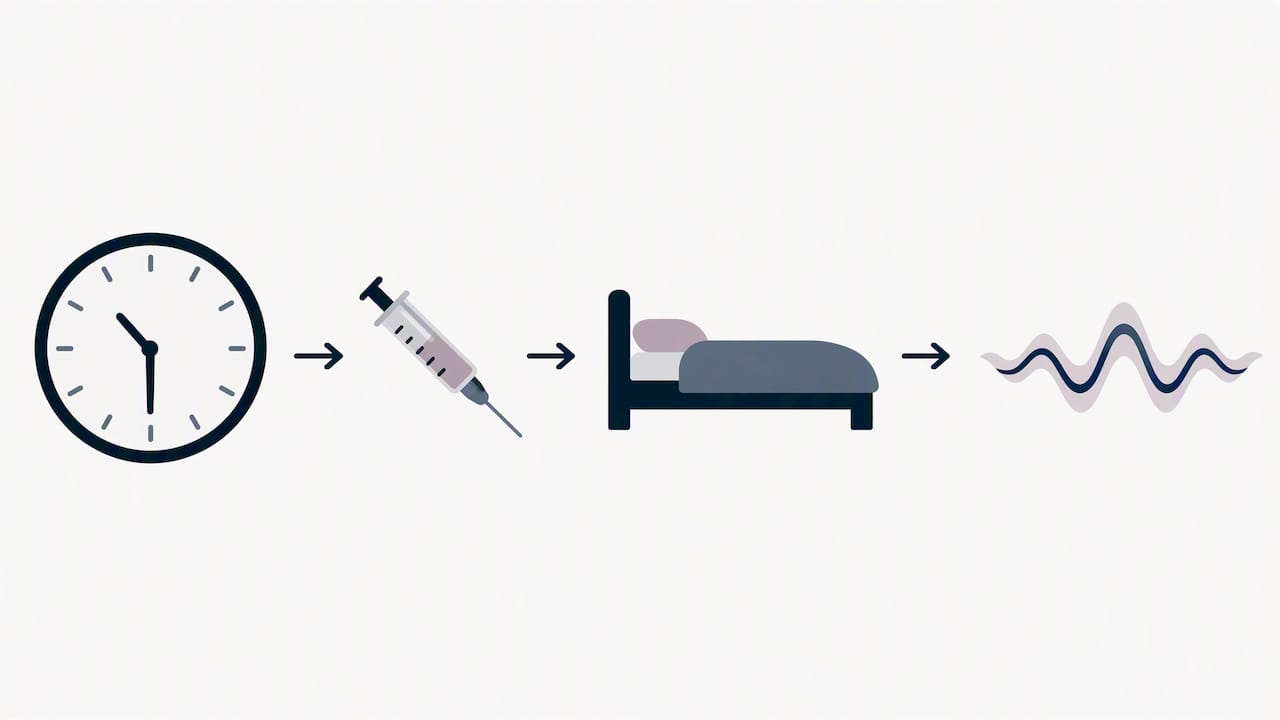
Timing shapes the pulse. A single bedtime injection can produce a large early GH surge, but it may leave less GH stimulation later in the night than several smaller pulses would. Since the natural pattern involves repeated pulses, a one-shot dose is only a rough imitation, and that difference may help explain the gap between infusion studies and real-world use.
Several practical factors change what happens:
- Age: older adults have less slow-wave sleep to enhance.
- Baseline sleep architecture: someone whose main problem is fragmented sleep or sleep apnea is not helped by a deeper-sleep signal.
- Concurrent medications: other drugs can blunt or mask any effect.
- Route and dose: subcutaneous dosing differs from intravenous pulses, and dose changes the size of the pulse.
Pro Tip: Track your sleep before any change, using the same routine and a simple log, so you have a baseline to judge against.
Is sermorelin legal and safe in Canada?
Health Canada has warned that unauthorized injectable peptide drugs may pose serious health risks. In that advisory, sermorelin is described as unauthorised in Canada and lacking a Drug Identification Number (DIN). A DIN is the number that shows Health Canada has reviewed a drug for sale. For a plain-language explanation, see our guide on why injecting peptides in Canada without a DIN is a problem.
Health Canada’s position: sermorelin holds no DIN in Canada and is treated as an unauthorised drug, and buying from unregulated online platforms bypasses Canadian safety and quality standards.
The risks of unregulated injectables are practical, not abstract:
- Contamination: a product made without oversight can carry bacteria or unwanted residues.
- Sterility failures: an injectable that is not sterile can cause infection at the injection site or beyond.
- Unknown purity: the vial may not contain what the label says, or the amount stated.
- Infection risk: repeated injections multiply the chance that any of these problems reaches you.
If a prescriber does recommend a peptide for you, ask them to use a licensed pharmacy, and ask for a third-party certificate of analysis for whatever you are given. Talk to a clinician before you start, not after. Our general reading list on peptide safety before you inject anything covers the precautions in more detail. For background on why some peptides are labelled for laboratory use only, a partner-vetted explainer on research use only peptides lays out how that classification works.
How do we think about sermorelin and quality?
We supply high-purity peptides and the ancillaries that go with them, and our products are backed by third-party lab certificates of analysis. Our formulations are made with purification methods that we state meet our purity standards. For any injectable, where it comes from and what the certificate of analysis shows matter at least as much as the compound itself.
Our view on sermorelin is the same as the evidence: it raises GH, but controlled trials have not shown it to be a proven sleep therapy, particularly for older adults. We would rather you hear that from us than from marketing. We recommend clinical oversight for anyone considering it.
The next steps we suggest are simple:
- Speak with a prescriber about your sleep problem first.
- Put evidence-based sleep treatments ahead of any peptide.
- If a clinician prescribes a peptide, use regulated pharmacy channels and ask to see the certificate of analysis.
Can sermorelin interact with other sleep aids or medications?
There is no robust body of controlled research on sermorelin combined with sleep medications, which is itself the main thing to know. Because the evidence is thin, the safest assumption is that any combination needs a clinician’s review.
A few general points are worth raising with a prescriber:
- Sedatives and sleep aids: sermorelin is not a sedative, so it does not replace one, but combining it with prescription or over-the-counter sleep products means two things are acting on your sleep at once, and it becomes hard to tell which is doing what.
- Other GH-axis products: peptides that also stimulate GH, such as ipamorelin or CJC‑1295, act on the same system. Stacking them is common in online forums, yet we are not aware of controlled evidence showing it improves sleep.
- Medications that affect glucose or thyroid function: GH changes can interact with how the body handles blood sugar and thyroid hormones, so people on diabetes or thyroid treatment should be especially careful.
- Supplements: products marketed for sleep can add effects you did not plan for.
Bring a full list of everything you take, including supplements, to any appointment where sermorelin comes up. Do not stop or change a prescribed medication on your own to make room for a peptide.
Who should avoid sermorelin for sleep?
Certain health situations make sermorelin a poor idea, and in some cases a risky one. Because it is unauthorised in Canada and has no DIN, nobody should treat it as a routine sleep remedy, but some people have extra reasons to stay away.
Speak to a clinician before considering it, and expect to be steered away from it, if any of these apply:
- Active or past cancer: GH and IGF‑1 influence cell growth, so anyone with a cancer history needs specialist advice first.
- Pregnancy or breastfeeding: there is no adequate safety evidence for these situations.
- Untreated or poorly controlled diabetes: GH changes can affect blood sugar.
- Pituitary or thyroid disorders: these conditions change how the GH system behaves.
- Known allergy to peptides or injection ingredients: reactions to an injectable can be serious.
- Untreated sleep apnea or another diagnosed sleep disorder: the real cause of poor sleep needs treating directly, and a GH signal will not fix it.
A sleep problem lasting more than a few weeks deserves a proper assessment. Cognitive behavioural therapy for insomnia (CBT‑I) is widely treated as the first-line approach, and it does not carry the regulatory and safety questions that an unauthorised injectable does.
An honest take on sermorelin as a sleep strategy
Here is where we land. The biology is interesting and the marketing is louder than the data. Deep sleep and growth hormone are linked, but that link runs both ways, and pushing on one end has not reliably moved the other in the trial that matters most for older adults.
The conventional advice, “try it and see,” falls short for a simple reason: sleep is subjective, easily shaped by expectation, and affected by dozens of habits. If you start an injectable and change your routine at once, you cannot tell what helped. Worse, the cost of being wrong is not just wasted money. It is an unauthorised injectable with unknown quality sitting in your fridge.
What deserves priority first is the unglamorous list: consistent sleep and wake times, a dark and cool room, less evening caffeine and alcohol, screening for sleep apnea, and CBT‑I if insomnia persists. Those have far stronger evidence than any peptide. If, after that, you and a prescriber still want to explore sermorelin, treat it as an informed, supervised decision rather than a sleep hack. The most useful thing a reader can do is lower the stakes of the decision by getting the basics right first.
— Pure Peptide
If you are exploring peptides, how can we help you source safely?
Peptides call for prescriber oversight where the law requires it, and that includes the conversation about whether one makes sense for you at all. What we do is supply high-purity peptides and ancillaries, and our products are backed by third-party lab certificates of analysis.
If you want to read further before deciding, start with our peptide safety guide, then look at our legal-status explainer. When you are ready to talk it through, discuss your options with your prescriber. You can browse everything we offer, from weight loss to recovery and anti-aging, at Purepeptide.
This article is general information, not a substitute for advice from a qualified doctor. Consult a qualified healthcare professional about your own circumstances before acting on anything here.
FAQ
Does sermorelin affect your sleep?
It can raise growth hormone, and an infusion study in young men increased deep sleep. A trial in older adults did not show improved sleep scores. So any effect is inconsistent, not reliable.
Can ipamorelin help with sleep?
Ipamorelin stimulates growth hormone release through a different pathway than sermorelin, and people often report better sleep anecdotally. We are not aware of controlled evidence proving a sleep benefit, so treat those reports cautiously and discuss it with a prescriber.
Is sermorelin a good peptide to take?
That depends on your goal and your health, and it is a conversation for a clinician. Health Canada states that sermorelin has no DIN and is unauthorised in Canada, so quality and sourcing deserve close attention.
Is a few months of sermorelin enough to judge sleep results?
Anecdotal reports describe changes within the first few weeks, but a controlled trial ran for an extended period and still showed no sleep benefit in older adults. If you try it under supervision, keep a sleep log so you and your prescriber can judge the results against a baseline.
Sources
- Unauthorized injectable peptide drugs seized and sold by Canada Peptide may pose serious health risks – Canada.ca
- Interrelations between sleep and the somatotropic axis
- Clinicaltrials