





Heavy metals testing for peptides is a separate laboratory measurement of toxic elements such as arsenic, cadmium, lead and mercury. A purity percentage does not show it. A vial can read above 99% on a purity test and still carry trace metals from its synthesis or handling, so the metals result is its own line on a certificate of analysis (COA). This guide explains what the test measures, how it works and how to read the number. It is written for people who use peptides for muscle growth, fat loss, recovery or anti-aging and want to judge quality, not just read a label.
TL;DR
- “Heavy metals” in peptide testing means specified elemental contaminants, usually arsenic, cadmium, lead and mercury. Some panels add other elements. The test reports a concentration, which purity percentage does not.
- Metals can enter through catalysts, water, excipients, manufacturing equipment and containers, according to the international ICH guideline that Health Canada has adopted.
- The usual method is ICP-MS, which atomizes a liquid sample in argon plasma and counts the resulting ions.
- A result means something only against a daily-intake limit and the dose you actually take, not as a bare number.
- Health Canada treats testing as one part of peptide safety, alongside authorization, manufacturing controls, ingredient quality and storage.
Table of Contents
- What “heavy metals” means on a peptide COA
- How metals get into peptide material
- Why a purity test does not catch metals
- How ICP-MS testing works
- How to read a heavy metals result
- What a good heavy metals line should show
- What the test does not cover
- The Canadian context
- Perspective: why we treat metals as part of purity
- Where to find tested peptides
- FAQ
- Sources
What “heavy metals” means on a peptide COA
In a peptide lab report, “heavy metals” is shorthand for a short list of toxic elements. Health Canada’s guidance warns that unauthorized peptides may contain heavy metals, solvents, particles, microbes or the wrong amount of active ingredient. That is why metals matter even to someone who only cares about results in the gym.
The four elements that nearly every panel covers are arsenic, cadmium, lead and mercury. Health Canada’s version of the ICH Q3D guideline classes them as Class 1 elements: human toxicants with limited or no use in pharmaceutical manufacturing. They give no therapeutic benefit, so the aim is to keep them as low as the process allows.
Two points are easy to miss:
- Purity and metals are different questions. Purity tells you what share of the material is the peptide itself. Metals are measured in tiny amounts, per gram or per daily dose, and sit outside that percentage.
- Panels differ. Some labs run only the big four. Others add elements such as nickel, cobalt or palladium. Read which elements the report lists rather than assuming.
How metals get into peptide material
Peptides are made through multi-step chemistry, then purified, dried and filled into vials. Each stage is a place where trace elements can arrive. The ICH Q3D guideline names the potential sources: catalysts, components of the drug substance, water or excipients, manufacturing equipment, and container-closure systems.
In plain terms:
- Catalysts and reagents. Some synthesis steps use metal-based catalysts. Residues can remain unless purification removes them.
- Water and fillers. Poor-quality water or excipients carry their own mineral load.
- Equipment. Reactors, tubing and filters can shed trace metal into a batch.
- Packaging. Vials and stoppers are part of the picture too.
Health Canada’s own guidance says these impurities can come from intentionally added catalysts, processing equipment, container and closure systems or components, and that levels should be controlled through a risk-based assessment. In practice, that points to the whole production chain, which is why a supplier’s purification methods matter as much as the final test.
The guideline also states its scope: it covers finished products containing synthetically produced polypeptides and recombinant or non-recombinant proteins. Peptides sit squarely inside the framework that regulators use to think about this problem.
Why a purity test does not catch metals
Purity is usually measured by high-performance liquid chromatography (HPLC), which separates and quantifies organic molecules: the peptide, its fragments and related impurities. Metal ions are not organic molecules, so they do not show up as a peak in that way. That is why a vial can carry a strong HPLC number and still need a separate elemental test.
The reverse is also true. A clean metals result says nothing about the peptide’s identity or how much of it is in the vial. Identity is confirmed by mass spectrometry of the peptide, and the amount by a content assay. A complete COA brings these separate results together, which is the reason to read the whole report and not a single headline figure. Our guide to what third-party tested peptides actually means walks through how those lines fit together.
How ICP-MS testing works
Most labs measure metals by inductively coupled plasma mass spectrometry (ICP-MS). The method, as described in a University of Toronto thesis, runs like this: a liquid sample is sprayed as an aerosol into an argon plasma, where it is atomized and turned into gas. Mass filters then sort the ions that form, and detectors count them.
For a freeze-dried peptide, the steps are roughly:
- A measured portion of the vial is dissolved or digested into a liquid.
- The liquid goes into the instrument and is atomized in the plasma.
- Each element is identified by the mass of its ions and quantified by the signal.
- The lab compares the signal with calibration standards and reports a concentration.
The key practical point is that ICP-MS reads out concentrations, often in parts per million or parts per billion. Those are small numbers by design. The test is sensitive enough to find trace contamination, which is the very thing you are worried about.
Some labs ask for an extra vial for the metals panel, because the sample is consumed during preparation. That is normal and separate from the sample used for purity.
How to read a heavy metals result
A concentration on its own is not a verdict. The ICH Q3D limits are expressed as permitted daily exposures, meaning the amount of an element a person can take in per day. They are not automatically concentration limits: a reported concentration has to be assessed against the maximum daily dose and the route of administration.
That has a direct consequence for how you read a COA:
- A result in parts per million has to be turned into micrograms per day using the amount of material you actually take.
- Injected products are held to tighter limits than oral ones, because injection bypasses the gut’s defences. The guideline sets different limits by route.
- Peptide doses are small, often micrograms to a few milligrams, so the contribution from a vial’s trace metals is correspondingly small. That arithmetic is what the guideline’s approach is built on.
A worked example of the arithmetic
Suppose a report lists lead at 2 parts per million (2 micrograms per gram) in the peptide material, and you take 500 micrograms (0.5 mg) of peptide in a dose. One gram is 1,000,000 micrograms, so your dose is 0.0005 g, and the lead that arrives with it is 2 × 0.0005 = 0.001 micrograms. That figure is what gets compared with the permitted daily exposure for the route. The numbers here are illustrative, not a limit: the actual permitted daily exposures are in the ICH Q3D tables for each element and route.
The lesson is that the same ppm figure means very different things at different doses, which is why a report that gives only “pass” with no figures is harder to use than one that gives the number and the limit it was assessed against.
What a good heavy metals line should show
When you open a COA, look for these items next to the metals result:
| What to look for | Why it matters |
|---|---|
| Elements listed by name (arsenic, cadmium, lead, mercury at minimum) | Shows what was actually screened |
| Result as a number with units, or a stated limit of quantification | A number can be compared with a limit; a bare “pass” cannot |
| Method named (ICP-MS) | Tells you the technique used |
| Batch or lot number matching your vial | Ties the result to what you hold |
| Laboratory name and report date | Lets you see who tested and when |
Our COA checklist for peptide contamination risks covers the other contaminants, such as endotoxins, that sit alongside metals in a quality review.
What the test does not cover
A clean metals report is one result in a larger set. It does not tell you the peptide’s identity, its purity or its potency, and it does not address bacteria or endotoxin. Health Canada’s perspective is that testing is one part of safety, and that authorization, manufacturing controls, ingredient quality, storage and regulatory oversight all have to be considered together.
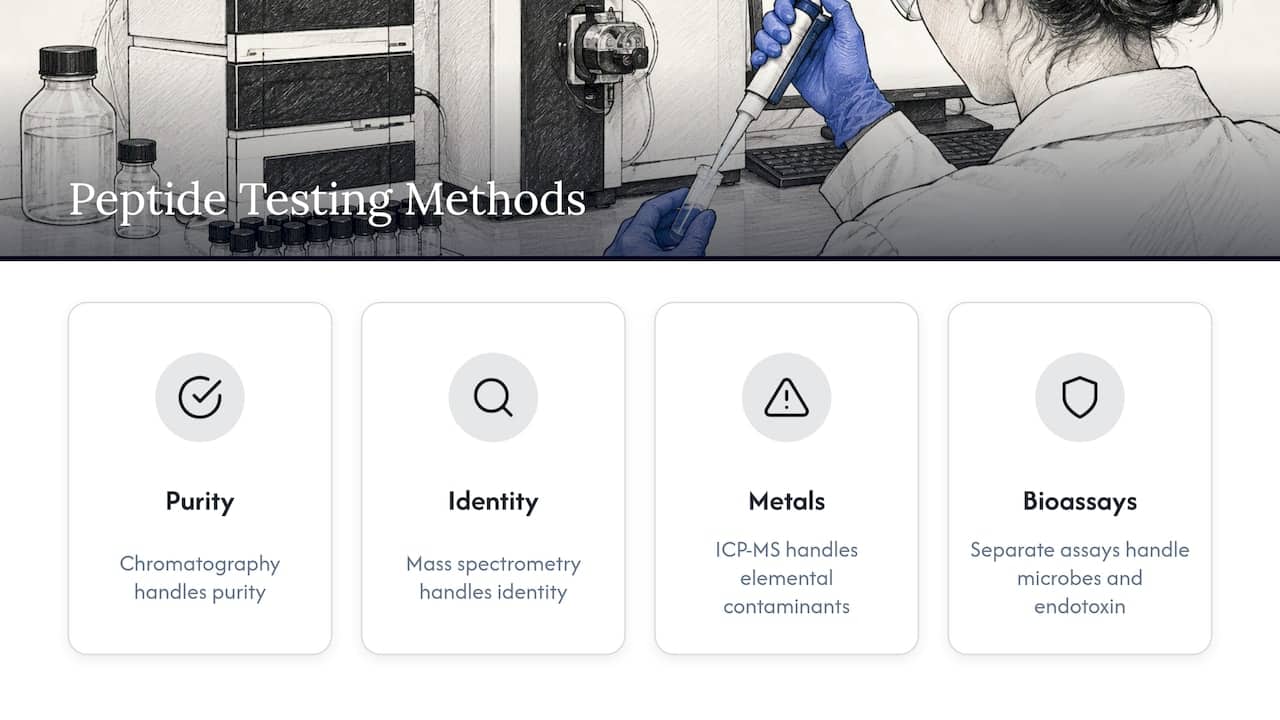
That is also why peptide analysis is a set of methods, not a single test. Chromatography handles purity, mass spectrometry handles identity, ICP-MS handles elemental contaminants, and separate assays handle microbes and endotoxin. Asking which of these a supplier reports tells you how complete its quality picture is.
For a parallel look at how product risks and contaminants are discussed for another supplement category, see this overview of plant protein risks.
The Canadian context
Peptides sit in a regulated space in Canada. Health Canada’s guidance on peptide health risks is the starting point, and our page on peptide legality in Canada and the eight-digit DIN explains what authorization means for injectables.
On oversight, 2023 testimony to the House of Commons health committee described new labelling rules, planned risk-based inspections and new powers to deal with serious safety issues. The direction is toward more scrutiny of health products, which makes documented quality more relevant, not less.
If you have a medical condition, are pregnant or breastfeeding, take other medication or have kidney or liver disease, speak to your doctor or pharmacist before using any peptide. Metal exposure matters more for people whose bodies clear it less efficiently, and a physician can judge that. For safe handling, our guide on peptide safety before you inject anything covers the practical side.
Perspective: why we treat metals as part of purity
We think a purity number is the start of a quality conversation, not the end. Our formulations are made with advanced purification methods and exceed 99% purity, and every product is backed by third-party lab certificates of analysis.
Metals are the kind of contaminant that a purity percentage cannot show, so we encourage everyone who uses peptides for muscle growth, fat loss, recovery or anti-aging to read the whole COA, line by line, and to match the lot number to the vial in their hands.
Good habits around the product matter too: correct storage, sterile reconstitution with proper ancillaries, and keeping your records. Quality is a chain from synthesis to your fridge, and we build our range around that idea.
Pure Peptide
Where to find tested peptides
If you are ready to buy, our range covers weight loss, muscle growth, recovery, anti-aging and libido, plus the reconstitution ancillaries (bacteriostatic water, syringes and alcohol pads) that go with them. Each product is supported by third-party certificates of analysis. You can browse everything on the Pure Peptide store, and our guide to buying peptides in Canada explains what we look at on quality and compliance.
FAQ
What is peptide analysis?
Peptide analysis is the set of laboratory tests that describe a peptide product. Chromatography measures purity, mass spectrometry confirms identity, and assays measure content. Heavy metals testing by ICP-MS is the part that measures elemental contaminants.
Which heavy metals are tested in peptides?
Panels normally include arsenic, cadmium, lead and mercury, which Health Canada’s ICH Q3D guidance classes as Class 1 toxicants. Some labs add other elements, so read the element list on the report.
Why can’t HPLC purity show heavy metals?
HPLC separates and measures organic molecules, and trace metal ions are a different kind of contaminant. A separate elemental test, usually ICP-MS, is needed to measure them. A high purity percentage and a clean metals result are two different results.
How do I judge a heavy metals number on a COA?
Convert the concentration into a daily amount using your dose, then compare it with the permitted daily exposure for the route of use. ICH Q3D sets limits as daily intake, so the same ppm figure can mean different things at different doses.
Sources
- Peptides: Health risks, Health Canada
- ICH Q3D Step 4, Guideline for Elemental Impurities (2014)
- Health Canada, ICH Q3D guidance for industry (2016)
- University of Toronto, ICP-MS method description (2008)
- Standing Committee on Health, evidence (2023)