




Most peptides dissolve in a few minutes if you match the solvent to the peptide’s charge and its water-loving or water-avoiding character. Start with sterile water, move to a mild acid or base only if the powder stays cloudy, and keep strong organic solvents for the hardest sequences. Work in small test amounts, never with the whole vial.
This guide is for people who buy high-purity peptides for muscle, recovery, weight or anti-aging goals and want to understand why one vial clears at once while another stays hazy. It explains the chemistry in plain words, gives a step-by-step order of solvents, covers troubleshooting and storage, and ends with what Health Canada says, because dissolving a peptide tells you nothing about whether it is legal or safe to use.
TL;DR
- A peptide’s solubility depends on its amino acid sequence, its net electrical charge and the pH of the liquid, so the right solvent differs from vial to vial.
- Try a small test portion in sterile water first. If it stays cloudy, adjust with a dilute acid (for peptides with a positive charge) or a dilute base (for peptides with a negative charge), then consider a small amount of organic solvent.
- A properly dissolved peptide is completely clear. Flecks, haze or gel mean it is not fully in solution.
- Dissolving well says nothing about safety or effectiveness. Health Canada states that injectable peptides are always classed as drugs and that authorized products carry a DIN or NPN.
- Check the certificate of analysis for any solvent advice before you start.
Table of Contents
- Why peptides behave differently in liquid
- Step 1: Read the label and the certificate of analysis
- Step 2: Estimate whether your peptide is acidic, basic or neutral
- Step 3: Follow the solvent ladder
- Step 4: Judge the result
- Troubleshooting common problems
- Storing a dissolved peptide
- What solubility does not tell you
- Our perspective
- Choosing peptides that are easier to work with
- FAQ
- Sources
Why peptides behave differently in liquid
A peptide is a short chain of amino acids. Each amino acid has a side chain, and those side chains decide how the chain behaves around water. Some carry an electrical charge or like water (hydrophilic). Others are oily and avoid water (hydrophobic). A chain with plenty of charged residues usually dissolves in water. A chain dominated by oily residues tends to clump, because the oily parts stick together instead of mixing with water.
Three things matter most:
- Length. Very short peptides, a handful of residues, tend to dissolve easily. Longer chains give the oily parts more chance to stack up.
- Net charge. The more charged residues a peptide carries, the more readily it interacts with water.
- pH. The acidity of the liquid changes which residues carry a charge. Every peptide has a pH, called its isoelectric point (pI), at which its net charge is zero. Near that pH it is at its least soluble. Moving the pH away from it adds charge and usually helps.
The research backs the point that this is sequence specific. A peer-reviewed study of hard-to-dissolve model peptides confirmed a sequence-dependent effect of pH on solubility, and found that water is not the best solvent for every insoluble segment. That is why a one-size-fits-all recipe fails.
The powder in the vial also matters. What you weigh is not pure peptide alone: it includes counter-ions left from purification, which is one reason two peptides of similar sequence can feel different when you add liquid. This is also why a high-purity product with a published certificate of analysis is easier to work with: you know what you are dissolving.
Step 1: Read the label and the certificate of analysis
Before you add anything, look at what the vial and its paperwork tell you.
- Sequence or name. If you know the amino acids, you can estimate charge and water affinity (Step 2).
- Certificate of analysis (CoA). A CoA from a third-party lab confirms purity and identity. If it names a recommended solvent, follow it first. All Pure Peptide products are backed by third-party lab certificates of analysis, so that is the first place to look for batch details.
- Quantity. Note the amount in the vial. You will use it to work out concentration later.
If you plan to measure doses from a dissolved vial, read our worked examples for measuring peptide doses in Canada before you choose a volume, because the amount of liquid you add decides every later calculation.
Step 2: Estimate whether your peptide is acidic, basic or neutral
You do not need a chemistry degree. Count the charged residues in the sequence:
- Positive (basic) residues: lysine (K), arginine ®, histidine (H), plus the free amino end of the chain.
- Negative (acidic) residues: aspartic acid (D), glutamic acid (E), plus the free acid end of the chain.
Then compare:
- More positives than negatives: the peptide is basic. It dissolves best in slightly acidic liquid.
- More negatives than positives: the peptide is acidic. It dissolves best in slightly basic liquid.
- Roughly equal, or very few charged residues: the peptide is neutral. It often needs a little organic solvent.
A worked example
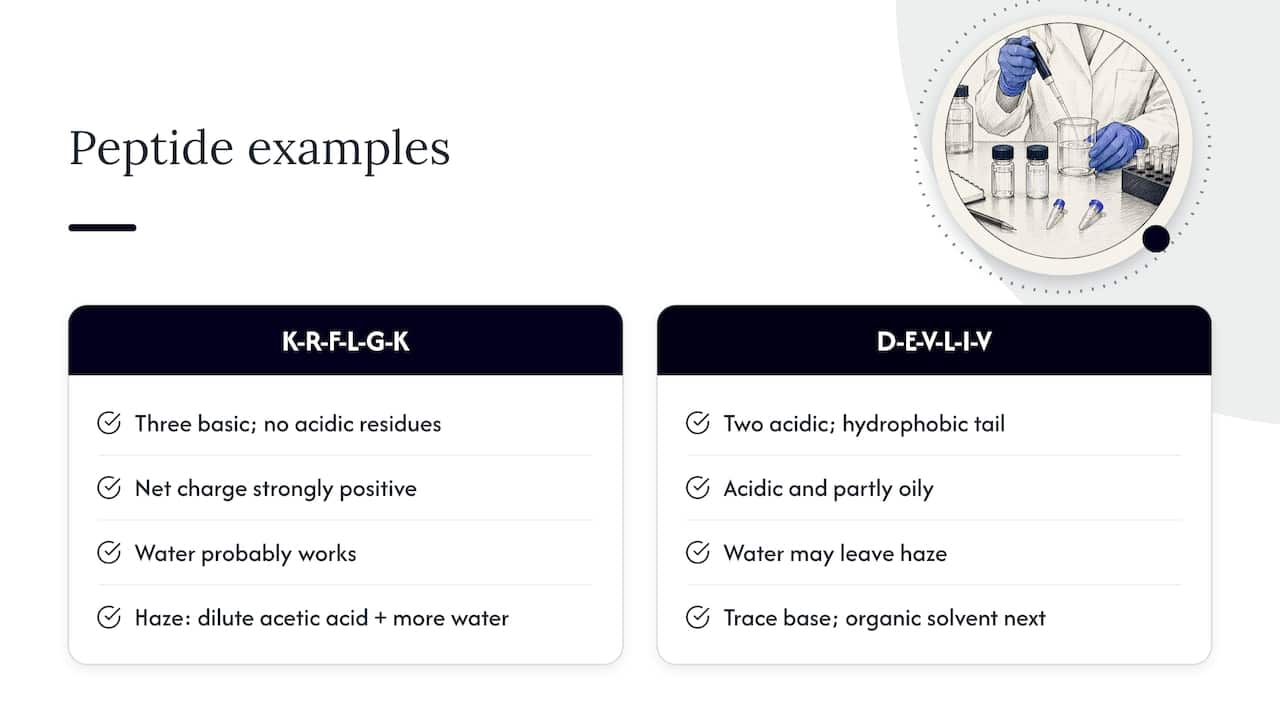
Take a made-up six-residue sequence, K-R-F-L-G-K. It has three basic residues (K, R, K), no acidic ones, and the free ends add one positive and one negative that roughly cancel out. Net charge is strongly positive, so it is a basic peptide. Water will probably work. If it comes out hazy, a drop of dilute acetic acid, the same acid found in vinegar, in a larger volume of water should clear it.
Now take D-E-V-L-I-V. It has two acidic residues and a hydrophobic tail. It is acidic and partly oily, so water alone may leave a haze. A trace of dilute base could help, and if not, a small amount of organic solvent would come next.
The proportion of oily residues (such as leucine, valine, isoleucine, phenylalanine, tryptophan) matters too. When they make up around half or more of the chain, expect water alone to fail.
Step 3: Follow the solvent ladder
Work upward one rung at a time, and stop as soon as the solution is clear. Always test with a small portion first, so a failed attempt does not waste the whole vial.
| Peptide type | First try | If still cloudy | Last resort |
|---|---|---|---|
| Short or very charged | Sterile water | Gentle swirling, then a short rest | Dilute acid or base |
| Basic (net positive) | Sterile water | Dilute acetic acid added drop by drop | A small amount of organic solvent, then dilute |
| Acidic (net negative) | Sterile water | Dilute base such as dilute ammonia, added drop by drop | A small amount of organic solvent, then dilute |
| Neutral or oily | A small amount of organic solvent (such as DMSO) to wet the powder | Add water slowly while mixing | Different solvent suited to the sequence |
A few rules make the ladder work:
- Add liquid slowly and down the side of the vial. Do not squirt it onto the powder.
- Swirl or roll the vial gently. Hard shaking can foam the solution and stress longer chains. Vortexing or brief sonication (a short burst in an ultrasonic bath) is a common lab step for stubborn samples, but gentle is the default.
- Keep warmth modest. Heat can degrade peptides. If you warm a vial at all, keep it to body-temperature gentleness, never hot.
- Dilute organic solvents last and slowly. For an oily peptide, wet the powder with the smallest amount of organic solvent first, then add water or buffer a little at a time while mixing. Adding water too fast makes the peptide crash out.
- Use weak acids and bases only, a drop at a time. Strong ones can damage the chain.
Watch the sensitive residues
Peptides containing cysteine, methionine or tryptophan can oxidise, meaning they react with oxygen and lose quality. Some solvents, including DMSO, can encourage this with certain residues, so check the CoA or sequence before choosing one for these peptides. Dissolving in water that has been sterile and freshly opened is the gentlest start.
Step 4: Judge the result
Hold the vial against a light and a dark background. A fully dissolved peptide is clear, with no flecks, no cloudiness and no jelly-like threads. If you see any of those:
- Give it a few more minutes of gentle swirling.
- Move one rung up the ladder.
- If a solution was clear in organic solvent but turned cloudy when water went in, you diluted too fast or too far. Start a fresh test portion and add water more slowly, or accept a lower final volume of water.
A cloudy solution is not ready to use. Particles you cannot see through are particles you cannot account for.
Troubleshooting common problems
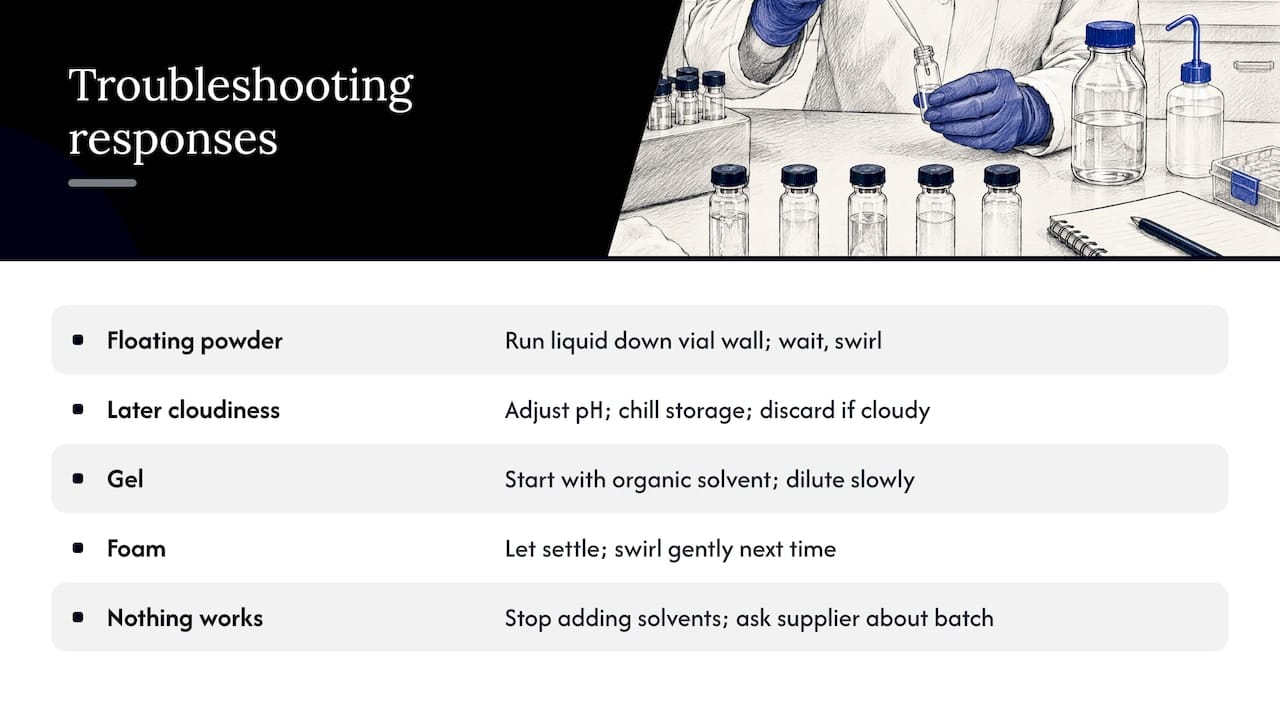
The powder floats or clumps. Some peptide powders are very light and static. Let the liquid run down the vial wall and wait a minute before swirling.
It dissolved, then turned cloudy later. The solution may be near the peptide’s pI, or the peptide may be slowly aggregating (clumping into larger particles). Moving the pH a little away from the pI or storing it colder can help. If cloudiness appears after storage, do not use it.
It forms a gel. Gelling is common with peptides rich in oily residues. A small amount of organic solvent at the start, then slow dilution, usually avoids it.
Foam after mixing. You shook too hard. Let the foam settle and swirl gently next time.
Nothing works. Stop adding more and more solvents to the same vial. A sequence that resists every ladder step is a question for the supplier’s batch information, and our team can help with questions about a Pure Peptide product’s CoA.
Storing a dissolved peptide
Once in liquid, peptides are much less stable than as dry powder. Principles that apply broadly:
- Keep it cold and dark. Refrigeration slows breakdown. Light and warmth speed it up.
- Avoid repeated warming and cooling. Each cycle stresses the peptide.
- Keep everything sterile. Clean the vial stopper with an alcohol pad each time, use a fresh sterile syringe and never reuse a needle. Our range includes ancillaries such as bacteriostatic water, syringes and alcohol pads for exactly this kind of handling.
- Label the vial. Write the date dissolved, the solvent and the volume added.
- Discard anything cloudy, discoloured or past its window. If you are unsure, do not use it.
Our guide to peptide syringes for Canadian beginners covers choosing the right syringe, and the peptide safety page explains what to know before you inject anything. If you only want powder storage and dissolved storage for later, the same cold, dark and sterile principles apply.
What solubility does not tell you
A clear solution proves one thing: the peptide is in liquid. It does not show that the product is authorized, that it is safe, or that it works for any goal.
Health Canada sets the Canadian rules. Its peptide regulations page states that a peptide product is classified either as a drug or as a natural health product depending on its use, composition and route of administration, and that injectable peptides are always classified as drugs, with stricter controls so they are sterile, safe and of high quality. It also states that authorized peptide products carry an 8-digit DIN (drug identification number) or NPN (natural product number), and that products without one have not been assessed for safety, efficacy or quality.
In its April 9, 2026 public advisory, Health Canada warned that unauthorized injectable peptides marketed online for goals such as anti-aging, weight loss, bodybuilding, athletic performance and injury recovery are illegal in Canada. It listed possible risks including hormonal imbalance, mood swings, blood sugar imbalance, liver or kidney damage, blood clots and growth of cancerous tumours. It also stated that a “For Research Use Only” label does not make a product legal or exempt it from the regulations.
So, safely used, this guide is about handling a peptide correctly in a research setting and understanding its chemistry. If you have any intention of injecting a peptide, speak with your doctor or pharmacist first, and read our page on why an eight-digit DIN matters in Canada. If you have used an unauthorized injectable peptide and have health concerns, Health Canada advises consulting a health care professional.
Our perspective
Solubility problems are rarely a mystery. They are almost always a mismatch between the peptide’s charge and the liquid it was put in, made worse by guessing at volumes. That is why we build our range around documentation: every product is backed by third-party lab certificates of analysis, and our formulations exceed 99% purity through advanced purification methods.
Purity matters here for a practical reason. A cleaner powder means fewer unknown leftovers competing with your peptide for solvent, so the steps in this guide behave the way the chemistry says they should. When a vial does not clear, you are troubleshooting one variable, not several.
We also supply the ancillaries that handling needs, including bacteriostatic water, syringes and alcohol pads, so the sterile basics are in the same order as the peptide. Our advice is simple: read the CoA, test a small portion, add liquid slowly, expect a clear solution and discard anything that is not. And keep the legal picture in view. Health Canada’s rules on DINs and NPNs are the reference for anything meant for the body.
Pure Peptide
Choosing peptides that are easier to work with
If you are comparing products for muscle growth, recovery, weight loss or anti-aging, build solubility into the decision. Look for a stated purity, a batch-specific certificate of analysis and clear identity information. We list our categories on the Pure Peptide home page: weight loss, muscle growth, recovery, anti-aging, libido and ancillaries. For category background, our guides to peptides for muscle growth and peptides for recovery explain what each group is typically used for, and our Canada buying guide covers quality and compliance.
FAQ
What is the best solvent for dissolving peptides?
Sterile water is the first choice for most peptides, especially short or highly charged ones. If it stays cloudy, a drop of dilute acid helps basic peptides and a drop of dilute base helps acidic ones. Oily peptides usually need a small amount of organic solvent first, then slow dilution with water.
Why is my peptide cloudy after adding water?
Cloudiness means the peptide has not fully dissolved or is clumping. The cause is usually a pH close to the peptide’s isoelectric point, a high share of oily residues, or water added too quickly. Move one step up the solvent ladder using a small test portion, and discard the solution if it stays hazy.
Can I heat or shake a peptide to dissolve it faster?
Gentle swirling is best. Hard shaking creates foam and can stress longer chains, and heat can break peptides down. A brief sonication burst is a standard laboratory step for stubborn samples, but keep warmth minimal.
Does a peptide that dissolves well mean it is safe to inject?
No. Solubility describes chemistry only. Health Canada states that injectable peptides are classed as drugs and that products without a DIN or NPN have not been assessed for safety, efficacy or quality. Talk to your doctor or pharmacist before using any peptide on your body.
How long does a dissolved peptide last?
Much less time than the dry powder. Keep it cold, dark and sterile, label the date you dissolved it, and discard anything cloudy or discoloured. Follow any storage guidance on your product’s certificate of analysis.
Sources
- Interpretation of the dissolution of insoluble peptide sequences (PMC)
- Peptides: Regulations and enforcement, Health Canada
- Public advisory: Think twice before injecting peptides bought online, Health Canada, April 9, 2026