





Documented peptide results come in three grades: controlled human trials, small uncontrolled studies and animal research, and personal testimonials. The grades are not equal. Human data is strongest for prescription GLP-1 drugs used for weight loss. For recovery, muscle and anti-aging peptides, most of what is documented is preclinical, with a few small human reports. This guide shows you how to tell the grades apart, what each category of peptide has on record, and what to check before you act on a before-and-after photo.
TL;DR
- The strongest human evidence is for prescription GLP-1 drugs such as semaglutide and tirzepatide. A 2025 meta-analysis found tirzepatide produced greater weight reduction than semaglutide in overweight and obese adults.
- For muscle growth, recovery and anti-aging peptides, a 2026 scoping review found that 67% of identified publications used animal models, and human studies were limited.
- Before-and-after photos and reviews show that something happened to one person. They cannot show why it happened.
- In Canada, injectable peptide drugs are regulated as prescription drugs. Look for an eight-digit DIN and speak with a licensed clinician before injecting anything.
Table of Contents
- What “documented” actually means
- Do peptides work? It depends on which peptide
- Why before-and-after photos prove less than they seem
- What documentation to ask for on a product
- Peptide rules in Canada
- A checklist for reading any peptide result
- Our perspective
- Where to go next
- FAQ
- Sources
What “documented” actually means
The word gets used loosely. A product page may say “documented results” and mean customer reviews. A researcher means something narrower: a measured outcome, in a defined group, compared with a control, written up so someone else can check it.
You can sort any claim you meet into four levels:
| Level | What it is | What it can tell you |
|---|---|---|
| Randomized controlled trial in humans | Participants split by chance into treatment and placebo or comparator groups | Whether the treatment caused the change, and by how much |
| Uncontrolled human study or case series | Patients treated and followed, with no comparison group | That some people improved. Not why |
| Animal or cell study | Rodents, tissue or lab models | A mechanism worth testing in people |
| Testimonial or photo | One person’s account | That one person’s experience happened |
A claim is only as strong as the level it rests on. This matters most with peptides, because a large share of the published material sits in the bottom half of that table.
One review of BPC-157 makes the point plainly: it notes that animal study findings cannot always be freely transferred to humans, and that comprehensive human studies are needed to establish the therapeutic and toxic profile of the compound.
Do peptides work? It depends on which peptide
“Peptide” covers a huge range, from approved diabetes and obesity drugs to compounds that have only ever been studied in rats. Asking whether peptides work is a bit like asking whether pills work. The useful question is which peptide, for which goal, with which kind of evidence behind it.
Weight loss and fat reduction
This is where the human record is deepest. Semaglutide and tirzepatide are GLP-1 receptor agonists, and Health Canada states they are authorized by prescription for type 2 diabetes or obesity. A 2025 systematic review and meta-analysis found tirzepatide produced significantly greater weight reduction than semaglutide in overweight and obese adults. The same Health Canada notice reports that the pooled comparison showed high heterogeneity, which means the trials differed enough that you should read the headline number as a range, not a promise.
Two things follow for a reader weighing fat-loss peptides:
- Strong documentation exists for specific, approved, prescribed drugs. It does not automatically carry over to every other peptide marketed for fat loss.
- If a result you are shown is attributed to a GLP-1 drug, ask whether the product in the photo was a prescribed, authorized one.
If you want the client-side view of how fat-loss peptides are described, our guide to fat loss peptides and the best peptide for fat loss page lay out the research people cite and how to read it.
Muscle growth and performance
The honest answer here is that the human record is thin. A 2026 scoping review of peptide supplements found that 67% of identified publications used preclinical animal models, and that the human studies that exist were limited, with most lacking robust controls or rigorous designs.
What that means in practice: a lifter’s log showing strength gains on a peptide is a real observation, but training, sleep, food, and expectation all moved at the same time. Without a control group nobody can separate them. That is not a reason to ignore the topic. It is a reason to treat any single result as a hypothesis and to track your own variables carefully with your clinician.
For background on how people approach this goal, see peptides for muscle growth and peptides for growth hormone.
Recovery and tendon healing
Recovery is the category with the most enthusiastic stories, and BPC-157 and TB-500 are the names you will see most. The same 2026 review concluded that current human trials do not substantiate the claimed benefits of emerging peptide supplements for musculoskeletal recovery and performance, and that most findings are preclinical.
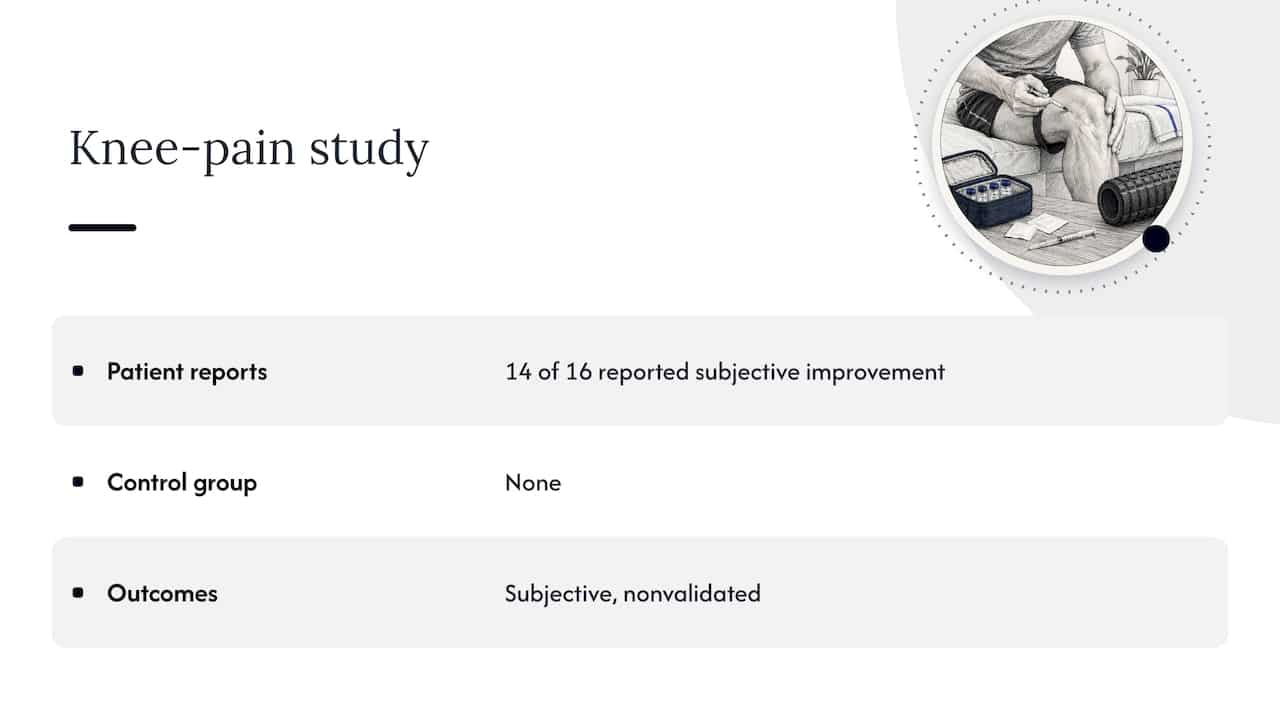
The best-known human report is a retrospective study of knee pain. According to a review of peptides in gerontology, 14 of 16 patients reported subjective improvement after BPC-157 injections. The same review points out the study had no control group and used subjective, nonvalidated outcomes.
Read that carefully. Fourteen of sixteen sounds striking. But knee pain fluctuates on its own, people who seek treatment often do so at a peak, and everyone knew they were receiving the injection. It is a lead worth following up, and a good example of what a documented result looks like when it sits at level two in the table above. A longer discussion of how the same limits apply to injections is in this look at what the evidence supports for BPC-157 and mild HBOT, which is useful if you are weighing different recovery approaches.
If you are researching this area further, our pages on BPC-157 and tendon healing, BPC-157 and TB-500 compared and BPC-157 dosage research cover what the research shows and where it stops.
Anti-aging and skin
Peptides for skin and longevity sit in the same position as the recovery group: interesting mechanisms, early or small human work, and a lot of marketing running ahead of the data. The gerontology review above is useful because it names the limits of the human evidence alongside the mechanisms. If a page promises you reversed aging, check which level of the table its evidence reaches.
Why before-and-after photos prove less than they seem
People search for peptide before-and-after images in far greater numbers than they search for clinical studies. That is natural: photos are vivid and studies are dense. But a photo series has built-in problems.
- No comparison. You see one person. You do not see the people who used the same product and changed nothing, or the person who made the same changes without it.
- Other changes travel with it. Someone who starts a peptide also tends to tighten up training and diet. That is the very reason trials use control groups.
- Selection. The images that get published are the best ones. Nobody posts the unremarkable result.
- Lighting, posture, timing. A tan, a pump, a flexed pose, a lower-water day, a different camera angle can change how a body looks within an hour.
- Unknown product. Unless the product was tested, nobody can say what was in the vial, which brings us to the safety side of documentation.
A useful habit is to ask what the photo would look like if the product did nothing. If the honest answer is “about the same”, the photo is not evidence.
What documentation to ask for on a product
Results documentation covers outcomes in people. Product documentation covers what is in the vial. You need both, and they answer different questions.
For a product, ask for:
- A batch-specific certificate of analysis from an independent third-party lab, showing the purity figure and the method used.
- Batch identification that matches the vial in your hand.
- Clear labelling of what the product is, and plain statements of how it may be used.
Health Canada warns that unauthorized products may be contaminated with solvents, heavy metals, particles such as fibres, glass or plastic, or microbes including bacteria, fungi and endotoxins, and may contain unlisted or unknown ingredients. A certificate of analysis helps you check purity, which is a real and worthwhile step. It does not turn a research compound into an authorized drug, and it does not document what the compound does in a human body.
Peptide rules in Canada
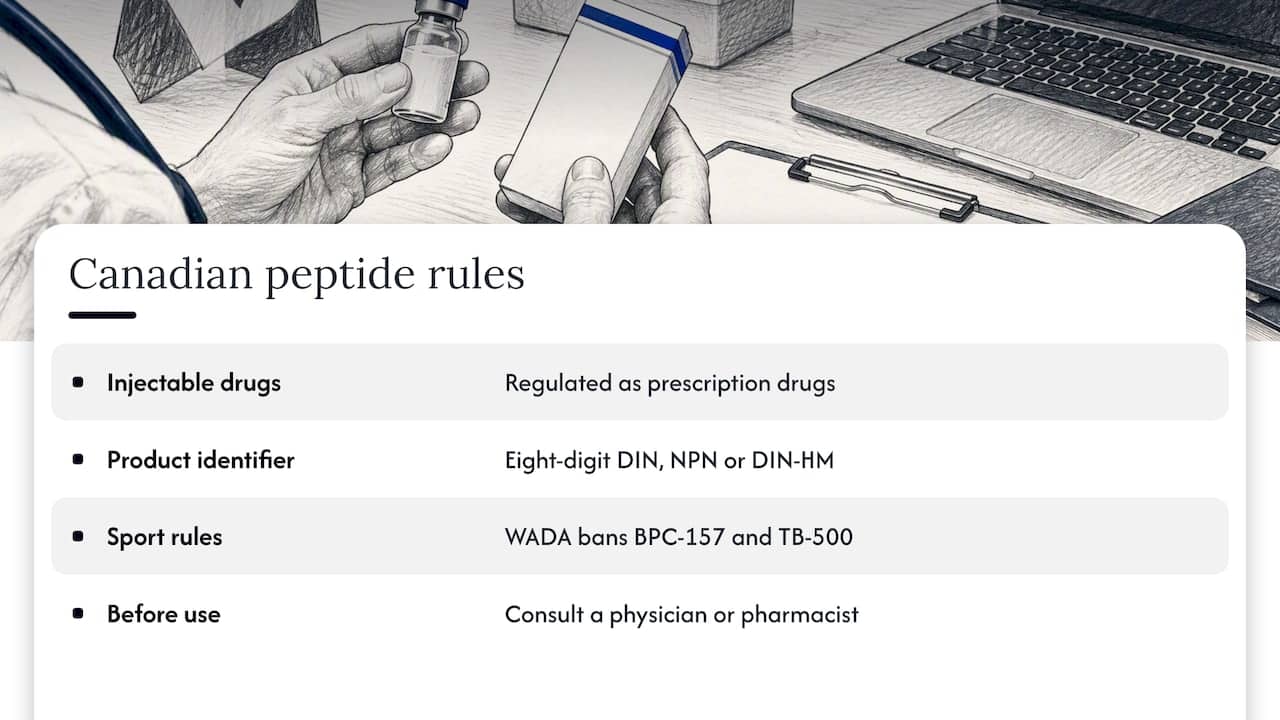
The regulatory picture shapes how you should read every claim above. Injectable peptide drugs are regulated as prescription drugs in Canada. Health Canada lists the risks of using unauthorized injectable peptides as including infections, blood clots, hormonal imbalances, mood swings, liver or kidney damage and the growth of cancerous tumours.
A practical way to check a health product is its identifier. Authorized health products carry an eight-digit number: a Drug Identification Number (DIN), a Natural Product Number (NPN) or a Homeopathic Drug Number (DIN-HM). If a product has none, you know it has not been through that authorization.
For those who compete in sport, there is a second layer. The World Anti-Doping Agency bans BPC-157 and TB-500, citing a lack of safety data and potential for abuse in performance enhancement. Tested athletes should check current rules with their sport’s governing body before using anything.
If you are considering any injectable, the safe path is to speak with a physician or pharmacist who knows your history, medications and conditions. Our own pages on peptide legality in Canada and peptide safety cover the practical points in more detail.
A checklist for reading any peptide result
Next time you see a headline number, run it through these questions:
- Who was studied? Humans, animals, or cells? How many?
- Was there a control group? Placebo or comparator, with participants assigned by chance?
- What was measured? A scan or lab value, or how people said they felt?
- How long did it run? A few days of tracking and 26 weeks of follow-up are not the same thing.
- Who paid for it? A seller’s own data deserves a second source.
- Is it the same product? A result for an approved prescription drug does not transfer to a different molecule.
- Has anyone repeated it? One result is a lead. Several independent ones are evidence.
A claim that passes five or six of these is worth taking seriously. A claim that passes none is marketing, however good the photo looks.
Our perspective
We built Pure Peptide around a simple idea: people who are serious about their health and training deserve clear information and products that are what the label says they are. That is why every product we list is backed by a third-party lab certificate of analysis, and why our formulations are designed to exceed 99% purity using advanced purification methods.
We also think the honest way to talk about results is to separate what has been measured in people from what is still being explored. The published record on peptides for recovery, muscle and anti-aging is still developing, and the most useful thing we can do is help you read it well: know the difference between a trial and a testimonial, ask for batch documentation, and keep your clinician in the loop.
Our goal is that when you choose a product, you do it with the evidence in front of you, in Canada, with an understanding of the rules that apply to you. Purity and transparency are where we put our effort, because they are the part of the picture a supplier can document and stand behind.
Pure Peptide
Where to go next
If you have a specific goal, start with the category that matches it. We organize our range by goal, including weight loss, muscle growth, recovery, anti-aging and libido, along with the reconstitution supplies such as bacteriostatic water, syringes and alcohol pads. You can browse everything on the Pure Peptide store, or read the goal-specific guides first: peptides for recovery for tissue and muscle repair, and the GHK-Cu guide for skin and aging research. Each product page is meant to be read alongside its certificate of analysis.
FAQ
Do peptides work?
Some do, and the evidence depends on the specific compound. Prescription GLP-1 drugs have substantial human trial data for weight reduction. For recovery and muscle peptides, a 2026 scoping review found human data limited and most findings preclinical, so claims in those areas are best treated as unproven.
Are peptide before-and-after photos reliable?
They show one person’s change, not its cause. Training, diet, lighting, posture and selection of the best images can all account for a visible difference. Controlled human trials with comparison groups are the way to tell whether a peptide itself made the difference.
Are there clinical studies on peptides like BPC-157?
Most published work on BPC-157 is in animals. The human reports that exist are small, such as a retrospective knee-pain study with 16 patients, no control group and subjective outcomes. Researchers say larger human studies are needed to establish both benefit and toxicity.
How can I tell whether a peptide product is authorized in Canada?
Look for an eight-digit DIN, NPN or DIN-HM on the label, which Health Canada uses to identify authorized health products. Injectable peptide drugs are regulated as prescription drugs, so talk to a physician or pharmacist before using one.
Sources
- Multifunctionality and Possible Medical Application of the BPC-157 Peptide (PMC)
- Peptide Supplements and Their Therapeutic Applications (SAGE Journals, 2026)
- Therapeutic peptides in gerontology: mechanisms and applications (PMC)
- Tirzepatide Versus Semaglutide for Weight Loss in Overweight and Obese Adults (2025)
- Health Canada: Thinking about buying GLP-1 drugs like Ozempic or Mounjaro?
- Health Canada: Using bodybuilding products
- Health Canada: Unauthorized injectable peptide drugs seized and sold in Canada
- Mild HBOT benefits: what the evidence supports