






Treat each peptide shipment according to its validated storage state: lyophilized powders usually tolerate passive pack-outs with conditioned refrigerants, while solutions generally need a controlled refrigerated chain with continuous monitoring. The right approach follows product-specific stability data, not a blanket rule that colder is always safer. Governing frameworks like Health Canada’s GUI-0069 and the WHO’s Annex 9 expect documented monitoring and a clear process for handling any temperature excursion.
TL;DR:
- Lyophilized powders generally tolerate passive transport with conditioned refrigerants, while solutions demand continuous cold chain control based on stability data.
- Passive systems rely on thermal mass, whereas active systems use powered refrigeration, and the chosen method must be validated for the specific product and transit conditions.
- Monitoring devices like data loggers and indicators are essential for verifying temperature maintenance, with calibration and records required by regulatory standards.
- Proper receipt handling includes visual inspection, slow equilibration inside a sealed container, and avoiding opening cold vials immediately to prevent condensation-related degradation.
- Winter over-freezing and summer heat exposure require adjusted insulation and refrigerant strategies, with pilot shipments recommended for high-risk routes to ensure cold-chain integrity.
Table of Contents
- Why peptide state (lyophilized vs solution) dictates cold-chain choices
- Pack-out design: passive vs active systems, refrigerants and thermal mass
- Monitoring and verification: data loggers, indicators and records
- Handling on receipt: inspection, equilibration and reconstitution safeguards
- Risk assessment, excursion handling and regulatory expectations
- Seasonal and lane-specific considerations: winter, heat and multi-leg transit
- Pure Peptide operational proofs and lab-level recommendations
- Common mistakes and a pre-shipment readiness checklist
- How we support validated cold-chain handling for your lab
- FAQ
- Sources
Why peptide state (lyophilized vs solution) dictates cold-chain choices
Peptides degrade through a handful of well-understood pathways: hydrolysis of the peptide backbone, deamidation of asparagine and glutamine residues, and aggregation into insoluble clusters. Water is the common accelerant in all three. A peptide dissolved in solution has far more molecular freedom for these reactions to occur, which is why a review of formulation strategies for peptide stability points to low-temperature handling and targeted excipients as common requirements for aqueous peptide products.
Lyophilized powder removes most of that free water, which is why freeze-dried peptides typically hold up far longer at room temperature or under refrigeration than their reconstituted counterparts. A reconstituted solution, by contrast, often needs to stay cold continuously and gets used within a defined window rather than stored indefinitely.
This difference shapes every downstream decision:
- Lyophilized powders can often ship in validated passive systems without aggressive refrigerants.
- Solutions generally require active cold chain control from the point of reconstitution onward.
- Freezing is not automatically protective. Some formulations lose activity or develop aggregates when frozen and thawed without validation.
- The correct transit temperature band (ambient, refrigerated, or frozen) comes from the product’s own stability data, never from habit.
Lane and packout design must be validated for the product’s state and route, not defaulted to the coldest option available. Defaulting to dry ice or deep-freeze conditions for a lyophilized product that was never validated at those temperatures can introduce the same instability risk it was meant to prevent.
Pack-out design: passive vs active systems, refrigerants and thermal mass
A passive system, insulated panels paired with conditioned gel packs or phase-change material, relies entirely on thermal mass to hold temperature for the length of transit. An active system uses powered refrigeration or compressed gas cooling and is reserved for longer transit times, extreme ambient conditions, or products with very narrow stability windows. Most lyophilized peptide shipments are well served by a properly validated passive system; solutions moving through multi-day lanes or hot climates may need active control.
Building a reliable pack-out generally follows this sequence:
- Confirm the product’s validated storage range and pick a shipper qualified for that range and the expected season.
- Condition refrigerants (gel packs or phase-change packs) to their target temperature before loading, never straight from a freezer unless that is the validated state.
- Place a barrier layer, bubble wrap or cardboard, between refrigerant and product so the payload never sits in direct contact with frozen packs.
- Position the product at the thermal centre of the shipper, away from walls and lids where temperature swings most.
- Add the monitoring device in a position representative of the product’s own exposure, not strapped to the exterior.
- Seal, label, and match the shipper size to the payload rather than overbuilding with excess insulation that is wasted cost without added protection.
Dry ice deserves particular caution. It holds a product near minus 78 degrees Celsius, well below what most lyophilized peptides need, and it carries its own handling and shipping restrictions as a hazardous material. For most lyophilized peptide products, a validated passive pack-out using conditioned gel packs or phase-change material is the more appropriate and lower-risk choice than dry ice, since it avoids both over-freezing and the regulatory overhead dry ice brings.
Pro Tip: Match the shipper to the payload: an oversized box with too much empty air space loses its thermal buffer faster than a right-sized one packed snugly with conditioned refrigerant.
Monitoring and verification: data loggers, indicators and records
Verifying that a cold chain actually held requires a monitoring device, not an assumption. Electronic data loggers record continuous time-temperature curves and are the strongest form of evidence for audits or excursion investigations. Electronic temperature indicators (ETIs) and chemical time-temperature indicators (CTIs) offer simpler pass/fail or threshold alerts at lower cost, useful for high-volume routine shipments where a full data curve is not required. Single-use colour-change indicators are the most basic option and work best as a quick visual check on receipt rather than as the sole record.
- Electronic loggers suit high-value, high-risk, or long-transit shipments where a defensible temperature history matters most.
- ETIs and CTIs work well for routine shipments on well-characterized, validated lanes.
- Single-use indicators are a useful receipt-side sanity check but should not stand alone as documentation.
WHO technical guidance recommends monitoring sensors accurate to within ±0.5°C for storage and transport equipment used with temperature- and time-sensitive pharmaceutical products. That precision matters because a logger drifting outside that range can mask a real excursion or flag a false one, undermining the whole record.
Calibration of monitoring devices should follow a defined schedule rather than an ad hoc one, and every logger needs a documented calibration certificate on file. On receipt, the logger should be downloaded promptly, its data curve reviewed against the product’s accepted range, and the resulting report retained alongside the shipment’s chain-of-custody paperwork. WHO Annex 9 calls for retaining these downloaded records as part of the evidence trail for the full distribution chain, not just the final delivery.
Handling on receipt: inspection, equilibration and reconstitution safeguards
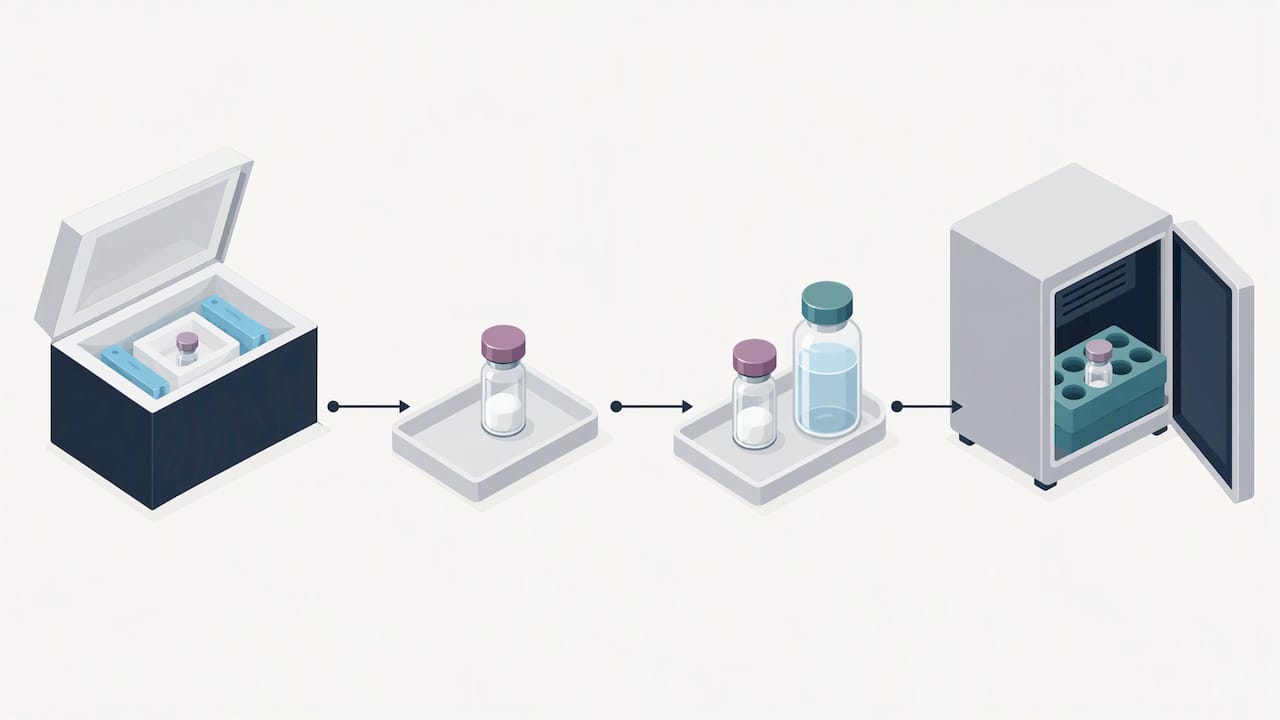
What happens in the first ten minutes after a peptide shipment arrives often determines whether the cold chain effort upstream was worth it. A disciplined receiving process looks like this:
- Check the shipping indicator or logger status before opening the insulated container, and photograph the packout as received.
- Log the observed condition and any indicator reading against the shipment’s temperature record.
- Leave the sealed product inside a dry, sealed container (with desiccant where possible) to equilibrate to room temperature before opening the vial.
- Only reconstitute once the vial has fully equilibrated and any surface condensation has evaporated.
- Label reconstituted product immediately with the date, concentration, and intended short-term storage condition.
Lyophilized peptides are hygroscopic, meaning they draw moisture from the air. Opening a cold vial straight out of the shipper invites condensation on the glass and stopper, and that moisture can migrate into the powder and accelerate hydrolysis before the product is ever used. Giving the vial time to reach room temperature inside a sealed, desiccated container removes that risk almost entirely, and it costs nothing but a short wait.
Once reconstituted, a solution generally needs refrigeration and a defined use window rather than indefinite storage, consistent with the stability behaviour described earlier. Our reconstitution guide walks through the technique step by step, including diluent selection and handling after mixing.
Pro Tip: Never reconstitute a vial that still feels cold to the touch. Condensation you can’t see on the inside of the stopper is often already there.
Risk assessment, excursion handling and regulatory expectations
A temperature excursion is any point where the product left its validated range, and the response to one should be defined before it happens, not improvised afterward. Health Canada’s GUI-0069 expects shippers to keep drug products within their labelled storage conditions throughout transport and storage, and to back any deviation from that with documented stability data or a formal risk assessment, not a guess.
WHO’s Annex 9 model guidance adds the expectation that storage and transport equipment itself be qualified, temperature-mapped, and monitored with calibrated devices, with records retained as evidence the chain held. Together these frameworks point to the same discipline: know your product’s validated range, prove you stayed inside it, and document what happens when you didn’t.
A workable excursion investigation generally follows these steps:
- Pull the logger data and identify the duration and magnitude of the excursion.
- Compare the excursion against the product’s own stability data or validated acceptable range, not a generic industry assumption.
- Decide disposition: release, quarantine pending further testing, or reject, based on that comparison.
- Document the investigation, the decision, and the rationale, and file it with the shipment record.
- Feed the finding back into pack-out design if the same lane or season keeps producing excursions.
Seasonal and lane-specific considerations: winter, heat and multi-leg transit
Winter introduces its own failure mode: over-freezing. A pack-out validated for 2 to 8 degrees Celsius can drop well below that range in a cold loading dock or an unheated cargo hold, and repeated freeze-thaw cycling from dock to vehicle to warehouse can be just as damaging as a single hard freeze. Summer heat runs the opposite risk, with refrigerant depleting faster than expected and ambient temperature pushing a passive system past its hold time.
- In winter, add insulation margin and avoid refrigerant that is colder than the product’s own validated floor.
- In summer, add refrigerant mass or move to expedited, fewer-leg transit to limit total exposure time.
- Choose carriers with cold-chain experience and defined transfer protocols at hubs, since most failures happen during handoffs, not in transit.
- Pilot a new or high-risk lane with a monitored test shipment before committing production volume to it.
Pro Tip: Profile a new lane with a single monitored shipment before scaling, since the data from that first run tells you more about real-world risk than any spec sheet.
Pure Peptide operational proofs and lab-level recommendations
Our formulations are manufactured to exceed 99% purity, verified by third-party certificates of analysis available for each batch. Those COAs and the stability expectations behind them are a practical starting point for building an internal SOP, since the documented purity and testing standards behind a product tell you how much margin you have for handling variation.
- Our laboratory standards page outlines the testing and COA practices behind each batch.
- Our reconstitution guide details diluent choice, technique, and post-mix storage.
- Our liquid peptide guide covers formulation considerations relevant to solution stability.
Labs can adapt these documents directly into pack-out checklists, monitoring protocols, and excursion response plans rather than building an SOP from first principles.
Common mistakes and a pre-shipment readiness checklist
The same handful of errors show up repeatedly in peptide cold-chain failures: shipping in an unqualified container, skipping monitoring entirely to save cost, opening a cold vial the moment it arrives, under-conditioning refrigerant before loading, and shipping without a documented record to fall back on if something goes wrong. Each one is avoidable with a short pre-shipment check.
- Confirm the product’s validated stability range before choosing a shipper.
- Condition refrigerant fully before pack-out, not partway.
- Install a calibrated monitoring device inside the shipper, positioned near the product.
- Run through a written pack-out SOP checklist rather than relying on memory.
- Confirm transit time and carrier handling commitments before the lane is used for critical shipments.
- Have a receiving plan in place before the shipment leaves, including who checks the logger and when.
— Pure Peptide
How we support validated cold-chain handling for your lab
We built our documentation around the same discipline this guide describes: certificates of analysis for every batch, formulations verified above 99% purity, and reconstitution guides written for lab use rather than general consumers. Those resources give teams a validated starting point instead of building stability assumptions from scratch.
- Our main product catalogue covers weight loss, muscle growth, recovery, anti-aging, libido, and reconstitution ancillaries in one place.
- Our laboratory standards guide documents the COA and testing process behind each batch.
- Our buying and compliance guide walks through what to check before ordering research-grade peptides.
If a refrigerator or freezer upgrade is part of your cold-chain plan, this guide to evaluating storage options for temperature-sensitive medical supplies covers practical selection criteria worth reviewing, even though it comes from outside the peptide space. Browse our full product range to find documented, lab-ready material for your next order.
FAQ
How long can BPC 157 stay unrefrigerated?
The safe duration depends on whether it is lyophilized powder or already reconstituted, since powder generally tolerates room temperature far longer than a mixed solution. Always check the specific product’s stability documentation rather than assuming a fixed number of hours or days applies across formulations.
What are the four stages of the cold chain?
A pharmaceutical cold chain is commonly broken into production and packaging, storage, transport, and final receipt and handling. WHO Annex 9 guidance treats each stage as requiring its own qualification and monitoring rather than only checking the start and end points.
What is the king of all peptides?
There is no single peptide recognized industry-wide by that label, since stability needs and uses vary widely across compounds. The more useful question for cold-chain purposes is each product’s own validated storage state, lyophilized or solution, which determines how it should be shipped and stored.
How do I keep peptides cold without a fridge?
A validated passive pack-out, insulated packaging with conditioned gel packs or phase-change material, can hold a product within its target range for the length of a typical shipment without active refrigeration. This works well for lyophilized peptides validated for that approach, though reconstituted solutions generally still need continuous refrigeration once mixed.
Why shouldn’t I open a cold peptide vial right away?
A vial straight out of refrigeration or a shipper is colder than the surrounding air, which causes condensation to form on the glass and stopper. Letting it equilibrate inside a sealed, dry container before opening prevents that moisture from reaching the hygroscopic powder and triggering early degradation.
Sources
- Canada
- Designing formulation strategies for enhanced stability of therapeutic peptides in aqueous solutions: a review – Pharmaceutics (MDPI)
- Temperature and humidity monitoring systems for storage and transport (WHO technical supplement)