







Small, local flushing and mild welts after a subcutaneous peptide injection are common and usually self-limited. Watch the site for about 30 minutes for hives or swelling that could signal an early allergic reaction, apply a cool compress, and note the time and product. Seek urgent care immediately if you notice breathing trouble, widespread hives, or dizziness.
TL;DR:
- Reactions like flushing and welts are mainly caused by local immune responses involving histamine release, influenced by solution concentration, pH, and injection technique.
- Most reactions occur within 24 to 96 hours, typically peak around 48 hours, and resolve in days or weeks, with persistent discoloration being harmless.
- Preventive measures include proper solution warming, slow injection, site rotation, and potential antihistamine use, with documentation to aid future adjustments.
- Emergency signs such as spreading redness, severe pain, or systemic symptoms require immediate medical attention and should not be self-treated.
- Maintaining detailed records and consulting healthcare providers ensures safe ongoing use, especially if reactions become more frequent or severe over time.
Table of Contents
- What causes flushing, welts and redness after peptide injections
- How a typical reaction looks and the usual timeline
- How to reduce flushing and other local reactions before they start
- How to manage flushing and welts at home after an injection
- When flushing or redness is an emergency
- Safe reconstitution and technique: what we recommend to our customers
- Long-term considerations if flushing keeps happening
- Practical perspective: balancing benefits and manageable risks
- How we support safer peptide use
- FAQ
- Sources
What causes flushing, welts and redness after peptide injections
Most injection-site flushing comes down to a local immune response. When a peptide solution enters the subcutaneous tissue, nearby mast cells can release histamine, which dilates small blood vessels and produces the redness, warmth, and itch many people notice within minutes.
A few variables make this reaction more or less likely:
- Concentration and pH: a highly concentrated or acidic solution irritates tissue more than a dilute, neutral one.
- Preservatives and excipients: bacteriostatic agents and stabilizers can themselves trigger mild irritation in sensitive people.
- Needle trauma and depth: a dull needle, repeated punctures in the same spot, or injecting into inflamed tissue increases local irritation.
- Temperature: injecting a cold solution straight from the fridge tends to sting and flush more than a solution brought closer to room temperature.
Dose matters too. Higher doses of the same peptide generally push more histamine-releasing compound into one spot, which is part of why some chemistries are known to provoke more frequent or intense reactions than others regardless of technique. A systematic review of subcutaneous oligonucleotide therapies found that injection site reactions are common across this drug class, with incidence that varies widely by compound and dose rather than by user error alone. That’s a useful reminder: flushing often reflects the formulation as much as the person giving the injection.
How a typical reaction looks and the usual timeline
A typical benign reaction starts fast: local redness, itch, mild pain, or a small raised welt, sometimes within minutes and almost always within a day or two. The same review of subcutaneous oligonucleotide injections found onset commonly between 24 and 96 hours, with symptoms often peaking around 48 hours after the dose, and resolution ranging from days to several weeks depending on the compound and the individual.
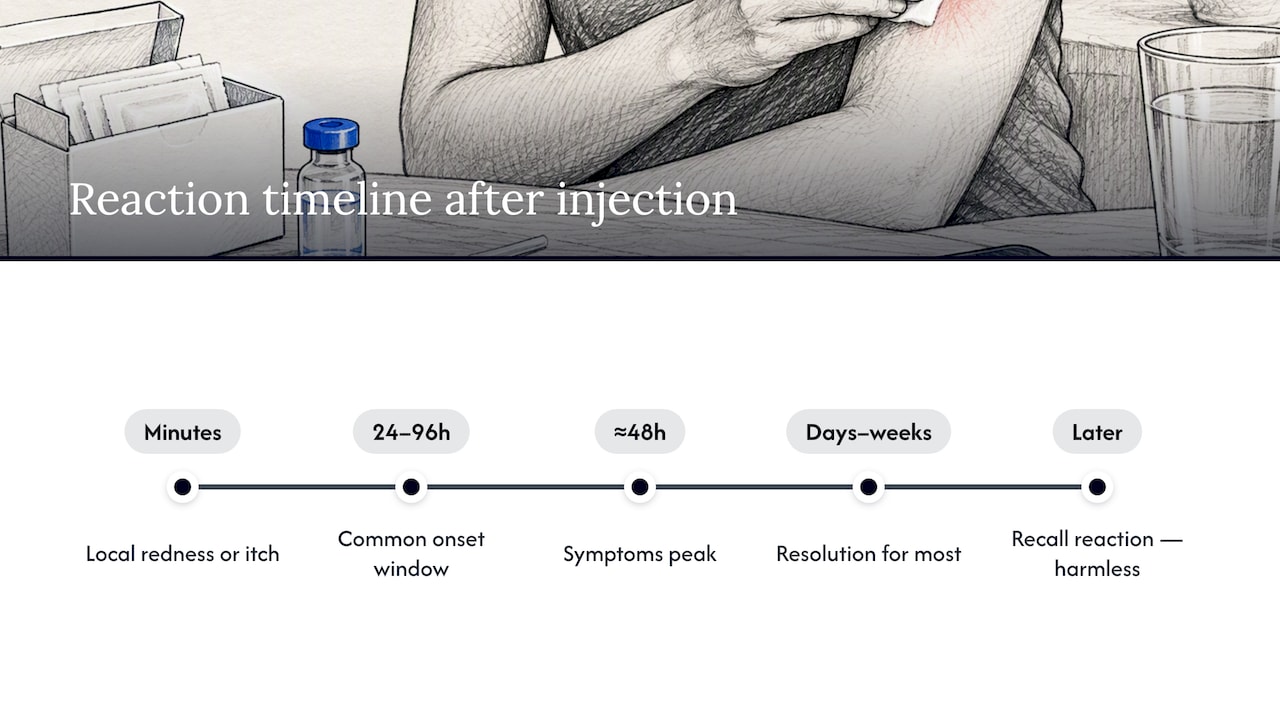
Most welts and redness fade on their own within that window. A minority of people are left with faint, lingering discolouration at the site for longer, which usually isn’t a sign of anything dangerous. If you notice the same reaction reappearing at an old injection site after a later dose elsewhere, that’s a recognized pattern called a recall reaction, and it’s generally considered harmless on its own. The key contrast to watch for is spreading, worsening redness rather than a reaction that peaks and then fades, since that pattern points toward infection instead of a simple local response.
How to reduce flushing and other local reactions before they start
Most local reactions are easier to prevent than to treat. A few adjustments to reconstitution and technique make a real difference:
- Reconstitute carefully: use sterile or bacteriostatic water, follow the labelled dilution volume, and mix by gently rolling the vial rather than shaking it.
- Pick the right site and depth: choose fatty subcutaneous tissue over muscle unless your protocol specifies otherwise, and avoid scarred, bruised, or inflamed skin.
- Rotate injection sites: moving between the abdomen, thigh, and other approved areas gives each spot time to heal and lowers cumulative irritation.
- Warm the solution slightly: letting a refrigerated solution sit at room temperature for a few minutes before injecting reduces sting and flushing.
- Inject slowly: a slow, steady push causes less tissue trauma than a fast injection and tends to produce less post-injection pain, often called PIP.
- Consider a non-drowsy antihistamine: taking one 30 to 60 minutes beforehand, only with your clinician’s approval, can blunt histamine-driven flushing in people who react consistently.
If a specific peptide is known for causing more post-injection pain, such as copper-containing formulations, choosing a deeper subcutaneous site like the lateral abdomen or glutes, alongside proper dilution, tends to help.
Pro Tip: Keep a simple injection log with date, site, and dose. It makes rotation easier and gives you (and any clinician you consult) a clear record if reactions start recurring.
For a step-by-step walkthrough, our reconstitution guide and injection-site guide cover the mechanics in more detail.
How to manage flushing and welts at home after an injection
Once a reaction has started, the goal is to calm it down without masking something more serious.
- Observe first: stay near the injection site for about 30 minutes, since local hives or swelling can be an early sign of a bigger reaction.
- Cool, don’t heat: apply a cool compress to the area and avoid rubbing, scratching, or applying heat, which can worsen swelling.
- Cleanse gently: wipe the site with a clean, damp cloth if there’s any residue, without scrubbing.
- Use oral relief as needed: a standard oral antihistamine or analgesic can ease itching and discomfort; save topical steroid creams for when a clinician has specifically advised them.
- Skip antibiotics: don’t start antibiotics on your own. They’re appropriate only when a clinician diagnoses an infection.
- Document it: photograph the site, and note the time, dose, and product batch if you have it.
Pro Tip: If the same spot flushes badly more than once or twice, pause further injections there and bring your log and photos to a clinician before continuing.
When flushing or redness is an emergency
Most reactions stay local, but a few patterns demand immediate attention.
- Anaphylaxis signs: breathing difficulty, throat tightness, widespread hives, dizziness, or fainting mean you call emergency services and use an epinephrine autoinjector right away if one is available and prescribed.
- Infection signs (cellulitis): rapidly spreading redness with poorly defined edges, increasing warmth, fever, or worsening pain, rather than symptoms that peak and improve, point toward a bacterial infection that needs urgent medical assessment, not home care.
- Follow the 30-minute rule: Canadian immunization guidance recommends observing anyone with injection-site hives or swelling for at least 30 minutes, since that’s the window in which an evolving allergic reaction typically declares itself.
If epinephrine is used, note the time and dose given, and arrange follow-up medical care even if symptoms improve, since reactions can recur after the medication wears off.
Safe reconstitution and technique: what we recommend to our customers
We built our reconstitution guide and injection-site resource around the same principles outlined above: correct dilution, gentle mixing, proper site selection, and rotation. We emphasize the importance of third-party lab certificates of analysis to give customers confidence in the purity and safety of their peptides.
A few habits we encourage across our educational content:
- Store reconstituted peptides as directed and discard anything past its stated stability window.
- Rotate sites on a set schedule rather than returning to the same spot out of convenience.
- Keep photos and written records of any reaction so a clinician reviewing it later has something concrete to work from.
If you notice a reaction you’re unsure about, we encourage reaching out to our support team with your product details and reporting it to your prescriber as well, since a reaction worth documenting is also one worth a professional’s eyes.
Long-term considerations if flushing keeps happening
A single mild reaction rarely means much. A pattern of repeated flushing at every injection is worth taking more seriously, because it can signal either a sensitivity that’s building over time or a formulation that doesn’t suit your physiology.
Some people develop a mild tolerance to the local irritation of a given peptide, where early injections flush noticeably and later ones at the same dose cause less reaction as the body adapts. Others see the opposite: a reaction that grows more pronounced with repeated exposure, which is more consistent with a developing sensitivity than simple irritation.
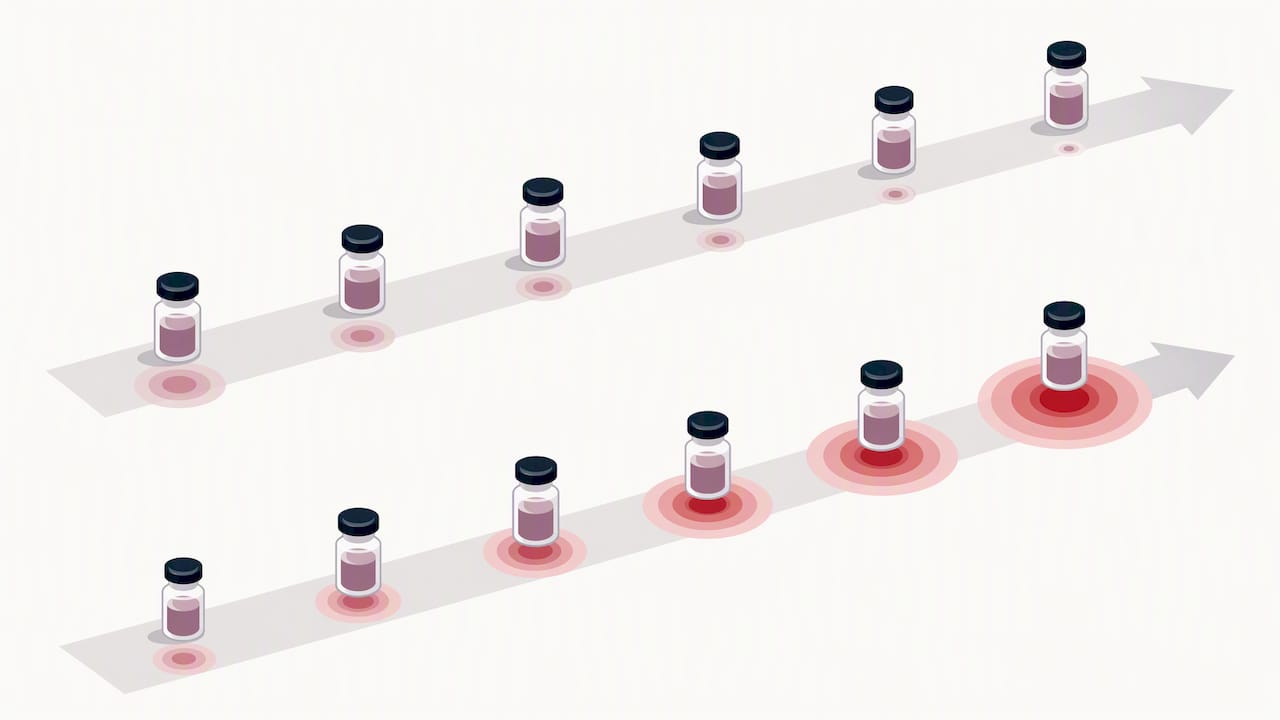
If reactions are becoming more frequent or severe rather than fading, that trajectory itself is useful information for a clinician, separate from the severity of any single episode. Some people explore switching to a different peptide chemistry, adjusting concentration or dilution, or using a planned antihistamine premedication protocol under medical guidance, sometimes called desensitization when done formally for a specific compound. None of these decisions should be made in isolation. A clinician who knows your history can help weigh whether to continue, adjust the protocol, or stop a specific peptide altogether, and can rule out an evolving allergy before it becomes a bigger problem.
The practical takeaway is to treat a worsening pattern as a signal to pause and reassess, not as something to push through.
Practical perspective: balancing benefits and manageable risks
People use peptides for real reasons, from recovery to body composition to skin and ageing concerns, and most local reactions along the way are manageable with the steps above. The safest approach treats documentation and clinician input as part of the routine, not an afterthought reserved for when something goes wrong.
— Pure Peptide
How we support safer peptide use
We focus on providing customers with a documented starting point through lab certificates of analysis, purity claims, and detailed reconstitution and technique guidance. That combination matters more than any single injection trick, since the formulation itself drives much of the reaction risk.
Before ordering, we’d suggest:
- Reviewing our reconstitution guide and injection-site resource so your technique matches the product.
- Talking to a healthcare provider about any recurring reaction or underlying condition before starting or continuing a peptide protocol.
- Reaching out to our support team with product-specific questions, including batch details if you’ve had a reaction worth reviewing.
You can browse our weight loss, muscle growth, recovery, and other peptide categories to see what’s currently available and start from there.
This article is general information, not a substitute for advice from a qualified doctor. Consult a qualified healthcare professional about your own circumstances before acting on anything here.
FAQ
Is a red spot after a peptide injection normal?
Yes, a small red spot or mild welt right after a subcutaneous injection is a common, usually harmless local reaction. Watch it for the first 30 minutes for any spreading swelling or hives, and it should fade within a few days to a couple of weeks.
What are the benefits of peptides?
People use peptides for a range of goals, including weight loss, muscle growth, recovery, anti-aging support, and libido, depending on the specific compound. We carry product categories organized around these goals, each backed by third-party lab certificates of analysis for purity.
Is BPC-157 administered subcutaneously or intramuscularly?
BPC-157 is often administered subcutaneously, though some protocols use intramuscular injection depending on the goal and clinician guidance. Our subcutaneous versus intramuscular guide walks through how route and depth affect absorption and local reactions.
Does ipamorelin cause flushing?
Mild local redness or warmth at the injection site is possible with ipamorelin, as it is with many injected peptides, though it’s typically limited to the injection area. Any flushing that spreads beyond the site or comes with systemic symptoms warrants medical assessment rather than being assumed to be a routine reaction.
How long should I watch an injection site before assuming it’s fine?
Canadian immunization guidance recommends observing an injection site for at least 30 minutes, since local hives or swelling can be the first sign of an evolving allergic reaction. If nothing systemic develops in that window, ongoing mild local redness is reasonable to manage at home.
Sources
- Anaphylaxis and other acute reactions following vaccination: Canadian Immunization Guide
- Injection site reactions after subcutaneous oligonucleotide therapy
- Cellulitis – StatPearls