





Some peptide nasal sprays work, but only certain peptides, in certain doses, in well-designed formulations. Human studies on approved nasal peptides show that very little of the dose reaches the bloodstream, usually under 5% and often under 1%, yet a few potent peptides still produce a real effect. For most peptides sold online as sprays, no human data of that kind exists. In Canada, the product also has to carry an 8-digit DIN or NPN before you can treat it as authorized.
This guide explains how nasal absorption works, what the numbers look like, what the PT-141 trials tested, and how to judge any nasal peptide claim before you act on it.
TL;DR
- Nasal absorption of peptides is low. Reviews put it below 1% for many peptides and generally under 5% for marketed products.
- Low absorption is not the same as no effect. Potent peptides such as desmopressin and oxytocin are marketed as nasal products and are considered efficacious.
- Results do not transfer between peptides. A study of one peptide says little about another, and animal results often overstate human results.
- Intranasal PT-141 has human trial data, with a first response at about 30 minutes in one trial. Most other peptides sold as sprays have nothing comparable.
- In Canada, look for a DIN or NPN, and know that a “research use” label does not make a product legal to sell or import.
Table of Contents
- How a nasal spray delivers a peptide
- So, do peptide nasal sprays work?
- How long does a nasal spray take to work?
- What the PT-141 trials actually tested
- Selank and other peptides sold as sprays
- What the reviews say about future formulations
- Canadian rules: DIN, NPN and research labels
- Product quality: what to check before you use any spray
- Where Pure Peptide fits
- Reading efficacy claims on a product page
- Frequently asked questions
- Sources
How a nasal spray delivers a peptide
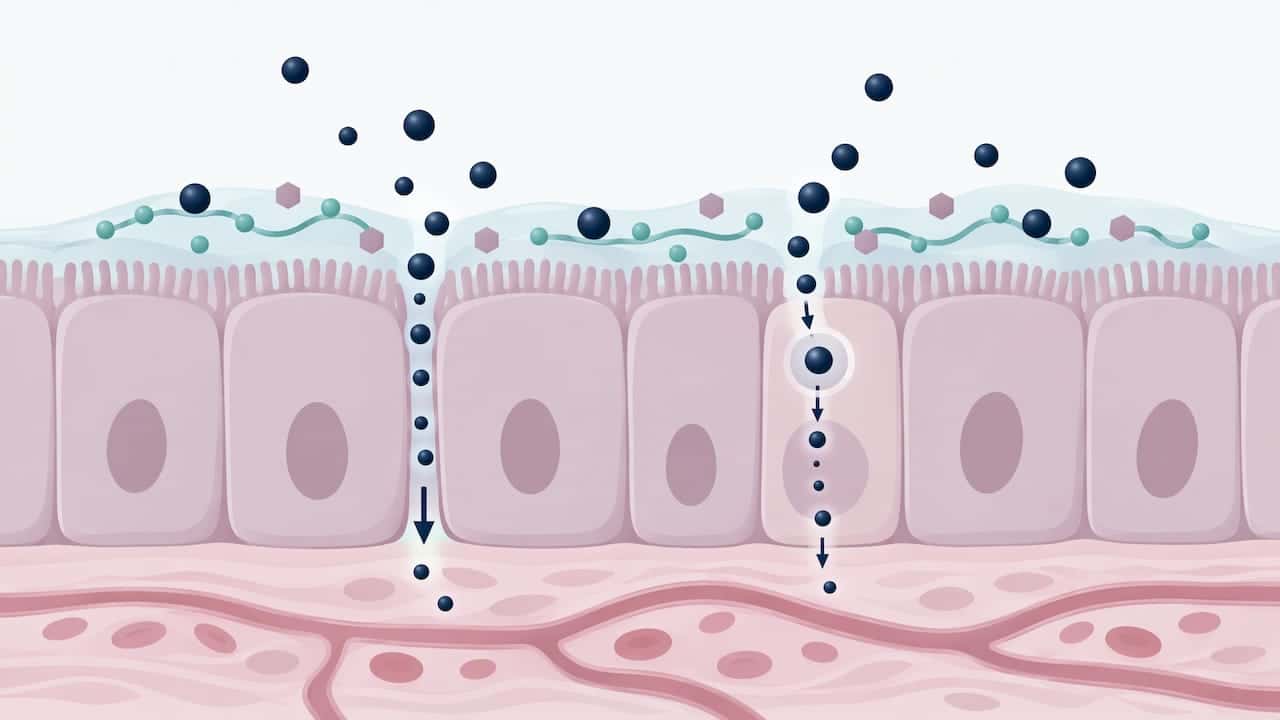
The nose looks like an ideal delivery route. It is richly supplied with blood vessels, its fluids contain fewer digestive enzymes than the gut, and its lining is more permeable than the stomach wall. A 2012 review in the Journal of Controlled Release lists these advantages over the oral route.
The same review also states the catch: nasal absorption of peptides and proteins is normally below 1%.
A 2009 review in Molecules by Ozsoy and colleagues ties that low figure to three obstacles:
- Weak membrane permeability. Peptides are large, and the nasal lining is not very permeable to large molecules.
- Enzymes. The nasal mucosa still contains enzymes that break peptides down.
- Mucociliary clearance. The nose moves mucus toward the throat quickly, carrying much of a dose away before it can be absorbed.
The same review describes how drugs cross the lining. They pass between cells (the paracellular route), through cells, or by being carried inside vesicles. The paracellular route is particularly important for peptides and proteins.
A 2018 review in Expert Opinion on Drug Delivery adds that the exact mechanism is not fully understood. It appears to involve both paracellular and endocytotic routes. It also found that peptides up to about 6,000 Da have been delivered intranasally, and that permeation enhancers and mucoadhesives have shown promise for improving absorption.
So, do peptide nasal sprays work?
They can, and the reason is potency. The 2012 review notes that marketed nasal peptide products, namely calcitonin, desmopressin, buserelin, nafarelin and oxytocin, have very low bioavailability but are efficacious. Low blood levels are enough for a therapeutic effect when the peptide acts at tiny concentrations.
The Expert Opinion review puts the typical range for currently marketed intranasal peptides at under 5% bioavailability in humans.
That is the first thing to understand about efficacy: how much gets absorbed and how much is needed are two separate questions. A peptide that works at picogram levels can be a good nasal candidate. A peptide that needs high blood levels is a poor one.
Why one peptide’s result does not carry over to another
The evidence shows how unpredictable this is:
- A 1989 study of intranasal atrial natriuretic peptide gave six healthy volunteers doses of 50 to 500 micrograms. There was no effect on blood pressure or heart rate, and no significant rise in plasma levels. The authors found no evidence that the peptide crossed the nasal barrier.
- A 2019 study of parathyroid hormone fragment 1-34 as a nasal spray found relative bioavailability of 1% or less compared with injection. Mean peak concentration was 5 pg/mL for the spray against 253 pg/mL for the injection. The researchers had expected at least 10% from preclinical data, which shows how far animal results can mislead.
So the honest answer to “do peptide nasal sprays work” is: it depends on the specific peptide, the formulation and the dose, and the evidence must exist for that exact combination.
What changes the outcome
| Factor | Effect on absorption |
|---|---|
| Size of the peptide | Smaller peptides cross more easily; delivery has been shown up to about 6,000 Da |
| Potency | A very potent peptide can act on a small absorbed fraction |
| Absorption enhancers and mucoadhesives | Can raise absorption, but the 2012 review notes none of the marketed nasal peptides contain an enhancer, most likely because of tolerability problems |
| Mucociliary clearance | Fast clearance shortens the time the peptide spends on the lining |
| Species | Animal results can overestimate what happens in people |
How long does a nasal spray take to work?
Onset depends on the peptide, so no single number applies. The best-documented example in this space is PT-141, also called bremelanotide. In a double-blind, placebo-controlled trial published in 2004, intranasal PT-141 reached its peak blood level at a median of 0.5 hours, with a mean half-life of roughly 1.85 to 2.09 hours. The first erection in that trial occurred at about 30 minutes.
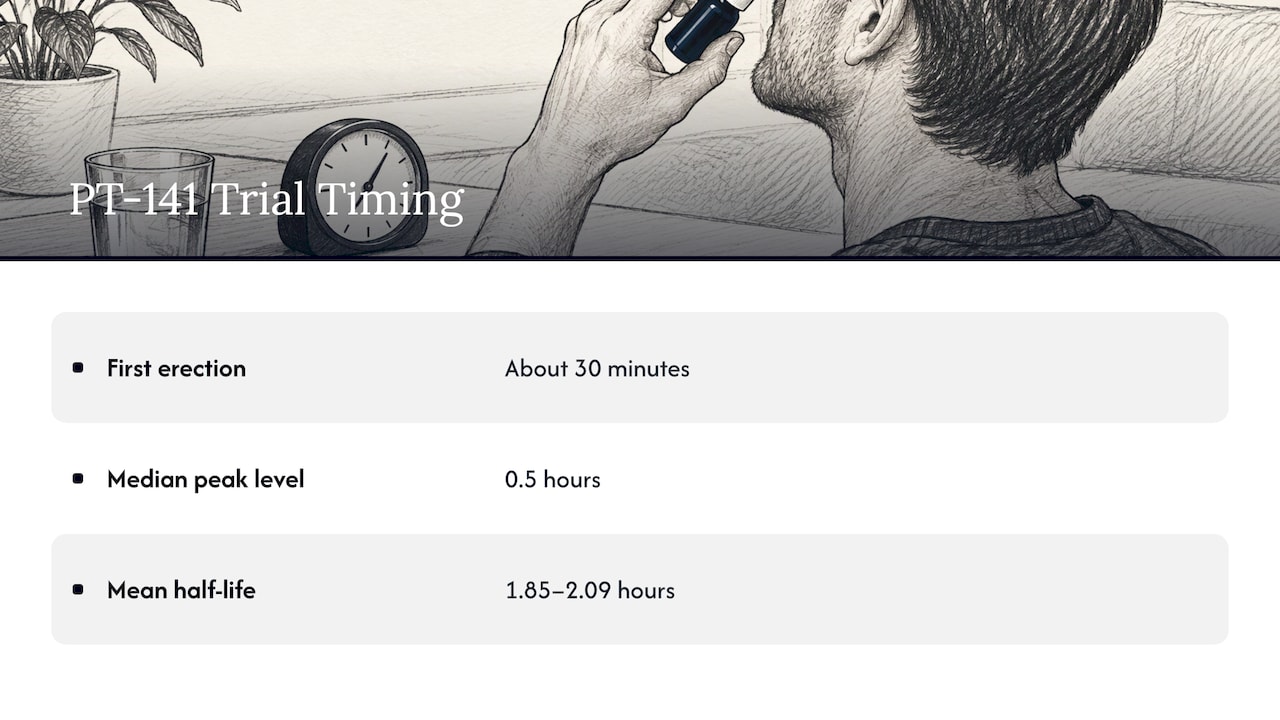
Those figures describe one peptide, one formulation and one trial population. They are not a general timeline for nasal peptides.
What the PT-141 trials actually tested
PT-141 is the most common example in “does it work” searches, so it is worth reading the study carefully. The 2004 trial by Diamond and colleagues tested intranasal PT-141 against placebo in healthy men and in men with erectile dysfunction who responded to sildenafil. At doses above 7 mg it produced a statistically significant erectile response compared with placebo. Flushing and nausea were the most common adverse events. Peak levels and exposure rose with dose, and a maximum tolerated dose was not identified.
Three points matter if you are reading a product page that cites this trial:
- The trial used a specific clinical formulation and doses above 7 mg. A spray with a different formulation or dose is not the same test.
- The participants were adult men in a monitored study. It does not tell you about other uses or people.
- It was a trial of a drug under clinical conditions, which is different from a product sold online.
Selank and other peptides sold as sprays
The search results for this topic also feature sprays containing Selank, Semax, BPC-157 and NAD+. Apply the same test to each: is there human data for this peptide, delivered nasally, in this formulation, at this dose, measuring an outcome that matters to you? Claims built on cell studies, animal work or injected-peptide research do not answer that question. When a page cannot point to a human study of the nasal version, the claim is a hope, not a result.
What the reviews say about future formulations
The 2012 review sees a great medical need for better nasal absorption enhancers so that less potent biological drugs can be delivered safely and efficiently. The 2018 review reaches a similar view: enhancers and mucoadhesives look promising. In practice, that means nasal peptide delivery is an active research area, and better formulations are being developed. It also means the products already proven are the ones built around potent peptides.
Canadian rules: DIN, NPN and research labels
This is the part most nasal spray pages skip, and it matters if you live in Canada.
Health Canada explains that a peptide product may be classified as a drug or as a natural health product, depending on its use, ingredients and how it is administered. Authorized peptide products carry an 8-digit DIN or NPN. Products without either number have not been assessed by Health Canada for safety, efficacy and quality, and selling or promoting unauthorized health products is illegal. Injectable peptides are always classified as drugs.
Health Canada also states that a research use label does not make a product legal to import or sell in Canada. A drug that is being studied in an authorized clinical trial has not been proven safe or effective.
On April 9, 2026, Health Canada issued a public advisory about unauthorized peptides bought online. CBC News reported that the advisory warns of severe side effects, including liver or kidney damage, blood clots and cancerous tumours, and that Health Canada is working with the Canada Border Services Agency to stop unauthorized shipments. The advisory’s examples were injectable peptides, but the reasoning on quality applies to any form. Peptides are generally regulated as prescription drugs in Canada, and the advisory says to use only medications prescribed by a health-care professional and sold by licensed pharmacies.
For more detail on how this plays out, our guide to peptide legality in Canada walks through the DIN requirement.
Product quality: what to check before you use any spray
Health Canada’s health-risks page warns that unauthorized peptides may be contaminated, poorly labelled, improperly made or stored, or contain too much, too little or none of the stated ingredient. Products it has tested contained no peptide, were not sterile, or lacked the advertised peptide. It also says that third-party testing alone cannot verify that a product is safe, effective, authorized for sale or made to quality standards. And a natural origin does not make a substance safe: dose, route, frequency and your own health all matter.
A practical checklist:
- Find the number. Look for an 8-digit DIN or NPN on the label.
- Match the claim to a study. The exact peptide, route (nasal) and dose should appear in published human research.
- Read the lab documents properly. A certificate of analysis shows what a tested batch contained. It is useful information on purity, but it does not replace authorization.
- Talk to a professional. If you take medication, have a heart, kidney, liver or hormone condition, or are pregnant, speak to your doctor or pharmacist before using any peptide. They can check interactions that no product page can.
- Avoid improvising. Do not combine sprays, injectables and supplements on your own.
Our page on peptide safety covers handling and safe-use basics in more depth.
Our perspective
We start from a simple view: purity and documentation should come first, because the rest of a peptide’s story means nothing if you cannot trust what is in the vial. The science on nasal delivery shows how much depends on exact formulation and exact dose. That is exactly why we put so much weight on third-party lab certificates of analysis and on purification methods that take our peptides above 99% purity.
The people we serve are serious about a specific goal, whether it is fat loss, muscle growth, recovery or healthy ageing. They want to understand what they are using. So we encourage the same discipline the research rewards: know the exact compound, read the batch documentation, and measure carefully. Our guides on verifying 99% purity and measuring peptide doses are written for that reader.
We also supply the ancillaries that careful preparation needs, including bacteriostatic water, syringes and alcohol pads, so everything comes from one place.
Pure Peptide
Where Pure Peptide fits
If your goal is weight loss, muscle growth, recovery, anti-aging or libido, we offer high-purity peptides backed by third-party lab certificates of analysis, along with reconstitution ancillaries. You can browse every category on the Pure Peptide home page. If you are comparing options on cost first, see what peptides cost in Canada, and for the wider picture read our peptides in Canada handbook.
Reading efficacy claims on a product page
When you see a claim like “rapid mucosal absorption” or “precise dosing per spray,” turn it into questions:
- Absorbed how much? Reviews put typical nasal bioavailability of peptides at under 5%, often under 1%. A page that implies near-complete absorption is out of line with the literature.
- Compared with what? The PTH study compared the spray with an injection and found far lower blood levels. A claim of equivalence needs the same kind of comparison.
- Measured in whom? Human data, not rodents or cells.
- Which outcome? Blood levels, a biomarker and a felt result are three different things.
- Authorized by whom? In Canada, that means a DIN or NPN.
The efficacy of nasal peptide delivery is real for a short list of potent, well-studied peptides. For everything else, the burden of proof sits with whoever makes the claim.
Frequently asked questions
Do peptide nasal sprays work?
Some do. Approved nasal peptides such as desmopressin and oxytocin are considered efficacious even though only a small share of each dose is absorbed. Whether a different peptide works nasally depends on its size, potency and formulation, and on whether human studies exist for it.
How much peptide does the body absorb from a nasal spray?
Reviews report that nasal absorption of peptides is normally below 1%, and that marketed intranasal peptides generally have under 5% bioavailability in humans. Absorption enhancers and mucoadhesives are being explored to raise that figure.
Does PT-141 nasal spray work?
In a 2004 placebo-controlled trial, intranasal PT-141 produced a significant erectile response at doses above 7 mg, with a first response at about 30 minutes. Flushing and nausea were the most common side effects. That result applies to the trial formulation and dose, not to every spray sold under the name.
Are peptide nasal sprays legal in Canada?
Authorized peptide products carry an 8-digit DIN or NPN. Health Canada says a research use label does not make a product legal to sell or import, and that unauthorized health products cannot legally be sold or promoted. Ask your pharmacist or doctor about authorized options.
How do I know if a nasal peptide spray is high quality?
Check for a DIN or NPN, look for human research on that exact peptide and route, and read the batch documentation. Remember that Health Canada says third-party testing alone cannot confirm a product is safe, effective or authorized.
Sources
- Nasal drug delivery: recent developments and future prospects (Journal of Controlled Release, 2012)
- Overview of intranasally delivered peptides (Expert Opinion on Drug Delivery, 2018)
- Nasal Delivery of High Molecular Weight Drugs (Molecules, 2009)
- Nasal Administration and Plasma Pharmacokinetics of PTH 1-34 (Pharmaceutics, 2019)
- Effects of intranasal administration of synthetic atrial natriuretic peptide (1989)
- Double-blind, placebo-controlled evaluation of intranasal PT-141 (2004)
- Peptides: Health risks (Health Canada)
- Peptides: Regulations and enforcement (Health Canada)
- Peptides: Research and clinical trials (Health Canada)
- Health Canada public advisory on peptides bought online, April 2026
- CBC News: Health Canada warns against injecting unauthorized drugs