





A peptide TFA salt is the form in which most synthetic peptides leave the lab: the peptide molecule paired with trifluoroacetate, a leftover of the chemistry used to make and purify it. That means the white powder in your vial is not 100% peptide by weight, and the purity percentage on a certificate does not tell you how much TFA is in it. Once you know that, you can read a certificate of analysis properly and understand why salt form is part of quality, not a footnote.
This guide is for people who buy high-purity peptides for muscle growth, fat loss, recovery or anti-aging goals and want to understand what is actually in the vial. We keep the chemistry plain and the evidence sourced.
TL;DR
- TFA (trifluoroacetic acid) is used to cut a synthetic peptide off its resin and to sharpen purification, so the finished peptide is usually a trifluoroacetate salt. Source: a 2025 academic review in PMC.
- The TFA counter ion is part of the powder’s weight, so the peptide content of a vial is lower than the gross weight.
- A standard HPLC purity figure does not show TFA, because TFA is not detected by that method. Separate methods are used to measure it.
- Residual TFA can affect cell assays and peptide behaviour, which is why salt exchange to chloride or acetate is widely considered.
- In Canada, peptides are generally regulated as prescription drugs, so decisions about use belong with a healthcare professional.
Table of Contents
- What a peptide TFA salt actually is
- Why TFA ends up in almost every synthetic peptide
- What the purity percentage does and does not tell you
- How TFA is measured
- Why residual TFA gets attention
- TFA, acetate or chloride: the salt forms compared
- How TFA salt exchange works
- What this means when you reconstitute and dose
- What Canadian buyers should keep in mind
- Perspective
- Browse our range
- FAQ
- Sources
What a peptide TFA salt actually is
Peptides carry positive charges. The free amino end of the chain and the basic side chains (arginine, lysine and histidine) all hold a positive charge in solution. Those charges need a negatively charged partner, called a counter ion, to balance them.
When a peptide is made and purified with trifluoroacetic acid, that partner is trifluoroacetate (TFA⁻). According to a 2025 academic review in PMC, freeze-drying (lyophilization) the peptide solution locks in the peptide–TFA salt, so the powder contains TFA as part of its weight.
Think of it like a table salt analogy. Sodium chloride is not “sodium plus a contaminant”; the chloride is part of the compound. In the same way, a TFA salt is a defined form of the peptide, not dirt on top of it. The difference is that TFA was not chosen for being gentle on biology. It arrived because of how the peptide was made.
You will also see “TFA in peptides” used for the same idea: the residual acid and its salt that stay with the peptide after manufacturing.
Why TFA ends up in almost every synthetic peptide
Most research and performance peptides are made by solid-phase peptide synthesis (SPPS). The chain is built one amino acid at a time while anchored to a resin bead. When the chain is finished, two things have to happen: the peptide must be released from the resin, and the protective groups on the side chains must be removed.
The same PMC review explains that in the common Fmoc approach, TFA replaced highly toxic hydrogen fluoride as the global deprotection and cleavage agent. That was a safety gain for the people running the synthesis.
TFA then does a second job. In reverse-phase liquid chromatography, the technique used to purify peptides, TFA works as an ion-pairing reagent that improves the separation of polar compounds. A University of Delaware protocol on TFA salt exchange notes that freeze-dried peptides dry as trifluoroacetate salts for exactly these two reasons: TFA remains from purification and from cleavage.
So the answer to “why is there TFA in my peptide?” is simple. It is in the process twice, and freeze-drying keeps it.
What the purity percentage does and does not tell you
This is the part that surprises most buyers. A certificate that says 99% purity is describing the HPLC chromatogram: of the peptide-related material detected, how much was the target sequence. It is a measure of peptide-related impurities such as truncated or deleted sequences.
It does not describe the counter ion. The PMC review states that TFA is UV-inactive and is not picked up by standard analytical HPLC. A peptide can therefore show an excellent HPLC purity and still carry a substantial share of its weight as TFA, water and other salts.
Two numbers matter for a real picture of a vial:
- HPLC purity: how much of the detected peptide material is the correct sequence.
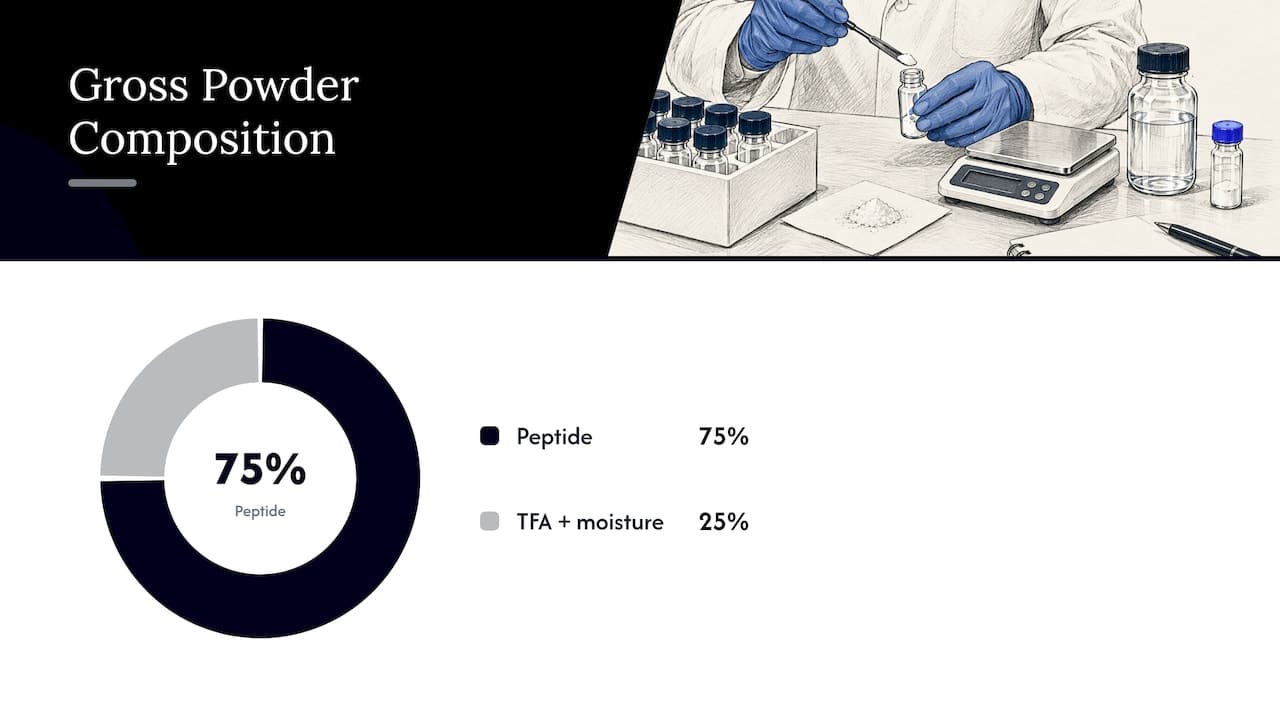
- Net peptide content: how much of the powder’s mass is peptide at all, once counter ions and residual water are subtracted.
The gap matters most when you weigh and dose. If a vial is labelled by gross powder weight, the active peptide can be meaningfully less than that figure. Our own explainer on why a headline purity can mask a lower true value walks through the arithmetic, and our guide to peptide laboratory standards covers the tests a good certificate should include.
A worked example
Suppose a vial contains 10 mg of powder by gross weight. If a quarter of that mass is TFA counter ion and moisture, the peptide itself is about 7.5 mg. Dosing from the 10 mg figure would overstate the peptide by a third. The numbers here are illustrative only: actual net content depends on the sequence, the number of basic residues and the water content, and it is reported on the certificate for the specific batch.
Peptides with many basic residues bind more TFA. A short, neutral sequence carries less. That is why one rule of thumb cannot replace a measured value.
How TFA is measured
Because standard HPLC cannot see TFA, laboratories use dedicated methods. The United States Pharmacopeia chapter USP <503.1>, Trifluoroacetic Acid (TFA) in Peptides, treats TFA as either a residual process impurity or a counter ion in active ingredients, and sets out a liquid chromatography procedure with UV detection at 210 nm. It uses a reference standard of 0.01 mg/mL when TFA is tested as a process impurity and 0.25 mg/mL when it is tested as a counter ion.
Other validated approaches named in the PMC review include ion chromatography, ¹⁹F-NMR, FT-IR and HPLC with evaporative light scattering detection. The authors also note that many of these methods lack validation under ICH guidelines, which is one reason results can differ between labs.
You do not need to run any of this yourself. What you need is to know that TFA content is a separate line from HPLC purity, and that a thorough certificate of analysis can report it. All our products are backed by third-party lab certificates of analysis, and we describe our formulations as exceeding 99% purity through advanced purification methods.
Why residual TFA gets attention
Counter ions are not passive. The PMC review emphasises that they can significantly influence the physical and functional properties of peptides, so the salt form should be reported and considered whenever synthetic peptides are used in studies.
The specific effects described in the literature include:
- In laboratory and animal settings, residual TFA⁻ has been shown to raise or inhibit cell proliferation, increase cell and liver toxicity and drive stronger antibody responses (PMC, 2025).
- It can introduce errors in molecular weight, and so in concentration calculations, and can change peptide conformation.
- It can shift the pH noticeably when the powder is dissolved, according to the University of Delaware protocol.
- An older 1998 analytical paper describes TFA as corrosive and toxic and says it can alter biological action in preclinical work, so residual TFA should be removed before final formulation. The same paper notes acetate is gentler on toxicity but may lower biological potency.
In plain terms: the counter ion is one more variable. For anyone who cares about reproducible results, knowing which salt form is in the vial removes a source of guesswork.
TFA, acetate or chloride: the salt forms compared
| Salt form | Where it comes from | What to know |
|---|---|---|
| Trifluoroacetate (TFA) | Direct result of cleavage and HPLC purification | Standard form after SPPS; adds mass; not seen by routine HPLC |
| Acetate | Exchange after purification | Often used where a milder counter ion is wanted; may influence potency per the 1998 paper |
| Chloride (hydrochloride) | Exchange with HCl, then freeze-drying | Studied as an exchange target in the 2025 PMC work |
The PMC review concludes that removing TFA or replacing it with chloride or acetate should be considered for synthetic peptides.
How TFA salt exchange works
Salt exchange swaps TFA⁻ for a different counter ion. The commonly described route has three parts.
- Dissolve the peptide in dilute hydrochloric acid. Chloride competes with TFA for the positive charges on the peptide.
- Freeze-dry the solution. The volatile TFA is carried off as acid while chloride stays with the peptide.
- Repeat for a number of cycles, then verify the result with a TFA-specific measurement.
The PMC study found that freeze-drying in 10 mM HCl was the optimal condition, with no impact on peptide purity at any HCl concentration it tested. It also reports that there is no consensus yet: published HCl concentrations range from 2 to 100 mM and the number of cycles typically runs from 1 to 5. Alternatives include anion-exchange columns, reverse-phase HPLC with different counter ions, and deprotonation and reprotonation cycles.
This is a manufacturing-stage process. It needs controlled acid concentrations, a freeze-dryer and an analytical method to confirm the outcome. It is not something to attempt on a finished vial at home, because repeated handling risks degrading the peptide and you would have no way of confirming how much TFA remains.
What this means when you reconstitute and dose
Two practical points follow from the chemistry.
Dissolving. Because TFA is an acid, a peptide TFA salt can lower the pH of the solution. Use the diluent and technique your supplier recommends, and handle the vial gently. Our complete reconstitution guide covers diluents, technique and storage step by step.
Measuring. Dose maths is only as good as the starting figure. If you do not know the net peptide content of the vial, calculations based on the gross powder weight carry an error. Our worked examples for measuring peptide doses in Canada show how to turn a vial size and a diluent volume into a measured quantity, and why checking each step matters.
If you want the wider background on how research-grade material is made and tested, our research peptides guide is the place to continue.
What Canadian buyers should keep in mind
Salt form is a quality question. Whether and how a peptide may be used by a person is a separate, regulatory one, and in Canada the two should not be confused.
Health Canada states that peptides are generally regulated as prescription drugs, and that decisions about prescription medication should be made in consultation with a healthcare professional. Products labelled for research use are not products authorized by Health Canada for human use, and a purity or salt-form specification on a certificate does not change that.
If you have a medical condition, take medication, are pregnant or breastfeeding, or are thinking about any peptide for a health goal, speak with your doctor or pharmacist first. That is the person who can weigh your history against any option.
Perspective
Most of the confusion we see around peptide quality comes from one number doing too much work. A purity percentage is useful, but it describes the peptide-related fraction of what the detector sees. It says nothing about the counter ion, which is a separate and measurable part of the vial.
That is why we put third-party certificates of analysis behind every product and why we talk about purity above 99% together with the methods used to reach it. A buyer who understands TFA, net peptide content and salt form reads a certificate the way a laboratory does, and makes better decisions about measuring and handling.
Our approach is to give people the whole picture: what the powder is, how it was made, how it is tested and how to reconstitute it carefully. High purity, documented testing and clear guidance belong together.
Pure Peptide
Browse our range
If you are ready to look at specific products, our catalogue covers weight loss, muscle growth, recovery, anti-aging, libido and the ancillaries such as bacteriostatic water, syringes and alcohol pads. Each category is built around high-purity material backed by third-party certificates of analysis.
FAQ
Is TFA in a peptide an impurity?
It depends on how it is classed. USP <503.1> treats TFA as either a residual process impurity or a counter ion, and the test standard differs for each. In a freeze-dried peptide it is normally present as the counter ion, forming the peptide–TFA salt.
Does 99% purity mean the vial is 99% peptide?
No. HPLC purity describes the share of detected peptide-related material that is the target sequence. TFA is not detected by standard HPLC, so counter ions and water are outside that number. Net peptide content is the figure that tells you how much of the powder is peptide.
Can TFA be removed from a peptide?
Yes, at the manufacturing stage. The usual method exchanges TFA for chloride by dissolving the peptide in dilute HCl and freeze-drying, repeated for several cycles. A 2025 study found 10 mM HCl to be the best condition it tested, while noting that no consensus exists on concentration or cycle number.
Why does the salt form matter for dosing?
The counter ion adds weight and can change how a peptide behaves in solution. If dosing is calculated from gross powder weight rather than net peptide content, the real amount of peptide can be lower than expected. Working from the certificate’s batch values and a careful measuring routine reduces that error.
Are peptides sold online approved for human use in Canada?
Health Canada says peptides are generally regulated as prescription drugs and that unauthorized products have not been assessed by it for safety, efficacy and quality. Talk to your doctor or pharmacist before considering any peptide for a health goal.
Sources
- Towards a Consensus for the Analysis and Exchange of TFA as a Counterion in Synthetic Peptides (PMC, 2025)
- USP <503.1> Trifluoroacetic Acid (TFA) in Peptides
- Trifluoroacetic Acid (TFA) Salt Exchange Removal Protocol, University of Delaware (2024)
- Capillary electrophoretic determination of acetic acid and trifluoroacetic acid in synthetic peptides (1998)
- Health Canada: Think twice before injecting peptides bought online