







Yes, peptide timing matters, but only for specific compounds. Growth hormone secretagogues work best fasted and near sleep onset because that is when your natural GH pulse fires. Weekly injectables and most oral peptides need consistency, not a specific clock time. The one rule that never changes: match the schedule to the compound’s mechanism and half-life, and follow the product label or your prescriber’s plan over any generic chart you find online.
TL;DR:
- Growth hormone secretagogues should be dosed fasted and near sleep onset to align with the body’s natural GH pulse, which occurs shortly after sleep begins.
- Long half-life peptides and weekly injectables require consistent timing based on routine rather than specific clock hours, with weekly injectables tolerating any day of the week.
- Oral peptides with absorption enhancers must follow strict fasting protocols, including taking the medication on an empty stomach and waiting 30 minutes before eating or drinking.
- Timing-sensitive peptides like GH secretagogues benefit from short fasts and deliberate scheduling around workouts or sleep, while steady-release formulations do not depend on precise timing.
- Verify peptide legitimacy with product registration numbers before considering timing and follow the prescribing guidance to ensure safety and efficacy.
Table of Contents
- Why peptide timing matters: physiology and pharmacokinetics explained
- Timing rules by peptide class and mechanism
- Food, sleep, and exercise: turning mechanism into a daily routine
- Half-life, cadence, and cycling: building a schedule that lasts
- Practical schedules and templates you can adapt
- Safety and regulation: what Health Canada wants you to know
- Where purity fits into the timing conversation
- A practical view on chasing the perfect schedule
- Get your timing right on a product you can actually trust
- Sources
- FAQ
Why peptide timing matters: physiology and pharmacokinetics explained
Timing sensitivity comes down to two things: what a peptide is trying to trigger, and how long it stays active in your body.
Growth hormone secretagogues, like GHRP-class compounds and GHRH analogues, are built to amplify a pulse your body already produces. Research on GH secretion shows the most reproducible GH pulse occurs shortly after sleep onset, which is why pre-bed dosing shows up so often in secretagogue guidance. Dosing the same compound during the day may not align with the natural growth hormone pulse pattern.
Food complicates this further. Insulin and somatostatin released after eating blunt GH release, and research on acyl-ghrelin shows a measurable link between ghrelin levels and GH pulse amplitude that shifts depending on whether you are fed or fasted. A meal an hour before a GH secretagogue dose can meaningfully dull the response.
None of this applies evenly across every peptide class, though.
- Long half-life compounds don’t care much about clock time, since blood levels stay relatively steady across the day.
- GH-axis peptides are the most timing-sensitive group, because they depend on a specific physiological window.
- Oral peptides with absorption enhancers follow strict fasting rules set by the manufacturer, not general physiology.
- Weekly injectables prioritize a fixed weekday over any particular hour.
One caveat worth sitting with: physiology explaining why a pulse happens is not the same as proof that hitting that window improves outcomes for every off-label use. The mechanism is real; the clinical payoff for micro-timing an unregulated product is often unproven.
Timing rules by peptide class and mechanism
Different peptide families answer to different clocks. Here is how the major categories break down in practice.
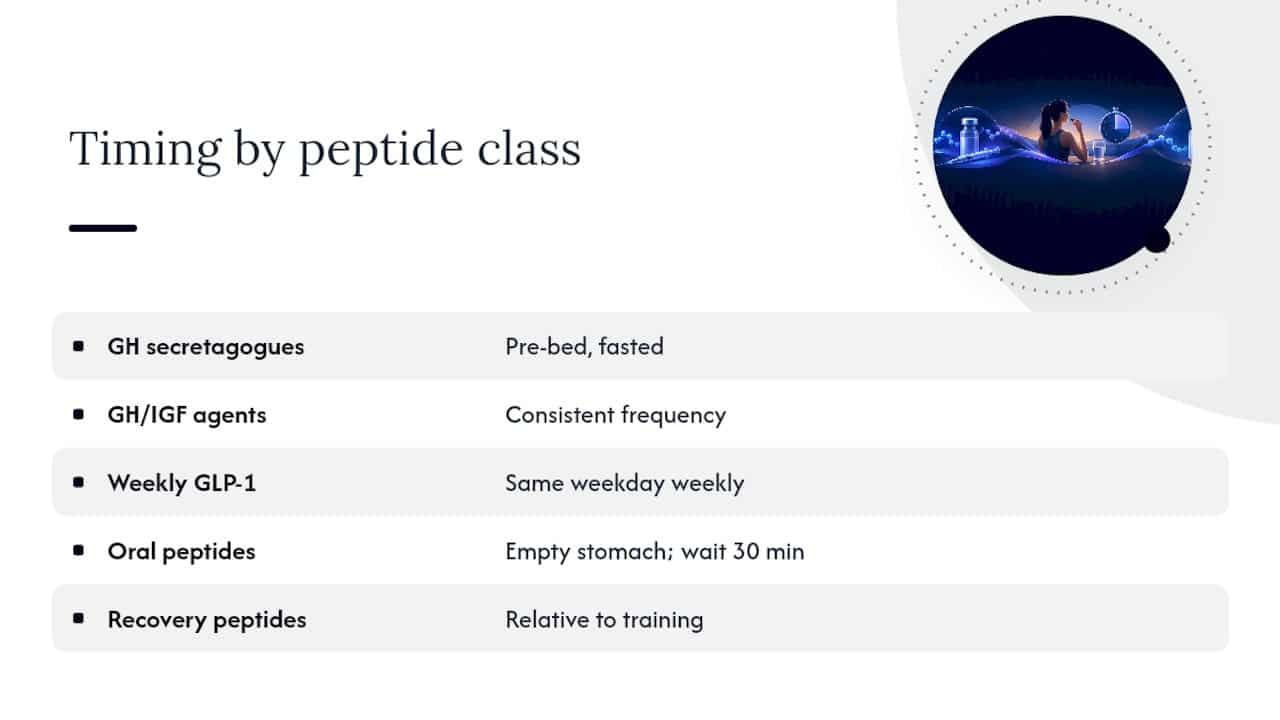
GH secretagogues (GHRP-2, GHRP-6, ipamorelin, hexarelin) are typically dosed pre-bed on an empty stomach, riding the natural sleep-onset GH pulse rather than fighting it. Some protocols add a second fasted dose earlier in the day, but the bedtime dose carries the most physiological logic.
GH analogues and IGF agents, including longer-acting growth hormone formulations, behave differently. Their half-lives run longer, so blood concentration stays elevated across the day regardless of when the dose lands. Clock time matters less here than consistent frequency.
Weekly GLP-1 injectables are the most forgiving on timing. Prescribing information for products in this class states dosing can occur at any time of day, provided the same weekday is used each week. The label also specifies a missed-dose window rather than requiring perfect daily punctuality.
Oral peptides with absorption enhancers are the strict outliers. Rybelsus (oral semaglutide) must be taken on an empty stomach with water only, followed by a 30-minute wait before any other food, beverage, or medication. Miss that window and absorption drops sharply, because the enhancer needs an empty stomach to do its job.
Recovery and healing peptides, such as those used around soft-tissue repair, generally get scheduled relative to training rather than the clock. Some protocols favour dosing away from an intense training session to avoid stacking two forms of physical stress, while others tie dosing to the workout window itself.
The pattern across all five groups: short-acting, receptor-triggering compounds are timing-sensitive; long-acting or steady-release compounds are frequency-sensitive. Confusing the two categories is where most homemade schedules go wrong. Reviewing a complete guide to research peptides before starting a new compound helps you place it in the right category from the start.
Food, sleep, and exercise: turning mechanism into a daily routine
Mechanism tells you why timing matters. These rules tell you how to actually build a day around it.
- Respect fasted windows precisely. Most fasted-dosing guidance calls for 2 to 3 hours after a meal, or 30 to 60 minutes before the next one, largely because insulin and somatostatin activity is at its lowest in that window, which supports the GH-response research noted above.
- Decide pre- or post-workout deliberately, not by habit. Recovery-focused peptides are sometimes dosed post-workout to align with the body’s repair window, while others are kept away from training entirely to avoid compounding stress hormones. Check the specific compound’s guidance rather than assuming one rule fits all.
- Shift dosing days to manage side effects. GLP-1 agents and some GH-axis peptides can cause nausea or GI upset in the first hours after dosing. Many people schedule injections for a weekend evening the first few weeks, so any rough patch happens on personal time, not during a workday.
- Flag every other medication you take. Oral peptides with strict fasting rules, like Rybelsus, explicitly warn against taking other oral medications during that 30-minute window. If you manage diabetes or another condition with daily pills, map out the full sequence before you start, ideally with a pharmacist’s input.
None of these four rules override a product label. They fill the gaps a label leaves open, like which meal to skip or which day of the week to pick.
Half-life, cadence, and cycling: building a schedule that lasts
Half-life is the number that tells you how often to dose, not necessarily when.
Very short half-life peptides, often measured in minutes, need multiple daily doses to maintain any meaningful effect. Short half-life compounds, in the range of a few hours, usually land on once or twice daily. Medium half-life peptides can stretch to once daily. Long-acting or depot formulations, including weekly injectables, hold steady levels with a single dose per week.
Cycling exists mostly for GH secretagogues and some recovery peptides, where a common structure runs 12 to 16 weeks of active use followed by a 4 to 8 week break. The rationale is to avoid blunting receptor sensitivity over time, though the exact length varies by compound and goal.
Missed doses get handled by the product’s own rules, not intuition:
- Weekly injectable labels typically define a specific catch-up window if a dose is missed, after which you wait for the next scheduled day.
- Daily secretagogues generally just resume at the next scheduled time rather than doubling up.
- Oral peptides with strict fasting rules almost never allow a “make-up” dose later the same day.
Pro Tip: Keep a simple log with the date, time, and dose for every injection or oral dose. If you ever notice an unexpected side effect, that log is what lets you or a healthcare professional trace it back to a specific timing pattern instead of guessing.
Consistency also does something quieter but just as valuable: it makes any adverse effect far easier to attribute to the right cause, since you are not juggling five variables at once.
Practical schedules and templates you can adapt
Pick the template that matches your compound, then build the rest of your day around it.
- Pulsed GH secretagogue, pre-bed. Set an anchor time roughly 30 to 60 minutes before you typically fall asleep. Keep the prior meal at least 2 to 3 hours earlier, and avoid a late snack after dosing.
- Oral fasted AM. Wake, take the dose with plain water only, and set a timer for the 30-minute wait before coffee, breakfast, or other medications. This template is non-negotiable for absorption-enhanced orals like Rybelsus.
- Weekly injectable, fixed weekday. Choose a weekday that fits your routine long-term, such as every Sunday morning. Note the label’s missed-dose window in your calendar so a busy week doesn’t turn into a guessing game.
- Quick setup for any new peptide. Pick your anchor time first, log every dose from day one, and confirm the product’s DIN or NPN and your prescriber’s plan before adjusting anything. If injections are new to you, a walkthrough on choosing the right injection site removes a lot of the guesswork on technique.
The first week is about establishing the anchor time and noticing how your body responds, not chasing perfect optimization.
Safety and regulation: what Health Canada wants you to know
Health Canada has issued a direct warning that unauthorized injectable peptide products sold online can seriously harm users, and that injectable peptides are generally regulated as prescription drugs in Canada. A separate notice lists specific unauthorized products seized from a peptide vendor, including common names like BPC-157, TB-500, CJC-1295, and ipamorelin.
Before you worry about timing at all, verify what you’re actually holding:
- Check for an eight-digit DIN (Drug Identification Number) or an NPN on the packaging, then confirm it in the Drug Product Database.
- Treat “for research use only” labelling on an injectable product as a red flag, not a technicality.
- Be skeptical of any listing with no batch number, no certificate of analysis, or claims that sound too dramatic to be true.
If you suspect you’ve used an unauthorized product, stop, talk to a healthcare professional, and dispose of remaining product safely rather than returning it to circulation. Timing advice only matters once you know the product itself is legitimate. Pure Peptide’s own guide to buying peptides in Canada walks through these verification steps in more detail.
Where purity fits into the timing conversation
Timing advice is only as good as the product behind it. That’s also why every dosing recommendation here defers to the product label and a prescriber’s plan rather than a generic chart. For readers weighing injection technique or product verification, the peptide safety guide is the natural next stop.
A practical view on chasing the perfect schedule
Timing genuinely helps for mechanism-sensitive peptides like GH secretagogues. But no schedule fixes an unverified product or replaces a clinician’s judgment on your specific case. Log your doses, then let a professional guide any changes.
— Pure Peptide
Get your timing right on a product you can actually trust
None of the scheduling advice above means much if the peptide itself is unverified or impure. That’s the piece a timing chart can’t fix: the compound has to actually be what the label says before any schedule matters. Once you’ve confirmed a genuine need and you’re following authorized guidance, browse the Pure Peptide catalogue to see the full product range, or head straight to the recovery peptides category if healing timing is what brought you here. Check the certificate of analysis on any product before your next dose.
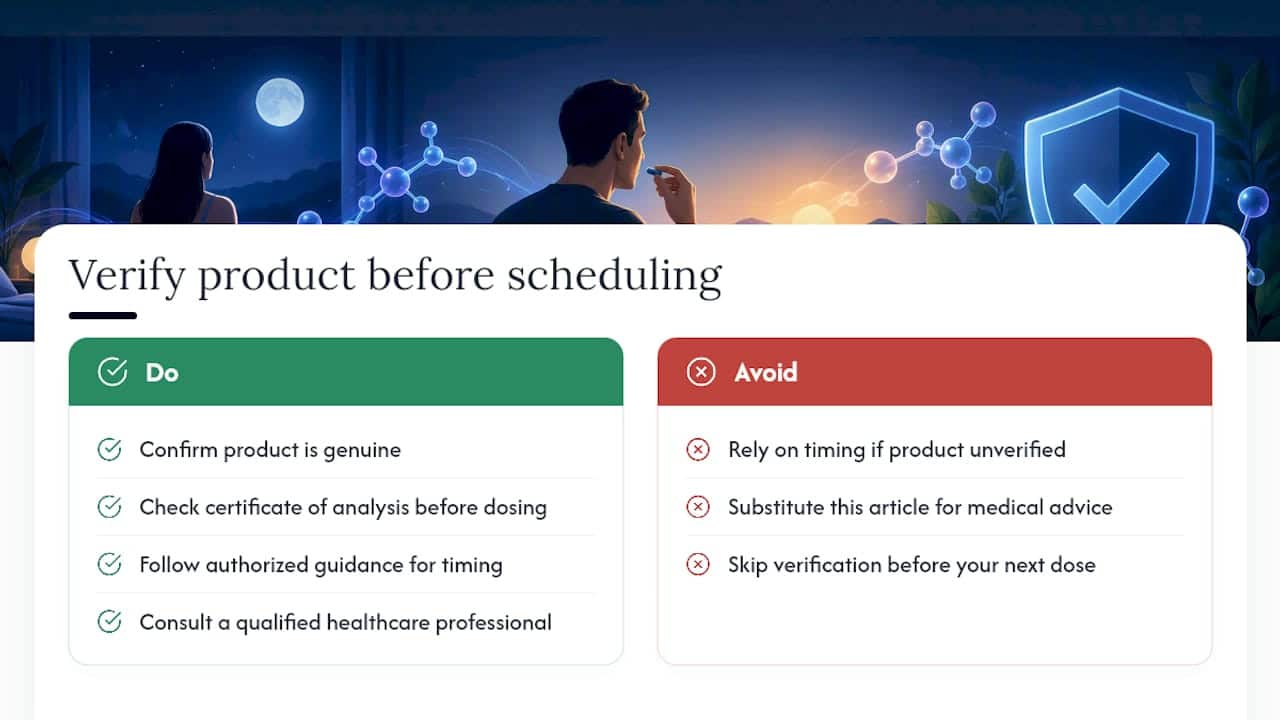
This article is general information, not a substitute for advice from a qualified doctor. Consult a qualified healthcare professional about your own circumstances before acting on anything here.
Sources
- Think twice before injecting peptides bought online: unauthorized products can seriously harm you – Canada.ca
- Van Cauter & Plat — GH pulse and sleep (PubMed)
- Study on ghrelin and GH pulse amplitude (PMC)
FAQ
Does peptide timing actually matter?
It matters a lot for some peptides and barely at all for others. GH secretagogues respond strongly to sleep onset and fasted states, while long half-life compounds and weekly injectables mostly need consistency rather than a precise hour.
When is the best time to take BPC-157?
Many recovery-focused protocols schedule BPC-157 relative to training rather than to a fixed clock time, with some users dosing away from intense workouts to avoid compounding physical stress. There is no single regulatory-labelled timing rule for this peptide, so following your prescriber’s specific plan matters more than any generic chart.
How long before peptides start working?
This depends entirely on the compound and its half-life. Short-acting GH secretagogues can produce a detectable hormonal response within hours of a dose, while effects tied to tissue repair or body composition typically take weeks of consistent use to become noticeable.
Is it okay to take BPC-157 before a workout?
Some protocols favour pre-workout dosing to align with the training window, while others avoid it to prevent stacking two stress responses at once; practices vary and no fixed labelled rule exists. If you’re unsure, a healthcare professional familiar with your training load is the better source than a general timing chart, and Pure Peptide’s peptide safety guide covers the general precautions worth reviewing first.