






Peptides may help scars look better, but the strong human evidence is narrow. The best result so far comes from a trial of one peptide gel, aCT1, applied to surgical incisions. Most other scar peptides, including ADSCP6 and GHRP-6, have only been tested in cells and animals. In Canada, a peptide product that has no DIN or NPN has not been assessed by Health Canada for any use, scars included. This guide covers which peptides have been studied, which kinds of scars they might suit, what realistic timelines look like, and how to lower your risk.
TL;DR
- The best human data is one trial of an aCT1 gel on surgical incisions. Scar scores were 47% lower at 9 months, with no meaningful difference at 1 month.
- ADSCP6, GHRP-6 and most other scar peptides are at the cell or animal stage. No anti-scar drug has FDA approval as of the last major review.
- Timing matters. Early treatment of a fresh wound looks more promising than trying to reverse a mature scar.
- In Canada, only products with an 8-digit DIN or NPN have been reviewed by Health Canada. Unauthorized peptides have turned up with no active ingredient or with contamination.
- For keloids, thick raised scars or scars that hurt, see a physician or plastic surgeon before trying any peptide.
Table of Contents
- Can peptides help heal scars?
- What the studies show, peptide by peptide
- Which scars are we talking about?
- Realistic timelines
- Safety and legality in Canada
- What not to mix with topical peptides
- What actually has strong support for scars
- A fair checklist before you buy any peptide
- Our perspective
- Where our range fits
- FAQ
- Sources
Can peptides help heal scars?
Peptides are short chains of amino acids that act as signals in the body. In wound healing, some signals calm inflammation, some guide skin cells to close the wound, and some tell fibroblasts how much collagen to lay down. A scar is largely a collagen problem: too much, laid down too densely and in the wrong pattern. That is why researchers are interested in peptides.
Interest is not proof, though. A 2026 review in Aesthetic Surgery Journal notes that regenerative peptides look promising in preclinical studies but lack rigorous human clinical trials. A 2021 review of scar prevention drugs found that many small molecules and polypeptides had reduced scarring in animals and trials, yet no anti-scar pharmaceutical had received FDA approval as of February 2021.
So the honest answer to “can peptides help heal scars?” is: possibly, for specific peptides, in specific situations, and the evidence is early.
What the studies show, peptide by peptide
aCT1: the strongest human evidence
aCT1 is a peptide that targets a protein involved in how skin cells communicate and migrate. In a multicenter, within-participant randomized trial, surgical incisions treated with aCT1 gel scored 47% better on the Vancouver Scar Scale at 9 months than incisions given standard care alone. The authors still called for further clinical investigation, and the trial was described as proof of concept.
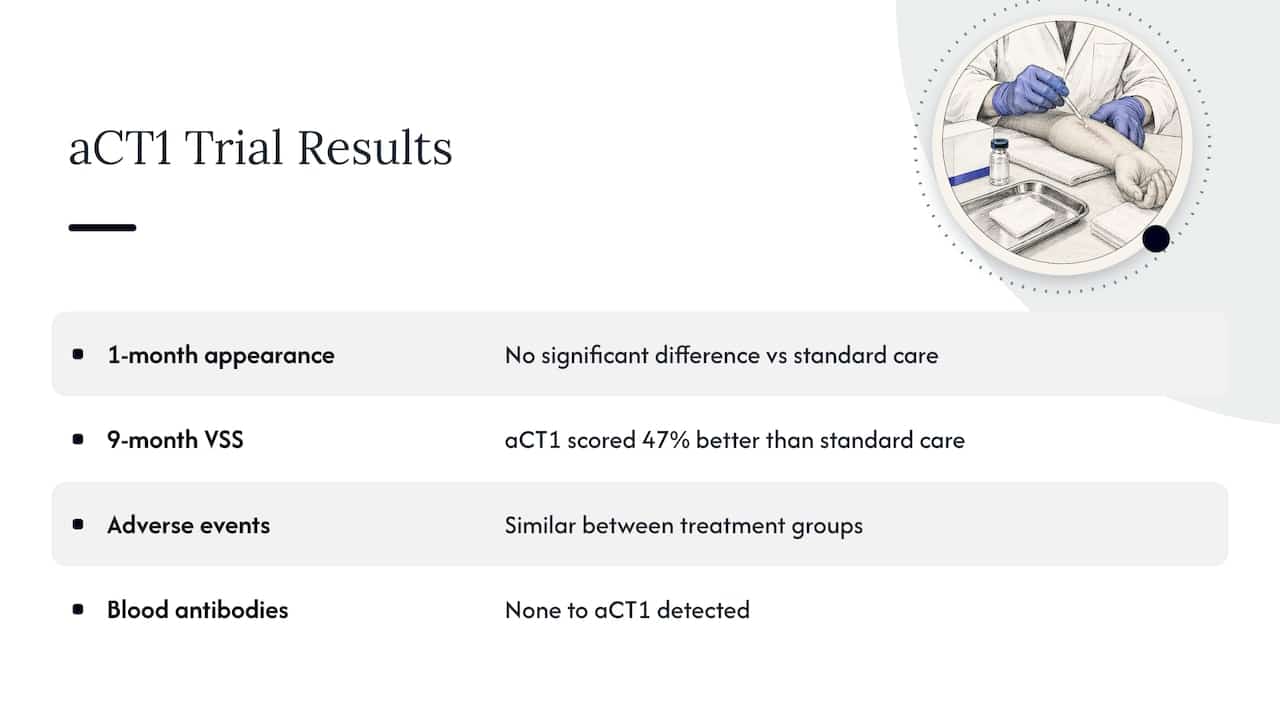
Two details matter for expectations. First, there was no significant difference in scar appearance at 1 month, so the benefit showed up as the scar matured. Second, adverse events were similar between the treated and control groups, and no antibodies to aCT1 were detected in participants’ blood.
The catch is access. This was a clinical-trial gel applied to fresh surgical wounds under supervision. It is not the same thing as a vial of peptide bought online.
ADSCP6: promising, but laboratory-stage
ADSCP6 is a peptide derived from adipose stem cells. A 2025 study by Li and colleagues found it lowered type I collagen and ACTA2 expression in human hypertrophic scar fibroblasts grown in a dish. In a mouse excision wound model, it improved wound healing while reducing collagen content.
That is a useful signal about how the peptide may work. It is not a human result. Nobody can yet tell you a dose, a schedule or a likely outcome for a person.
GHRP-6: prevention in rabbits, not reversal
Growth hormone-releasing peptide 6 gives one of the clearest lessons about timing. A 2018 study from Cuba found that topical GHRP-6 prevented hypertrophic scars from forming in rabbits, but did not significantly reverse mature, established ones. The authors also noted that for human fibrosis, details such as dosing and side effects remain undetermined.
If you want the background on this peptide, we cover its mechanisms on our GHRP-6 page. Its scar use is, for now, a research idea.
GHK-Cu, BPC-157 and TB-500: popular, thinly proven for scars
These are the names that dominate scar-peptide search results. Copper peptide (GHK-Cu) is widely discussed for skin texture and wound repair, and BPC-157 and TB-500 for tissue recovery. Thymosin-beta-4, which TB-500 is related to, appears in a 2014 review of molecular scar strategies among peptides that may become targets for treating keloids and hypertrophic scars. That wording is deliberately cautious, and it is the right level of confidence. We could not find controlled human scar trials that would let us promise a result from any of the three, so treat claims of dramatic before-and-after results with scepticism.
For general background, see our guides on GHK-Cu for skin and BPC-157 and TB-500.
Which scars are we talking about?
The word “scar” covers very different problems, and peptides do not behave the same way in each.
| Scar type | What it is | What the evidence suggests |
|---|---|---|
| Fresh surgical or wound scar | Closed wound, still remodelling | Best-studied window: aCT1 trial showed benefit when applied at the time of wounding |
| Hypertrophic scar | Raised, stays within the wound edges, excess collagen | Animal and cell data (GHRP-6, ADSCP6); prevention looks easier than reversal |
| Keloid | Grows beyond the original wound | Peptide targets are theoretical; see a specialist |
| Acne scar (atrophic, pitted) | Lost tissue, not excess | Peptide creams are marketed for texture; strong trials are lacking |
| Old, mature scar | Consolidated, stable | Least likely to respond to early-stage agents |
The mature-scar row deserves a plain explanation. The Cuban study authors suggested that established fibrotic tissue may carry an epigenetic imprint that makes it resistant to agents that work well early. And the 2014 review warns that blocking a pathway such as TGF-beta can backfire if given at the wrong place, dose or moment in the healing cascade.
That is also why standard care for raised scars is not simple. A 2019 review of peptides in scarring points out that lasers and corticosteroids, the usual treatments, often come with high recurrence rates. A peptide is being studied because current options are imperfect, not because it has already beaten them.
Realistic timelines
Scars mature slowly, so expectations should be measured in months. In the aCT1 trial, there was no difference at 1 month and a clear difference at 9 months. The authors of the scar prevention review stress that outcomes need to be judged after scars have matured, and that the right dose, frequency and post-wound timing still have to be worked out.
In practice that means:
- Fresh wound: timing is the variable that matters most. Early intervention may alter the wound environment and redirect scarring, according to the aCT1 trial authors. Ask your surgeon or physician about options before or right after a procedure, not months later.
- Months to a year: judge any change against photos taken in the same light, at the same distance, at regular intervals.
- Old scars: modest cosmetic improvement in texture or colour is a more realistic aim than erasing the scar.
Safety and legality in Canada
This is the part many peptide articles skip.
Health Canada classifies products as drugs or natural health products and authorizes them only after reviewing evidence on safety, efficacy and quality. An authorized peptide product carries an 8-digit drug identification number (DIN) or natural product number (NPN). If a product has neither, it has not been assessed by Health Canada.
The department’s page on peptide health risks says unauthorized peptides can cause infections, hormonal and blood sugar imbalances, and may contain contaminants such as heavy metals and microbes. Health Canada has also tested seized products and found some with no peptides at all, some that were not sterile, and some advertised with peptides that were not actually present.
For scars specifically, three practical points follow:
- Injecting is the highest-risk route. Injectable products need to be sterile and correctly dosed. Our own articles on peptide safety and why an 8-digit DIN matters for injectables in Canada explain this in more detail.
- Nobody has a validated scar dose. For GHRP-6, the researchers said dosing and side effects for fibrosis are undetermined. For other peptides the situation is the same or worse.
- A scar that is changing needs a clinician. A scar that grows, hurts, itches intensely, ulcerates or changes colour should be seen by a physician or dermatologist, not treated with a peptide on trial and error.
The 2026 review also says plastic surgeons are the professionals best placed to lead the evaluation of regenerative peptides in perioperative care. If you are having surgery and are curious about peptides, bring the question to your surgeon before the procedure.
What not to mix with topical peptides
This question comes up constantly, and the honest answer is that there is no strong clinical rule set for scars. What exists is mostly cosmetic-industry guidance and common sense about irritation. Treat the following as cautious habits, not as established science:
- Strong exfoliating acids and retinoids: these can irritate skin. Irritated, inflamed skin is the opposite of what a healing scar needs, so introduce one active at a time and stop if the skin stings or reddens.
- Vitamin C and copper peptides: a common claim is that vitamin C can oxidize copper and reduce its activity. Separating them, for example one in the morning and one at night, is a low-cost way to sidestep the question.
- Open or unhealed skin: do not put anything on a wound that has not closed unless your care team has said to. Stitches, scabs and infection risk change the calculation.
- Anything unlabelled: do not combine a product of unknown composition with others. If you cannot tell what is in it, you cannot tell what it mixes badly with.
A pharmacist can check combinations against any prescription creams you use, and that is a quick call worth making.
What actually has strong support for scars
Peptides are a minor part of the evidence-based scar picture. Silicone gel and sheeting are the long-established first-line approach for preventing and softening raised scars, and sun protection helps prevent a new scar from darkening. Procedures such as steroid injections, lasers and surgical revision sit with dermatologists and plastic surgeons. If a scar worries you, a clinic visit can tell you which category you are in, and that decides what is worth trying. A peptide product might then be a reasonable supplement to that plan, but it should not replace it.
A fair checklist before you buy any peptide
- Identify the scar type and age. Fresh, hypertrophic, keloid, acne and mature scars respond differently.
- Check the authorization. Look for a DIN or NPN on the label. If there is none, the product has not been reviewed by Health Canada.
- Ask for batch-level lab data. A third-party certificate of analysis showing purity and identity is the minimum for any research-grade material. See how we approach verifying 99% purity.
- Avoid injecting without training. If you are unsure how to measure and handle anything, read our worked examples on measuring doses and speak with a healthcare professional.
- Photograph and wait. Take dated photos and give any change months, not days.
- Stop and call a doctor if you see spreading redness, heat, discharge, rash or any systemic symptom.
Our perspective
We supply high-purity, research-grade peptides, and we want readers to understand what that means. Our products are backed by third-party lab certificates of analysis, and we report purity above 99% because purity is the one thing a buyer should be able to check. What we do not do is promise that a peptide will fade your scar. The human evidence is not there yet, and the scar-specific studies that exist involve particular peptides, formulations and conditions.
If you are exploring peptides for recovery or skin, start with what the science supports, keep your expectations modest, treat Canadian regulation as a real constraint, and involve a clinician for anything that is more than cosmetic. That is the advice we would give a friend.
— Pure Peptide
Where our range fits
If you are researching peptides for skin, recovery or healing, you can browse our full range of peptides by goal on our site, or start with our overview of peptides for healing. Our catalogue covers recovery, anti-aging and ancillaries such as bacteriostatic water, syringes and alcohol pads. Please read the guidance above on authorization and safety before you decide anything.
FAQ
Can peptides help heal scars?
Some may. The best human evidence is a trial in which an aCT1 gel improved surgical scar scores by 47% at 9 months compared with standard care alone. Most other peptides have been tested only in cells or animals, so results for people are unproven.
What is best for reducing scarring?
The research on peptides does not point to a single best option. Early care of a fresh wound looks most effective, and established first-line approaches such as silicone gel and sun protection, along with clinic procedures, have a longer track record. A dermatologist or plastic surgeon can match the treatment to the scar type.
What should you not mix with peptides?
There is no firm clinical rule for scars. As a precaution, avoid layering strong acids or retinoids on irritated skin, separate vitamin C from copper peptides, and never combine unlabelled products. Ask a pharmacist to check against any prescription creams you use.
Is there a downside to using peptides?
Yes. Health Canada warns that unauthorized peptides can cause infections and hormonal or blood sugar problems, and some tested products contained no peptide, were not sterile or were contaminated. Injectables carry the most risk, and dosing for scar use has not been established.
Sources
- A multicenter randomized controlled trial of aCT1 gel on surgical scars
- Pharmaceutical prophylaxis of scarring (D’Arpa and Leung, 2021)
- Peptide Plastic Surgeon: a review of evidence, Aesthetic Surgery Journal, 2026
- ADSCP6 peptide’s role in scar therapy (Li et al., 2025)
- Growth hormone-releasing peptide 6 prevents cutaneous fibrosis
- New molecular medicine-based scar management strategies
- Emerging evidence for the roles of peptides in scarring (Song et al.)
- Health Canada: Peptides, regulations and enforcement
- Health Canada: Peptides, health risks