






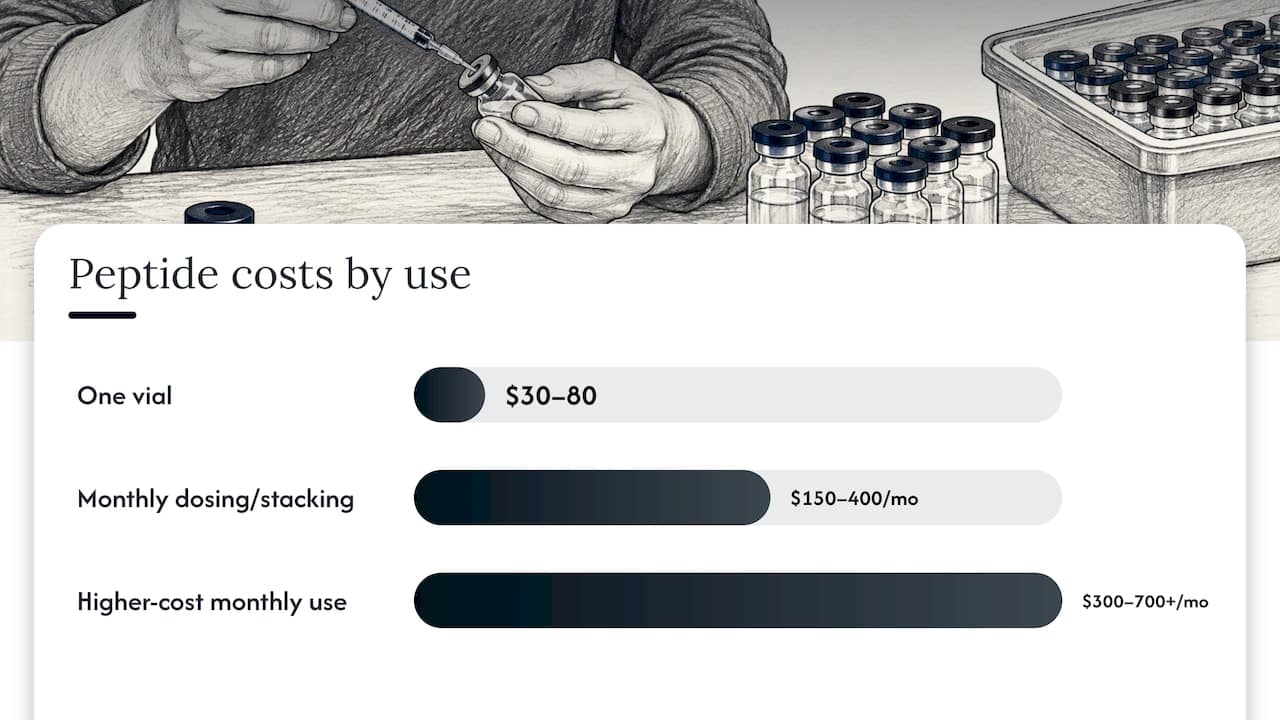
Peptides cost anywhere from about $30 to $80 CAD for a single research vial to several hundred dollars a month for a full protocol. A 2026 Canadian pharmacology review puts vials in that $30–$80 range, and repeated dosing and stacking at roughly $150–$400 a month, often $300–$700 or more. The gap between those numbers is the whole story. This guide explains what sits inside each figure, which costs people forget, and how to compare prices without being fooled by a low sticker.
TL;DR
- A single research-grade vial is typically $30–$80 CAD. A month of repeated dosing or stacking is typically $150–$400, and often $300–$700 or more.
- Clinic and prescription routes add consult and lab fees on top of the product. Public drug plans generally do not cover weight-management peptides.
- Compare cost per milligram and cost per month of actual use, not the price of one vial.
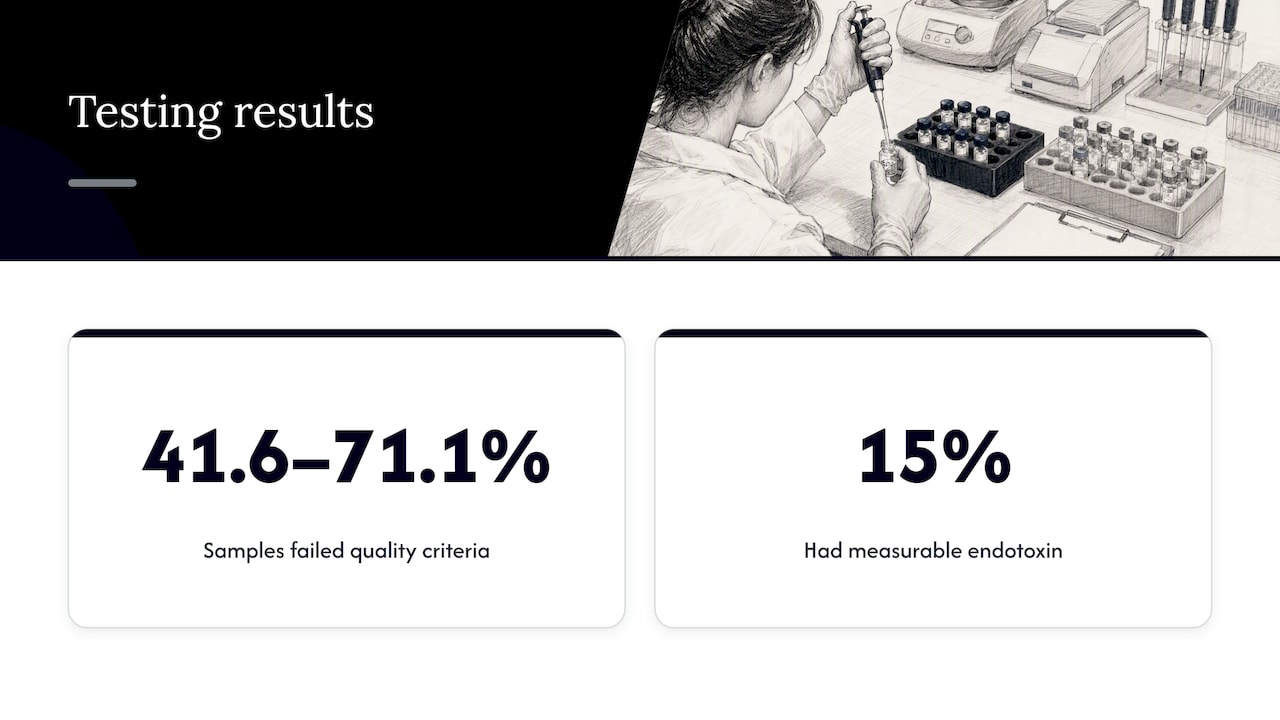
- A cheap vial with no verifiable certificate of analysis is not cheap: independent testing in 2026 found 41.6% to 71.1% of research-grade samples failed basic quality criteria.
Table of Contents
- The short answer: three routes, three price levels
- What a research vial costs, and why one vial is not a month
- The costs that sit around the vial
- What drives the price up or down
- Why the cheapest vial can be the most expensive
- Authorization, DINs and what Canadian labels should show
- Insurance and public coverage
- How to budget for a cycle
- Our view: price is the last thing to compare
- Where to find our products
- Frequently asked questions
- Sources
The short answer: three routes, three price levels
When someone asks “how much do peptides cost,” they usually mean one of three different things. The price depends far more on the route than on the molecule.
| Route | What you pay for | Typical cost in Canada |
|---|---|---|
| Authorized prescription drug (for example semaglutide) | The medicine, filled at a pharmacy, with a DIN on the label | Brand-name cash prices run into the hundreds of dollars a month without coverage |
| Clinic or telehealth protocol | Consultation, prescribed or compounded product, follow-up | Quoted most often as $200–$400 CAD a month all-in for standard protocols, per one Canadian provider’s 2026 guide |
| Research-grade vial | The vial and the testing behind it | About $30–$80 per vial; $150–$400 a month for repeated dosing or stacking |
These are not interchangeable products. A prescription medicine has been reviewed by Health Canada. A research-grade vial has not. We come back to that difference below, because it changes what a low price is worth.
What a research vial costs, and why one vial is not a month
The $30–$80 vial range is the number people see first, and it is the number that misleads. Vials are small. Most protocols use a fraction of a milligram to a few milligrams per administration, and many involve more than one compound, so a single vial can be gone in days or last a month depending on the compound and the schedule.
That is why the same Canadian review that gives the vial range also describes the monthly picture: repeated dosing and stacking typically costs $150–$400 a month, and often $300–$700 or more. The jump from “$50 vial” to “$400 month” comes from buying several vials, several compounds, and the supplies to reconstitute and use them.
A worked example of cost per milligram
Here is a simple illustration, with made-up round numbers to show the arithmetic, not a price list. Suppose vial A holds 5 mg and costs $40, and vial B holds 10 mg and costs $65.
- Vial A: $40 ÷ 5 mg = $8.00 per mg.
- Vial B: $65 ÷ 10 mg = $6.50 per mg.
Vial B costs more up front and less per milligram. If your protocol uses 2 mg a week, vial B lasts five weeks. Whether that is better depends on how long you will actually use it and how the compound keeps once reconstituted. Always work out the price per milligram, then the price per week of real use.
The costs that sit around the vial
The product is rarely the whole bill. Plan for these.
Reconstitution supplies
Lyophilized peptides arrive as powder. Bacteriostatic water, syringes and alcohol pads are separate line items. They are small purchases, but over a multi-week cycle they add up, and we sell them alongside our peptides so you can order in one place.
Consultations
If you go through a clinic or telehealth service, the consult is a recurring cost. One Canadian provider’s 2026 guide reports naturopathic doctor consultations at $150–$350 CAD and MD or private-clinic consultations at $200–$450 CAD. Treat those as ranges from a single source and ask any clinic for its current fee schedule before booking.
Lab work and monitoring
Baseline bloodwork and follow-up tests are usually billed separately, and a responsible prescriber will want them for anything that affects hormones, glucose or growth pathways. Fees vary by clinic and by whether a test is covered in your province, so ask for an itemized quote.
Shipping and duties
Orders from Canadian suppliers avoid cross-border surprises. Orders from abroad can be held, taxed or refused. Health Canada says it is working closely with the CBSA to stop unauthorized shipments from entering Canada, so a seized package is a real cost to price in, not just a nuisance.
What drives the price up or down
Five factors explain most of the differences you will see between two quotes for what looks like the same thing.
- The compound. Long, complex molecules cost more to synthesize and purify than short ones. Blends containing several compounds cost more than single-compound vials.
- Vial size and dose. Larger vials usually lower the price per milligram, but only help if you will use them in time.
- Purity and testing. Higher purity takes more purification steps, and independent testing costs money. A supplier that publishes a batch-specific certificate of analysis is carrying a cost that a no-questions seller is not.
- Duration. Cost per month is simple to compare. Cost per cycle is what you will actually spend. A compound taken for six weeks and one taken continuously are very different commitments.
- The route. A prescription or clinic route bundles professional oversight into the price. A direct purchase does not, and the oversight becomes your own responsibility.
Why the cheapest vial can be the most expensive
Price comparison only works if you are comparing the same thing. With injectable peptides sold as research products, that is hard to confirm from a product page.
Health Canada states that unauthorized peptides may contain contaminants, be poorly or incorrectly labelled, or contain unknown ingredients, and advises speaking with a health care provider. The Canadian pharmacology review adds that seized unauthorized peptide products have been found with potential contaminants and undeclared ingredients, with risks including infections and unpredictable interactions.
The numbers on testing are sobering. A 2026 independent analysis of research-grade peptides sold directly to consumers found that 41.6% to 71.1% of tested samples failed basic quality criteria, and that 15% had measurable endotoxin contamination. The same paper notes that consumer-directed third-party testing improves transparency but captures only a small part of the safety profile for people injecting these products themselves.
If a vial costs 30% less but fails purity, or carries endotoxin, you have not saved anything. What you need from a supplier is evidence you can read. Our guides on what third-party tested peptides actually means and on peptide contamination risks and a certificate-of-analysis checklist walk through the checks, and our page on endotoxin testing explains what to ask for when a lab report claims to cover it.
A quick checklist before you pay
- Is there a certificate of analysis for the batch, issued by a third-party lab, with a purity figure and a method named?
- Does the report identify the compound by mass spectrometry, not just report a percentage?
- Is the vial size and net content stated clearly, so you can calculate price per milligram?
- Does the seller ship from within Canada and state its return and storage terms?
- Are you comfortable with the regulatory status of the product? See the next section.
Authorization, DINs and what Canadian labels should show
Price cannot be separated from legal status in Canada. Authorized health products must display an eight-digit Drug Identification Number (DIN), a Natural Product Number (NPN) or a Homeopathic Medicine Number (DIN-HM) on the label, and you can verify these in Health Canada’s online databases.
Be careful with the number itself. Health Canada has confirmed that some unauthorized products seized in British Columbia carried falsified DINs to mislead consumers. Looking a DIN up in the official database, rather than trusting the label, is the right habit.
Research-grade peptides do not carry a DIN. That is exactly why we publish our own guidance on injecting peptides in Canada without a DIN and on peptide safety before you inject anything. If you are considering any peptide for use on your body, talk to a physician or pharmacist first. That matters most with anything affecting blood sugar, hormones or growth, where a prescriber should be involved.
Insurance and public coverage
Don’t count on coverage. The Canadian Medical Association notes that public drug plans generally do not cover GLP-1 drugs for weight management, and only a small number of private plans offer partial coverage for those approved for chronic weight management. Research-grade products and unapproved compounded peptides are, in practice, paid for out of pocket.
Coverage is where public money does show up for the approved peptide medicines. Health Canada’s own price review reports that semaglutide (1 mg/act) accounted for $237.78 million in public drug-plan spending in 2022/23. That is spending on the approved drug for its approved uses, which is a different category from the products discussed in the rest of this guide.
If you have a private plan, ask your insurer directly, with the drug name and the reason for prescription, before assuming anything is or is not covered. Plans differ and change.
How to budget for a cycle
A practical way to put a number on it:
- List the compounds you and your clinician have decided on, and the planned length of the cycle.
- Calculate milligrams needed for the whole cycle from the dose and schedule.
- Divide each vial price by its milligrams to get price per mg, then multiply by what the cycle needs. Round up to whole vials.
- Add supplies: bacteriostatic water, syringes, alcohol pads.
- Add professional costs if applicable: consult, labs, follow-up.
- Add a buffer of one vial for waste and mistakes, which happen to everyone early on.
That total is your real cost. Compare that, not the headline vial price, across suppliers and routes.
Our view: price is the last thing to compare
We sell research-grade peptides, and we hear the same question daily: why does one vial cost less than another that looks identical? Our honest answer is that the label tells you very little. Purity, identity and contamination are properties of a specific batch, and you can only know them if someone independent measured them and showed you the report.
That is why every product we sell is backed by third-party lab certificates of analysis, and why we work to formulations above 99% purity using advanced purification methods. You can read how we think about it in our pages on verifying 99% purity for research-grade peptides in Canada and on the 99% purity standard. We would rather you pay a fair price for something you can verify than a low price for something you cannot.
We also think people should plan for the whole cycle, not one vial, and should involve a health professional for anything they plan to put in their body. Research products are sold for research. Our legality and safety pages say plainly what the rules are in Canada, and we encourage you to read them before you order.
— Pure Peptide
Where to find our products
If you have worked out your budget and want to see what is available, our weight loss, muscle growth, recovery, anti-aging and libido categories are listed on the main site, together with the ancillaries (bacteriostatic water, syringes and alcohol pads) you need to reconstitute. Batch certificates of analysis back the products, so you can check purity before you buy. For compound-specific reading, see our guides to BPC 157 and TB 500 and tirzepatide peptides.
Frequently asked questions
How much do peptides cost per month in Canada?
It depends on the route. For research-grade products, repeated dosing or stacking typically runs $150–$400 a month, and often $300–$700 or more. Clinic protocols are commonly quoted at $200–$400 a month all-in, with consult and lab fees varying by provider. Your own total depends on the compounds, doses and length of the cycle.
Why is one peptide vial so much cheaper than another?
Vial size, compound complexity, purity and testing all change the price. Very low prices can also mean no batch testing. Compare the cost per milligram and ask for a third-party certificate of analysis before comparing anything else.
Does insurance pay for peptides in Canada?
Generally no for the products in this guide. Public plans generally do not cover GLP-1 drugs for weight management, and only a few private plans offer partial coverage for approved weight-management drugs. Call your insurer with the drug name before you rely on coverage.
How can I tell whether a peptide product is authorized in Canada?
Look for an eight-digit DIN, an NPN or a DIN-HM on the label, then check the number in Health Canada’s online databases, because falsified DINs have been found on seized products. Research-grade peptides carry none of these numbers. Ask a pharmacist or physician if you are unsure.
Sources
- Clinical Pharmacology & Toxicology Pearl of the Week: unauthorized injectable peptides
- Peptides: Health risks, Health Canada
- Evaluation of Research Grade Peptides Marketed Directly to Consumers
- Health Canada alert on buying GLP-1 drugs
- Health Canada: unauthorized products seized in Maple Ridge, BC
- Can you get GLP-1 drugs in Canada? CMA
- CompassRx, 10th edition: Data companion file, Canada.ca
- Peptides in Canada guide, 2026