






For most adults considering it, realistic expectations should centre on hormone shifts and incremental physical changes rather than dramatic transformation.
TL;DR:
- A trial of roughly 19 older adults found IGF levels rose within four weeks, while skin or lean mass changes took 12 to 16 weeks.
- Lean mass increased only in men, while skin thickness rose in both sexes at 16 weeks in the small older adult trial.
- The controlled adult trial found no improvement in sleep despite higher growth hormone, so sleep benefits remain unsupported by the strongest adult evidence.
- No controlled adult trial measured fat loss, and libido or cognition benefits remain anecdotal rather than established in controlled adult studies.
- Most adult use is off label; ask a clinician to check growth factor levels and glucose before treatment, then repeat both at four and 12 weeks.
Table of Contents
- At-a-glance: which sermorelin benefits hold up to evidence
- Clinical evidence and timeline: trials, sizes and measured outcomes
- How sermorelin works and why nightly timing matters
- Who may realistically benefit, and by goal
- Our approach to purity and education on sermorelin
- A measured read on where sermorelin fits
- Choosing a legitimate source for sermorelin
- FAQ
- Sources
At-a-glance: which sermorelin benefits hold up to evidence
Sermorelin shows up in marketing copy attached to almost every wellness goal imaginable: more muscle, less fat, better sleep, firmer skin, sharper thinking, a stronger libido. The human evidence behind these claims is uneven, and knowing where each one sits matters before you decide anything.
- GH and IGF-1 increase: strong evidence. Once-nightly GHRH injections raise integrated nocturnal growth hormone and lift IGF-1 reliably within weeks, as shown in a placebo-controlled trial in older adults.
- Lean body mass: limited evidence. The same trial found increased lean mass in men only, in a sample of roughly 19 older adults.
- Skin thickness: limited evidence. Skin thickness increased in both sexes at 16 weeks in that trial, a modest but measured change.
- Fat metabolism: minimal direct evidence. No robust adult trial isolates fat loss as a primary outcome.
- Sleep quality: not supported. The controlled trial found no sleep improvement despite the GH rise.
- Recovery, energy, libido, cognition: largely anecdotal. These outcomes appear in patient reports and smaller observational notes rather than controlled trials.
One of the clearest findings in human trials is that IGF-1 rises significantly within four weeks in the Khorram et al. GHRH trial, a biochemical shift that happens well before any structural change shows up.
The timeline matters as much as the outcome itself. The GH pulse itself arrives within minutes of a dose. IGF-1 climbs over two to four weeks. Skin and lean-mass changes, when they appear at all, take 12 to 16 weeks to become measurable, and individual variability is substantial.
Clinical evidence and timeline: trials, sizes and measured outcomes
The adult evidence base for sermorelin is small, and that is worth saying plainly rather than glossing over. The most cited controlled trial, led by Khorram and colleagues, enrolled a small group of older adults and ran for 16 weeks, measuring GH pulses, IGF-1, skin thickness, lean body mass and sleep architecture against a placebo. The results showed a reliable IGF-1 rise and a nightly GH pulse lasting about two hours, alongside the skin and lean-mass findings described above. Sleep did not improve, despite GH’s reputation as a sleep-linked hormone.
Paediatric evidence tells a different, more settled story. Multicentre trials in children with growth hormone deficiency showed clear increases in height velocity when treated with sermorelin analogues, a finding consistent enough that it shaped historical approvals for paediatric use.
| Study population | Design | Sample size | Key measured outcome |
|---|---|---|---|
| Older adults (Khorram et al.) | Randomized, placebo-controlled, 16 weeks | Small (approximately 19) | IGF-1 rise, lean mass in men only, skin thickness in both sexes, no sleep change |
| Children with GH deficiency | Multicentre trials | Larger paediatric cohorts | Increased height velocity |
Observational and real-world case series add some nuance but also conflicting signals, largely because small groups and inconsistent dosing make it hard to separate a true drug effect from normal variation between people. That gap between a controlled trial and a forum anecdote is exactly where marketing claims tend to outrun the data.
How sermorelin works and why nightly timing matters
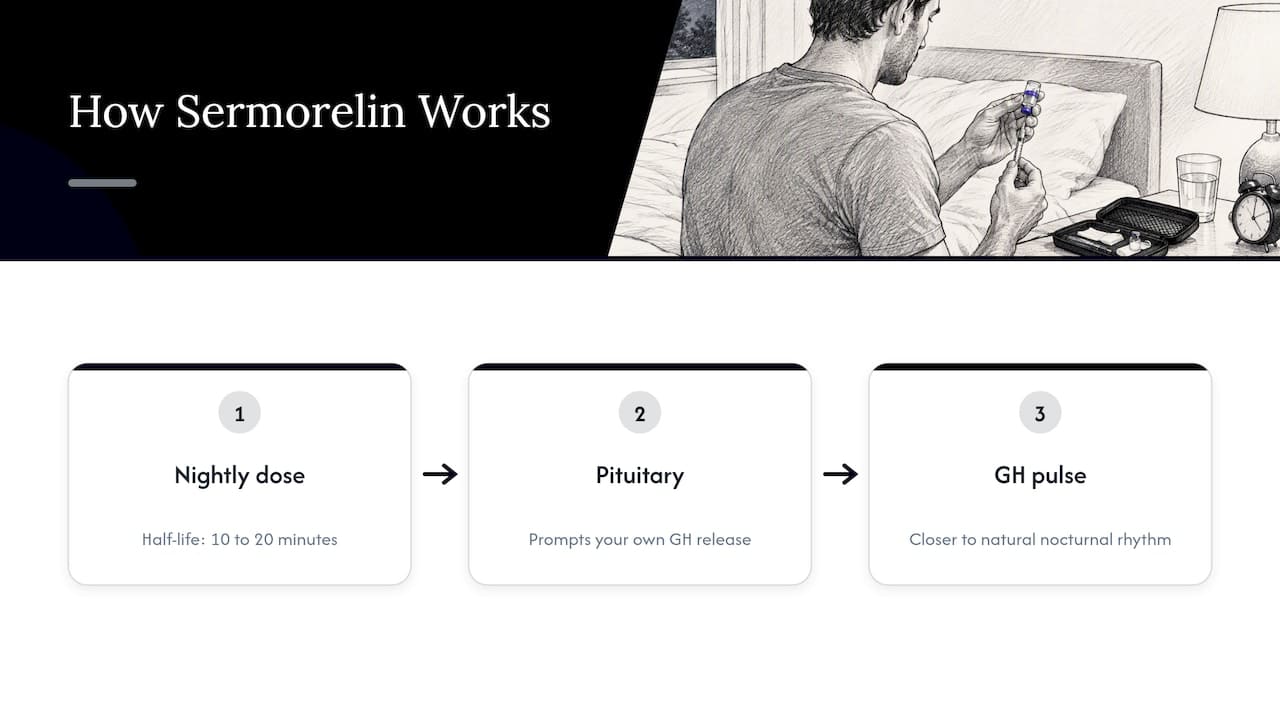
Sermorelin is a GHRH (1-29) analogue, a fragment of the natural hormone that tells your pituitary gland to release growth hormone. Rather than supplying exogenous GH the way injectable HGH does, it prompts your own pituitary to produce a pulse, which keeps the release pattern closer to your body’s natural rhythm. A broader look at GHRH peptides explains how this class of compounds fits alongside other growth hormone secretagogues.
Its systemic half-life is short, roughly 10 to 20 minutes, which is why it is typically dosed nightly rather than once a week. Nighttime dosing is meant to mimic your body’s natural nocturnal GH pulse, the period when growth hormone release is normally highest.
Response varies from person to person because it depends on how much GH-releasing capacity your pituitary still has. Age, sex and hormone status, including oestrogen use in women, all influence the size of the resulting GH pulse, which helps explain why two people on an identical protocol can report different experiences.
Who may realistically benefit, and by goal
The strongest evidence sits with two groups: children diagnosed with growth hormone deficiency, where height velocity gains are well documented, and adults with a confirmed diagnosis of adult growth hormone deficiency. Most other adult uses, including anti-aging, muscle-building and libido goals, are off-label and rest on a much thinner evidence base.
- Muscle and lean mass: possible modest gains in men over months, based on one small trial; not supported for women in that same study.
- Fat metabolism: biochemical shifts are plausible given the GH/IGF-1 rise, but no controlled trial isolates fat loss as an outcome.
- Sleep quality: not supported by the main controlled trial despite the GH connection.
- Skin texture: modest thickness increases measured at 16 weeks in both sexes.
- Libido and cognition: reported anecdotally; no controlled adult trial data available.
Pro Tip: Ask your clinician for a baseline IGF-1 and glucose panel before starting, then recheck both at the 4 and 12 week marks to see whether your own response matches the trial timeline.
Because sermorelin raises IGF-1 and affects glucose handling, monitoring blood sugar alongside IGF-1 is a sensible safety habit, and ongoing oversight from a clinician familiar with hormone therapy is appropriate given how off-label most adult use remains.
Our approach to purity and education on sermorelin
We focus on peptide formulations with quality controls so you can verify what you’re actually getting. Those quality controls matter most with a compound like sermorelin, where dosing consistency affects how closely your results track the trial data described above.
For readers who want to go deeper before deciding anything, our guides on growth hormone peptides and the differences between exogenous HGH and secretagogues cover dosing patterns, mechanism detail and monitoring practices in more depth than a single article can.
A measured read on where sermorelin fits
Sermorelin is scientifically interesting precisely because it works with your own pituitary rather than replacing it, but the adult evidence is thin enough that it would be dishonest to call it a cure-all. If you’re weighing it against a specific goal, get baseline bloodwork and a clinical evaluation first, and treat the controlled-trial timeline, not the fastest anecdote you find, as your benchmark for what to expect.
— Pure Peptide
Choosing a legitimate source for sermorelin
Once you’ve set realistic expectations, where you source a peptide matters as much as the protocol itself. We offer sermorelin alongside related compounds across our weight loss, muscle growth, recovery, anti-aging, libido, and ancillary categories, each backed by third-party certificates of analysis so purity isn’t a guessing game. If you’re also comparing mechanisms, this partner comparison of ipamorelin and sermorelin is a useful next read, alongside a conversation with your clinician before you start.
This article is general information, not a substitute for advice from a qualified doctor. Consult a qualified healthcare professional about your own circumstances before acting on anything here.
FAQ
What to expect when taking Ipamorelin?
Ipamorelin is a growth hormone secretagogue in a different class from sermorelin, working through a separate receptor pathway while still triggering pulsatile GH release. For a side-by-side look at how the two compounds compare on mechanism and typical goals, this partner breakdown walks through the distinctions in more detail.
How long does it take for sermorelin to burn fat?
No controlled adult trial has isolated fat loss as a measured outcome of sermorelin therapy, so there isn’t a validated timeline to point to. What the evidence does show is an IGF-1 rise within two to four weeks, with any downstream body composition change, if it occurs, likely following that biochemical shift over subsequent months.
Where is the best place to inject sermorelin?
Sermorelin is given as a nightly subcutaneous injection, typically in the abdominal area, following standard subcutaneous injection practice. Rotating injection sites helps reduce local skin reactions, which are among the most commonly reported side effects according to Mayo Clinic’s drug information.
Can sermorelin affect my thyroid?
Sermorelin’s documented effects centre on the GH and IGF-1 axis rather than direct thyroid hormone production, and clinical summaries emphasize monitoring GH-related metabolic markers rather than thyroid function specifically. Anyone with an existing thyroid condition should still flag it to their clinician before starting, since hormone axes can interact and routine monitoring is part of responsible use as outlined in Mayo Clinic’s overview.
Is sermorelin the same as HGH?
No. Sermorelin is a GHRH analogue that prompts your own pituitary to release growth hormone in a pulse, while HGH injections supply growth hormone directly from an external source. This distinction is why sermorelin’s effects depend on your remaining pituitary reserve, a factor that HGH therapy bypasses entirely.
Sources
- Sermorelin: A better approach to management of adult-onset growth hormone insufficiency?
- Sermorelin injection: drug information — Mayo Clinic
- Sermorelin: pharmacokinetics and clinical context — PeptideBreakdown