





Bacteriostatic water is the standard diluent for reconstituting peptides because it stays sterile between uses. It is not appropriate for neonates or infants, and intravenous use calls for professional guidance.
TL;DR:
- Check for a valid Canadian Drug Identification Number, a current batch certificate of analysis, and clear labeling showing 0.9% benzyl alcohol, or 9 mg/mL.
- Never use solutions preserved with benzyl alcohol for neonates or infants; exposure has caused serious and fatal reactions, including gasping syndrome.
- Consult a healthcare professional before intravenous use; bacteriostatic water is not isotonic and cannot replace preservative free diluents when clinically required.
- Calculate dilution from peptide vial content and intended dose instead of guessing, then label the preparation date and discard by the labeled use period.
Table of Contents
- What bacteriostatic water is made of and how it’s sold
- Why peptide users reach for bacteriostatic water
- Safety warnings every buyer should know before using it
- How to reconstitute peptides with bacteriostatic water
- Storing and disposing of opened vials correctly
- What matters most when you’re sourcing bacteriostatic water
- Where to buy bacteriostatic water and reconstitution supplies
- FAQ
- Sources
What bacteriostatic water is made of and how it’s sold
Bacteriostatic water for injection is a sterile, nonpyrogenic water-based solution with 0.9% benzyl alcohol, or 9 mg/mL added as a preservative. That same product listing reports a pH range around 5.7, with an accepted range of 4.5 to 7.0. The benzyl alcohol is what distinguishes it from plain sterile water for injection, which carries no preservative and is meant for a single use only.
In Canada, bacteriostatic water is sold in multi-dose formats, most commonly 30 mL vials, under labelling such as “bacteriostatic water for injection USP.” A few things worth checking before you buy:
- A valid Drug Identification Number (DIN), which confirms the product is listed in Health Canada’s Drug Product Database.
- A certificate of analysis (COA) from the manufacturer or supplier, showing batch-level purity and sterility testing.
- Clear potency labelling stating 0.9% benzyl alcohol (9 mg/mL) on the product page or vial.
Why peptide users reach for bacteriostatic water
Benzyl alcohol is what makes repeated withdrawals from the same vial practical. Without it, every puncture of a vial stopper would risk introducing bacteria, and the solution would need to be discarded after a single use. With it, a multi-dose vial can support repeated withdrawals over its labelled in-use period.
Typical reasons people choose it:
- Reconstituting peptides that ship as freeze-dried powder and need a liquid diluent before use.
- Preparing other small-volume lab preparations where repeated withdrawal from one container is needed.
- Avoiding the waste and cost of opening a fresh single-use vial for every dose.
It’s worth being clear on what it does not do. Bacteriostatic water is not isotonic, and it is not a substitute for preservative-free isotonic diluents in contexts where those are clinically required, particularly intravenous administration.
Pro Tip: Match the diluent to the use case, not just the peptide: multi-dose reconstitution for repeated subcutaneous use calls for bacteriostatic water, while anything destined for IV administration needs a conversation with a healthcare professional first.
Safety warnings every buyer should know before using it
The benzyl alcohol that makes multi-dose vials convenient is also the reason this product carries firm restrictions. Health Canada’s safety communications document that benzyl alcohol-containing solutions have caused serious and fatal reactions, including a condition known as “gasping syndrome,” in neonates and infants. This is why these populations should not receive products preserved with benzyl alcohol, and why preservative-free diluents are recommended in those specific product contexts instead.
A few points worth keeping in mind:
- The minimum toxic dose of benzyl alcohol in neonates has not been clearly established, which is part of why regulators take a precautionary stance rather than setting a simple cutoff.
- Benzyl alcohol exposure can add up across different products used at the same time, so cumulative intake matters, not just the amount in a single vial.
- Regulatory reviews note that repeated exposure to benzyl alcohol-containing solutions has historically been linked to severe adverse events in premature newborns.
If you are considering intravenous use or admixture of any kind, speak with a healthcare professional before proceeding, and use a preservative-free diluent where that is clinically indicated. None of this changes how the product performs for its intended purpose, which is safe, repeated subcutaneous reconstitution, but it does mean the population and route matter.
How to reconstitute peptides with bacteriostatic water
Sterile technique matters as much as the diluent itself. A consistent routine reduces contamination risk and keeps your peptide stable for its full in-use window.
- Wipe the rubber stopper of both the peptide vial and the bacteriostatic water vial with an alcohol swab and let it air dry.
- Use a new sterile syringe and needle for each reconstitution, and avoid touching the needle tip or the stopper surface with your fingers.
- Draw air into the syringe equal to the volume of bacteriostatic water you plan to add, then inject that air into the water vial before withdrawing the liquid.
- Add the bacteriostatic water slowly down the inside wall of the peptide vial rather than directly onto the powder, to avoid excess foaming.
- Gently swirl, never shake, until the powder fully dissolves.
For the actual volume to add, use the Peptide Calculator rather than guessing: the right dilution depends on the peptide’s total content and your intended dose per injection. Technique details on wipe contact time and drying are covered in our guide to alcohol-wipe use before injection.
Once reconstituted, a few habits keep things organized:
- Label the vial with the date and time of reconstitution so you can track its in-use period.
- Keep a record of the diluent volume used, so repeat preparations stay consistent.
- Discard the vial once it reaches the in-use lifespan stated on the product label, even if liquid remains.
More detail on technique and sterility steps is available in our full guide to bacteriostatic water use.
Storing and disposing of opened vials correctly
Follow the storage instructions on your specific product label, since exact temperature ranges can vary by manufacturer. As a general rule, unopened multi-dose vials are kept refrigerated or at controlled room temperature away from light, and reconstituted peptides often need refrigeration once mixed.
Watch for these signs that a vial should be discarded rather than used:
- Visible cloudiness, discolouration, or particles in a solution that was previously clear.
- The vial has passed its labelled in-use period, even if it looks normal.
- The rubber stopper has been punctured excessively, shows damage, or the seal was compromised at any point.
Dispose of unused solution and used needles or syringes according to your local sharps disposal regulations, typically through a pharmacy take-back program or an approved sharps container rather than household trash. Our storage instructions page covers product-specific handling details.
What matters most when you’re sourcing bacteriostatic water
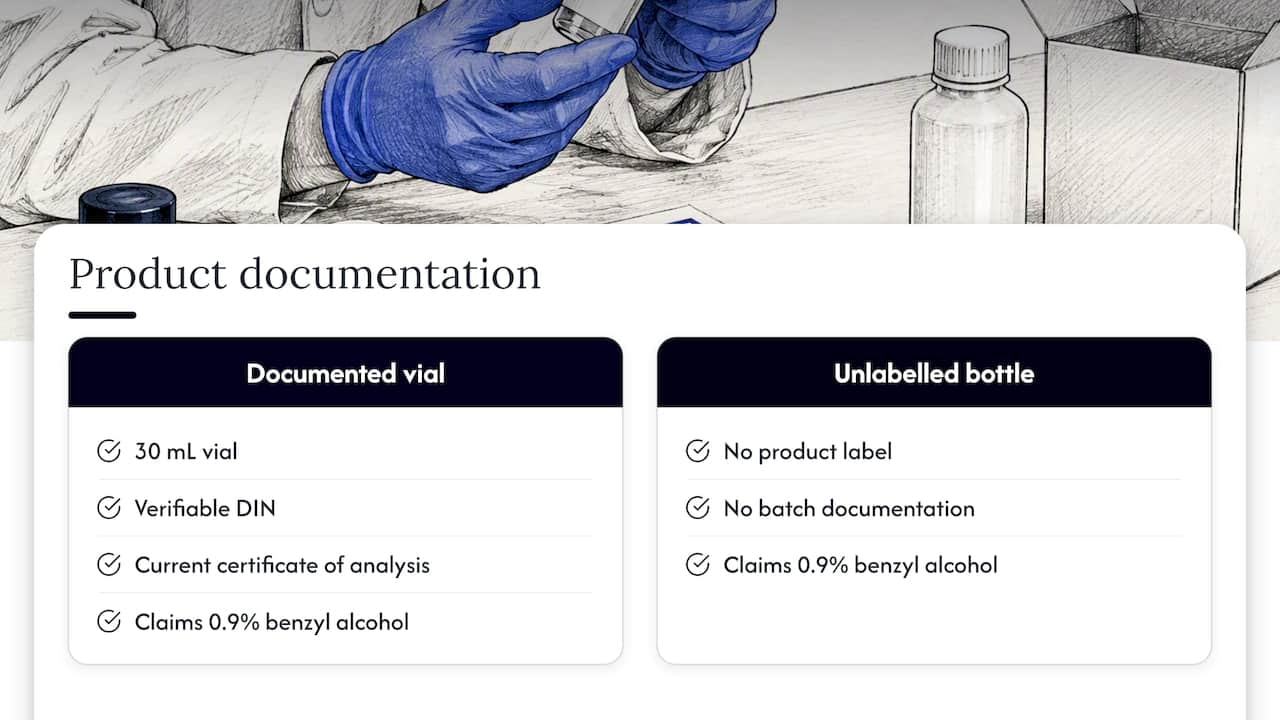
The single biggest mistake people make with bacteriostatic water is treating it as an interchangeable commodity. It isn’t. A 30 mL vial with a verifiable DIN and a current certificate of analysis is a fundamentally different product from an unlabelled bottle sold with no batch documentation, even if both claim the same 0.9% benzyl alcohol concentration on paper.
The second mistake is skipping the population and route caveats because they read like boilerplate. They aren’t. Benzyl alcohol’s restriction around neonates and infants, and the caution around IV use, are not generic warnings copied from a template. They reflect documented, serious outcomes, and they apply regardless of how reputable the supplier is. Quality sourcing and appropriate use are two separate questions, and a good vial does not make an inappropriate use case safe.
— Pure Peptide
Where to buy bacteriostatic water and reconstitution supplies
We supply bacteriostatic water alongside the syringes you need for a reconstitution setup. Our products are backed by third-party lab certificates of analysis, which are worth checking before you order.
A few practical next steps before you buy:
- Check the COA listed on the product page for the batch you are ordering.
- Run your peptide and target dose through the Peptide Calculator to confirm the diluent volume you need.
- Review the storage instructions for your specific product before it arrives.
- Reach out to support if you have technical questions about a specific peptide or ancillary.
Browse our full range of peptides and ancillaries to see current stock, COAs, and bundled ancillary options.
FAQ
What are the main uses of benzyl alcohol?
Benzyl alcohol is mainly used as a preservative and solubilising agent in injectable medicinal products, which is why it appears in multi-dose vials like bacteriostatic water. Regulatory reviews note it can also act as a mild local anesthetic and may cause minor irritation when applied topically.
What is the best bacteriostatic water for injection?
Look for a product with a valid Drug Identification Number listed in the Drug Product Database, a current certificate of analysis, and clear labelling of 0.9% benzyl alcohol (9 mg/mL). Our bacteriostatic water product page provides information to review before ordering.
Can I buy BAC water at a pharmacy?
Availability varies by pharmacy and region, and not every retail pharmacy stocks bacteriostatic water for over-the-counter purchase. Ordering online through our bacteriostatic water and ancillaries is a more consistent way to confirm what you’re getting.
How much bacteriostatic water do I mix with?
The right volume depends on the total peptide content in the vial and the dose you intend to draw per injection, so there’s no single universal number. Use the Peptide Calculator to work out the exact dilution for your specific peptide and target dose.
Sources
- Product information
- BLINCYTO (blinatumomab) and Benzyl Alcohol Toxicity for Pediatric Patients – Canada.ca
- Benzyl alcohol and benzoic acid group used as excipients