






Community-reported subcutaneous doses for DSIP are generally described in the low to mid microgram range, but the actual number you draw depends entirely on how you reconstitute the vial and read your syringe. Health Canada has taken enforcement action against unauthorized injectable peptide sellers, and resources like our peptide calculator exist precisely because reconstitution math is where most dosing errors happen. This article walks through that math; it is informational only, not a medical recommendation.
TL;DR:
- Community reports place subcutaneous doses at 100 to 300 mcg, but no modern controlled studies validate that range or compare schedules.
- A 5 mg vial mixed with 1 mL yields 5,000 mcg/mL; 2 units on an insulin syringe marked 100 units per mL equal 100 mcg.
- Older insomnia trials used intravenous DSIP at 25 nanomoles per kilogram and found limited, mixed effects; those results do not establish a subcutaneous dose.
- Health Canada has warned about unauthorized injectable DSIP products, which are not assessed for safety, efficacy, or quality before sale; consult a healthcare professional.
Table of Contents
- Community dosing ranges versus historical clinical IV dosing
- Reconstitution math: turning a vial into a usable concentration
- Converting syringe units to micrograms before you inject
- Common dosing schedules reported by the community
- Supplies, handling, and storage that keep dosing consistent
- What the evidence and Health Canada guidance actually say
- Tools that help you measure doses accurately
- Precision matters, but it is not the whole picture
- Where to find ancillaries and research-grade options
- FAQ
- Sources
Community dosing ranges versus historical clinical IV dosing
Most peptide community sources report subcutaneous DSIP doses generally in the low to mid microgram range per administration, with occasional reports outside that band. These figures come from protocol-sharing communities, not from modern controlled trials, so treat them as a starting reference point rather than an established standard.
The older clinical literature on DSIP used a very different route and scale. Small double-blind trials from the late 20th century administered DSIP intravenously at 25 nanomoles per kilogram, often repeated across several nights in people with chronic insomnia. For an adult weighing around 70 kilograms, that dose corresponds to a low microgram amount per administration, a figure derived purely from converting the trial’s own units and not a recommendation.
A few things are worth holding onto here:
- The IV trials used a precise molar dose tied to body weight, rather than a flat microgram amount.
- Those trials reported limited and mixed effects on sleep measures, not a consistent benefit.
- No contemporary dose-ranging studies exist for subcutaneous DSIP, which means the 100 to 300 mcg community figures carry real uncertainty.
Reconstitution math: turning a vial into a usable concentration
Before you can draw any dose, you need to know your concentration in micrograms per millilitre. The conversion starts with one fact: 1 milligram equals 1,000 micrograms. From there, the formula is straightforward.
- Divide the vial’s total milligrams by the millilitres of bacteriostatic water you add. That gives you mg/mL.
- Multiply mg/mL by 1,000 to convert to mcg/mL.
- Divide your target dose in micrograms by the mcg/mL concentration to get the volume you need to draw.
Two worked examples show how this plays out. A 5 mg vial reconstituted with 1 mL of diluent gives 5 mg/mL, or 5,000 mcg/mL. A 10 mg vial reconstituted with 2 mL gives the same result: 10 mg divided by 2 mL equals 5 mg/mL, or 5,000 mcg/mL. Both setups land at an identical concentration despite different starting amounts, which is why checking your own math matters more than memorizing a single example.
Always calculate from the actual vial label and the actual diluent volume you add, not from a number you remember from somewhere else. Label every prepared vial with the concentration and the date you reconstituted it, since an unlabelled vial in the fridge is a guessing game later.
Pro Tip: Recalculate your concentration every time you reconstitute a new vial, even if it is the same product you have used before.
Converting syringe units to micrograms before you inject
Most people measuring peptides use a U-100 insulin syringe, where “U-100” means 100 units equal 1 millilitre, so each unit holds 0.01 mL. To find out how many micrograms a given number of units delivers, multiply the units by 0.01 mL, then multiply that by your concentration in mcg/mL.
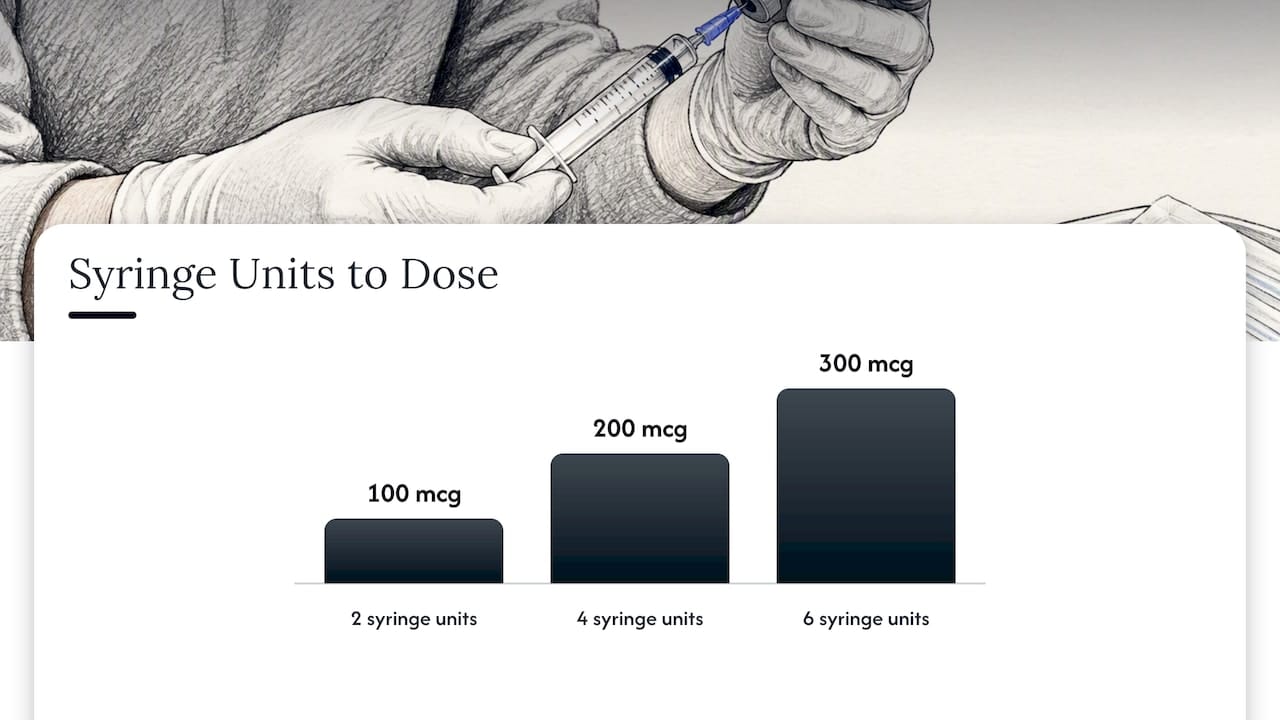
At a 5,000 mcg/mL concentration (the result from both reconstitution examples above), the math simplifies nicely:
- 2 units = 100 mcg, calculated as 2 × 0.01 mL × 5,000 mcg/mL.
- 4 units = 200 mcg, using the same formula doubled.
- 6 units = 300 mcg, covering the upper end of the common community range.
A 5,000 mcg/mL concentration turns every 2 units on a U-100 syringe into 100 mcg, which is why this particular dilution shows up so often in community protocols: it maps cleanly onto round syringe numbers.
A few habits reduce drawing errors: hold the syringe vertically and tap out air bubbles before you measure, use the same syringe type every time so the barrel markings stay familiar, and recheck your arithmetic against the numbers on the vial label rather than trusting memory. Our syringe guide walks through selecting the right syringe size for small-volume peptide doses.
Common dosing schedules reported by the community
People following DSIP protocols generally describe one of three patterns: nightly dosing for three to five consecutive nights followed by a break, a single bedtime dose used occasionally, or intermittent use timed around specific sleep goals. None of these patterns comes from a controlled trial comparing schedules against each other.
An illustrative example, shown only as a community pattern and not a recommendation: a dose of 150 mcg taken subcutaneously roughly 30 minutes before bed, repeated for three consecutive nights, then paused for several nights before resuming. This mirrors how early clinical trials administered DSIP across multiple nights rather than as a single dose, since cumulative effects over several nights are commonly reported rather than immediate sedation.
- Keep a simple sleep log noting the dose, time taken, and subjective sleep quality each morning.
- Track patterns over at least three to five nights rather than judging effect from a single use.
- Stop and speak with a healthcare provider if you notice any adverse reaction or if sleep quality worsens.
Supplies, handling, and storage that keep dosing consistent
Accurate dosing depends as much on your supplies as your math. A basic setup includes bacteriostatic water for reconstitution, U-100 syringes, alcohol swabs for the vial top and injection site, a sharps container for used needles, a refrigerator for storage, and the certificate of analysis that came with your vial so you can confirm lot and purity.
- Store unopened lyophilized vials refrigerated and protected from light until you reconstitute them.
- Once reconstituted, keep the vial refrigerated and label it clearly with the date and concentration.
- Puncture the vial stopper in the same spot each time where possible, and discard the vial if you notice cloudiness, discoloration, or if it has passed the timeframe you noted at reconstitution.
Pro Tip: Keep your certificate of analysis with the vial itself, not filed away separately, so you can double-check lot numbers at a glance.
What the evidence and Health Canada guidance actually say
The clinical case for DSIP rests on a handful of small, dated trials. Research from the late 1970s through the 1980s tested intravenous DSIP in chronic insomnia patients and found limited, mixed effects on sleep measures rather than a clear benefit. A separate early report described modest improvements in some sleep metrics in very small samples, but the overall evidence base remains thin and has not been updated with modern, larger trials.
No contemporary dose-response studies exist for subcutaneous DSIP at all, which means the 100 to 300 mcg figures circulating in community guides are not validated by controlled research.
Health Canada has obtained a permanent injunction against at least one seller of illegal injectable peptides and has issued public warnings about unauthorized injectable peptide products, listing DSIP among the products named in recall and alert notices. Unauthorized injectable peptides are not assessed by Health Canada for safety, efficacy, or quality before they reach the market.
- Historical IV trials are not interchangeable with subcutaneous community dosing in route, scale, or oversight.
- Unauthorized injectable products carry sterility and contamination risks beyond dosing accuracy alone.
- Speak with a healthcare professional before use, and seek medical attention promptly if you experience an adverse reaction.
Our legal and regulatory overview covers what the eight-digit DIN requirement means for injectable products in Canada.
Tools that help you measure doses accurately
Getting the math right matters more than getting the dose “close enough,” and a few resources make that easier to check. Our peptide calculator lets you enter vial strength and diluent volume to confirm concentration and syringe units before you draw anything. Products typically ship with a certificate of analysis so you can verify purity and lot information against what the label claims.
- Use the calculator to cross-check any manual math from the reconstitution steps above.
- Review the certificate of analysis for each vial before reconstituting it.
- Read our DSIP background guide for the scientific context behind the dosing numbers.
- Check our safety checklist before your first reconstitution.
Precision matters, but it is not the whole picture
Getting your reconstitution math and syringe units exact is the easy part of this conversation. The harder, less comfortable truth is that the underlying evidence for DSIP’s effects is thin, dated, and was never built around the subcutaneous dosing community guides now describe. Accurate measurement protects you from one kind of error; it does nothing to resolve the uncertainty around whether a given dose does what people hope it does. Use our calculator and the worked examples here to eliminate arithmetic mistakes, and treat a conversation with a clinician as the step that addresses the questions math cannot answer.
— Pure Peptide
Where to find ancillaries and research-grade options
Reconstituting a peptide accurately starts with having the right supplies on hand, and we carry bacteriostatic water, U-100 syringes, and alcohol swabs alongside our peptide lines so you are not assembling a kit from three different sources. Browse our full product range to see current categories, or check the peptide calculator before you order to plan your reconstitution in advance.
This article is general information, not a substitute for advice from a qualified doctor. Consult a qualified healthcare professional about your own circumstances before acting on anything here.
FAQ
What is a typical DSIP dosage for sleep?
Community-reported subcutaneous doses typically range from 100 to 300 micrograms per administration, though this range comes from user-shared protocols rather than controlled clinical trials. The exact amount you draw depends on your vial’s reconstitution concentration, so calculating it from your own vial label is more reliable than copying a number from someone else’s setup.
How do I convert vial strength into a usable concentration?
Divide the total milligrams in the vial by the millilitres of bacteriostatic water you add, then multiply by 1,000 to get micrograms per millilitre. For example, a 5 mg vial mixed with 1 mL of diluent yields 5,000 mcg/mL, which you then use to calculate how many syringe units correspond to your target dose.
How many syringe units equal 100 mcg of DSIP?
At a 5,000 mcg/mL concentration, 2 units on a U-100 insulin syringe equal 100 mcg, since each unit measures 0.01 mL. This conversion changes if your concentration differs, so recalculate it whenever you reconstitute a new vial at a different ratio.
Is DSIP legal to buy and inject in Canada?
Unauthorized injectable peptides, including DSIP, are not approved by Health Canada for sale as injectables, and the agency has issued warnings and obtained injunctions against sellers of these products. Anyone considering an injectable peptide should review the regulatory status for their own situation and speak with a healthcare professional.
How long does it take to notice effects from DSIP dosing?
Community reports and the pattern seen in early clinical trials suggest effects build cumulatively over several nights rather than appearing after a single dose. Tracking sleep quality with a simple log across three to five nights gives a clearer picture than judging from one night alone.
Sources
- Health Canada obtains permanent injunction preventing Canlab Research’s illegal sale of injectable peptides in Canada
- Unauthorized injectable peptide drugs seized and sold by Canada Peptide may pose serious health risks
- Effects of Delta Sleep-Inducing Peptide on Sleep of Chronic Insomniac Patients
- SYNTHETIC DELTA-SLEEP-INDUCING PEPTIDE IMPROVES SLEEP IN INSOMNIACS