







Tesamorelin has been shown in randomized trials to reduce visceral adipose tissue, especially in people with HIV-associated abdominal lipohypertrophy. A 2025 meta-analysis of randomized trials puts the average reduction near 28 cm², and in the main trials the benefit holds only while injections continue. Safety, glucose monitoring and availability follow below.
TL;DR:
- At 26 weeks, phase III trials reported 12% to 20% VAT reductions, while waist circumference fell only about 1.6 cm, often too little to notice.
- The strongest evidence applies to adults with HIV and abdominal fat accumulation on stable antiretroviral therapy; effects in people without HIV remain unestablished.
- Daily injections were used in trials, and visceral fat commonly returned after treatment stopped, so decisions should account for ongoing dosing and monitoring.
- Growth hormone pathways can affect glucose handling; clinicians advise regular glucose checks, while long term cardiovascular, diabetes, and cancer outcomes remain uncertain.
- Canada listed Egrifta as cancelled post market in September 2022; verify current authorization and supply with Health Canada or a pharmacist.
Table of Contents
- What do the best trials and meta-analyses say about tesamorelin and visceral fat?
- How much visceral fat can you realistically expect to lose?
- Who was studied, and does that match your situation?
- How does tesamorelin target visceral fat specifically?
- What safety signals and metabolic effects have been reported?
- Is tesamorelin approved and available where you live?
- How long does treatment last, and what happens when you stop?
- What do we make of the evidence overall?
- Why clinical prudence matters more than the headline number
- Where Pure Peptide fits in your research
- FAQ
- Sources
What do the best trials and meta-analyses say about tesamorelin and visceral fat?
The strongest evidence for tesamorelin visceral fat reduction comes from randomized, placebo-controlled trials that measured fat directly with imaging rather than relying on the scale. A 2025 meta-analysis of randomized controlled trials found that tesamorelin significantly reduced visceral adipose tissue (VAT) in people with HIV-associated lipodystrophy, with a mean difference of −27.71 cm² (95% CI −38.37 to −17.06).
The phase III programme sits underneath that pooled result. According to the regulatory clinical review of Egrifta, randomized trials in adults with HIV-associated abdominal fat accumulation consistently reported VAT reductions at 26 weeks, and those reductions were maintained to 52 weeks while treatment continued.
A few points explain why reviewers trust these findings:
- Imaging endpoints. VAT was quantified by CT, not estimated from body weight or a tape measure.
- Placebo comparison. Control groups typically gained or held steady in visceral fat, which sharpens the contrast with treatment.
- Consistency across studies. Separate trials, run by different groups, pointed in the same direction.
- Extension data. Follow-up to 52 weeks showed the effect persisting during continued dosing, not fading after the primary endpoint.
One smaller randomized trial is worth singling out because it looked beyond the abdomen’s outer shape. In that randomized clinical trial, tesamorelin 2 mg daily for 6 months reduced VAT (treatment effect −42 cm²; P = 0.005) and liver fat (net effect −2.9% lipid-to-water) versus placebo in HIV-infected patients with abdominal fat accumulation. Liver fat matters because visceral fat and hepatic fat often travel together in this population.
The honest summary is that the effect is real and measurable, and it is modest in absolute terms. We cover what that looks like in plain numbers next.
How much visceral fat can you realistically expect to lose?
Trial results become more useful once you translate them into percentages, square centimetres and weeks.
A phase III programme reported relative visceral fat reductions of roughly 12% to 20% at 26 weeks, which were maintained to 52 weeks while treatment continued. Treatment is a ceiling-raising tool, not a transformation: expect a clear but partial reduction in visceral fat, and only on therapy.
The absolute figures tell the same story. The pooled meta-analysis estimate of −27.71 cm² for VAT, cited above, is an average across trials. The single trial in the previous section found a larger treatment effect of −42 cm² against placebo. Both numbers sit on top of a baseline VAT that is often well above normal in these participants, so a reduction of this size is meaningful without erasing the problem.
Waist circumference moved far less than CT-measured VAT. A pooled drop of about 1.6 cm is statistically robust, yet most people would not notice it in the mirror or in how clothing fits. That gap is a feature of the biology: visceral fat is packed deep inside the abdomen, and a sizeable change in that compartment shows up only weakly on a tape measure.
Timing matters as much as size:
- 26 weeks is the standard primary endpoint, so most headline numbers describe six months of daily dosing.
- 52 weeks is where extension data show the reduction holding, provided injections continue.
- After stopping, the picture changes, which we address in the treatment course section below.
When you see a promotional claim of dramatic belly fat loss, check it against these ranges. Anything far outside the mid-teens percentage band at six months deserves scrutiny about who was measured and how.
Who was studied, and does that match your situation?
Applicability is the most overlooked part of any trial summary. The core tesamorelin evidence was built in adults living with HIV who had accumulated excess abdominal fat while on stable antiretroviral therapy (ART). That context shapes everything about how far the numbers travel.
What the trials generally required or reflected:
- A confirmed HIV diagnosis with abdominal lipohypertrophy, meaning fat gathered around the organs.
- Stable ART, so that changes in fat could be attributed to the study drug rather than a switch in HIV treatment.
- Objective entry measures, often a waist circumference threshold and CT-confirmed VAT.
- Older ART regimens in the earlier trials, with many participants on protease inhibitors.
Newer data widen that picture. A 2024 study in people with HIV on integrase inhibitors found a median VAT reduction of −25 cm² (IQR −93 to −2) at 12 months, versus a gain of 14 cm² in the placebo group. About two-thirds of participants reached a clinically significant VAT reduction over that period, according to the full trial report on efficacy and safety, which also noted hepatic fat declines of −4.2% and defined clinical significance as the FDA threshold of an 8% or greater VAT reduction. Because modern ART looks different from the regimens in the earliest studies, this trial matters for people on current treatment.
The practical implication is straightforward. The strongest evidence applies to people with HIV-associated visceral fat. If you do not have HIV, the trial results are an imperfect guide: the biology may be similar, but the effect size, safety profile and risk-benefit balance have not been established in the same rigorous way. Extrapolating the headline percentages to the general population would overstate what the data support.
If you want a broader view of how other peptide categories are discussed for abdominal fat, our guide to peptides for belly fat lays out the landscape without borrowing tesamorelin’s trial numbers.
How does tesamorelin target visceral fat specifically?
Tesamorelin is an analogue of growth hormone-releasing hormone (GHRH). Rather than supplying growth hormone from outside the body, it prompts the pituitary gland to release the body’s own growth hormone in its natural, pulsatile rhythm. That distinction is central to why the effect is selective.
Pulsatile growth hormone release tends to promote the breakdown of fat stored in the abdomen while generally sparing the fat just under the skin. Direct growth hormone injections produce a flatter, sustained exposure and a different side-effect profile, which is part of why a GHRH analogue is considered a separate approach. For readers who want more on the biology of this class, our explainer on the GHRH peptide covers the mechanisms in more depth.
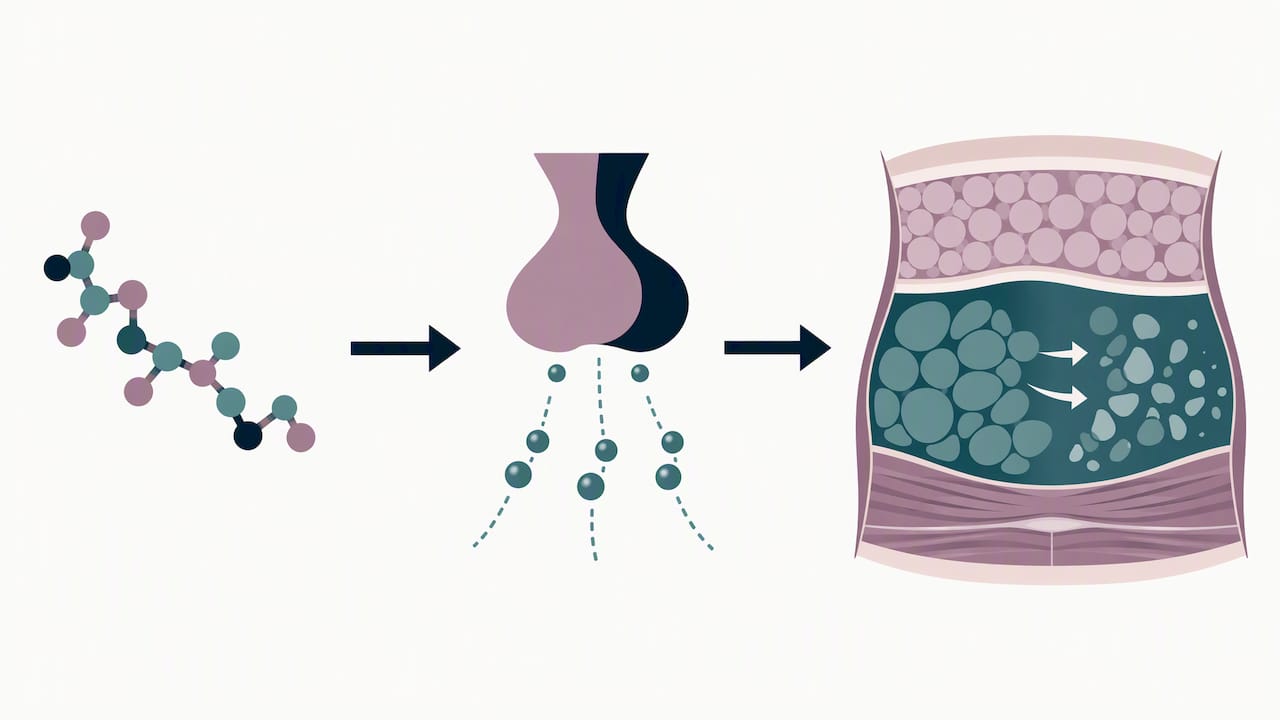
The selectivity helps explain what the trials observed: VAT fell while body mass index and subcutaneous fat changed little. Researchers have also looked at fat quality rather than just quantity. An analysis of tesamorelin responders reported that VAT and subcutaneous fat density increased (VAT +6.2 HU; SAT +4.0 HU in one analysis), which suggests the remaining fat becomes healthier-looking on imaging, independent of how much fat is lost.
This is why tesamorelin is not a weight-loss drug in the everyday sense. Someone could lose a measurable amount of visceral fat and see almost no change on the bathroom scale. If your goal is overall weight reduction, the mechanism simply does not aim at that.
What safety signals and metabolic effects have been reported?
Benefit has to be weighed against risk, and the trial record is clear that tesamorelin is not free of either side effects or monitoring demands. Some studies reported more withdrawals due to adverse events in the tesamorelin arm than in the placebo arm, so tolerability is a genuine consideration rather than a footnote.
Points to keep in view:
- Glucose effects. One trial saw a transient rise in fasting glucose, while glucose outcomes over the treatment period were generally not significantly different from placebo. Because growth hormone pathways influence glucose handling, regular glucose monitoring is advised.
- Injection-related and general side effects. Reactions at the injection site and other common effects are documented in the product literature. Our page on tesamorelin side effects walks through blood sugar signals, skin reactions such as hives, and when to seek care.
- Limited long-term data. Regulatory reviewers note the need for longer follow-up to assess cardiovascular, diabetic and cancer outcomes, because most trials ran for months rather than years.
- Lipid changes. Some trials reported improvements in triglycerides and the total-to-HDL cholesterol ratio alongside the VAT reduction, a favourable signal that still needs long-term confirmation.
Pro Tip: Ask for baseline and follow-up fasting glucose and lipid results before and during treatment, so changes can be tied to the therapy rather than guessed at.
Anyone with diabetes, prediabetes or a history of cancer has extra reasons to discuss risks with a prescriber before considering this drug.
Is tesamorelin approved and available where you live?
Regulatory status varies by market, and it can change. In the trial context, the authorized indication was for excess abdominal fat in treatment-experienced adults with HIV, which is narrower than the way tesamorelin is sometimes discussed online.
In Canada specifically, the branded product Egrifta was previously authorised, but the Canadian Drug Product Database lists it as “Cancelled Post Market” as of September 2022. That entry signals that availability here has changed, and it is a good reason to verify current status instead of relying on older articles or retailer claims.
Practical steps if you are considering treatment:
- Confirm current authorisation and supply with Health Canada’s database or a pharmacist.
- Talk to a licensed clinician who treats HIV or metabolic conditions.
- Check provincial and private formulary coverage, since cost and access can differ sharply.
Treat any source that skips these steps and simply tells you where to buy as incomplete.
How long does treatment last, and what happens when you stop?
In the trials, tesamorelin was given as a daily subcutaneous injection of 2 mg. The primary outcomes were measured at 26 weeks, with extension data reaching 52 weeks, as described in the regulatory clinical review.
The key point about durability is that the benefit depends on staying on therapy. VAT reductions were sustained while participants continued treatment, and stopping was commonly followed by re-accumulation of visceral fat in many people. The drug does not reset the underlying tendency to store fat in the abdomen; it counters it for as long as the signal continues.
That reframes how to think about the decision:
- It is closer to maintenance therapy than to a six-month course that ends with a permanent result.
- Expectations should include the long term: ongoing injections, ongoing monitoring, and a plan for what happens if treatment is interrupted.
- It complements, not replaces, other health habits. Diet quality, activity and ART choices continue to matter for overall metabolic health.
For the studied population, that trade can be worthwhile. For anyone expecting a one-time fix, the trial pattern points the other way.
What do we make of the evidence overall?
Here is our synthesis. The strengths are real: several randomized trials and a 2025 meta-analysis consistently show selective VAT reduction measured by imaging, with early signs of benefit in liver fat and lipids. The limits are equally real: participants were people with HIV, many on older ART regimens, long-term safety is unsettled, and results do not automatically transfer to people without HIV.
The practical takeaway is that for people matching trial criteria, tesamorelin can reduce visceral fat meaningfully, with the understanding that treatment is ongoing and needs monitoring. For deeper trial-by-trial detail, see our write-up on tesamorelin and fat loss, which covers methods and endpoints beyond what fits here.
Why clinical prudence matters more than the headline number
Our view is that the most useful way to approach this question is to start with measurement, not marketing. Visceral fat is invisible from the outside, so a CT-based or otherwise objective assessment, plus waist measurements and metabolic labs, tells you far more than a before-and-after photo ever will. The trial effects are real, but they are specific, and the evidence supports tesamorelin most clearly for HIV-associated visceral fat. Outside that setting, we would treat bold claims with caution and bring a knowledgeable prescriber into the decision before committing to a daily injectable.
— Pure Peptide
Where Pure Peptide fits in your research
We keep evidence resources on tesamorelin and related peptides, along with safety guides and product pages for readers who want to go further. If you are comparing options or need supply information, our team can point you to the right place.
- Browse our full range of categories, from weight loss to recovery, on the Pure Peptide home page.
- Read our guide to buying peptides for weight loss for purchasing and safety guidance.
- For technical background on research compounds and lot-specific certificates, this resource on peptide research compounds is a useful reference.
Reach out through our site when you are ready, and we will help you find what fits your question.
This article is general information, not a substitute for advice from a qualified doctor. Consult a qualified healthcare professional about your own circumstances before acting on anything here.
FAQ
Does tesamorelin only reduce visceral fat?
Tesamorelin acts mainly on visceral fat and generally spares the fat under the skin. In trials, VAT fell while overall body weight and subcutaneous fat changed little. Some studies also reported lower liver fat, as in the randomized trial of liver and visceral fat.
Does growth hormone reduce visceral fat?
Growth hormone can reduce visceral fat, but tesamorelin works differently: it stimulates the body’s own pulsatile growth hormone release rather than supplying hormone directly. That pulsatile pattern is thought to explain its more selective effect on abdominal fat and a different side-effect profile.
Can tesamorelin help with weight loss?
Tesamorelin is not a general weight-loss treatment. The trials showed visceral fat reductions without large changes in body mass index, so the scale may barely move even when CT-measured visceral fat falls.
What happens to visceral fat after you stop tesamorelin?
Visceral fat commonly returns after treatment stops, because the reductions were maintained only while dosing continued. That is why the therapy is best viewed as ongoing maintenance in the population studied, not a permanent cure.
Sources
- Pubmed
- Effect of Tesamorelin on Liver Fat and Visceral Fat in HIV-Infected Patients With Abdominal Fat Accumulation: A Randomized Clinical Trial – PMC
- Pubmed
- Executive Summary – Clinical Review Report: Tesamorelin (Egrifta) – NCBI Bookshelf