




Sermorelin and HGH both end in higher growth hormone levels, but they get there differently. HGH (somatropin) is the hormone itself, injected directly. Sermorelin is a short synthetic peptide that signals your pituitary gland to release your own growth hormone. In Canada, both are regulated as prescription drugs, and the evidence for using either one for muscle, weight loss or anti-aging in healthy adults is much thinner than marketing suggests.
This guide explains the mechanism, the evidence, the risks and the Canadian rules, so you can judge which route fits your goal and how to approach it safely.
TL;DR
- HGH replaces growth hormone directly. Sermorelin is a GHRH analogue that asks the pituitary to release more of your own.
- Clinical research does not show that either one reliably improves strength, weight loss or functional aging in healthy adults. Modest body-composition shifts appear mainly in older or hormone-deficient groups.
- In Canada, injectable peptides and somatropin are regulated as drugs. Check for an 8-digit DIN and use licensed pharmacies and a prescriber for anything you inject.
- Match the tool to the goal: a diagnosed deficiency is a medical question, while performance and recovery goals call for realistic expectations and careful sourcing.
Table of Contents
- How sermorelin and HGH work
- Sermorelin vs HGH at a glance
- What the research says about results
- Side effects and safety
- Is it legal in Canada?
- How to choose between them
- Our perspective
- Explore our peptide range
- FAQ
- Sources
How sermorelin and HGH work
Your pituitary gland releases growth hormone in pulses, triggered by growth hormone-releasing hormone (GHRH) from the hypothalamus. Growth hormone then prompts the liver and other tissues to produce IGF-1, which drives much of its effect on tissue and metabolism.
HGH (somatropin) skips that signalling chain. It is the finished hormone, given by injection. Health Canada describes somatropin as prescription human growth hormone used for children or adults with stunted growth from insufficient natural growth hormone, and for some children with Turner syndrome or chronic renal failure, with treatment supervised by physicians experienced in these disorders. Marketed brands include Omnitrope, which Health Canada’s database lists as a Schedule D prescription biologic given subcutaneously.
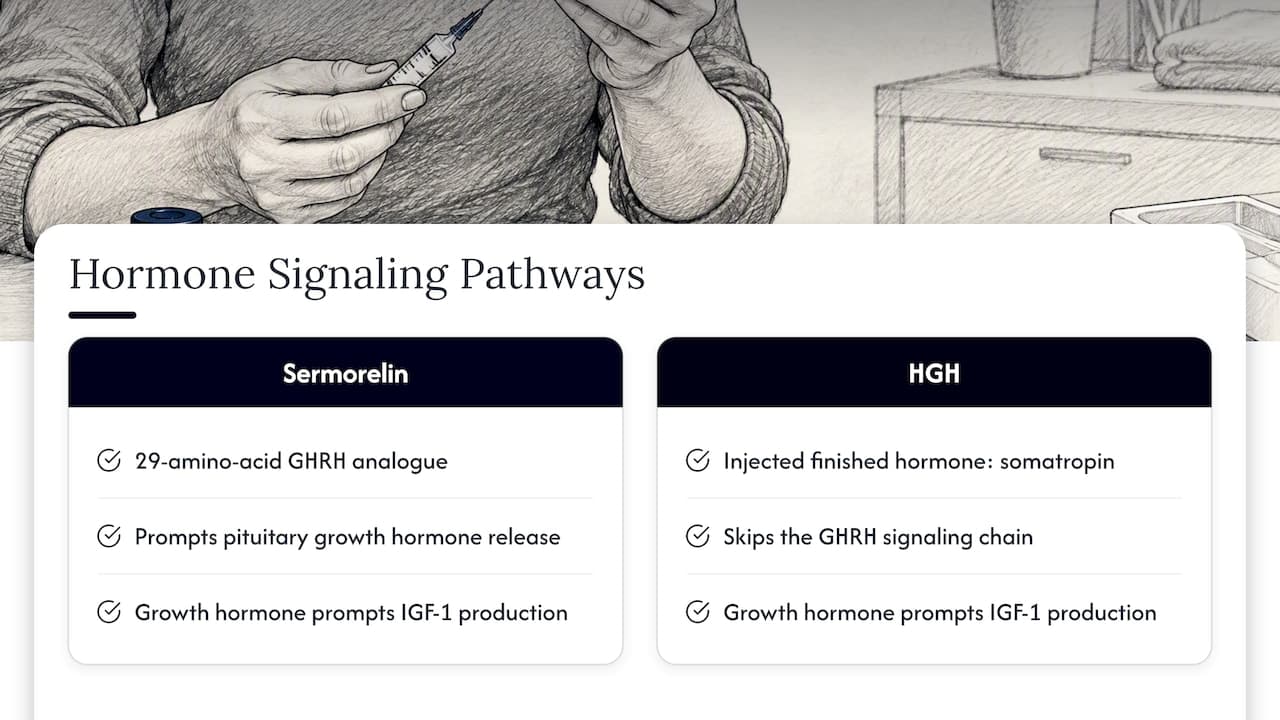
Sermorelin is a 29-amino-acid analogue of GHRH. A review of its diagnostic and therapeutic use describes it as the shortest synthetic peptide with full GHRH biological activity. Because it works upstream, your pituitary still controls how much is released. That feedback loop is the main reason people describe sermorelin as more “natural” than direct replacement. If you want the mechanism in more depth, our GHRH peptide guide and overview of peptides and growth hormone cover it.
Sermorelin vs HGH at a glance
| Feature | Sermorelin | HGH (somatropin) |
|---|---|---|
| What it is | GHRH analogue (peptide) | The growth hormone itself |
| Mechanism | Stimulates your pituitary to release GH | Supplies GH directly |
| Control by your body | Pituitary feedback stays in play | Bypasses the feedback loop |
| Administration | Injection | Subcutaneous injection |
| Regulatory status in Canada | Injectable peptides are regulated as drugs and need authorization | Prescription drug (Schedule D biologic) |
| Established medical uses | Mainly diagnostic and limited therapeutic history | Growth hormone deficiency and specified paediatric conditions |
| Evidence for anti-aging | Limited | Limited |
The practical takeaway: HGH is a proven treatment for a short list of diagnosed conditions. Sermorelin is a signalling peptide whose appeal rests on working with your own physiology. Neither has been established as an anti-aging therapy.
What the research says about results
The most useful recent overview is a 2025 clinical review of growth hormone and aging. Its conclusion is measured: there is no definitive evidence that sermorelin or HGH significantly improves functional aging, muscle strength or weight loss in healthy adults. Some studies show modest, short-term shifts in body composition, such as lean mass, in older or hormone-deficient populations.
Two details are worth keeping in mind.
- Trials of GHRH in older adults reported increases in skin thickness and lean body mass, according to the same review. That is a real signal, but it is a body-composition measure, not proof of better strength or longevity.
- Sex differences matter. Research on growth hormone in the aging male notes that women appear more resistant than men to growth hormone treatment, so results from one group do not transfer neatly to another.
Muscle growth and recovery
Both approaches raise growth hormone or IGF-1, and growth hormone plays a role in tissue repair. That is why athletes and lifters are interested. But the clinical record does not show reliable gains in muscle strength for healthy adults. If your goal is muscle, set expectations around modest changes in lean mass at best, and keep training, protein intake and sleep as the foundation. Our guides to peptides for muscle growth and peptides for recovery look at where peptides fit alongside those basics.
Weight loss
No randomized human trial shows weight loss from sermorelin. Related evidence is indirect and concerns small body-composition shifts in older or growth-hormone-deficient adults. Authorized obesity medications such as GLP-1 and GIP agonists have trials showing double-digit weight loss, a comparison drawn in this evidence summary. If fat loss is your main goal, see our fat loss peptides guide for the options that have been studied for that purpose.
Anti-aging and sleep
Sermorelin is not an established or medically accepted anti-aging treatment, and medical bodies advise against using it or HGH for this purpose. Small controlled studies exist in aging populations, but the evidence does not support the broad benefits that marketing often claims. Sleep is a good example of a claim worth testing rather than assuming. We have written up what the largest sleep trial found and what changes in IGF-1 look like in the first weeks.
Side effects and safety
The risk profile depends on what you take and where it comes from.
- Sermorelin: the US Anti-Doping Agency notes associated side effects can include swelling or edema, joint and nerve pain, and insulin resistance. Athletes in tested sports should also know that the substance is a concern under anti-doping rules.
- HGH: Health Canada states that somatropin can alter blood sugar and thyroid hormones, may cause brain swelling in certain patients and may raise the risk of hip problems in children, which is why it is used under the direct supervision of experienced physicians.
- Product quality: Health Canada warns that unauthorized peptides may contain bacteria or particles, be mislabelled, or include unlisted ingredients. It also warns that sharing needles can spread hepatitis C and HIV.
If you have diabetes, thyroid disease, a history of cancer, or take other hormones, talk to your doctor or an endocrinologist before considering either. They can order the bloodwork that tells you whether a growth hormone problem exists at all.
Handling matters too. Reconstitution, sterile technique and storage are where many avoidable problems begin, and a guide to safe peptide handling covers the practical steps. Our own peptide safety primer goes through what to know before you inject anything.
Is it legal in Canada?
This is the question that most changes how you should proceed.
HGH: somatropin products are prescription drugs. Health Canada’s database shows Omnitrope among marketed products, and its recall notices describe Omnitrope as a human growth hormone given by subcutaneous injection for adults and children with growth-hormone deficiency and certain paediatric growth disorders. A prescription from a physician and a licensed pharmacy are the legitimate path.
Sermorelin and other peptides: Health Canada states that injectable peptides are regulated as drugs and need its authorization before sale, and that selling or promoting unauthorized health products is illegal. Its 2025 warning about seized products lists both sermorelin and HGH among unauthorized items, and notes the products were not assessed for safety, efficacy or quality.
One point of nuance: as of 2012, Health Canada’s Office of Controlled Substances confirmed sermorelin was not listed in the schedules of the Controlled Drugs and Substances Act. That is a different question from whether it is authorized as a drug for injection in people.
How to check a product
Canadian authorities advise getting prescription drugs only from licensed pharmacies and checking for an authorized 8-digit Drug Identification Number (DIN) or Natural Product Number (NPN). Health Canada also cautions that lower-priced unauthorized peptides may lack manufacturing controls and quality standards. Our guides on peptide legality in Canada and buying peptides in Canada walk through the DIN check step by step.
How to choose between them
Start with the goal, not the product.
- A suspected deficiency or a medical diagnosis. See a physician. Testing and a prescription decide whether somatropin is appropriate, and it is the one with an established medical role.
- General aging concerns. Neither option is an established anti-aging treatment. Sleep, resistance training, protein and bloodwork are the evidence-based base. Our peptides and HGH guide explains where each fits in the wider picture.
- Body composition or performance goals. Expect modest effects at best. If you explore peptides, prioritize verified purity, third-party lab testing and a clear understanding of Canadian rules. Our page on verifying 99% purity explains how to read a certificate of analysis.
- Cost. Sermorelin is often marketed as cheaper than HGH, but any price comparison only means something when both products are authorized and the supply chain is legitimate. A low price is not a quality signal.
Other questions come up often. Sermorelin versus ipamorelin is a comparison between two growth hormone secretagogue peptides, and the same caution on authorization applies to both. Combining either with testosterone is a conversation for your physician, since both affect your hormonal and metabolic picture. If testosterone is your focus, see peptides for testosterone.
Our perspective
We hear the same question again and again: do I need the hormone, or do I need the signal? Our view is that the signal is the more interesting place to start for most people, because it works with the pituitary rather than around it.
That is why we focus on purity and documentation. Every product we offer is backed by a third-party lab certificate of analysis, and our formulations are designed around purification methods that target purity above 99%. A growth hormone peptide is only as good as what is in the vial, and verification is the part you control.
We also believe in being straightforward about expectations. The research points to modest, goal-specific effects, so the best results come from pairing a well-sourced product with training, sleep and nutrition, and from understanding Canadian rules before you buy. Know your DIN requirements, ask questions, and work with a healthcare professional where your health is involved.
Pure Peptide
Explore our peptide range
If you are exploring growth hormone-related peptides, our peptides for growth hormone guide is the best next step. You can also browse every category, from weight loss to recovery and anti-aging, along with reconstitution supplies such as bacteriostatic water, syringes and alcohol pads, on the Pure Peptide store.
FAQ
Is sermorelin better than HGH?
Neither is better across the board. HGH is an established prescription treatment for specific diagnosed conditions, while sermorelin works by prompting your own pituitary to release growth hormone. For healthy adults seeking anti-aging, muscle or weight loss benefits, the evidence is limited for both.
Can you legally take HGH in Canada?
Yes, with a prescription. Somatropin products such as Omnitrope are authorized by Health Canada as prescription drugs, and they should come from a licensed pharmacy. Selling or promoting unauthorized health products is illegal, so check for an 8-digit DIN.
Does sermorelin work for weight loss?
There is no randomized human trial showing weight loss from sermorelin. Related research concerns modest body-composition changes in older or growth-hormone-deficient adults. Authorized obesity medications have far stronger trial data for weight loss.
Can I take testosterone and HGH together?
That decision belongs with your physician or endocrinologist. Both affect hormone and metabolic balance, including blood sugar, so monitoring and bloodwork are part of safe use. Do not combine them on your own.
Sources
- Growth hormone and aging: a clinical review (Frontiers in Aging, 2025)
- Growth hormone in the aging male (PMC)
- Sermorelin for Weight Loss: What the Evidence Actually Shows
- What Should Athletes Know About Sermorelin? (USADA)
- Peptides: Health risks (Canada.ca)
- Peptides: Regulations and enforcement (Canada.ca)
- Unauthorized health products sold on Steroid Hub Canada (Health Canada)
- Unauthorized injectable peptide drugs seized and sold by Canada Peptide (Health Canada)
- Two lots of Omnitrope injectable human growth hormone recalled (Health Canada)
- Omnitrope product information (Drug Product Database)
- Sermorelin status decision (Health Canada Office of Controlled Substances, 2012)
- Sermorelin: a review of its use in diagnosis and treatment (Prakash, 1999)